How Ontology plans to drive enterprise adoption of blockchain applications
Messari hosted a public AMA with Erick Pinos, US Ecosystem Development lead at Ontology ($ONT), in the Messari community group. Below is a transcript of the conversation.
You can find all of Messari's historical AMA's here
Messari: I’m excited to introduce @erickpinos, US Ecosystem Development at Ontology! Thank you for joining us today. We have some great questions from the community, but to get started, could you give a quick intro on yourself and what led you to crypto?
Erick: For sure! Thanks for having me, Wilson! I am Erick Pinos and I am the US Ecosystem Development Lead for Ontology. I help with expansion to the US markets through business development partnerships, conference participation, and English developer resources for Ontology's US community.
I also run the Blockchain Education Network (BEN), a global network of blockchain students, alumni, and professors. I got started in crypto in 2014 when every MIT student (I went to school there) was airdropped a $100 worth of bitcoin (half a bitcoin at the time). From that, we started the MIT Bitcoin Club which helped me get where I am today.
Messari: Multi-talented! BEN is a great program, so thank you for all of the important work you do there. It would be great to get some background on Ontology as well. How did the project get started? And as a follow-up, what is the mission and vision of Ontology? What kind of problems will Ontology solve?
Erick:
*What Ontology Is*
Ontology is a high-performance public blockchain and distributed collaboration platform. As the blockchain infrastructure with multi-chain and multi-system integration, Ontology provides multi-layer, sharding, and multi-VM public blockchain services, and is able to readily customize easy-to-use blockchains that protect privacy through component technology and achieves secure and efficient cross-chain communication using a set of protocols.
A bit jargony (VC's like that) but essentially what it means is that with Ontology you can launch applications on the mainchain (NFT's, utility tokens) as well as set up side chains for more of the private blockchain use cases (supply chain, healthcare consortiums, etc) while still linking them back to the mainchain.
*Founding*
We were founded in 2017 and the mainnet officially launched in 2018. We celebrated our mainnet anniversary just a few months back.
*Mission & Vision*
Ontology is dedicated to working with the community to develop a win-win global ecosystem, with the aim of building a blockchain network capable of serving all businesses, and public infrastructure for trust collaboration, thus empowering business.
We have long worked with investors and the community to explore new areas, such as gaming, DeFi, and the attention economy (content, short videos, and advertising trade). We will continue to do so and launch products and protocol frameworks that can be widely adopted. With the adoption of the community and the growing demand of enterprises, we are aiming to work with the community to iterate products in a more agile manner, to make Ontology the most widely adopted blockchain network in the market.
More specifically, in the next stage, Ontology will strive to lead in technology, be developer- and user-friendly, and widely recognized.
Messari: Great high-level overview. There's a lot to unpack here. I'll start quickly with the founding and mainnet launch. Ontology did not pursue an ICO to fund its development and our community wants to know why did you decide to launch [your] token with an airdrop vs. ICO? What lessons did you learn from that and do you think it was successful?
Erick: We wanted to ensure our community was utility driven instead of being token driven. By airdropping ONT, we put our token in the hands of proven cryptocurrency users, not just hands-off investors.
We are also creating a positive feedback loop by utilizing a dual-token design. Ontology’s dual-token design uses ONT for staking and ONG as gas. In the Ontology infrastructure design, ONT is used as the staking tool, and the time cost of staking and the operating costs of the nodes are considered to be inputs and ONG is distributed as revenue. ONG is the utility token used as a value anchoring tool for on-chain applications.
The airdrop kicked off the ecosystem while the dual-token design ensures the development of the infrastructure and provides more services to justify the value of the infrastructure. Staking is both a fundamental governance model and can also develop a range of value-based businesses. I think this model has proven successful as ONT and ONG have enhanced and will continue to enhance each other’s value in the long run.
To learn more, check out this article
Messari: This makes a lot of sense. Widespread distribution is key for a platform that utilizes a staking mechanism, and airdrops are a great tool for increasing token distribution.
This model is also very similar to NEO and its NEO/GAS token model. What is the relationship between NEO and Ontology?
Erick: NEO and Ontology are both not-for-profit public blockchains and open source projects. NEO and Ontology focus on different sectors but facilitate positive interaction with each other in the permissionless ecosystem.
NEO is a more generic smart contract platform that focuses on digital assets. Ontology focuses more on digital identity and the data linked to identities (think medical records, credit scores, copyrights, etc).
There is cooperation between the two, such as our cross-chain platform and shared ecosystem projects (article for more info)
Messari: Very interesting. Will definitely be keeping an on this development. You talked about the different use cases and application Ontology aims to support. We have a couple of questions on Ontology's support for enterprises:
- Is the team still targeting enterprise applications? Are there any big names using the chain?
- How does ontology compare to other enterprise focused blockchains (i.e., r3 & Orbs)?
Erick: Enterprise applications are most certainly still our target.
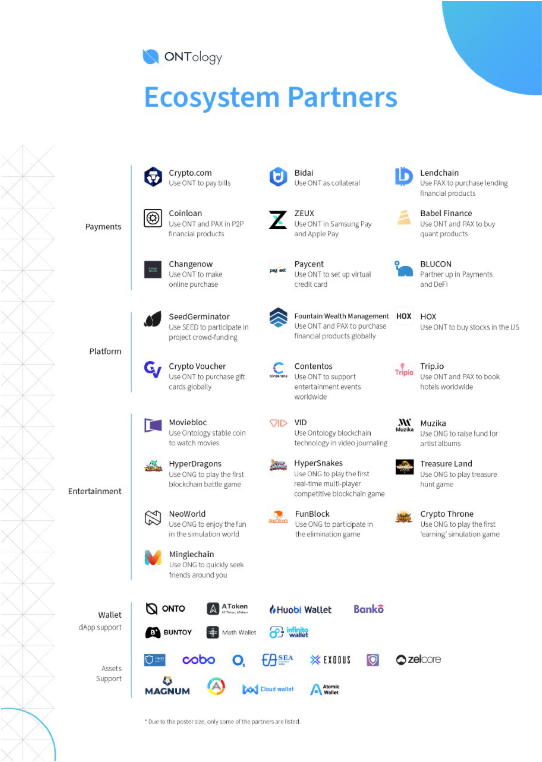
Currently, our enterprise applications include DeFi, platforms, entertainment, wallets etc. we are continuing to explore more use cases worldwide.
Currently, our main markets are the Japanese, Korean, U.S., and European markets.
For ex, In Korea, we are partnered with the Klaytn project, the public chain of Kakao, one of the Korean biggest enterprises. We will have more technology, product integration, and interactions with Klaytn, including data privacy and the ONT ID application, so that more Korean users can join the Ontology ecosystem and more projects and enterprises can access the markets.
Compared to other enterprise focused blockchains, we have developed specific functionalities and features which will make the use and implementation of the blockchain protocol easier for different scenarios.
In real-world businesses, there are many more types of business processes than just digital assets exchange. As mentioned before, the Ontology blockchain allows interactions between the main chain and side-chains and also between side-chains.
Just as our slogan “Business-ready” says, our cross-chain protocols will support a wide range of scenarios in traditional businesses, instead of digital asset exchanges alone.
Also, since Ontology was founded, we have also given special focus on ONT ID, a decentralized framework that helps users control their data and identity. The ONT ID solution will remedy the disadvantages of existing pain points such as a lack of individual role, data oligopoly, fragmented sources of trust, difficulty in achieving accuracy in identity verification, and so on. https://ontid.ont.io/
Messari: Ah, I'm glad you brought up ONT ID. We had a couple of questions on it, and while it was already addressed, this question pertains to some of the other Ontology technologies.
- What are the outstanding technologies of ONT ID, ONTO, and DDXF? How does this technology create an overwhelming advantage for Ontology products?
Erick: ONT ID, ONTO, and DDXF are all tools built by Ontology to aid in the creation of enterprise use case blockchain applications.
ONT ID - decentralized identity solution framework that helps users control their data and identity. Opens the door to creating applications that require assigning identities to people or things (supply chain, medical records, credit scoring, financial services, copyrights, real estate)
ONTO - ONTO Wallet is the official wallet of Ontology, which can connect you to the diverse Ontology ecosystem, such as dApps, airdrops, ONT ID authentications, DEXes, ONT NFTs, etc. ONTO maps your digital identity and real-life identity. Users can use this product to build their own digital identity and multi-factor personal portrait, and use cryptographic algorithms to protect their privacy. ONTO can manage digital assets in a safe and reliable way and apply it to your life. At the same time, it will build a reliable and controllable data transaction system for users through an authorization system and encryption algorithm.
DDXF - the data assetization and resource exchange frameworks built by Ontology for blockchain applications. This is a new way of processing and managing application data. Through DDXF, application data is stored in a distributed way and data privacy is ensured. Essentially the achievement of self-sovereign data.
These tools make the Ontology solution a complete commercial solution, where the trusted scenarios of the Internet can be migrated completely to blockchain.
Messari: Alright, switching it up one last time, we have a couple of questions on the level of adoption Ontology is seeing
- Where have you seen the most adoption for Ontology? What sectors look most promising for you?
- Maybe Ontology has many advantages. What are your plans for adoption Ontology? What are your plans for the future?
Erick: The most adoption we've seen thus far has been DeFi and pilot projects run by our enterprise partners. There is a clear promise in both native digital assets like DeFi and NFTs as well as real-world use cases like the aforementioned supply chain, medical records, digital identity, etc.
Our goal is to bring about mass adoption and increase blockchain activity. We are looking for high-quality dApps to be built on top of the Ontology platform. So, at the end of 2018, we launched the Renaissance dApp Incentive plan and have attracted dozens of active dApps (https://oodapp.io/). We have also launched a full-stack incubation program. Furthermore, we try to build mature tools and an open platform for engaging with traditional users and developers.
Recently, we launched Ontology’s Global University Workshop program, which aims to educate newcomers. Other than education, we also hope to attract more budding developers from top schools such as UC Berkeley, Harvard, Cornell, Princeton etc. to widen our base and see more creative and practical adoptions.
Ontology's aim is simple: bring real-world adoption to the blockchain industry.
Messari: The workshop program is great to hear. Education is key going forward. Would also like to see if BEN plays a role in future development/outreach. Alright, that is all the time we have for today. I’d like to thank Erick for joining us and answering our questions. @erickpinos, other than on Messari where can people learn more about Ontology or get in touch with the team?
Erick: Yes BEN has been very helpful. For sure, Ontology is on all your favorite social networks!