How DeFi Exploits Impact Price and TVL

Although the frequency of DeFi exploits is slowing as projects learn from past mistakes, the magnitude of hacks has been increasing. Just over a week ago, DeFi experienced its largest exploit ever as Alpha Homora lost $37.5 million.
Is this necessarily bad?
To point fingers at DeFi for being especially risky is unfair. Even Bitcoin had bugs that core developers patched in the early days. For example, in August 2010, a block contained 92 billion BTC. And in March 2013, Bitcoin Core version 0.8 wasn’t compatible with previous versions. There was also an attack in July 2014, where the mining pool gHash.IO briefly exceeded 50% of the network's computing power in July 2014, leading the pool to voluntarily commit to reducing its share of the network.
If DeFi protocols are to ever win the privilege of storing hundreds of billions if not trillions of dollars in value, they must be battle-tested. Past attacks serve as bounty programs that reduce the risk DeFi will ever get “too big to fail.”Each attack has been met with an equal reaction to build protocols with security first in mind. The next hack will be no different.
Here is a list of major exploits in the past couple of years.
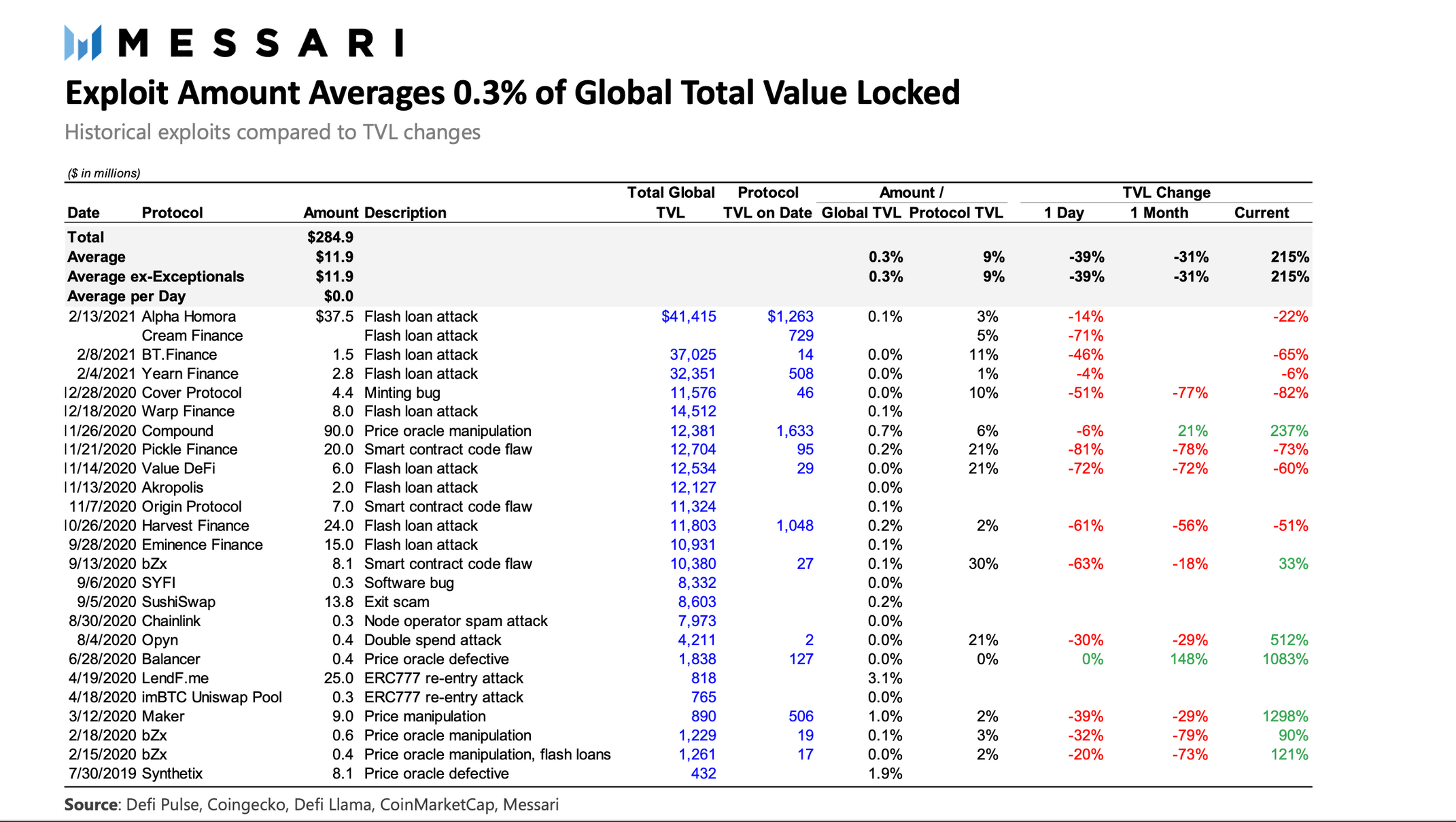
Exploits are always scary but in the broader context, the amount is trivial. The total amount lost since July 2019 was $285 million. The average amount lost to hackers and contract failures was $12 million. That’s a global average loss per day of $20,000.

Mira was a Senior Research Analyst at Messari. Prior to joining Messari, Mira was a Senior Portfolio Manager for a US$6 billion Asia Pacific equities fund at APG Asset Management. Mira received a BA in Economics and Mathematical Methods in the Social Sciences from Northwestern University.