
Executive Summary
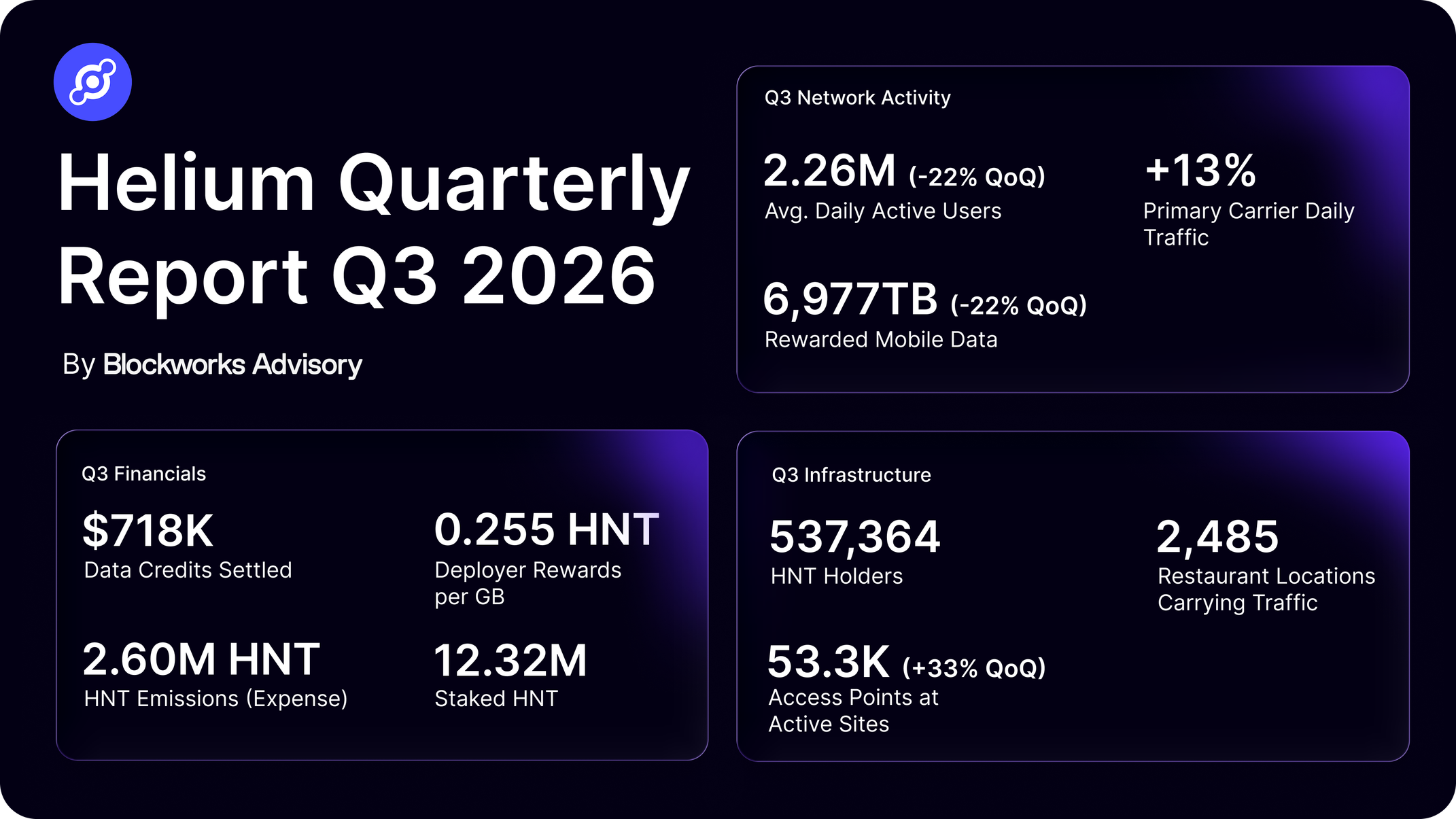
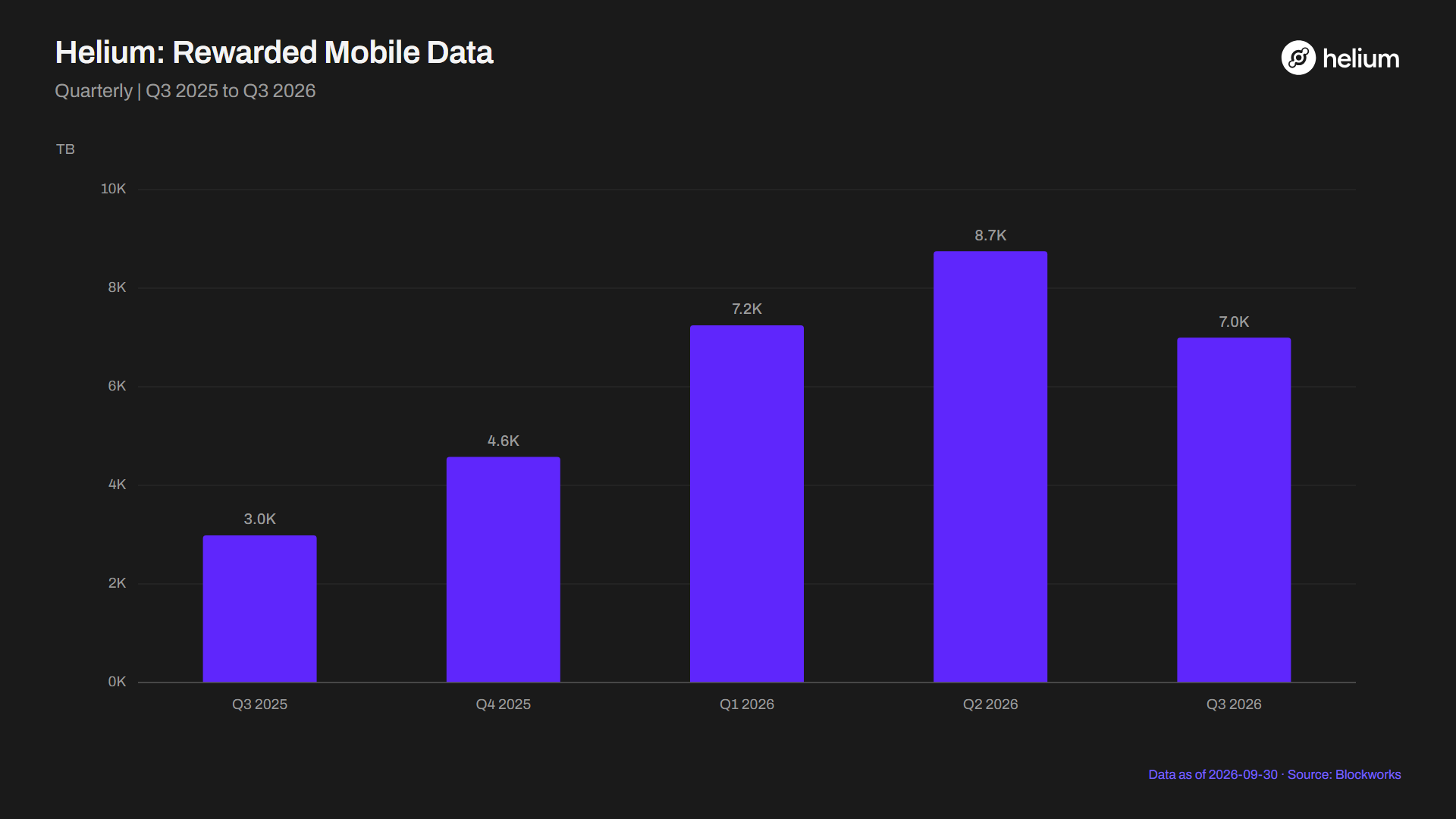
Helium carried 6,977 TB of rewarded mobile data in Q3-2026 and settled $718K of Data Credits through the protocol. It was the first full quarter at a carrier payer rate that accurately reflected aggregate carrier contract rates, closer to $0.10/GB, implemented under HIP-143 in early June. Daily active users averaged 2.26M across the quarter. On September 1, Helium launched HeliumOS, its software platform for carriers, MVNOs, and large indoor venues. All access points at active sites, including partner-reported, grew from about 40,100 at the end of Q2 to 53,300 at quarter close, as venues brought Wi-Fi they already operate onto the Network.
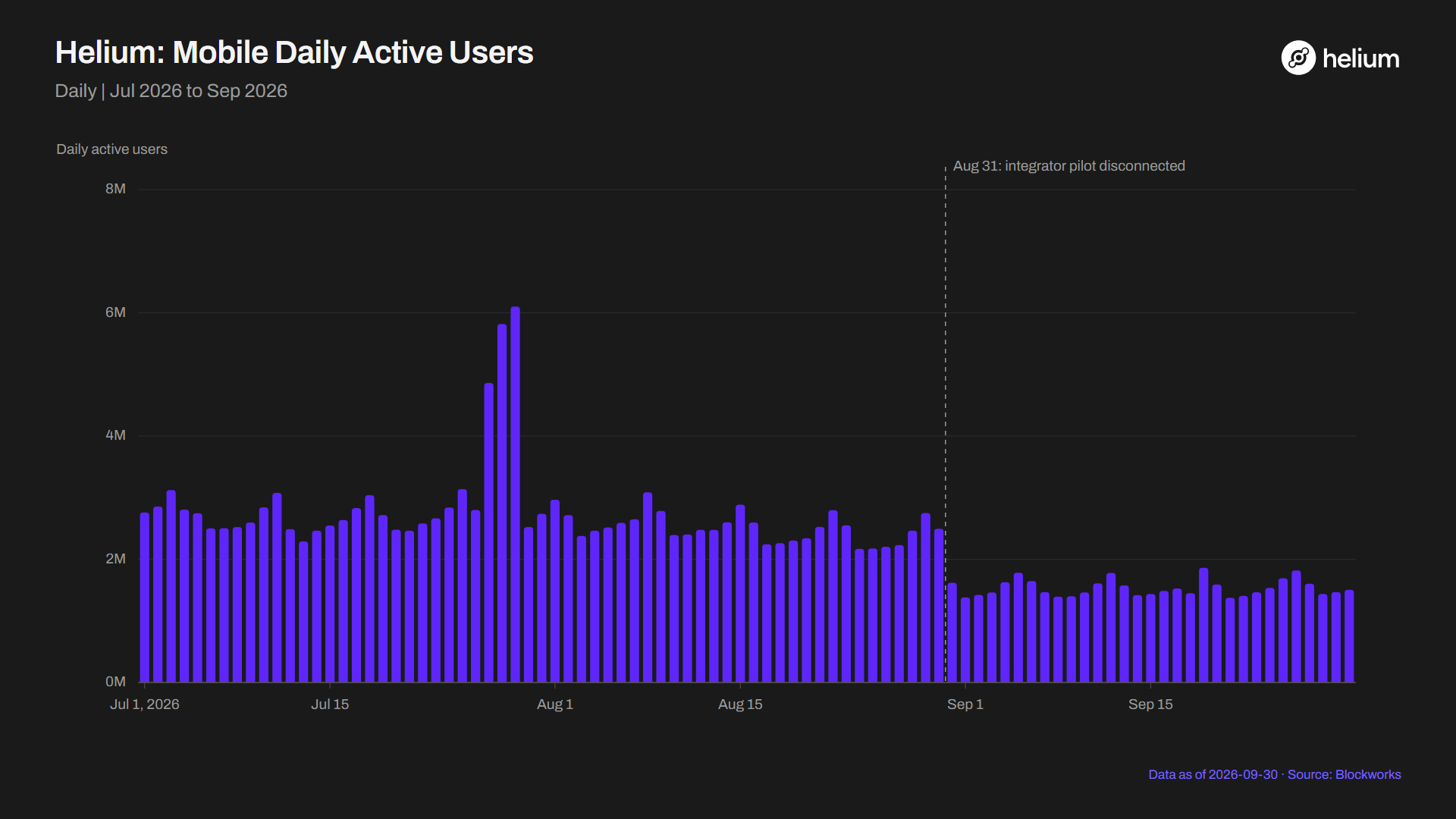
August 31 split the quarter. That day, a pilot with a third-party integrator that routes traffic from a US carrier disconnected, and the traffic it brought left the network. Rewarded data averaged 87.8 TB a day in July and August and 51.0 TB a day in September, while daily active users moved from 2.60M to 1.54M across the same split and then held at about 1.6M through the first weeks of October. The primary paid carrier went the other way. Its average daily rewarded traffic rose 13% in September from August. The traffic that left was routed through an intermediary, while the demand that stayed, and grew, runs through a direct carrier relationship.
The reward economics were rebuilt in the same months. HIP-149 passed on July 2. It moved Mobile rewards to a usage basis, ended Proof of Coverage, created a seven-seat Advisory Council, and authorized the operations and growth supplement, which began minting into a Council-overseen vault on August 6. HIP-150, approved on August 31, added per-site reward multipliers of up to 5x at high-demand venues and raised the deployer target minimum from 50% to 80% of what carriers pay for rewardable data. Deployer data rewards per rewardable gigabyte rose to 0.255 HNT from 0.143 HNT in Q2.
Venue conversions reached building types that cellular networks struggle to serve from outside. A 23-hospital health system, a 100,077-seat college stadium, a school district, hotel portfolios, and a city's municipal Wi-Fi all began carrying carrier traffic on existing infrastructure. Each is a site where Helium makes third-party Wi-Fi verifiable to carrier standards, and HeliumOS packages that capability for operators directly.
That gives Q3 a clean baseline: the payer rate held for the full quarter, usage-based rewards were in force by its end, and the post-August usage level carried into October. Every terabyte on the Network today is commercially priced, rewarded on usage, and carried on infrastructure its owners chose to integrate or purpose-build for Helium. Q3 built a sturdier foundation for the Network and the metrics that follow will reflect that.
Management Commentary
In our Q2 letter I commented on hard resets, deliberate choices and that we saw only opportunity ahead. Q3 was the quarter we saw a renewed foundation underneath those resets hold firm in the places that matter most.
I’ll start with the issue everyone will ask about. On August 31, a pilot with a third-party integrator ended, and the traffic routed from one carrier left the Network. The demand that remains runs through direct, commercially negotiated carrier relationships, and our largest one grew 13% in September, the first month after the transition. The Network is running on a stronger, more sustainable model.
Q3 was our first full quarter at a payer rate that is much closer to real carrier contracts, and the first with HIP-149's usage-based rewards fully in force. Deployers now earn for carrying real subscriber traffic, their earnings per rewardable gigabyte rose nearly 80% from Q2, and HIP-150 points rewards at the venues where carrier demand runs heaviest.
For whatever perceptions exist within crypto spheres, Helium continues to inspire confidence for builders and Network users. In the midst of this transformation period, Helium became the default offload platform for a health-care system of 23 hospitals, school districts, hotels, resorts, and casinos. On top of that Celina, Texas, one of the fastest growing cities in the US, turned its municipal Wi-Fi into carrier coverage through Helium. These are venues that tower-based networks can’t adequately serve and carriers still struggle to serve their subscribers. Active access points on the Network ended the quarter a third higher than they began it. The validation comes from two key factors: (1) that Helium is turning existing venue Wi-Fi infrastructure from a sunk cost to a monetizable asset, and (2) that Helium is leading the telco industry in “Wi-Fi access network metrics” which brings carrier-grade quality Wi-Fi indoor coverage like never before.
Validation also comes from above. In August, SpaceX made moves to bring satellite closer to the handset, and the FCC opened proceedings to give direct-to-device more spectrum. While satellite will capture much of the outdoor edge, everyone in the industry knows it stops at the door. 70-80% of mobile data is consumed indoors, behind walls a satellite cannot see through, and that coverage has to be built building by building. Any satellite-based operator needs an indoor layer, and Helium is the natural complement with verified, measurable coverage inside the buildings satellite cannot reach, deployed and paid for by the people who own them.
Q3 also saw the launch of HeliumOS and first customer sign-on from Andrew Yang’s Affiniti Ventures (owner of Noble Mobile). This is the work that’s changing Wi-Fi from “best-effort” to a fundamental element of the telco stack for carriers: a governed extension of the network that the carrier engineered, verified session by session. We’re shifting industry standards in close collaboration with AT&T, Cisco, and Ruckus Networks through the Wireless Broadband Alliance to bring measured performance data into offload and roaming decisions for the whole industry. Helium’s own Chief Network Officer is leading that conversation.
Q2 was the reset and Q3 was the first steps of rebuild. The Network enters Q4 with commercial pricing on every gigabyte, rewards that follow real usage, a software platform carriers can use to run their offload strategy on, and a deployment engine pulling in exactly the buildings (such as hospitals, arenas, airports, large retail stores, and more) carriers cannot serve any other way. We enter Q4 with tailwinds and big changes behind us. I remain highly optimistic of Helium’s ability to deliver on its new, refreshed promise.
Mario Di Dio
CEO, Helium
Financials
Data Credits Settled at the Current Payer Rate
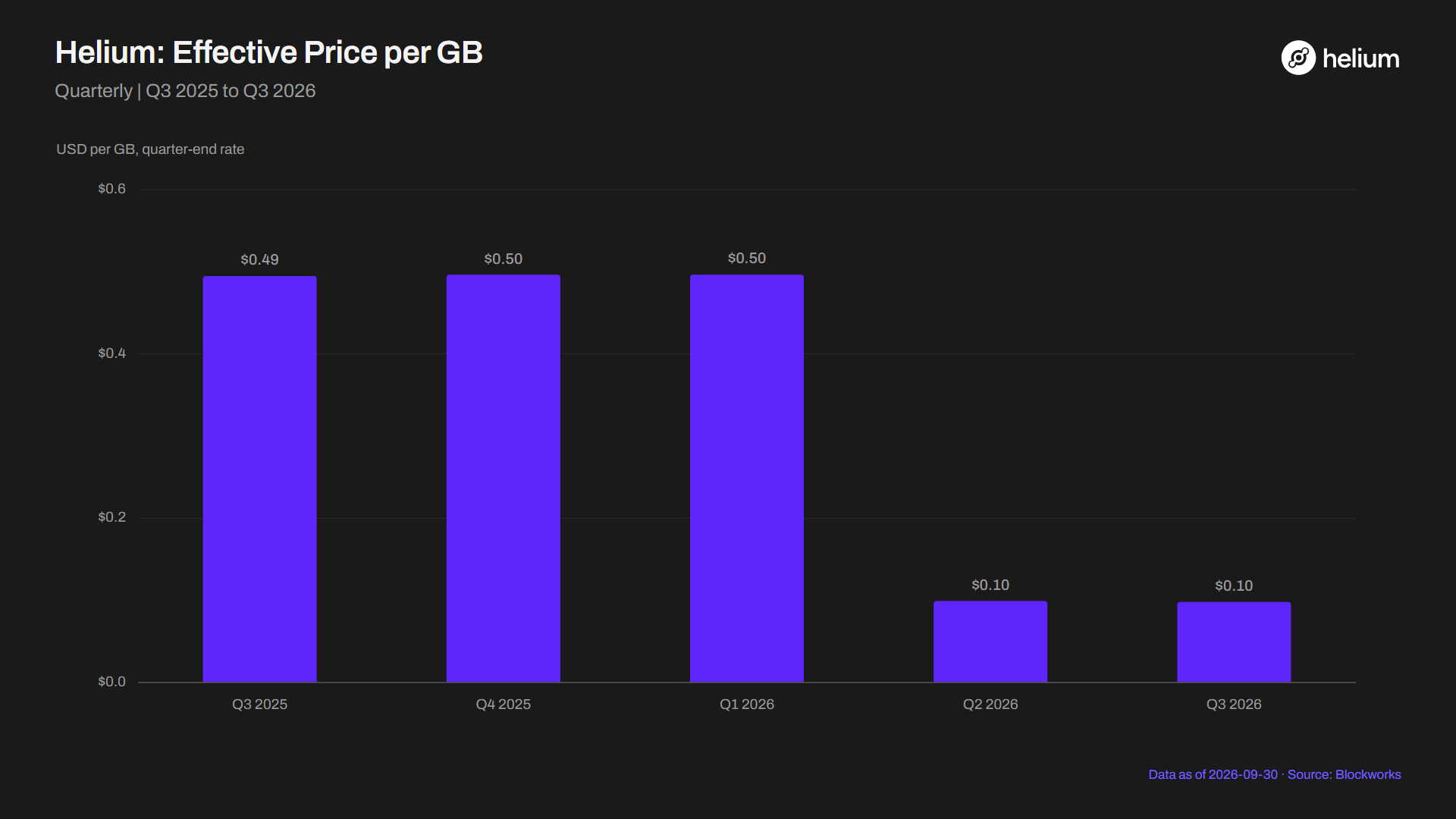
Data Credits settled through the protocol totaled $718K in Q3-2026. Mobile accounted for $700K, nearly all of it carrier offload, and IoT for $17.7K. In Q2 the total was $3.35M, but two of that quarter's three months still cleared at the prior protocol rate of $0.50/GB. Q3 ran entirely at the current rate, which averaged about $0.10/GB and reflects aggregate carrier contract rates: a reset towards durable economics based on real market rates versus a protocol rate.
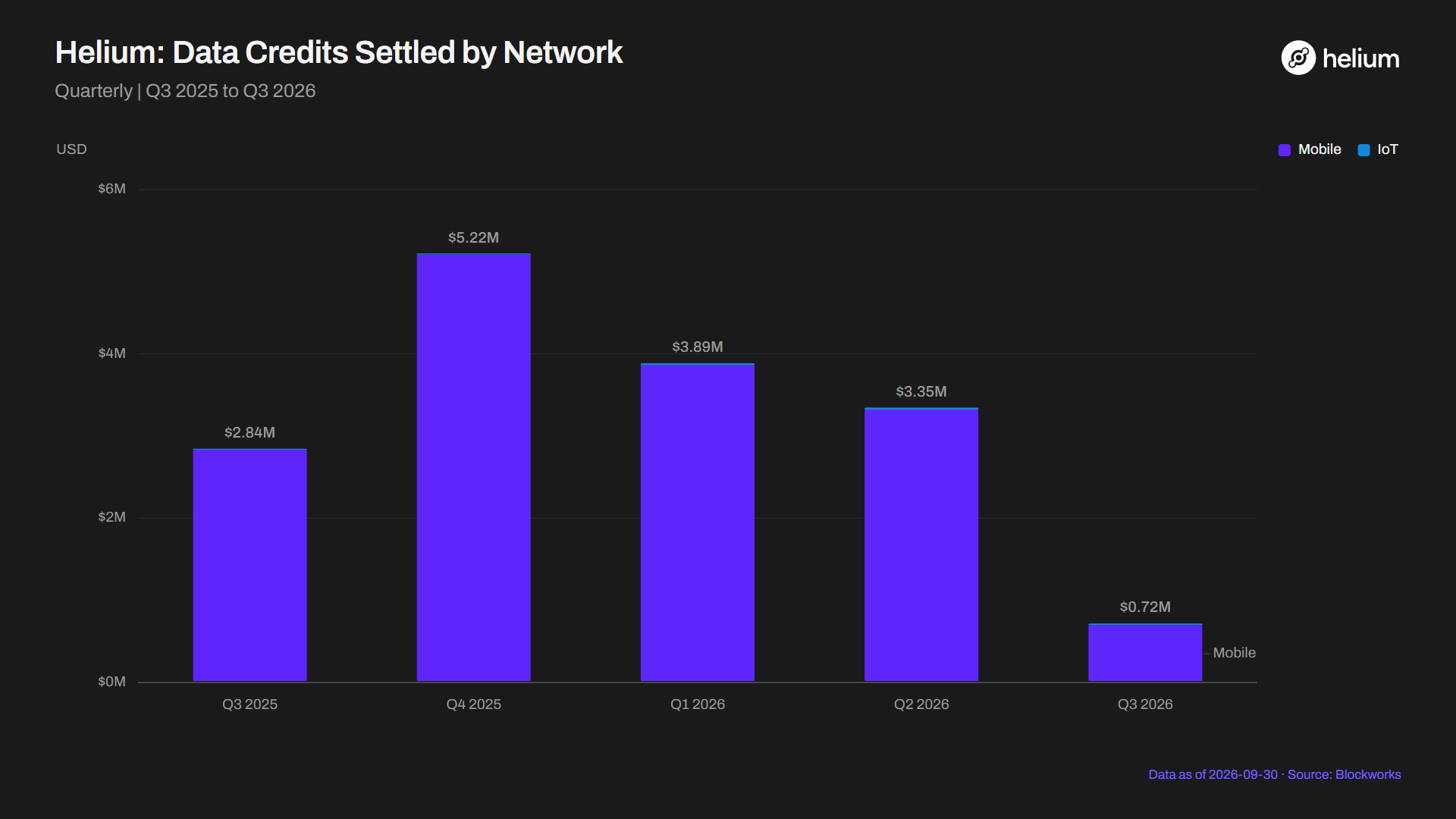
Monthly settlement held near $290K in July and $270K in August and fell to $159K in September, the first month without the integrator-routed traffic. Because Data Credit burns are volume settled through the protocol at the payer rate, they track paid carrier usage one for one.
HNT Issuance and the Operations and Growth Supplement
HNT issuance totaled 13.58M HNT in Q3, against 2.02M in Q2. The operations and growth supplement accounts for most of the gap.
HIP-149 authorized approximately 141M HNT over 36 months, minted into a vault that Nova Labs administers as Receiving Entity, with Advisory Council oversight. The schedule is front-loaded. Minting runs at a flat rate for about 12 months, then tapers to zero over the following 24.
Minting began on August 6 at 193,550 HNT a day to the vault, plus 2,450 HNT a day to the Council's five community seats. Over the quarter's 56 minting days, the vault received 10.84M HNT and the Council seats 137K HNT. With the supplement, the effective maximum HNT supply rises from roughly 206M to roughly 347M.
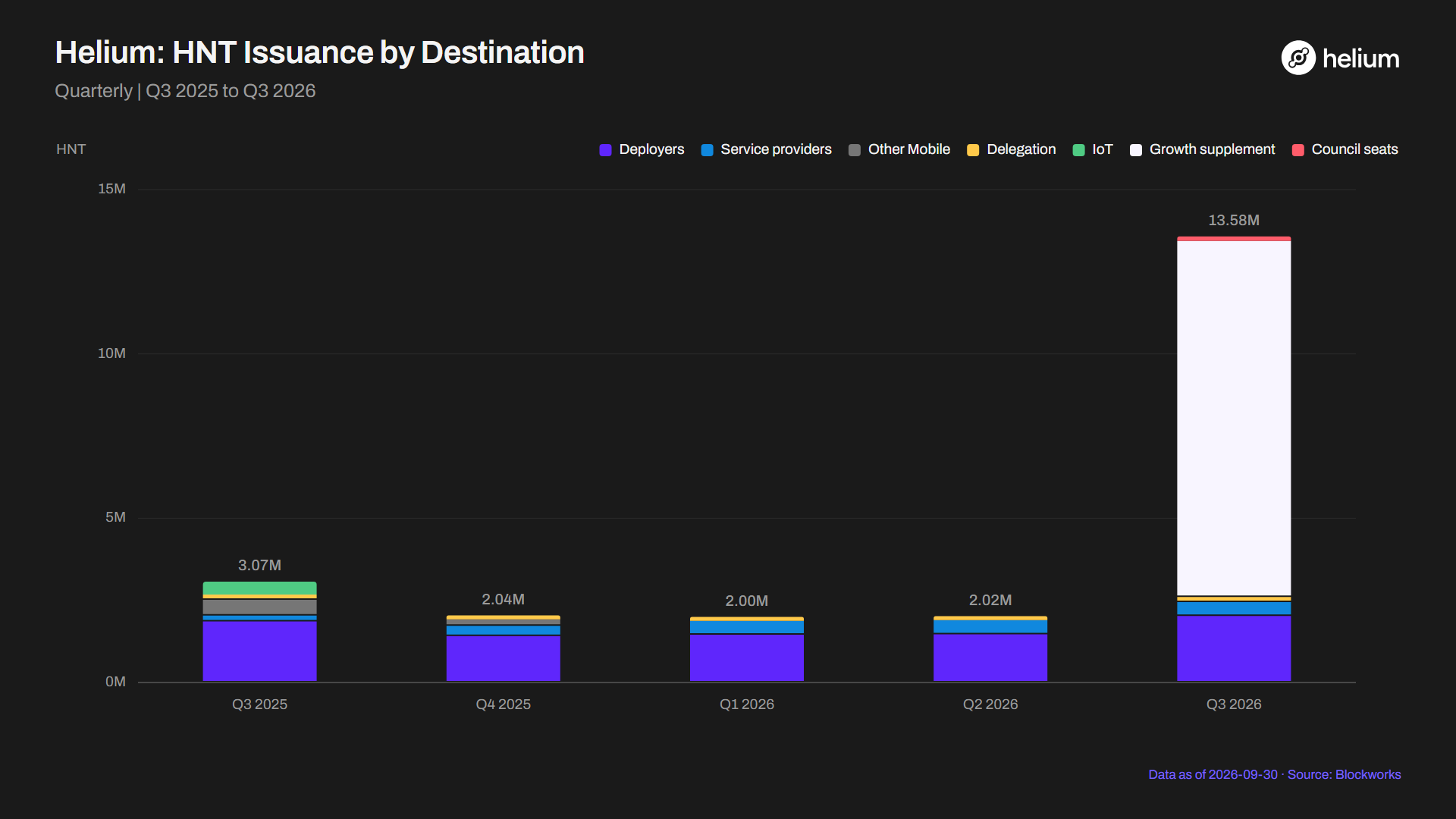
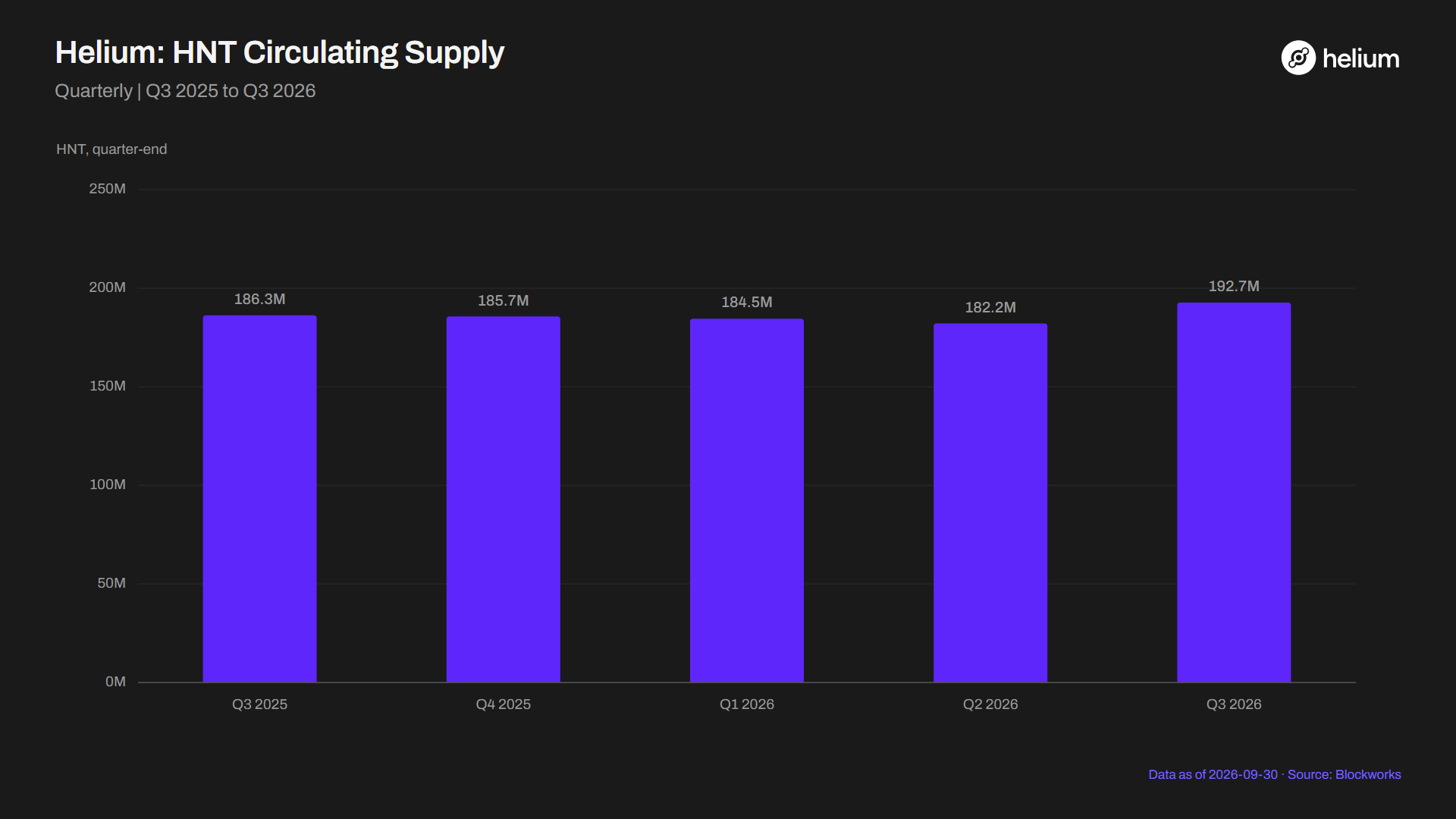
Issuance to network participants outside the supplement totaled 2.60M HNT, up from 2.02M. Deployer rewards drove most of the increase, rising to 2.03M HNT from 1.47M as HIP-149's usage-based rewards took effect. Circulating supply ended the quarter at 192.7M HNT, compared with 182.2M at the end of Q2.
Deployer Earnings per Gigabyte
Deployers earned 0.255 HNT per rewardable gigabyte in Q3, up from 0.143 HNT in Q2, and the monthly figure climbed from 0.137 HNT in June to 0.368 HNT in September.
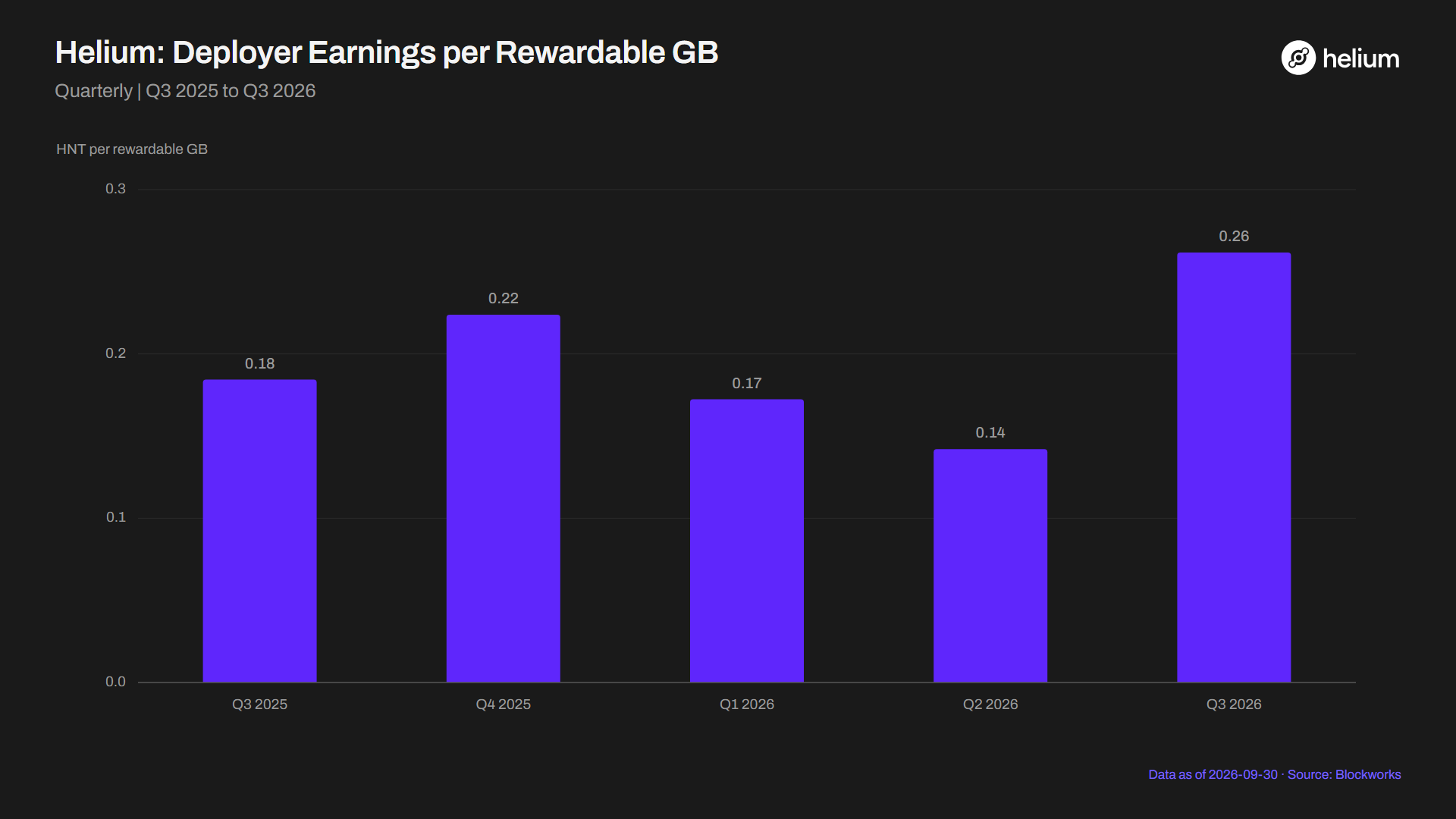
Two governance changes produced that climb. HIP-149 introduced a target minimum for deployer earnings, denominated in US dollars at half the payer rate, or $0.05/GB at current commercial rates. The protocol funds any shortfall by re-emitting HNT already burned to pay for the same data, which adds nothing to total supply, and earnings are capped at three times the payer rate. HIP-150 then raised the target minimum to 80% of the payer rate for approximately one to two years. Nova Labs is funding part of that increase by redirecting its own Service Provider rewards to deployers through at least July 2027.
Only a community vote can move the earnings band, whether by changing its target minimum or its cap, and because rewards now follow carried data, deployer earnings concentrate wherever carriers route traffic.
Carrier Demand Drivers
Paid carrier traffic on Helium runs through a small number of relationships, and the quarter's change sits almost entirely in one of them. The primary paid carrier accounted for about 63% of the network's rewarded data in Q3, up from 52% in Q2. Its rewarded traffic for the quarter was slightly below Q2, and its daily average rose 13% in September from August, the first month after the integrator pilot ended.
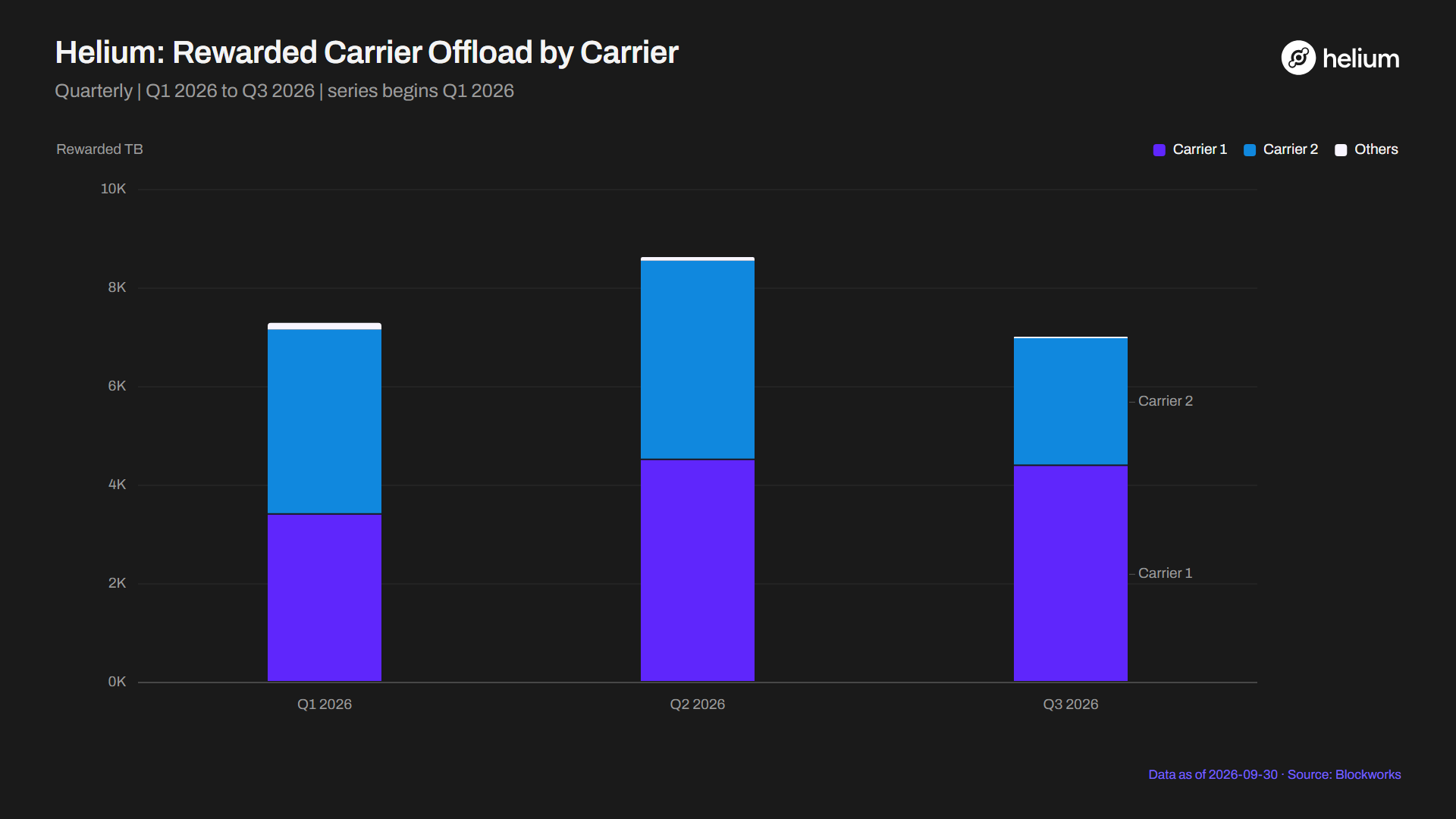
The second carrier reached the network through the third-party integrator, and its traffic ran until August 31. Across July and August it carried 47% of the network's rewarded data, which is why September's daily rewarded volume came in 42% below the July and August average. After August 31, paid traffic ran most heavily through the direct primary carrier relationship with smaller contributors alongside. Helium said on its September 2 community call that conversations about a direct interconnect with the affected carrier remain active.
Concentration is the main exposure in this model. In Q3, one integrator's decision moved close to half of daily rewarded traffic off the network, while the paid traffic that remains comes from a direct relationship whose September volume grew.
What carriers will pay also varies sharply by site. Industry planning assumptions place 70% to 80% of mobile data traffic indoors, and the heaviest indoor demand gathers in a small number of venues. Demand at those venues also arrives in peaks, concentrated on event days. HIP-150 lets that difference reach the deployer. At a site carrying the maximum 5x multiplier, carriers pay $0.50/GB, and the deployer's target minimum and cap rise with it, to $0.40/GB and $1.50/GB. The additional amount flows to that site and does not reduce earnings elsewhere on the network. Nova Labs sets individual multipliers commercially, after receiving indications of interest from carriers.
Satellite moved closer to the handset during the quarter. SpaceX, whose purchase of 65 MHz of spectrum the FCC approved in May, said it will pair its satellite network with distributed wireless infrastructure on the ground, and on August 6 the FCC voted unanimously to explore opening roughly 200 megahertz of unlicensed spectrum to direct-to-device satellite use. Satellite service terms typically limit coverage to the outdoors with a clear view of the sky, so the indoor share of traffic still has to be served building by building, the layer that converted venue Wi-Fi supplies.
Two other demand channels carried into Q3. In July, Helium added Expansion Zones in New York City, covering Madison Square Garden, Radio City, Grand Central, the Javits Center, and Port Authority, where carriers have flagged unmet coverage demand. Subscribers of a major U.S. carrier also continue to roam onto the Helium Network when traveling in Mexico.
Helium Mobile stayed on the network under its new owner. Affiniti Ventures, the company behind Noble Mobile and Helium Mobile, became the first HeliumOS customer, with Andrew Yang, CEO of both brands, citing its Carrier Enablement platform for subscriber management, and Noble Mobile continues to route subscriber traffic onto Helium offload. On its September 2 community call, Helium described the sale of the consumer business as essentially complete, with subscriber support now handled through Noble Mobile's channels. Data Credit burns attributed to Helium Mobile, $29K in Q2, fell to $1.7K in Q3, and none in September, as Helium Mobile's rewarded traffic moved under the main carrier payer account.
Network & Protocol Analysis
Daily Active Users
Daily active users averaged 2.26M in Q3, down from 2.88M in Q2. The quarterly figure averages two different networks. July and August ran at 2.60M a day with the integrator-routed traffic in place; September ran at 1.54M without it. The September level held into October, averaging about 1.6M through the first weeks of the month, which puts sustained usage on the current carrier base at roughly 1.5M daily active users at scale.
Data Carried
Rewarded mobile data totaled 6,977 TB in Q3, 21% below Q2's 8,780 TB, with the decline concentrated in September. Rewarded data is the measure tied to carrier payment and to deployer earnings. IoT settled $17.7K of Data Credits in Q3, against $23.1K in Q2, and remains a small share of network activity.
Access Points
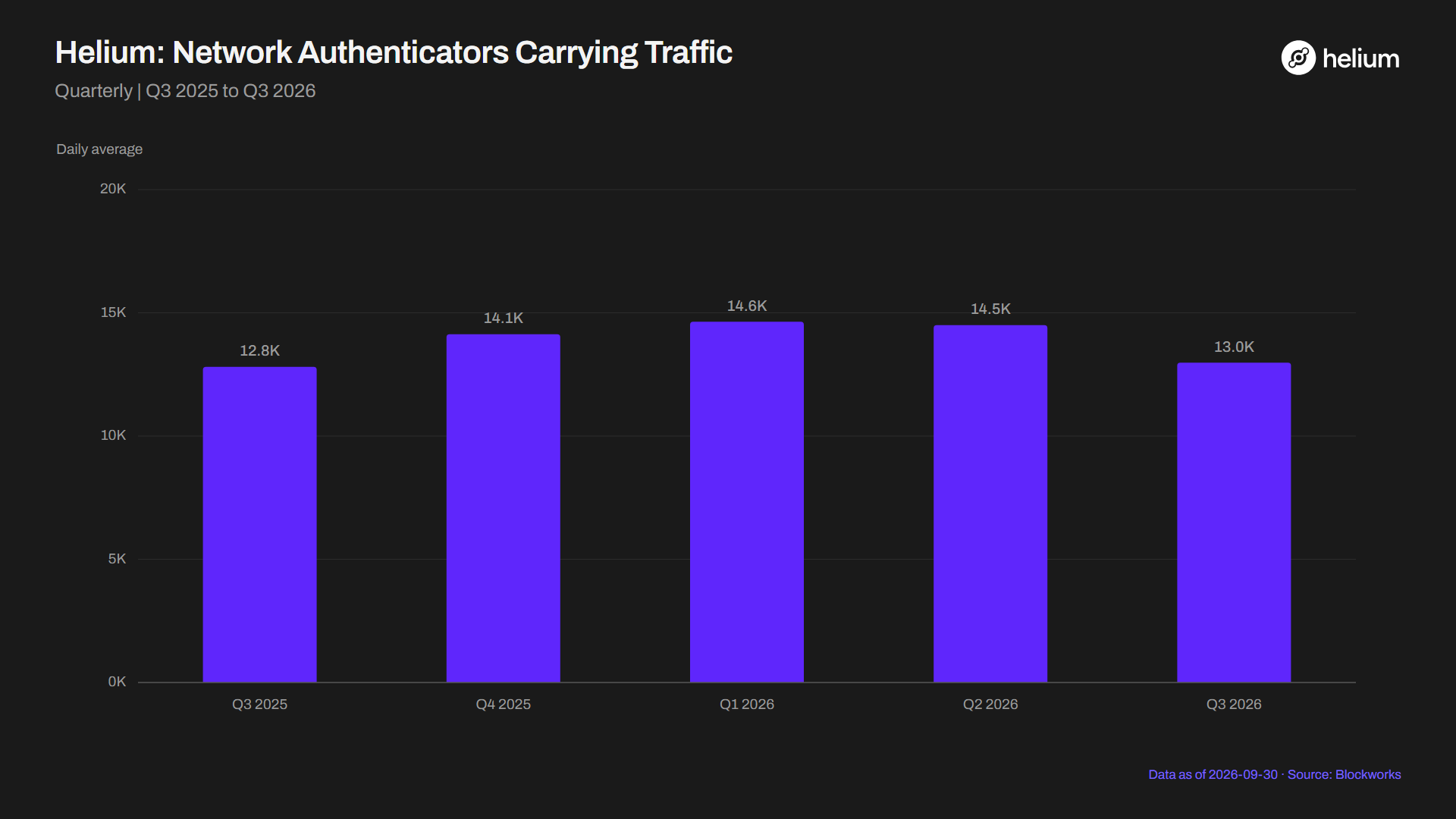
The network's physical footprint grew through the quarter even as the count of traffic-carrying network authenticators consolidated. Access points at active sites, including partner-reported, rose from about 40K at the end of Q2 to 53K at quarter end, an increase of nearly 33%, as venues converted Wi-Fi estates they already operate. A single converted venue can place hundreds or even thousands of access points behind a handful of network authenticators: Bryant-Denny Stadium, home of Alabama's Crimson Tide, alone added 2,296. Network authenticators carrying traffic averaged 12,973 a day in Q3, compared with 14,502 in Q2, stepping down in September with the integrator exit.
HNT Burn, Holders, and Staking
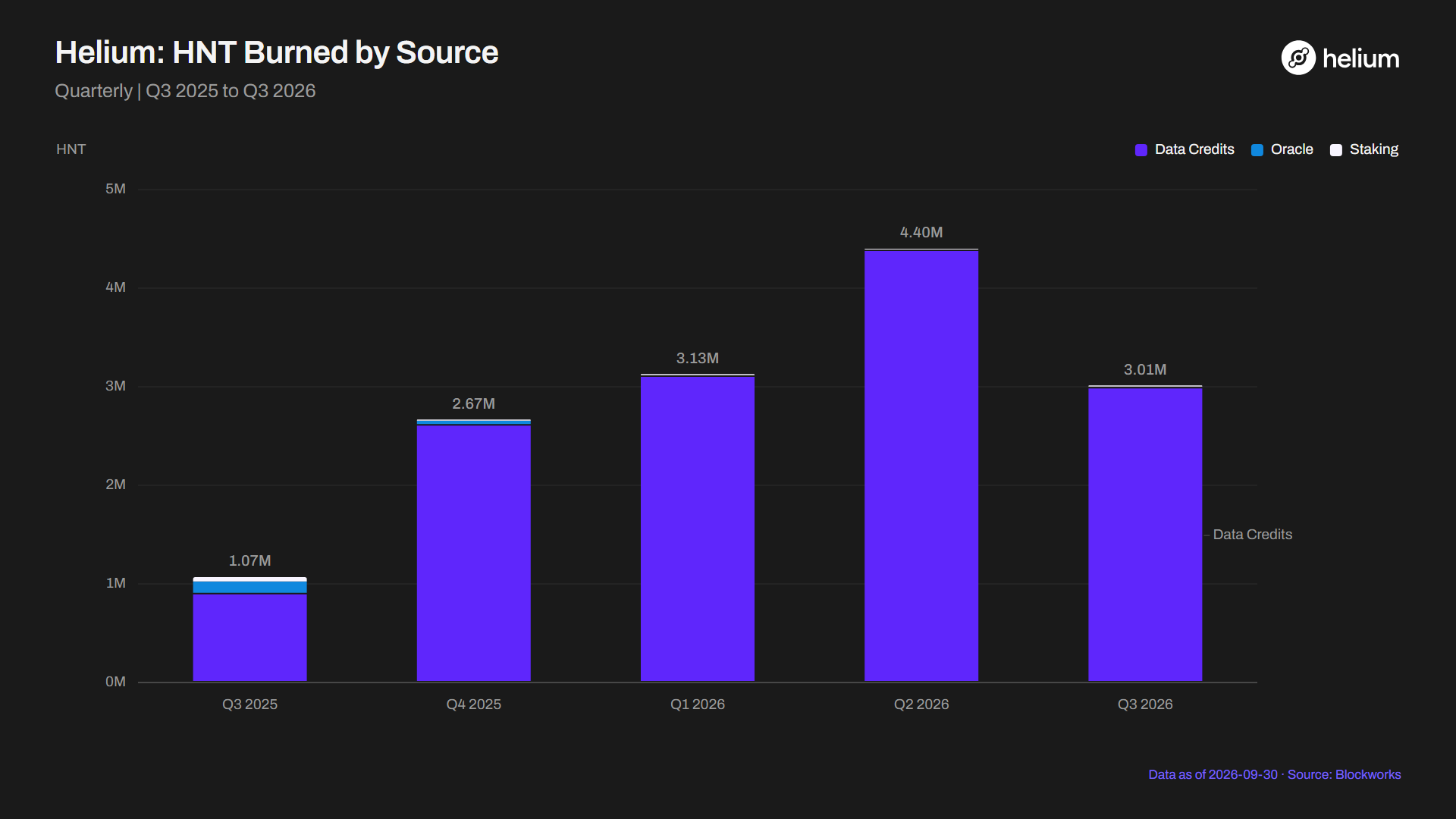
Data Credit burns consumed 2.98M HNT in Q3, against 4.38M in Q2. HNT burned fell 32% while settled dollars fell 79%, because Data Credits are fixed in US dollars and the HNT burned for each dollar depends on the conversion rate at the time of the burn.
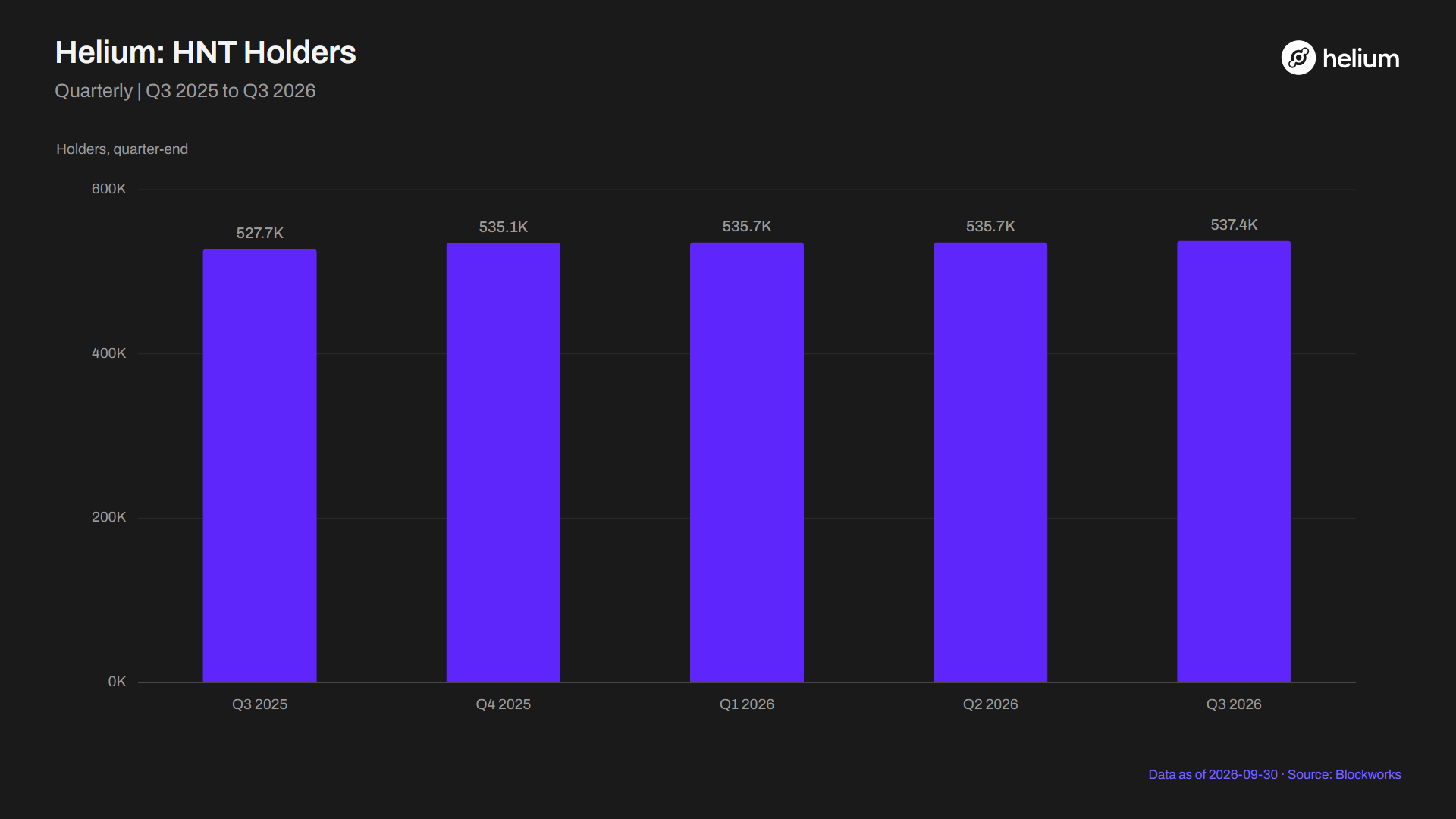
HNT holders numbered 537,364 at quarter end, up from 535,719.
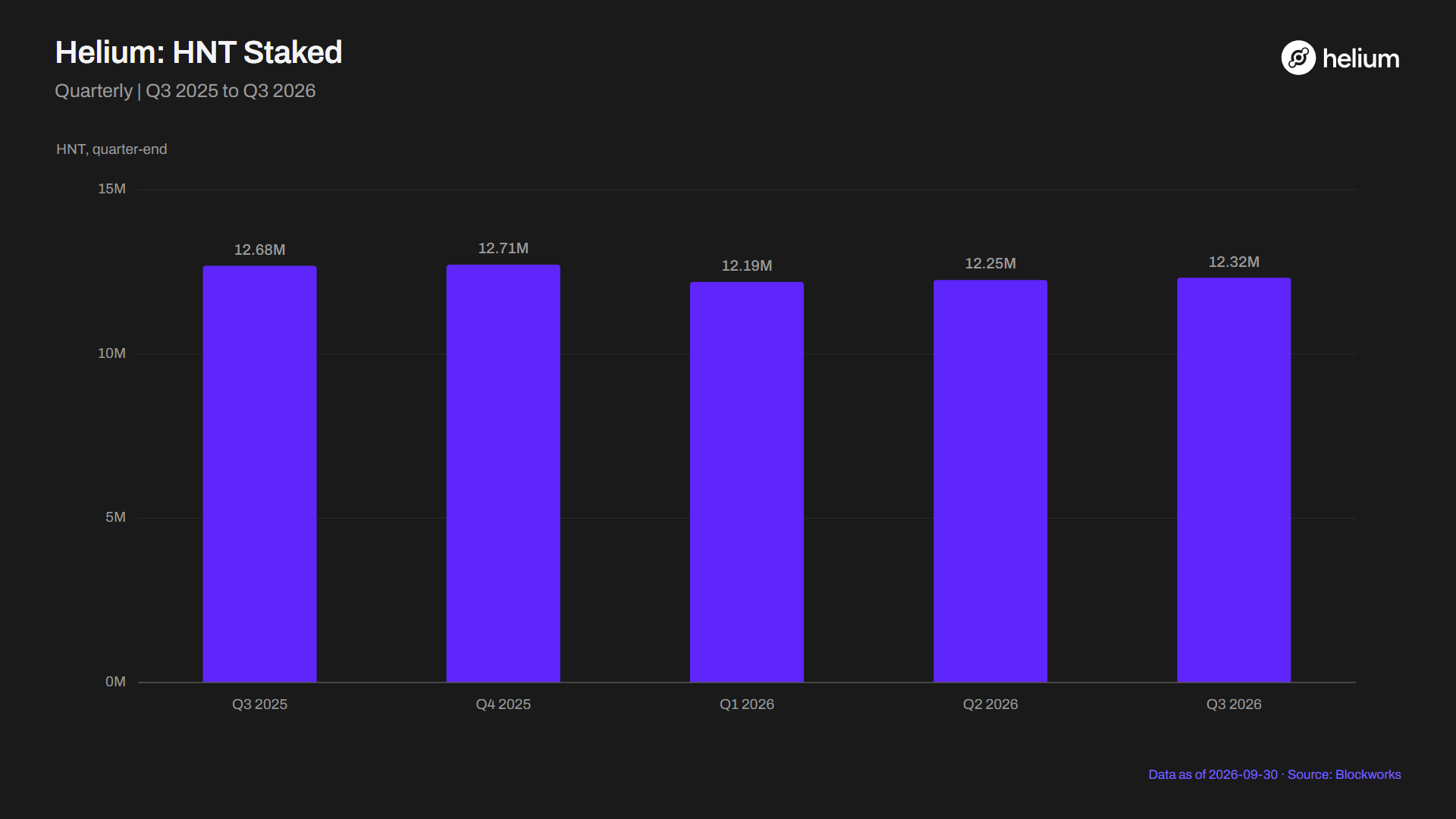
Staked HNT stood at 12.32M, 6.4% of circulating supply, compared with 12.25M at the end of Q2.
Product & Ecosystem Updates
Product Updates
HeliumOS launched on September 1 as a software platform for carriers, MVNOs, and large indoor venues such as airports, arenas, schools, and shopping centers. Customers can adopt its components one at a time. The main ones:
- Carrier Enablement: full MVNE capabilities, including subscriber management, billing, SIM activation, provisioning, and carrier integrations.
- WOX (Wi-Fi Offload Experience): real-time visibility into user sessions for carriers and control over whether a connection should move onto a given Wi-Fi network.
- HeliumAI: agentic, no-code access to Helium Network data, from pulling metrics to building dashboards.
- Wi-Fi Toolkit: Passpoint-based offload built into a consumer-facing app, with no passwords and no extra infrastructure.
The first HeliumOS customer is Affiniti Ventures, the company behind Noble Mobile and Helium Mobile. Earlier in the quarter, Helium World added a Governance tab where HNT holders can review active proposals, track voting participation, and manage staking positions.
Community Deployments
Venue conversions in Q3 concentrated in buildings where cellular signal struggles indoors:
- Health care: a multi-state health system put existing Wi-Fi at 28 locations, including 23 hospitals, onto the network. The first location began carrying traffic in late July; the large hospital campuses came online in September.
- Stadiums: Bryant-Denny Stadium, with 100,077 seats and 2,296 access points, joined in September and carried its first game day on September 26.
- Schools: Mustang Public Schools in Oklahoma put 14 sites on the network, moving 3.4 TB across about 65,000 sessions by August 30.
- Hospitality: in July, 243 hotels, resorts, and casinos offloaded 212 TB across 15.2M sessions. At the Olde Naples Hotel, a single network authenticator processed 6.8 TB across 713,854 sessions between late May and early September.
- Restaurants: 2,485 locations across 34 U.S. fast food chains carry carrier traffic.
- Municipal and remote: Celina, Texas turned its city-wide Wi-Fi into carrier coverage carrying about 110 GB a day, and a local deployer brought coverage to Waimea Valley, Hawai'i, a designated conservation area, by converting existing hardware.
Since quarter close, the first Wakefern stores have gone live. Wakefern is a retailer-owned cooperative whose 48 member companies operate some 365 supermarkets.
Incentives & Emissions
On August 18, Helium introduced a No Fee Program for Helium Plus: deployers pay no connect fees on network rewards, whether they are paid in USD, USDC, or HNT, and one-time onboarding fees are waived. Helium Plus sites are also eligible to apply for HIP-150 multipliers.
Industry and Standards
Helium is collaborating with a major U.S. carrier, Cisco, and Ruckus Networks through the Wireless Broadband Alliance's Access Network Metrics program, which brings measured performance data into carrier offload and roaming decisions.
Governance & Corporate Developments
HIP-149 in Force
HIP-149 passed on July 2, clearing the 66.67% supermajority required to authorize the operations and growth supplement. It created a seven-seat Advisory Council: five seats elected by veHNT holders in a vote among twelve nominees that closed July 20, and two seats appointed by Nova Labs. The Council has NDA-level visibility into how the supplement is used, and it can demand disclosure, publish dissent, and trigger a community vote to end the supplement. Nova Labs administers the vault as Receiving Entity, with Council oversight.
By the September 2 community call, Proof of Coverage had ended on Mobile and IoT, the 36-month supplement was active, and the Council was overseeing its use. The supplement ends at the earliest of a community vote to dissolve it, full distribution of the supplement, or the Receiving Entity declining further distributions. The Advisory Council has also recommended that Nova Labs focus its resources on Mobile and transition IoT to another capable party.
HIP-150
HIP-150, Mobile Deployer Prioritization, went to a veHNT vote on August 24 and was approved when voting closed on August 31. Under the proposal, multipliers are capped at 5 and can be reduced on thirty days' notice, with Nova Labs handling individual locations commercially based on expected traffic, deployment characteristics, and carrier interest.
Regulatory Engagement
On July 17, Chief Legal Officer Sarah Aberg testified before the U.S. House Financial Services Subcommittee on Digital Assets, Financial Technology, and Artificial Intelligence in support of the CLARITY Act. On August 10, Helium filed formal comments with the FCC on 911 interoperability, arguing that the definition should cover every network able to carry an emergency call, including Wi-Fi Calling.
Closing Summary
Q3-2026 was Helium's first full quarter at a payer rate that reflects aggregate carrier contract rates, and its first under usage-based rewards, representing a stronger and higher integrity foundation for the quarters ahead. The protocol settled $718K of Data Credits on 6,977 TB of rewarded data. The integrator pilot's end on August 31 reset daily usage to a level that then held, at about 1.5M daily active users and 51.0 TB of rewarded data a day in September. The primary paid carrier's traffic grew through that change.
The reward system now matches that footing. HIP-149's supplement is minting under Advisory Council oversight, deployer earnings per rewardable gigabyte rose to 0.255 HNT, and HIP-150 multipliers point rewards at the venues that carry the network's heaviest traffic. HeliumOS gives carriers, MVNOs, and venues a way to run on the network directly, and the quarter's conversions extended it into hospitals, a college stadium, schools, hotels, and municipal Wi-Fi. Access points at active sites ended the quarter 33% higher than at its start, with new supply primarily arriving through venue conversion.
From here, the measures that matter are rewarded data per day against September's 51.0 TB, the number of paying carrier relationships, multiplier uptake at premium venues, and HeliumOS adoption across carriers, MVNOs, and venues.
This report was commissioned by Nova Labs, Inc. By providing this disclosure, we aim to ensure that the research reported in this document is conducted with objectivity and transparency. All content was produced independently by the author(s) and does not necessarily reflect the opinions of Blockworks. or the organization that requested the report. The commissioning organization may have input on the content of the report, but Blockworks maintains editorial control over the final report to retain data accuracy and objectivity. Author(s) submit financial conflict of interest (FCOI) disclosures on a monthly basis that are reviewed by appropriate internal parties and may hold cryptocurrencies named in this report. This report is meant for informational purposes only. It is not meant to serve as investment advice. You should conduct your own research and consult an independent financial, tax, or legal advisor before making any investment decisions. Past performance of any asset is not indicative of future results. Please see our Terms of Service for more information.