Helium: No Longer Inert

The network and the token sit at different points upon approval. For network viability and deployer alignment, retiring PoC and paying for served traffic is a structural improvement to deployer unit economics, and ~2.8M daily users on ~45K active Hotspots with rewardable bytes up ~4x year-over-year reflects genuine product-market fit. For the HNT holder, the picture is more balanced than before: the D2C businesses have been sold, and the token is being issued to fund growth, so near-term value accrual depends on the supplement converting to durable burn rather than on revenue routed into HNT.
The principal considerations are the size of the issuance relative to the current burn, the dilution itself, which lifts the effective max HNT supply from 206M to 347M, the leadership transition spanning both Nova and the Foundation, and the distributional effects of PoC retirement on the deployer base. Di Dio has declined to promise the new ceiling is final, noting no emission lock can bind future governance, so 347M is a governance fact rather than a protocol constant. Against these, the network has clear usage momentum and a structurally cleaner reward model.
The growth spend is the open question from here. Until it converts the program's issuance into sustained carrier burn within the taper, the network runs net inflationary through the flat window. The KPI to track is carrier offload burn growth, net of the new emission.
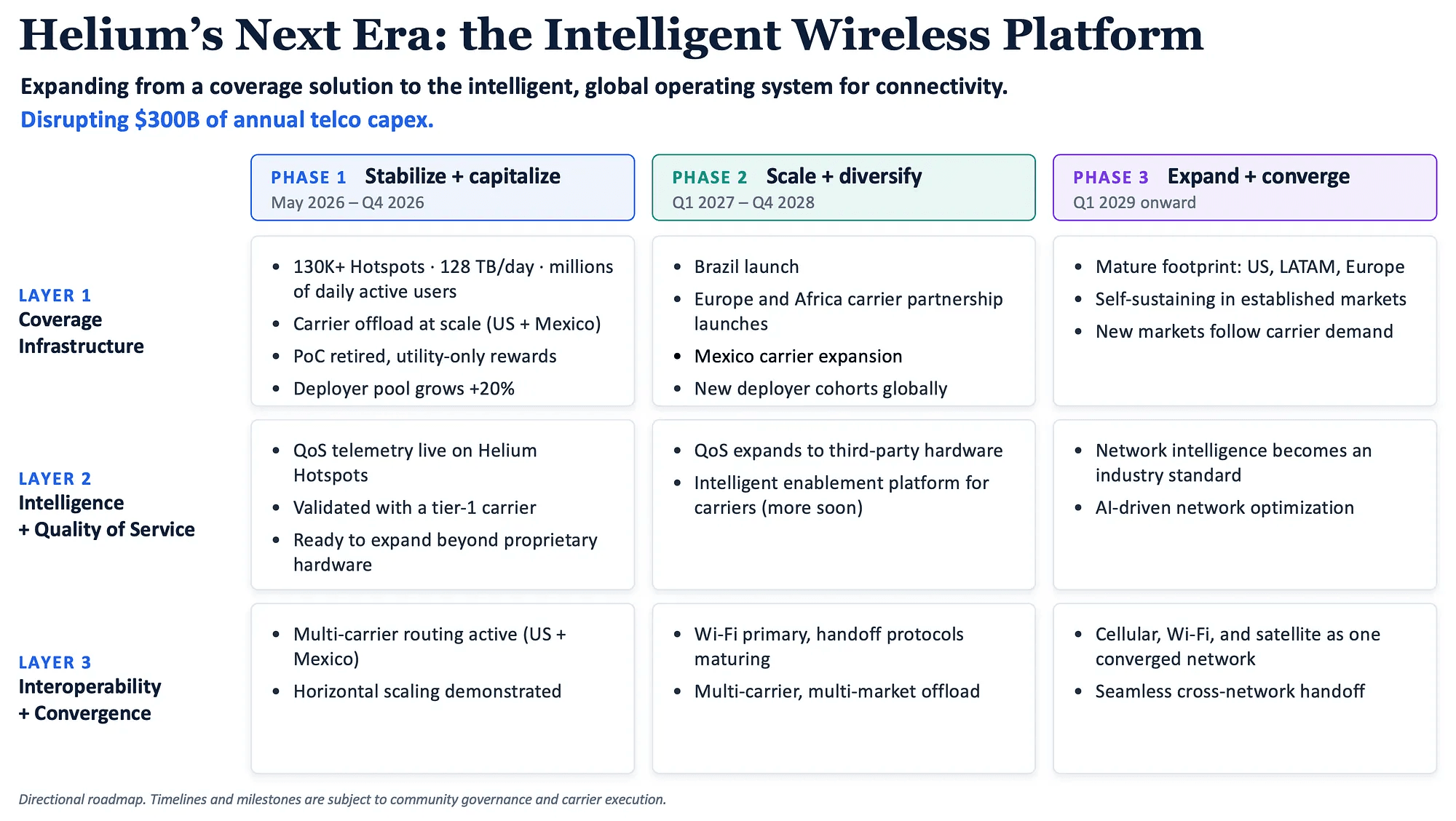
The roadmap Di Dio published with the proposal gives a stated destination. It frames Helium's next phase as a move from coverage network to platform layer, structured in three windows: stabilize and capitalize through Q4 2026, scale and diversify through 2028, and expand and converge from 2029. The near window carries the front-loaded supplement and the measurable targets: PoC retired, US and Mexico offload scaled, the deployer pool up 20%, and QoS telemetry validated with a tier-1 carrier. The later windows — international expansion into Brazil, Europe, and Africa, QoS on third-party hardware, and cellular-Wi-Fi-satellite convergence — sit further out and carry more execution risk. Nova labels the roadmap directional and subject to governance and carrier execution, so it reads as a set of checkable milestones rather than committed delivery. The Phase 1 targets are the natural reference points for the milestone-tied taper review raised above, though they are denominated in Hotspots, throughput, and deployer count rather than in the offload burn that services the dilution.
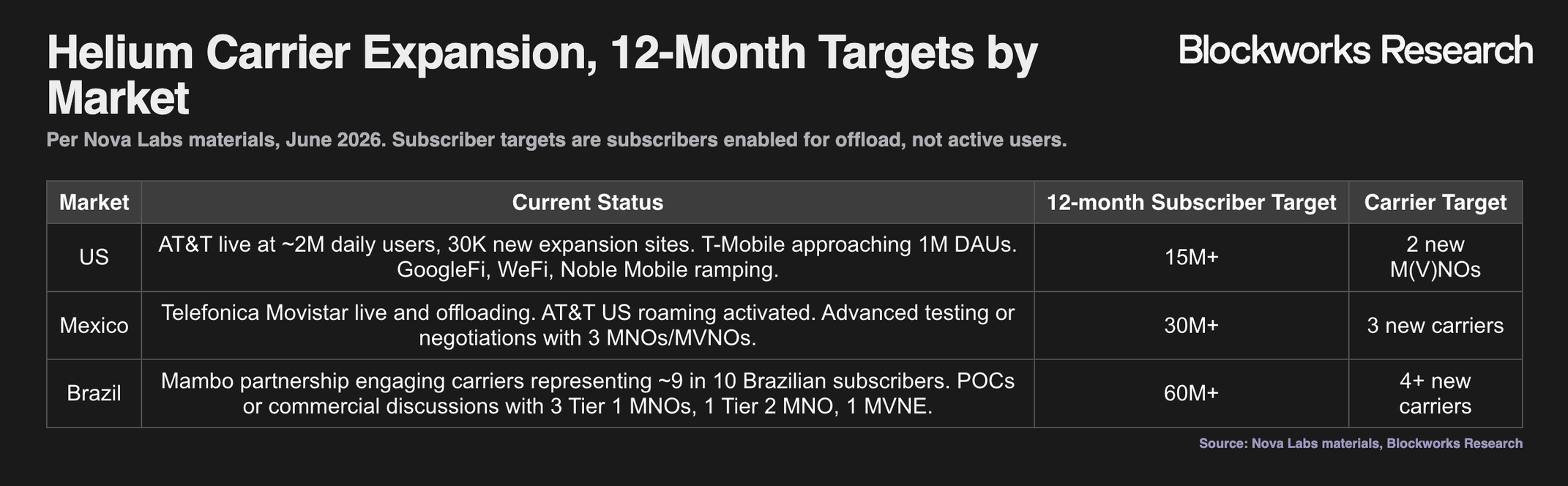
On the demand side, the Helium team has revealed that one of its largest US carrier relationships has multiplied, and three international carriers are in pilot, and materials the team shared in a June 10, 2026 AMA put names on the carrier pipeline. AT&T connects ~2M daily users to the network and recently designated 30,000 expansion-zone sites. T-Mobile is approaching 1M, Telefonica Movistar is live and offloading in Mexico, where AT&T has activated US-subscriber roaming, and a Mambo partnership in Brazil has produced POCs or commercial discussions with carriers the team says represent ~90% of Brazilian subscribers.

Nick leads coverage on the DePIN and Proof of Work sectors. Previously led research and engineering at a DePIN-focused accelerator.