
Key Takeaways
- Exchanges are well positioned to become neobanks. Gate has more than 63M registered users and held $8.69B in reserves in October. It already offers stocks and tokenized gold alongside crypto, and Gate Money allows Gate to offer everyday money services to its existing user base.
- The revenue model is the story. CEX spot volume fell to $865B in October 2026, 69% below its December 2024 peak. Over the same period, stablecoin card spend grew about 9x to a record $1.4B. Gate Money gives Gate revenue that is less tied to crypto’s cyclicality.
- The near-term opportunity is converting existing users. We assume 10% of Gate’s 63M registered users are active in a given month. Converting 1% to 10% of them into Gate Money customers would mean about 63k to 630k customers. At $25 to $100 per customer a year, that’s $1.6M to $63M of card revenue that doesn’t depend on trading.
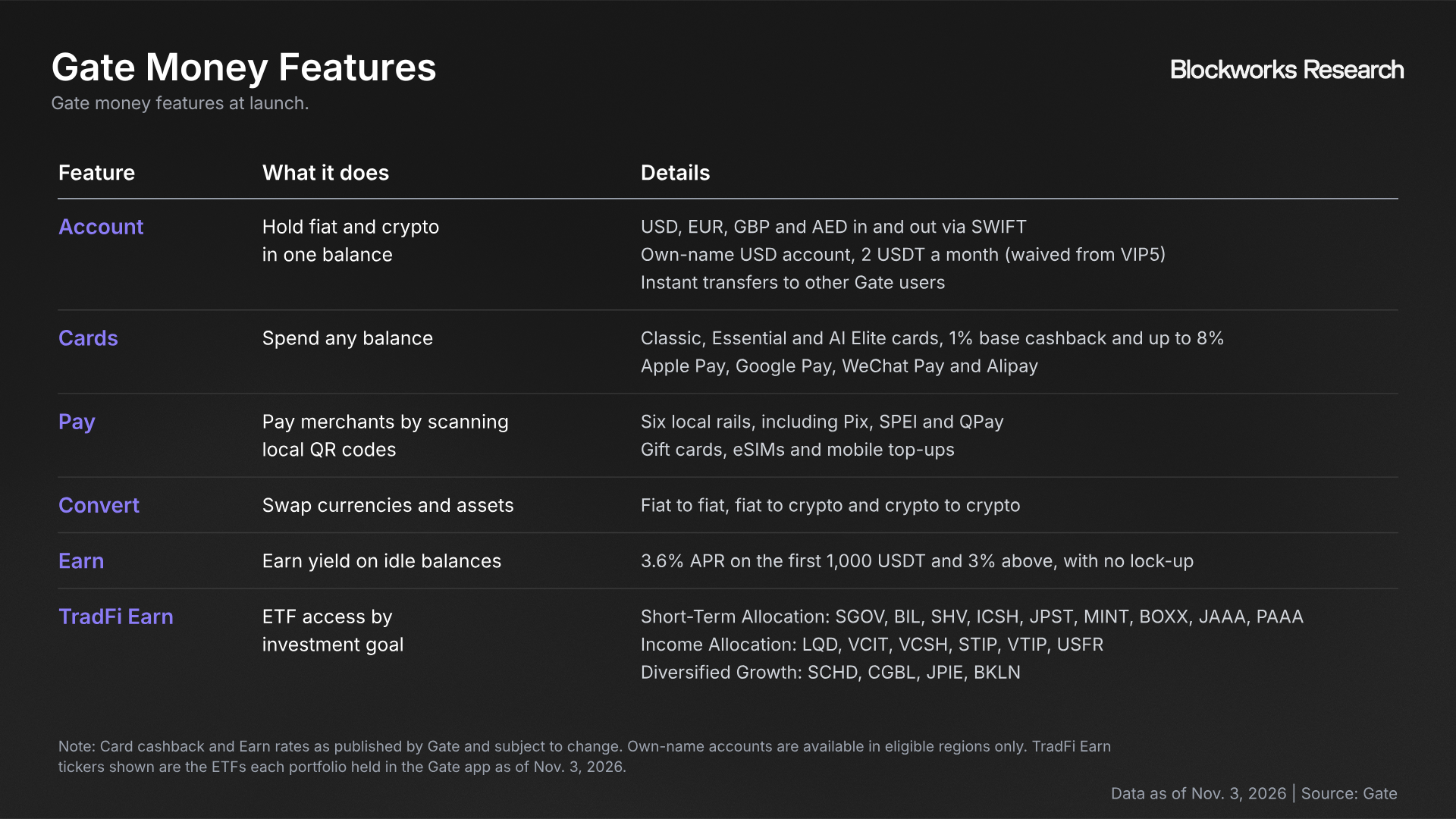
- Gate Money allows users to store, spend and earn, with localization as the wedge. The Money view adds fiat accounts, payment cards, USDT Earn and ETF portfolios through TradFi Earn. Users can also pay merchants directly from their Money balance through local QR codes in six countries, including Pix in Brazil and SPEI in Mexico, straight from their Money balance.
- Early traction is fast-growing but small. Gate Card spend has grown about 66% a month over the past three months, reaching $3.8M across 27,925 active cards in October. At $136 in spend per card a month, it looks like a second card for most users. The opportunity is turning it into their main card.
Introduction
We believe crypto exchanges are well positioned to evolve into full-fledged neobanks. Every major consumer finance platform is trying to become the primary place users manage their money. Exchanges already have one of the hardest pieces in place: distribution. Leading exchanges count their registered users in the tens of millions, some in the hundreds of millions, and Gate alone has more than 63M. Across Binance, OKX, Binance, and Gate, tracked onchain assets total roughly $183B as of November 4, 2026.
While the broader centralized exchange (CEX) universe is much larger, these figures illustrate the opportunity: established customer bases with substantial balances around which to build broader financial services. By adding tokenized equities and commodities, exchanges have also expanded into services traditionally offered by brokerages. Their core business, however, remains crypto trading, leaving revenue exposed to volatile market cycles.
Banking features could help make these businesses more resilient. A card, for example, gives users a reason to keep money on the platform for everyday spending. That creates an opportunity for exchanges to become part of users’ daily financial lives and build revenue streams that are less dependent on trading activity. This report examines the economics of that transition, using Gate Money as an early case study.
Exchanges Need a Second Revenue Stream
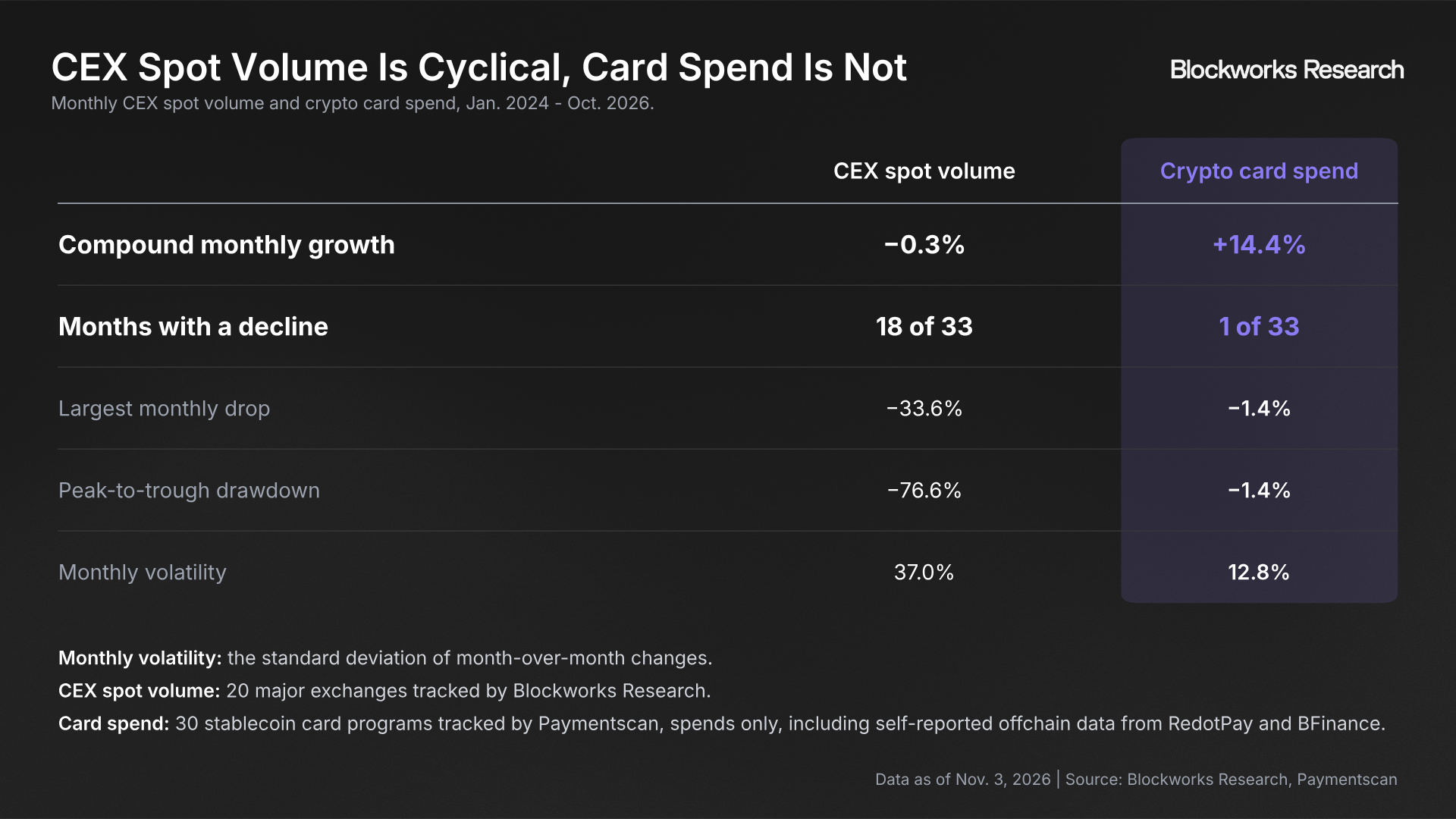
CEX spot volumes have trended downward for almost two years. Across 20 major exchanges tracked by Blockworks, spot volume totaled $865B in October 2026, down 62% YoY and 69% from the December 2024 peak of $2.8T. By contrast, stablecoin card spend has grown at a compound monthly rate of 14% since January 2024, reaching a record $1.4B of spend volume in October 2026.
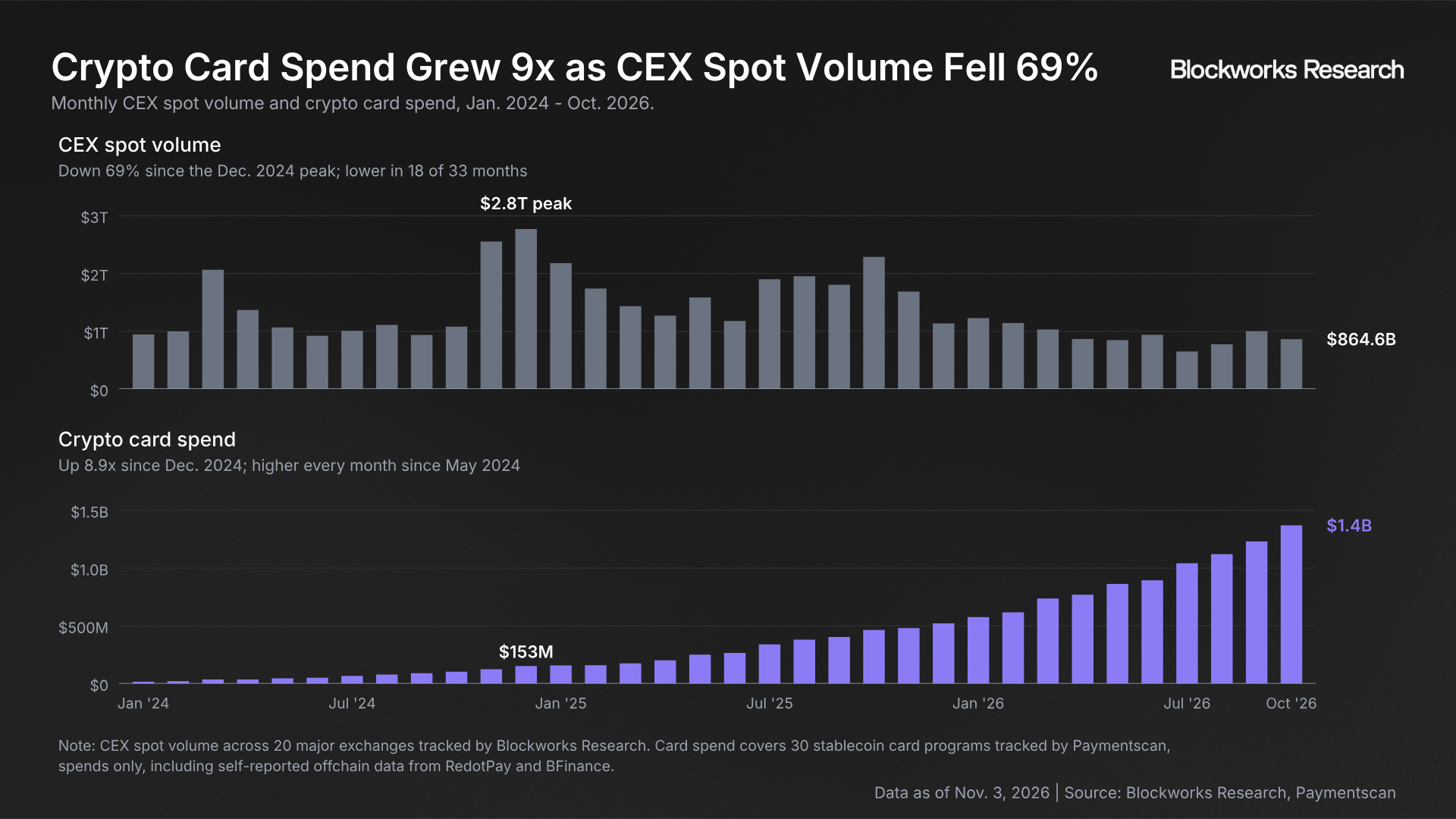
Reliance on trading fees exposes exchanges to crypto cyclicality, creating an incentive to diversify into steadier income streams. This helps explain why exchanges are adding banking features: consumer spending, as we see from the exponential trend in crypto card spend, is far less cyclical than trading. These features also give existing users more reasons to keep money on the platform, allowing exchanges to offer more value and better monetize those relationships.
Scenario Analysis: Converting Existing Users
For an exchange, the initial phase of growth of the neobank business is less about winning new customers than converting the ones it already has. To estimate Gate Money's revenue potential, we use a scenario model based on customer activity, conversion rates and annual revenue per customer.
- Customer base. Gate has 63M registered users. However, these are lifetime users and we don't expect all of them to be active. Coinbase, for comparison, reported 7.4M monthly transacting users in Q3 2026 against more than 100M verified users. Based on guidance from Gate, we assume about 10% of Gate's registered users, or roughly 6.3M, are active in a given month.
- Conversion. We model 1% to 10% of active users making Gate Money their main money account, or about 63k to 630k customers. For reference, Gate Card had about 28k monthly active cards in October 2026, about 0.04% of registered users or about 0.4% of our assumed active users, assuming one card per user.
- Revenue per customer. We assume $25 to $100 per customer a year from card fees. With the current 0.9% conversion fee on Gate, that comes out to about $2,800 to $11,100 spent per customer annually, or roughly $230 to $930 a month. For reference, mature neobanks can earn more in total: Nubank about $204 a year per active customer and Robinhood about $200 per funded customer. However, those totals include credit for Nubank and trading for Robinhood. Excluding trading, Robinhood earns about $80 per customer, and that still includes interest on margin loans. At the low end, Gate Card's 0.9% conversion fee comes to about $15 per active card a year at October's spend of $136 a month, before interchange and FX fees.
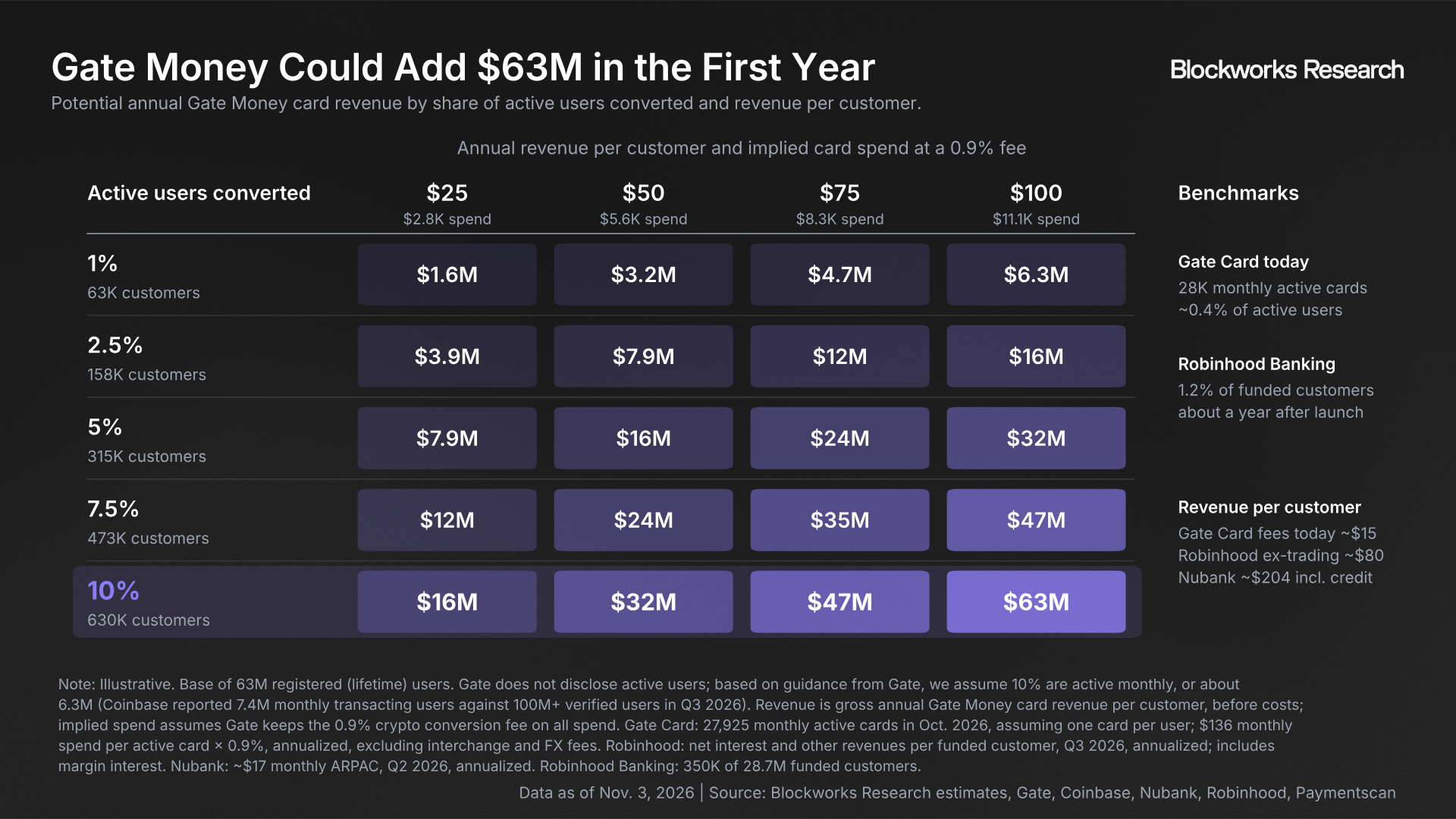
At 10% conversion and $100 per customer, Gate Money would add about $63M a year that does not depend on trading. The shift works for both sides. Gate earns more from users it already has and gives them more ways to use their balances within the Gate ecosystem, and users get trading, savings and spending in one app.
Gate Money: The Product
Gate Money is a second view inside the Gate app. Users can switch between the exchange view and a Money tab that feels like a neobank. Whereas the exchange view is focused on a trading experience, the Money view is pared back and built around three everyday uses of stablecoins: store, spend, and earn. Before his keynote at TOKEN2049 Singapore, Gate founder and CEO Dr. Han paid for a coffee with NVDA stock, a moment he used on stage to illustrate where Gate wants to take Gate Money: one account where any asset can be spent in daily life. That’s the vision for Gate Money. Below, we lay out Gate Money features at launch:
Localization Is the Wedge
We believe localization is how money apps reach users beyond crypto natives. Users in the US and Europe are already well served by banks and fintechs. The clearer opportunity is people elsewhere who want dollar access but still pay for daily life in local currency, on rails like Pix in Brazil or SPEI in Mexico.
Most crypto money apps stop at local on- and off-ramps, which have become table stakes. Gate Money goes a step further: users scan a merchant's QR code and pay over the local rail straight from their Money balance, with no cash-out in between. Currently, it supports six countries:
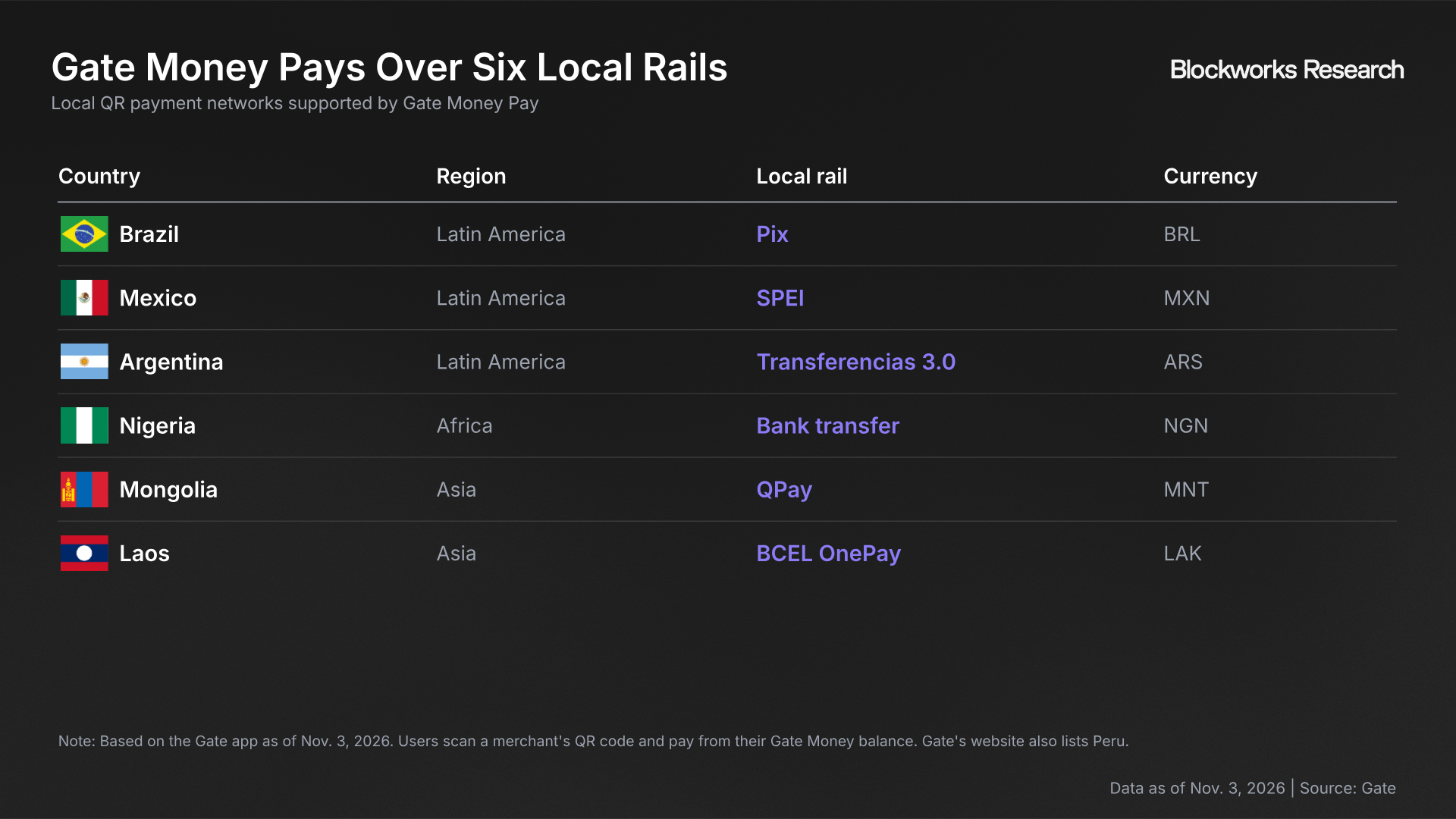
The rest of the product points the same way. AED is one of four supported fiat currencies, own-name accounts are planned to receive payments in more than 60 local currencies, and Gate Money bundles everyday services such as gift cards, eSIMs and mobile top-ups. Rivals are chasing the same users with other tools: Ethena has floated local-currency yield, and Plasma is building multi-currency cards with Stripe. Gate's bet is that paying locally from a dollar balance is the habit that brings users in, and the share of spend on these rails is the clearest sign of whether it works.
Compliance and Footprint
Serving users locally depends on being licensed locally. Gate Money runs on a region-by-region licensing model rather than one global license, with users served by the local entity. Gate says its footprint covers 81 regulated jurisdictions. Below, we lay out the core authorizations.
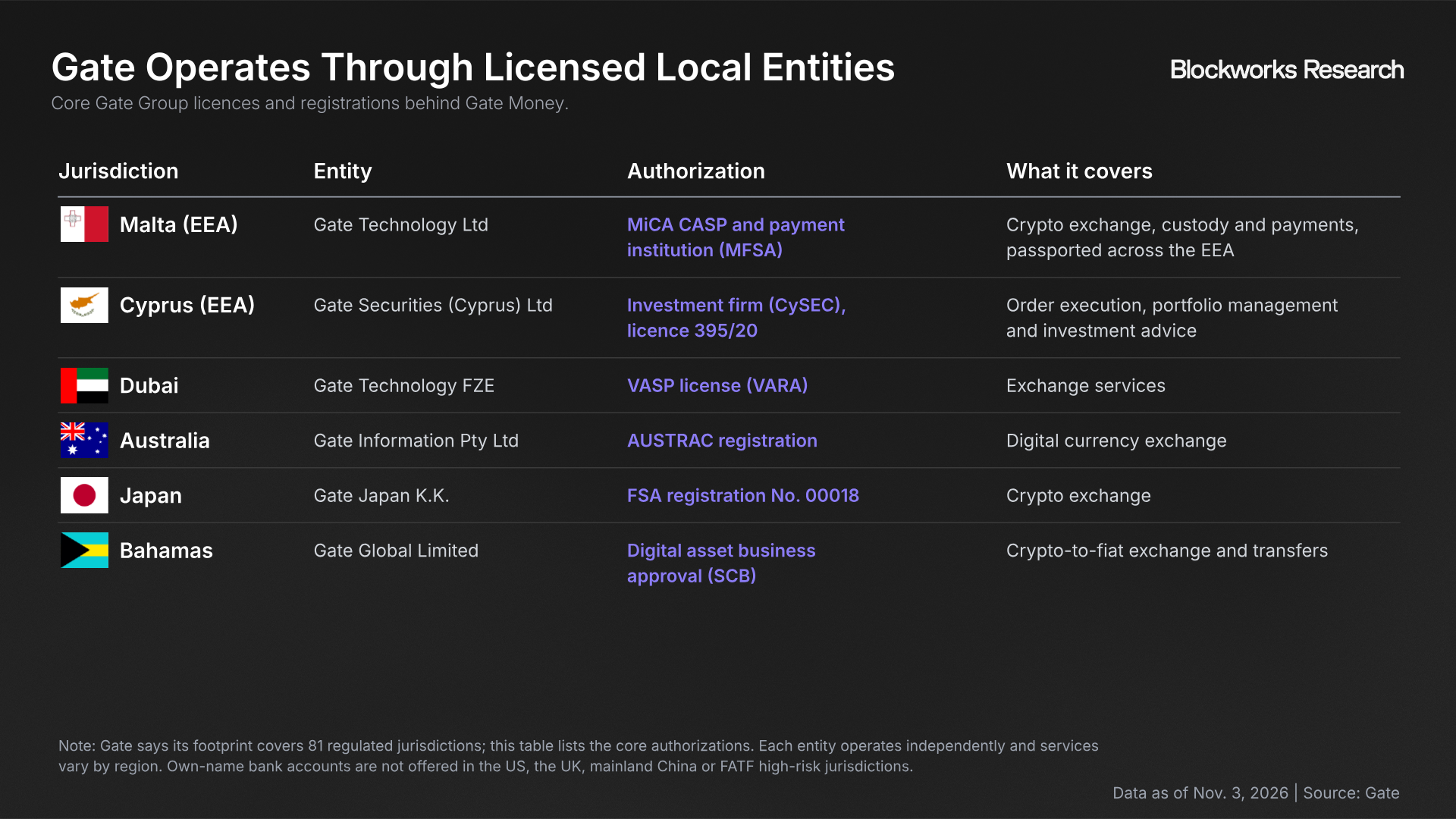
Any verified Gate user can open Money, but features vary by region. The own-name USD account is not offered in the US, the UK, mainland China or FATF high-risk jurisdictions. Gate plans to extend own-name accounts to Europe, Australia and Dubai, with receipts in more than 60 local currencies.
Early Traction
Gate Card is the best public proxy for Gate Money usage so far. Over the last three months, Gate Card spend has grown about 66% a month on a compound basis, from $831K in July to $3.8M in October. The monthly rate is slowing as the base gets bigger, which is expected.
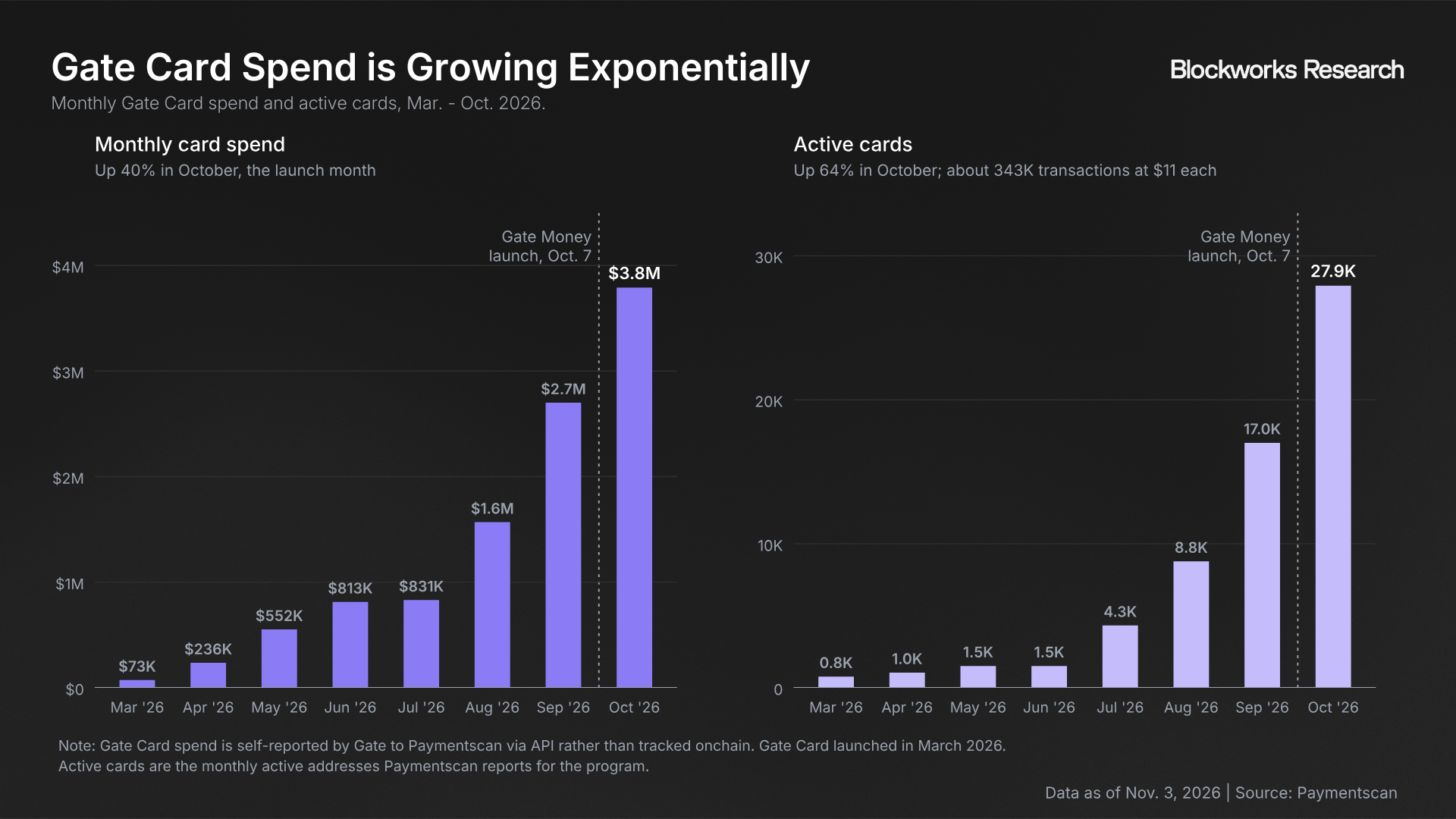
October, the launch month, added 40% to spend and 64% to active cards. Usage is frequent but small: about 343k transactions at roughly $11 each, or $136 per active card a month. That looks like a convenient second card today, and the opportunity is turning it into the main one.
Why an Exchange, and Why Now?
Gate starts with what stablecoin-first neobanks spend the most to acquire: verified users, balances and assets worth managing.
Why an exchange.
- Cheaper customer acquisition. Gate's users are already onboarded and verified. Many new entrants into the neobank space have to bootstrap distribution, which translates to high acquisition costs in the form of cashback.
- Balances already on the platform. Gate's reserves reached $8.69B in October, and Simple Earn holds more than $1.85B. Money gives those balances somewhere to work without leaving Gate.
- Asset breadth. We know of no neobank today that offers 5,400+ crypto assets, 12,800+ stocks and ETFs, and gold in the same app.
Why now?
- Cards are inflecting. Crypto card spend roughly tripled in a year. More than 160 stablecoin-linked Visa card programs are live, with payment volume up nearly 200% YoY.
- Rules are clearer. The MiCA transition period ended on July 1, 2026, and Gate Europe already held MiCA and payment institution licenses.
- Competition is intensifying as more exchanges and fintechs add cards, accounts and yield. However, onchain banking is still early, and spending habits tend to form around whoever arrives first. That leaves room for Gate to become a dominant player.
Competitive Landscape
The race to turn exchanges into money apps is crowded, and the prize is the same for everyone: the user's main account. It helps to separate two things that often get lumped together. Crypto cards are a feature. A money app is an account. Most of the activity in this market so far has been the former.
Card-first and stablecoin-first apps have proven the demand. Over the 30 days ending Nov. 2, 2026, RedotPay processed $408M in card spend, EtherFi $137M and KAST $116M. Those figures matter less as a benchmark for Gate than as a signal: if spending stablecoins from a card alone can reach that scale, the ceiling for an account that holds cash, 5,400+ crypto assets, stocks and gold, converts between them and puts idle balances to work could be considerably higher. Gate Card’s $3.8M in October is the early volume of a product that launched its full stack weeks ago, not the measure of the category it is entering.
The real benchmark sits outside crypto. Revolut and Cash App are what a primary money relationship looks like at scale: multi-currency accounts, cards, peer payments, investing and yield in one app, with crypto as one asset among several rather than the organizing idea. Revolut reached that position from a card and FX product, Cash App from peer-to-peer payments. Gate Money is attempting the same outcome from a third starting point, a global exchange, which gives it the asset range and 24/7 conversion the incumbents added later, and leaves it to build the everyday banking features they started with.
Within crypto, the closer comparison is other exchanges building a full money layer rather than a card. OKX Money is the most direct analogue, built on a similar exchange base and aimed at the same primary-account outcome. Binance and Bybit offer cards and stablecoin yield across many of Gate’s international markets but have not reorganized their apps around money as a product. Coinbase, Robinhood and Kraken are building fuller banking stacks, mostly in the US and Europe, with direct deposit and credit cards. Where those stacks are deep in one or two currencies, Gate Money is wide across assets and markets.
In a field this competitive, the biggest advantage is the user base an exchange already has. Binance, Coinbase and Gate each can start by converting existing exchange users, and the race is about how many of those traders each can turn into banking customers. Robinhood shows the conversion is possible: its Gold Card reached 1.3M customers, about 4.5% of its 28.7M funded customers.
Gate's clearest differentiator is local payments. Six QR rails, spanning Latin America, Africa and Asia, give users a reason to spend from Gate Money in daily life rather than just cash out. The gaps are just as clear: no credit product or direct deposit yet, own-name accounts in USD only, and card volume that is still early.
Final Thoughts
We think exchanges will keep adding features until they own the user’s entire financial relationship: where they store money, spend it, grow it and eventually borrow it. Gate Money shows what that looks like at an early stage. It already covers storing, spending and growing, and it launched with a broader set of local payment options than most competitors.
Borrowing is the next step as the neobank matures. Gate already lets users borrow against their crypto through Crypto Loan, and credit is the largest profit pool for mature neobanks: at Nubank, it made up 41% of gross profit in Q2 2026. Bringing borrowing into Gate Money would complete the stack.
The space remains fiercely competitive, and the largest exchanges are chasing the same users. As Gate Money scales, we are watching:
- Gate Card monthly spend and active cards, which reached $3.8M and 27,925 in October.
- Own-name account openings, inflows and Money Earn balances.
- QR payment volume across the six countries where Gate Pay is live, in Latin America, Asia and Africa.
- Whether a credit feature comes to Gate Money.
Exchanges have always competed for trading volume. We think the next contest is for the user’s entire financial relationship, which would give exchanges a new source of revenue and make them less dependent on crypto’s cycles.
This report was commissioned by Gate. By providing this disclosure, we aim to ensure that the research reported in this document is conducted with objectivity and transparency. All content was produced independently by the author(s) and does not necessarily reflect the opinions of Blockworks. or the organization that requested the report. The commissioning organization may have input on the content of the report, but Blockworks maintains editorial control over the final report to retain data accuracy and objectivity. Author(s) submit financial conflict of interest (FCOI) disclosures on a monthly basis that are reviewed by appropriate internal parties and may hold cryptocurrencies named in this report. This report is meant for informational purposes only. It is not meant to serve as investment advice. You should conduct your own research and consult an independent financial, tax, or legal advisor before making any investment decisions. Past performance of any asset is not indicative of future results. Please see our Terms of Service for more information.