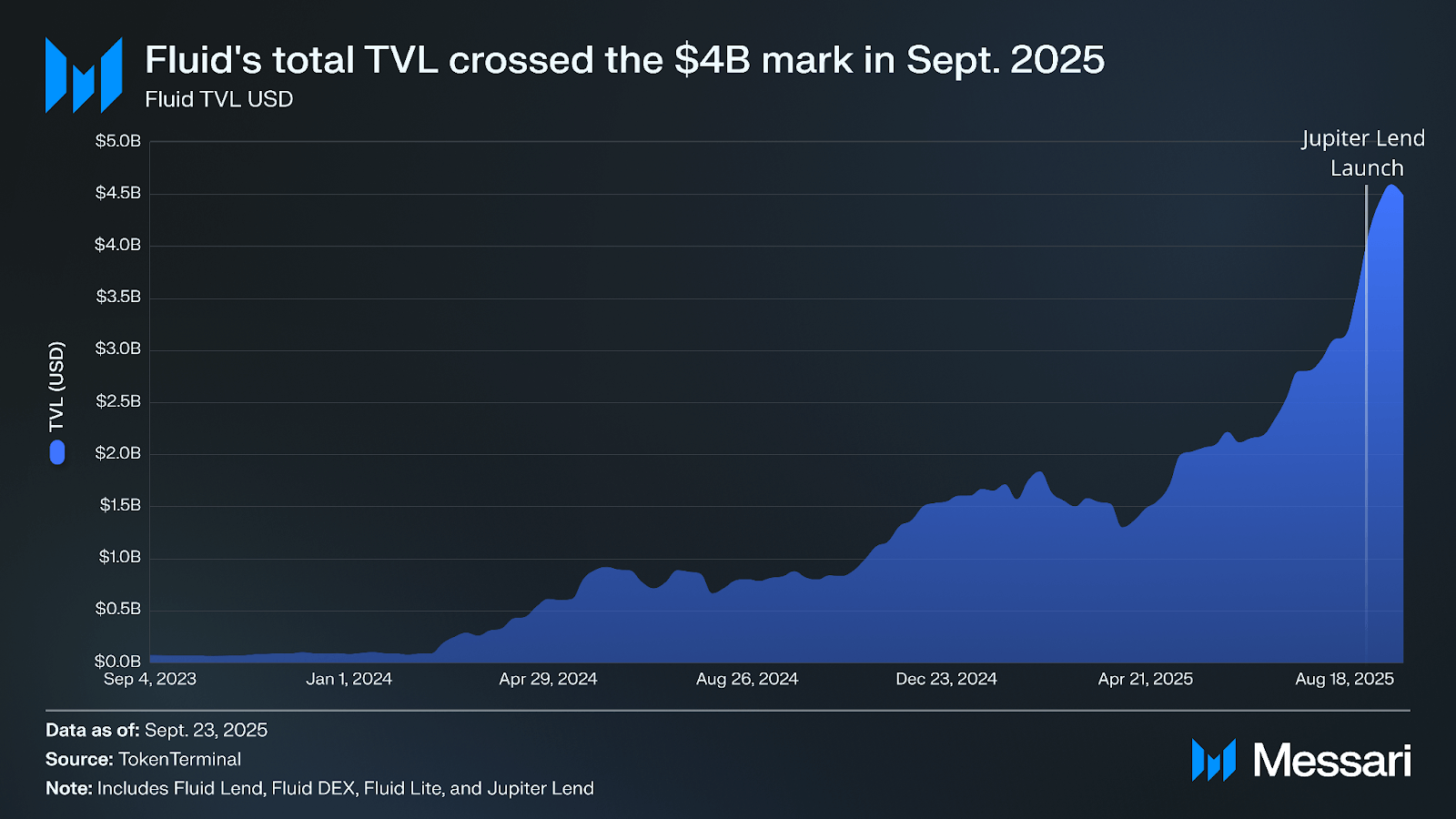
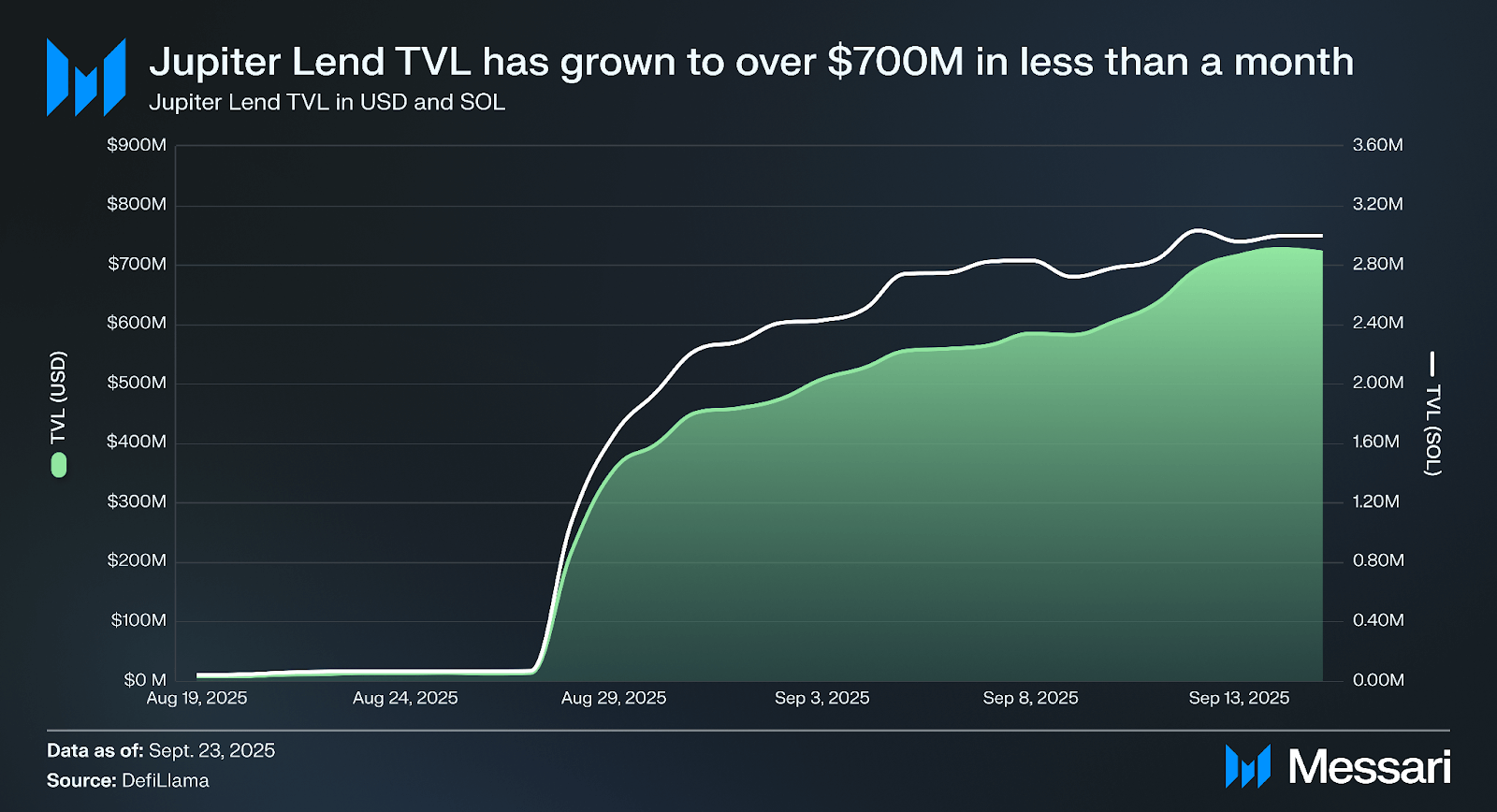
Launched in partnership with Jupiter, Jupiter Lend is Fluid’s first non-EVM deployment and has already become the second-largest lending protocol on Solana with over $700 million in TVL, reaching $1.3B in market size.
Fluid’s market size surged 449.9% in the past year, climbing from $816.1M to $4.48B. The growth reflects both strong adoption of existing products and the rollout of new ones.
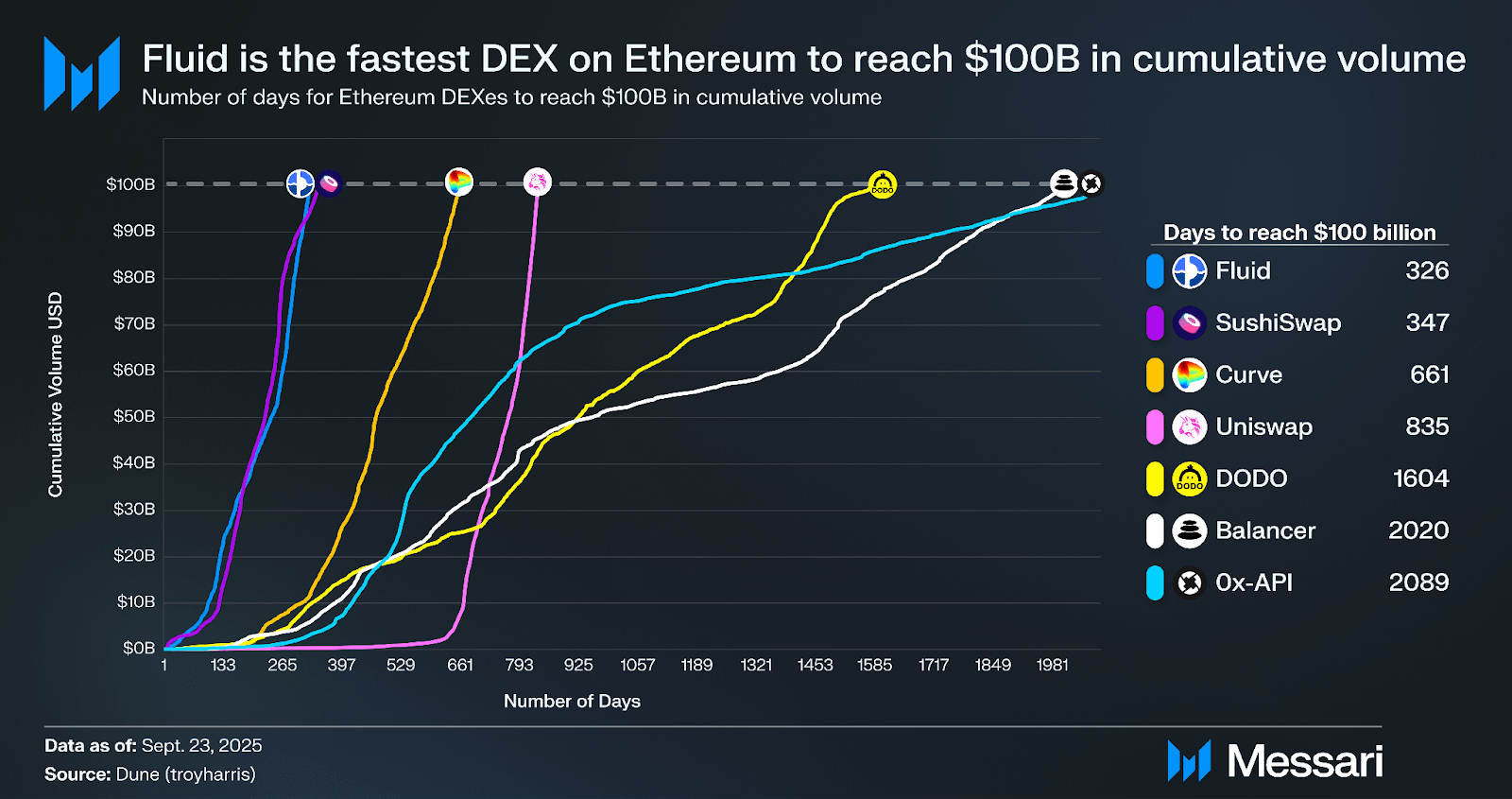
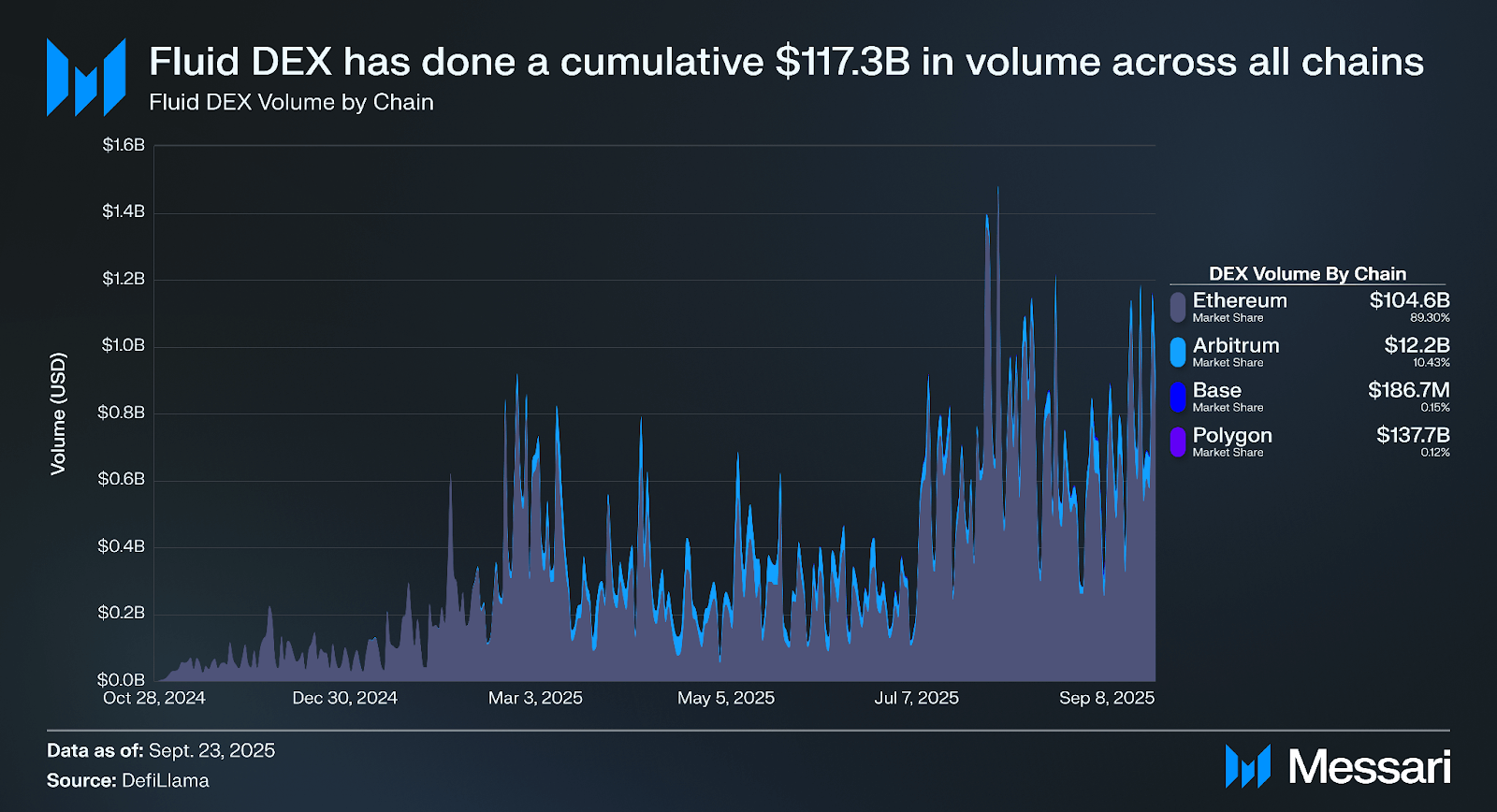
Fluid DEX became the fastest DEX on Ethereum to reach $10B, $20B, and now $100B in cumulative volume. It now ranks among just seven DEXes on Ethereum to surpass $100B, and has processed over $117 billion in total volume, 89% of which has occurred on Ethereum.
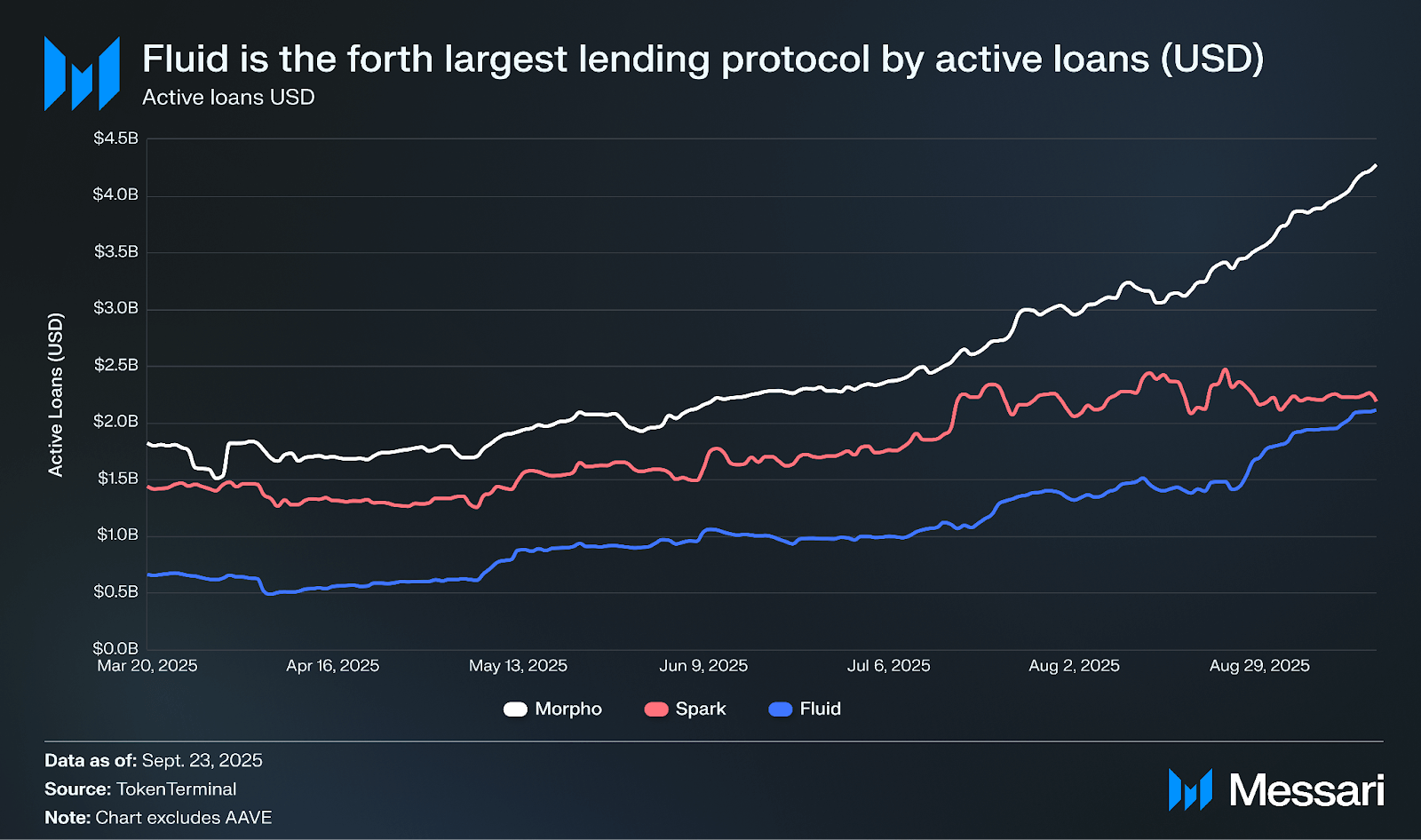
Fluid is 4th in active loans, with $2.1 billion borrowed, reflecting real protocol engagement and capital utilization, not just idle deposits chasing incentives.
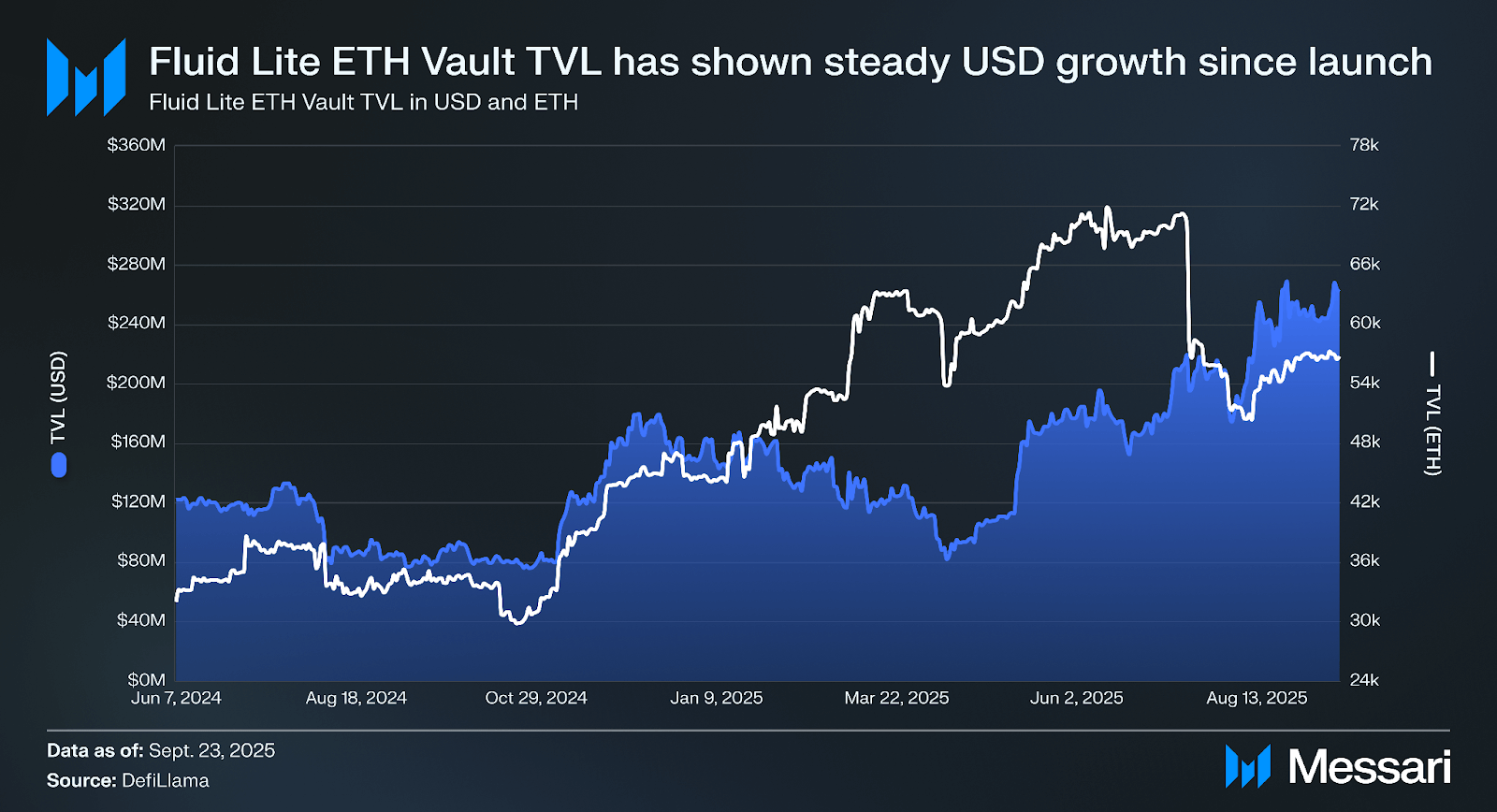
Fluid Lite’s ETH Vault has $250M in ETH TVL, earning 7.1% APY. Built for retail users, Fluid Lite’s ETH Vault abstracts away the complexity of DeFi and allows users to earn yield with one click.
Introduction
As DeFi continues to scale across chains and protocols, liquidity fragmentation remains a persistent bottleneck, hindering capital efficiency, interoperability, and user experience. Most attempts to solve this issue either build aggregation layers or optimize isolated protocol mechanics. Fluid takes a different approach, embedding unified liquidity as a foundational design principle across its stack, bringing capital efficiency to all financial products.
Fluid rebranded from Instadapp in December 2024 after the early success of its DEX protocol, which went live at the end of October 2024. As part of this rebrand, the project’s token ticker changed from INST to FLUID. The protocol now operates a deeply integrated suite of financial primitives: a Lending protocol, a Vault protocol, and a DEX protocol, all powered by a shared Liquidity Layer. This architecture enables cross-protocol capital reuse, transforming idle deposits and collateral into productive assets that simultaneously power borrowing, lending, and trading.
In contrast to siloed DeFi protocols, Fluid allows collateral and debt to act as liquidity itself. Smart Collateral and Smart Debt, two primitives unique to Fluid’s DEX, allow users’ borrowing positions to also serve as market-making capital. This enables Fluid to reach levels of capital efficiency that traditional DeFi and TradFi designs cannot match.
The protocol’s technical architecture is modular but tightly coupled. Protocols are deployed via factories, orchestrated by a unified Liquidity Layer, and protected through risk management primitives like dynamic ceilings and multi-source oracle systems. Most interactions occur through permissioned vaults and standardized token wrappers (ERC-4626), supporting broad composability with other DeFi systems.
Since its DEX launch in October 2024, Fluid has scaled rapidly, with nearly $1.5 billion in collateral and over $100 billion in cumulative trading volume. With its second-generation DEX (DEX V2) planned to launch in October, and a newly released Solana deployment via Jupiter Lend, Fluid is establishing itself as a leading infrastructure layer in DeFi. The Fluid protocol is governed by the Fluid DAO, which is controlled by FLUID tokenholders.
Fluid’s ecosystem is built around a suite of modular products, each designed to serve different user segments and deployment environments, yet all powered by a shared core: the Liquidity Layer. This unified infrastructure connects the Lending, Vault, and DEX protocols, allowing capital to move frictionlessly between them. Deposits, collateral, and debt aren’t siloed; they function as active liquidity, earning yield, and supporting trading or borrowing activity without requiring users to manually reposition assets.
At the center of this system is the Vault protocol, which acts as the entry point to the Liquidity Layer. Users deposit assets into Vaults to mint Smart Collateral or borrow as Smart Debt, both of which automatically serve as liquidity within the DEX. Each Vault comes with configurable parameters, automated liquidations, oracle feeds, and risk controls, giving users leveraged exposure with integrated capital efficiency.
While every product shares this common foundation, each is tailored for a specific use case, user profile, or chain environment, extending Fluid’s Liquidity Layer's reach and utility across the DeFi landscape.
Fluid’s TVL across all products has shown impressive growth, rising 449.9% from $816.1 million to $4.48 billion in the past year. This growth was not only fueled by continued adoption of existing products, but also by the deployment of new products and expansion to new networks, including the launch of Jupiter Lend in late August 2025.
Fluid DEX
Fluid DEX is a decentralized exchange (DEX) that reimagines liquidity provisioning through two novel primitives: Smart Collateral and Smart Debt. Instead of relying on traditional LP tokens or dual-asset deposits, Fluid DEX sources liquidity directly from user positions within the Vault protocol. Borrowers and lenders effectively become liquidity providers, with collateral and debt dynamically rebalanced to support trading activity. This design enables users to earn trading fees on top of lending interest or reduce borrowing interest, maximizing capital efficiency.
Fluid’s DEX protocol launched on October 29, 2024, and quickly set a record-breaking pace. It became the fastest DEX on Ethereum to hit both $5 billion and $10 billion in cumulative volume, reaching those milestones in just 72 and 100 days, respectively. It continued its momentum by being the fastest DEX to cross $100 billion in cumulative volume in 326 days, narrowly beating out SushiSwap, which took 347 days. Only seven DEXes on Ethereum have ever crossed the $100 billion mark, placing Fluid in elite company.
Today, Fluid DEX has surpassed $109 billion in cumulative volume, continuing the aggressive growth seen since launch. Fluid DEX’s Ethereum deployment continues to dominate in volume, comprising $97.6B or 89.3% of the cumulative trading volume across all networks.
Fluid Lend
DeFi lending is an extremely competitive market, with lending protocols competing for a share of the existing $82.6 billion of TVL. Fluid Lend is the protocol’s lending layer, allowing users to earn passive yield by supplying assets to the Liquidity Layer. Built using the ERC-4626 standard, it issues fTokens that represent claims on deposited assets, making it fully composable with the rest of DeFi. Deposits into Fluid Lend are used across the stack, powering borrowing in the Vault protocol and liquidity in the DEX, without requiring user intervention. This allows lenders to gain exposure to yield opportunities across multiple protocols, all from a single deposit position.
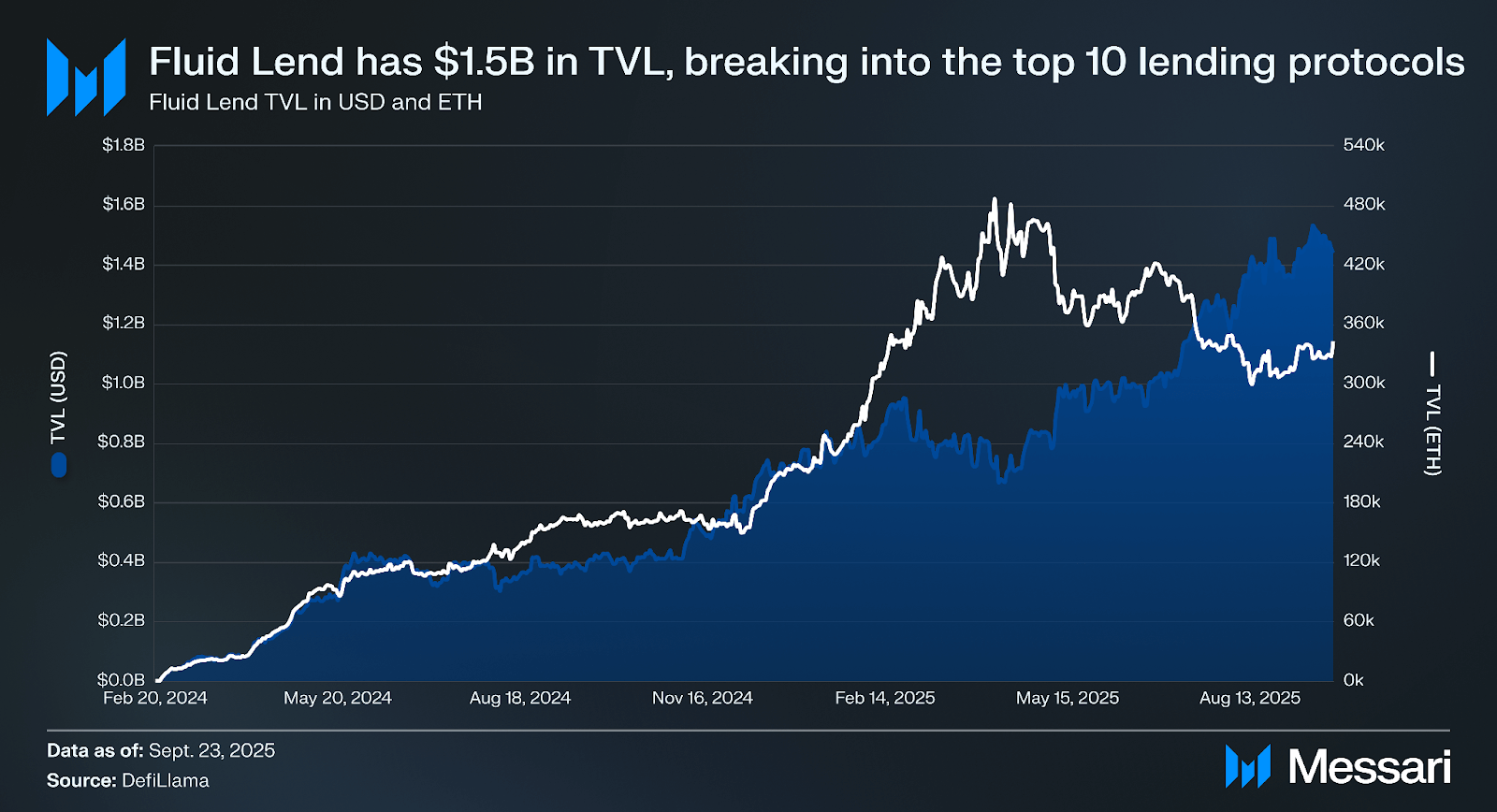
Since launch, Fluid Lend’s EVM deployments have scaled rapidly to $1.5 billion in TVL, placing it among the top 10 lending protocols by total deposits. As with Fluid DEX, the Ethereum deployment leads by a wide margin with $1.3 billion, followed by Arbitrum at $160.7 million.
More telling than Fluid Lend’s TVL is the growth in active loans, a metric that reflects actual protocol usage rather than idle capital. Fluid now ranks as the fourth-largest lending protocol by active loans, with $2.1 billion outstanding, just behind Spark ($2.2B) and Morpho ($4.3B). Despite being only tenth by total TVL, Fluid’s high loan-to-TVL ratio signals a user base that’s actively borrowing, not just passively farming.
Fluid Lite
Fluid Lite is a simplified, retail-friendly interface built on top of Fluid Lend, designed to make accessing yield opportunities as seamless as possible. It abstracts away the complexities of vault interactions, token standards, and position management, allowing users to earn on ETH by depositing it into an ETH vault, which then uses external protocols to generate yield. As of Sept. 23, 2025, the vault’s net APY is 7.31%, vastly outperforming the 2.6% APY of ETH staking.
Fluid Lite’s ETH Vault has shown steady growth, accumulating over $250 million in TVL since launching.
Jupiter Lend
Launched on Aug. 27, 2025, Jupiter Lend is Fluid’s first non-EVM deployment, built in partnership with Jupiter and deployed natively on Solana. It brings Fluid’s overcollateralized lending model and liquidation engine to the Solana ecosystem while leveraging Jupiter’s brand, liquidity network, and frontend integrations. All revenue earned by Jupiter Lend is split evenly between Jupiter and Fluid’s DAOs to be utilized however the DAOs see fit. Under the hood, Jupiter Lend uses the same architectural principles as Fluid Vaults and Lend: unified liquidity, automated liquidation ranges, and dynamic risk parameters. By adapting its core infrastructure to Solana, Fluid demonstrates the modularity and portability of its Liquidity Layer across chains and ecosystems.
Although still in its early stages, Jupiter Lend has already surpassed $700 million in TVL, and reached a market size of $1.30 billion, making it the second-largest lending protocol on Solana, trailing only Kamino.
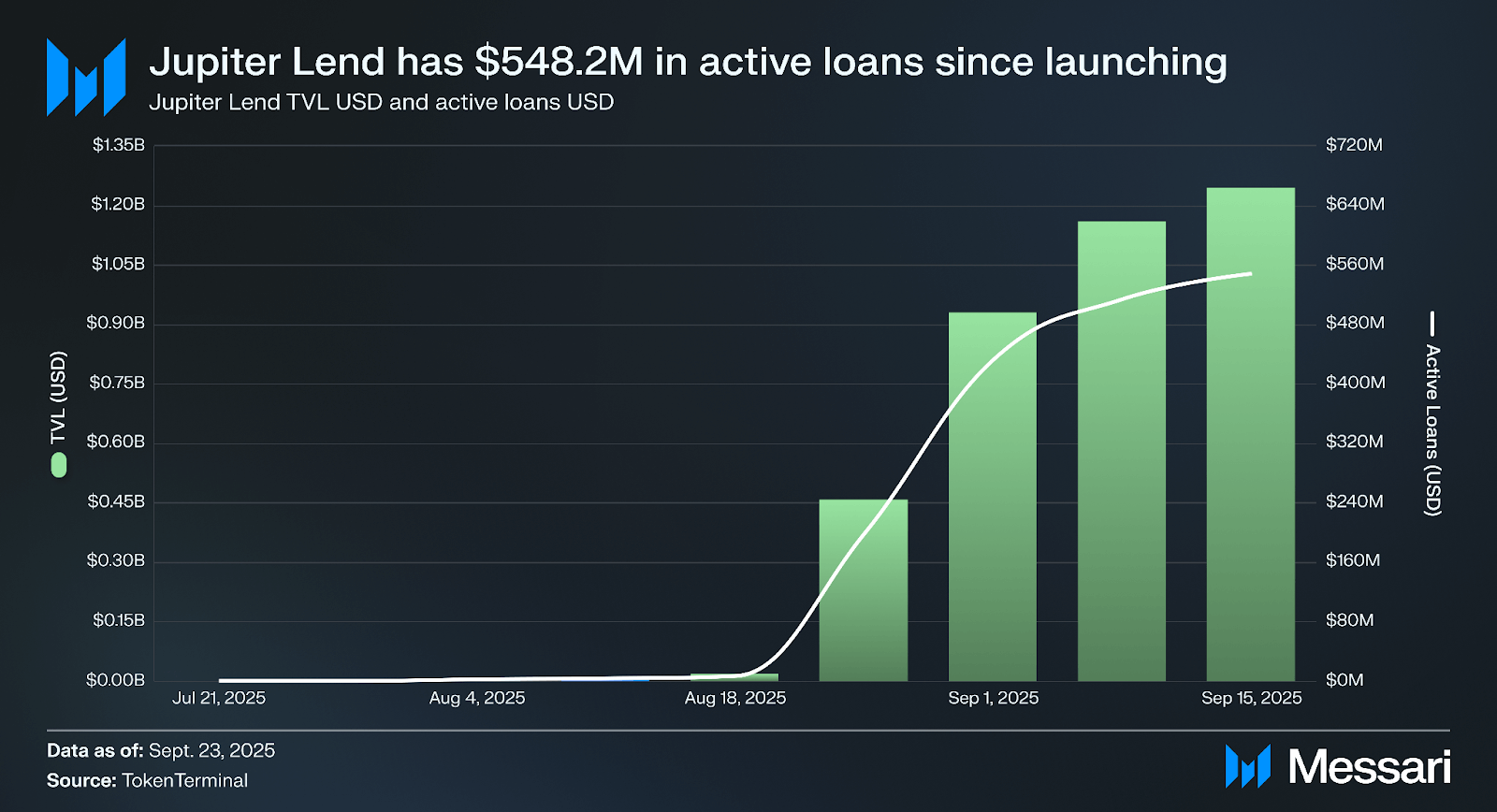
Alongside its rapid TVL growth, Jupiter Lend is seeing strong capital efficiency, with $597 million in active loans against $729 million in TVL. By comparison, Kamino holds $2.9 billion in TVL with $1.8 billion in active loans. While Kamino leads in absolute terms, Jupiter Lend boasts a higher utilization rate, signaling strong borrower demand and efficient use of deposited capital. Beyond Jupiter Lend, Fluid is deepening its push into the Solana ecosystem. On Sept. 22, 2025, the team bridged the FLUID token to Solana and seeded a pool on Meteora, with plans to launch Fluid’s DEX protocol on Solana in Q4 2025.
Closing Summary
Fluid is redefining DeFi architecture by embedding unified liquidity at the protocol level. Unlike siloed platforms that optimize individual components in isolation, Fluid fuses lending, trading, and vault mechanics into a single, composable Liquidity Layer, unlocking capital efficiency at every layer of the stack. From its innovative Smart Collateral and Smart Debt primitives to its record-breaking DEX growth, Fluid has proven that tightly integrated systems can outperform fragmented ones in both scale and utility.
Its core products, Fluid DEX, Fluid Lend, and Fluid Lite, serve different user profiles but operate on the same foundational infrastructure, enabling seamless capital reuse and yield generation without friction. Meanwhile, Jupiter Lend’s rapid growth on Solana shows Fluid’s architecture isn’t just scalable, it’s portable, able to extend across ecosystems without compromising performance or design.
With over $100 billion in cumulative volume, $4.48 billion in market size, and strong active loan utilization across chains, Fluid is no longer an emerging protocol; it’s core infrastructure. And as cross-chain liquidity deepens and user demand for capital efficiency intensifies, Fluid is positioned to be one of the foundational applications that powers the next phase of finance.
This report was commissioned by Fluid All content was produced independently by the author(s) and does not necessarily reflect the opinions of Messari, Inc. or the organization that requested the report. The commissioning organization may have input on the content of the report, but Messari maintains editorial control over the final report to retain data accuracy and objectivity. Author(s) may hold cryptocurrencies named in this report. This report is meant for informational purposes only. It is not meant to serve as investment advice. You should conduct your own research and consult an independent financial, tax, or legal advisor before making any investment decisions. Past performance of any asset is not indicative of future results. Please see our Terms of Service for more information.
No part of this report may be (a) copied, photocopied, duplicated in any form by any means or (b) redistributed without the prior written consent of Messari®.
Drexel is a Research Manager at Messari for the Protocol Reporting team with a focus on base layers and DeFi. He is a strong follower of the crypto mullet thesis of diligence in the front and degen in the back.
Drexel is a Research Manager at Messari for the Protocol Reporting team with a focus on base layers and DeFi. He is a strong follower of the crypto mullet thesis of diligence in the front and degen in the back.