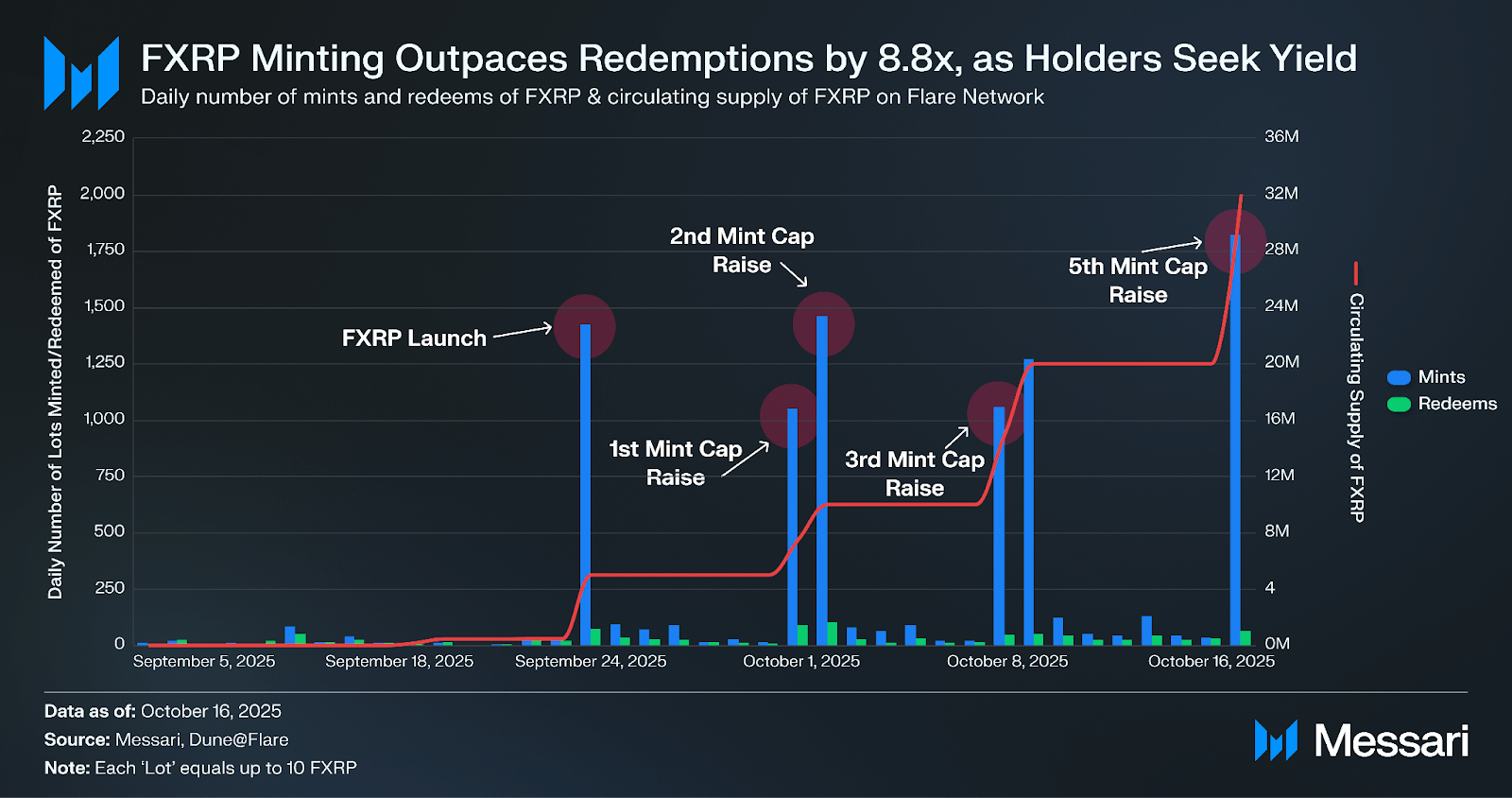
FXRP’s mainnet launch marked the first realization of the FAssets design. The initial 5 million FXRP mint cap filled in under four hours, and subsequent increases to 15 million were reached just as quickly.
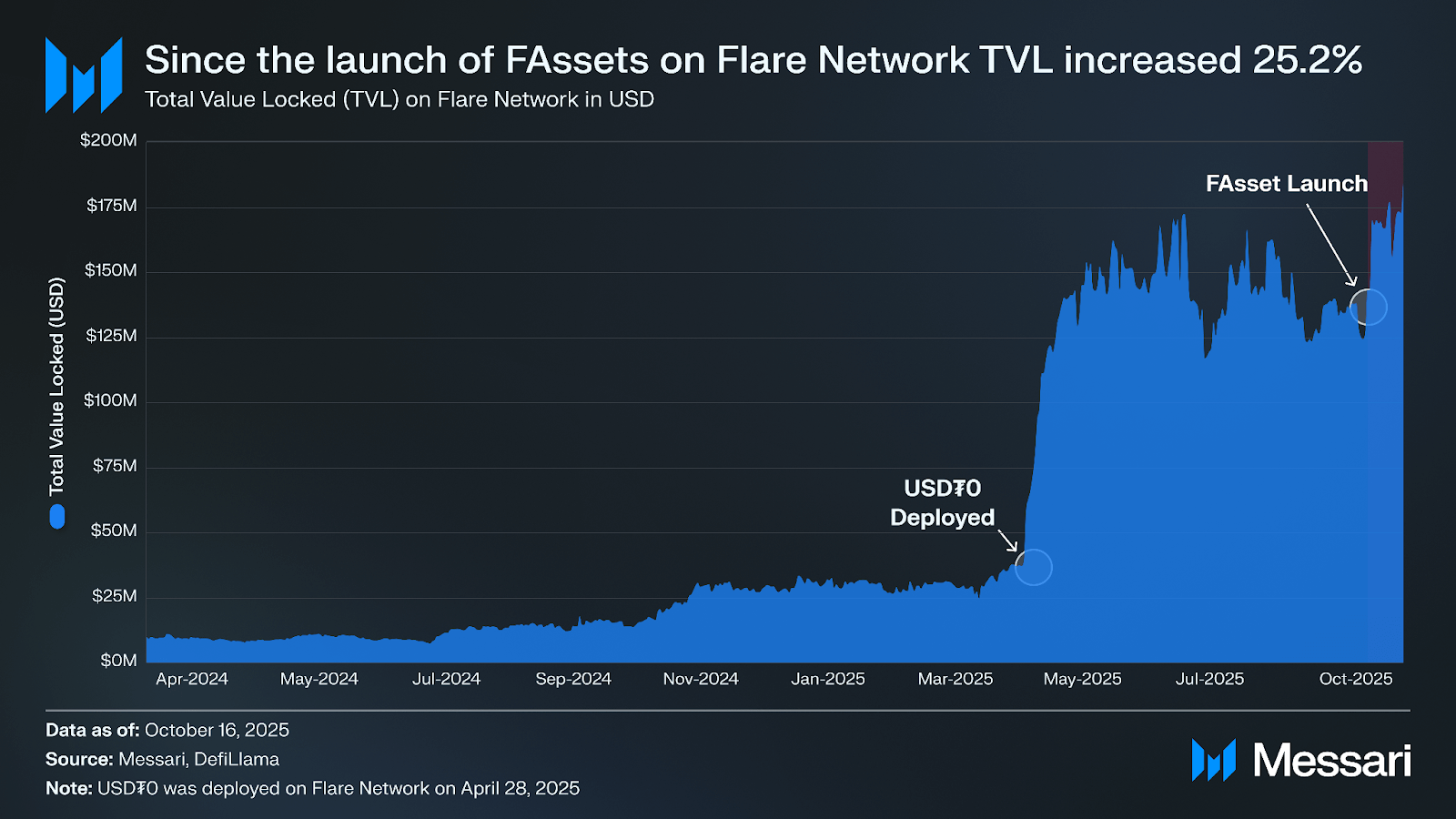
Following the deployment of USD₮0 in April 2025 and the FAssets launch in late September, total value locked (TVL) on Flare rose by 25.2%, with FXRP and USD₮0 pools emerging as the network’s largest liquidity centers across SparkDEX, BlazeSwap, Enosys, and Kinectic.
The 2.2 billion FAssets Incentive Program continues distributing rFLR rewards to pools that support FXRP supply, FXRP/USD₮0 pairs, and future modular DeFi stack such as CDP and yield market. This structure directs incentives toward durable liquidity and collateral formation rather than short-term yield rotation.
Flare’s native oracle and data verification infrastructure (FTSO + FDC) continues to anchor the network’s positioning as a data blockchain. This baked-in stack enables decentralized pricing and verifiable cross-chain proofs, which are foundational for maintaining the trustless minting and redemption of assets like FXRP.
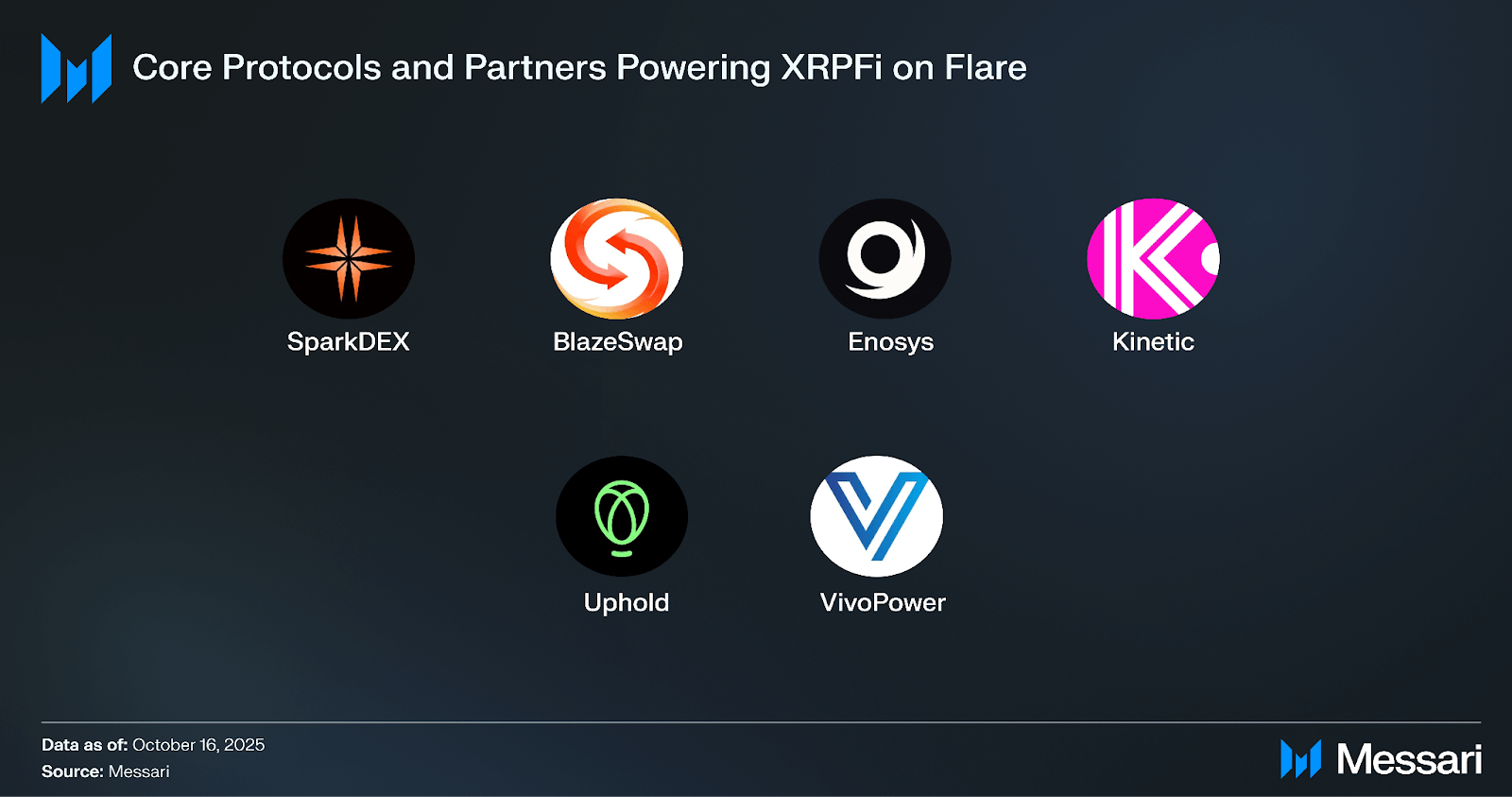
XRPFi has started to take shape. DEXs (e.g., SparkDEX, BlazeSwap, and Enosys), lending protocols (e.g., Kinetic), and institutional entrants (e.g., Uphold and VivoPower) are contributing to early network utility and depth, setting the groundwork for a broader yield-bearing XRP economy.
Primer
Flare (FLR) is a full-stack Layer-1 designed for data-intensive use cases. It provides a bridge between non-smart-contract blockchain assets and the world of DeFi. At its core, Flare has three main features: (i) Flare Time Series Oracle (FTSO), which is an enshrined oracle that provides decentralized pricefeeds for dApps on Flare; (ii) Flare Data Connector (FDC), which is designed to validate external Web2 & Web3 data for Flare's EVM state; and (iii) FAssets, which enables the creation of fully collateralized representations of non-smart contract assets on Flare.
The most prominent FAsset example is FXRP, a version of XRP that can be used within Flare's EVM-compatible environment. FXRP contributes to the XRPFi narrative: the emergence of a DeFi ecosystem built around XRP, one of the largest cryptocurrencies by market capitalization.
As XRP's market presence continues to grow, Flare's technology offers a pathway to unlock this dormant value and integrate it into the broader DeFi landscape. This potential has attracted attention from both retail users and institutional players, setting the stage for what could be one of the most significant developments in the XRP ecosystem since its inception.
Co-founded by Hugo Philion, who has a background in finance and machine learning from University College London and serves as the CEO of Flare Labs, and Dr. Nairi Usher, who rounds out the founding team with a PhD in Quantum Computing and blockchain knowledge and also serves as the Chief Scientist Officer (CSO), Flare has raised ~$46.3 million across three funding rounds from 17 investors, including notable names like Xpring (formly RippleX, Ripple’s venture capital arm), Kenetic Capital, DWF Labs, MetaStone Group, Wintermute Ventures, Backend Capital, and Borderless Capital.
Unlike traditional wrapped tokens that rely on centralized custodians, FAssets operate through a decentralized system that maintains security and trustlessness. For a full overview of how FAssets work, reference Flare: Expanding XRP’s Role in DeFi.
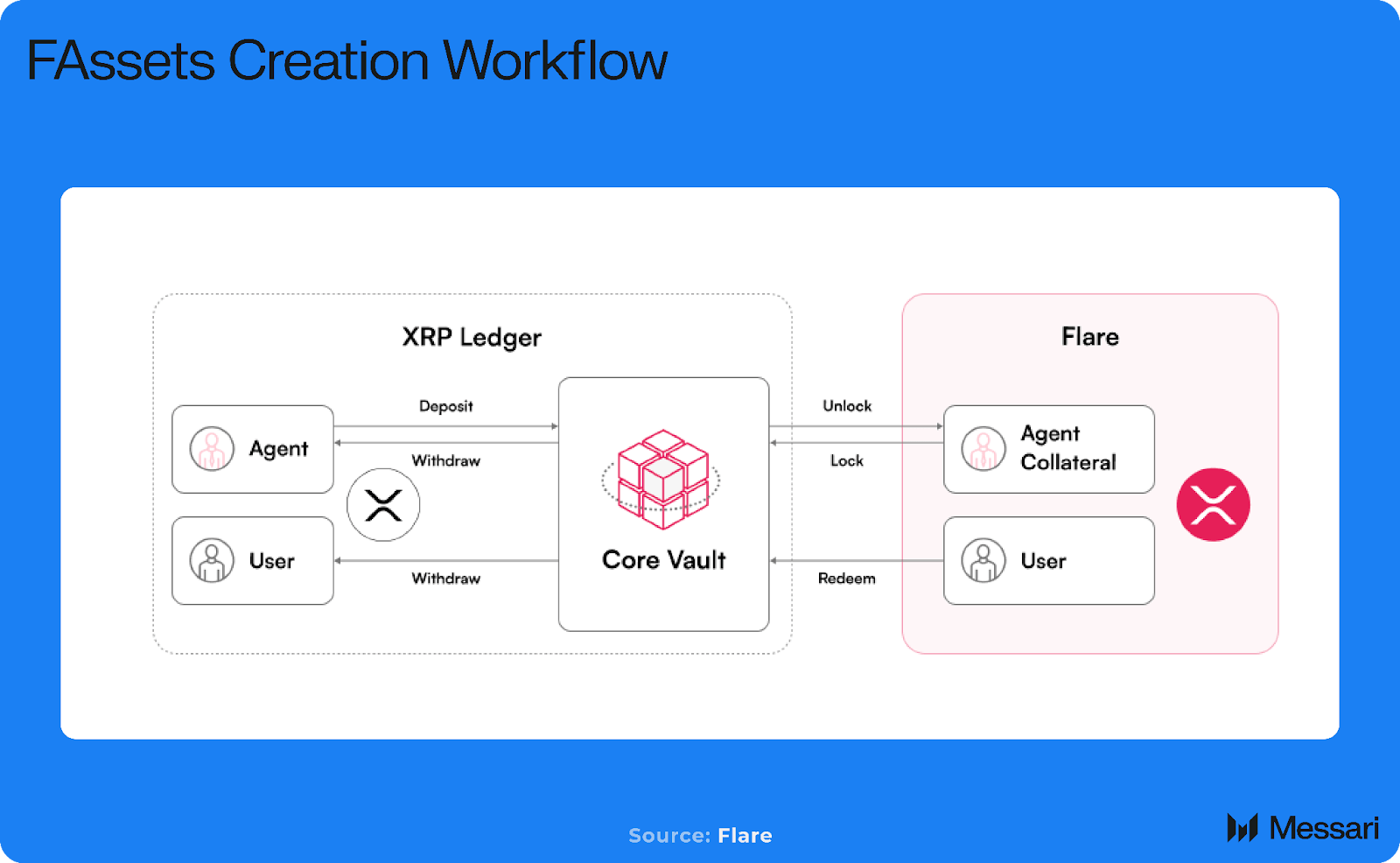
The FAssets system works through a multi-step process:
FAssets agents play a crucial role in this ecosystem, providing the collateral to back the minting of underlying assets (e.g., XRP). The agents are all known participants who have been KYC’d. There are currently five live agents. Agents can accept a combination of stablecoins (e.g., USD₮0) and network token (FLR ) as collateral. The Core Vault is deployed to store additional funds supporting the FAssets protocol. This vault increases asset liquidity, minting rate, and agent profitability across the FAssets system.
To ensure the system's stability, agents must maintain a healthy collateral ratio, which is dynamically adjusted based on market conditions. The decentralized price feeds for the collateral are provided through the Flare Time Series Oracle (FTSO).
State of FAssets
FAssets launched on Flare mainnet on Sept. 24, 2025, with a week‑one mint cap of 5 million FXRP to ensure a controlled rollout and stable secondary markets. That initial cap filled within four hours, and subsequent cap raises were enacted the following week, bringing the total to 15 million FXRP.
Early FXRP activity shows concentrated minting events following each cap adjustment, with issuance volumes quickly reaching the defined limits. Redemptions have been comparatively low and sporadic over the same period. The pattern suggests that FXRP supply growth is primarily constrained by existing caps, implying underlying demand that could surface more clearly as limits are progressively lifted.
The initial liquidity foundation for Flare was established with the deployment of USD₮0 in April 2025, which provided the primary stablecoin base for subsequent FXRP activity. The FAsset rollout in late September added incremental capital inflows, reflected in the recent uptick in network TVL.
XRPFi in Motion
XRP has been one of crypto’s largest, most widely held assets, but structurally under‑utilized in DeFi due to XRPL’s limited programmability. FXRP solves the composability gap by becoming an EVM‑native building block for lending, liquidity, and structured yield, with security anchored by Flare’s enshrined data stack (FTSO + FDC). In other words, previously “static” XRP balances can now earn yield onchain.
Beyond bridging XRP into EVM DeFi, XRPFi’s next phase is unfolding through integrations with Kinetic (FXRP lending), Enosys Loans (CDPs using FXRP collateral), and forthcoming stXRP staking via Firelight. DEX liquidity has begun consolidating around FXRP/USD₮0 pairs on SparkDEX and BlazeSwap, while institutional participants like Uphold and VivoPower signal growing interest in deploying capital through these new rails. Together, these developments turn XRPFi from an experimental bridge into a functioning onchain economy.
Incentive Program
Flare launched a dedicated FAssets Incentive Program of 2.2 billion FLR (distributed as rFLR) to accelerate FXRP adoption and seed a modular DeFi stack. The program spans from July 2025 to July 2026 with committee oversight and flexible emissions, emphasizing TVL that does real work over mercenary rotations.
At‑Launch Allocations (FXRP‑Centric)
Onchain & non-custodial yield for FXRP pools.
Kinetic: FXRP Supply: ~5% (target) APR to reward lenders of FXRP liquidity.
Kinetic: FXRP/USD₮0 (isolated): risk‑segregated book with USD₮0 as primary borrow asset.
FXRP/USD₮0 LPs on SparkDEX, BlazeSwap, Enosys: ~50% (target) APR to bootstrap depth for price discovery and routing.
Post-Firelight Incentives (Real Yield for FXRP Stakers)
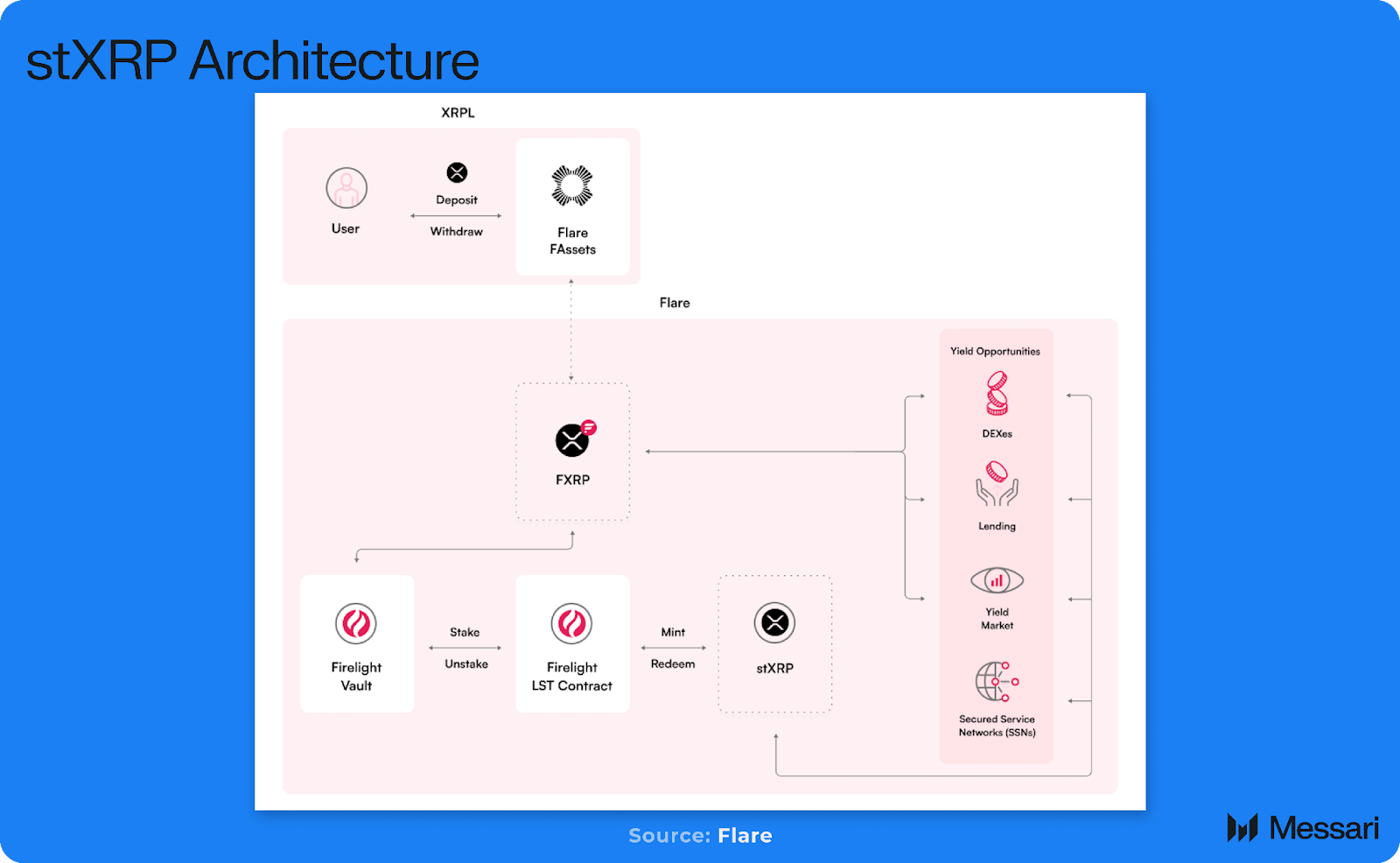
Through Firelight’s Economically Secured Services (ESS), a marketplace where onchain protocols can lease economic security, users who wish to participate deposit FXRP into Firelight’s vaults and receive a liquid staking token (stXRP). They can continue using this token across DeFi while their underlying assets back those ESS primitives.
The fees paid by ESS operators for access to this security service are distributed by the protocol to vault participants according to predefined onchain rules, reflecting real protocol activity and network usage, not just inflationary rewards.
The FLR Flywheel
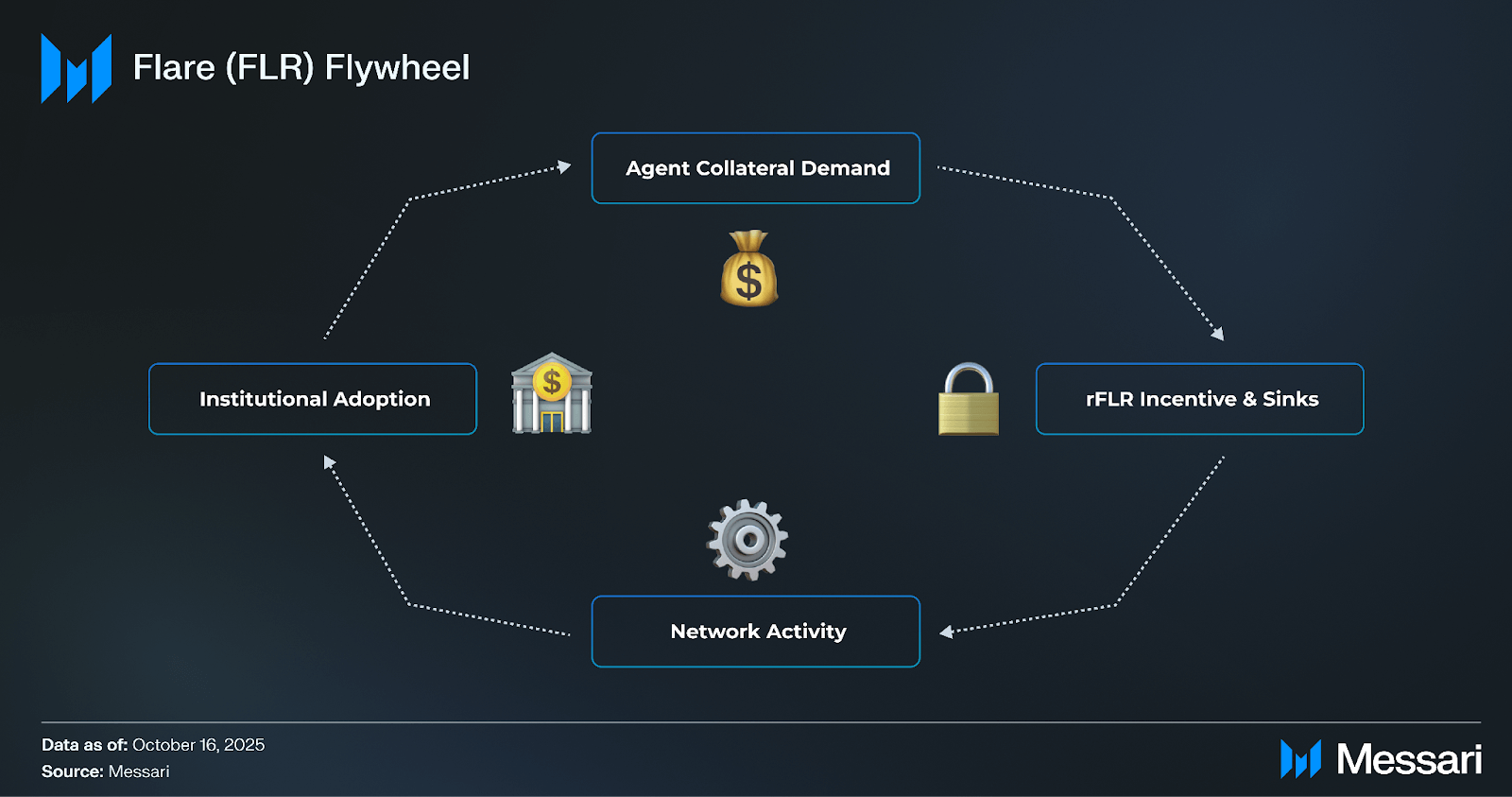
Flare’s design creates a self-reinforcing value loop, a “flywheel,” in which each layer of network activity strengthens FLR’s utility and demand. The cycle starts with FXRP growth: as more XRP holders mint FXRP, agents must lock proportionally higher collateral in FLR to maintain system health. This converts FXRP adoption directly into structural FLR demand.
Next, emissions from the 2.2 billion FLR Incentive Program, distributed as rFLR, act as a controlled sink. Participants who stake, lock, or provide liquidity with rFLR remove it from circulation while supporting deeper liquidity across the network. In effect, rFLR incentives turn short-term rewards into long-term network stickiness.
At the same time, the introduction of USD₮0 adds a stable, yield-bearing base asset to the system. Stablecoin liquidity deepens FXRP and stXRP markets, enables efficient lending and trading pairs, and provides a predictable medium for cross-chain collateralization. As users deposit USD₮0, that capital feeds back into protocol rewards, validator revenue, and liquidity incentives, further accelerating the flywheel. This activity loop keeps the network economically alive.
Finally, institutional participation from actors like Uphold and VivoPower can amplify these dynamics. As larger players deploy XRP and leverage FXRP, USD₮0, and stXRP in yield strategies, liquidity equilibria across DEXs and lending markets shift, creating higher sustained TVL and reinforcing the cycle’s momentum.
Even modest adoption can have outsized effects: if only a few basis points of total XRP supply flow into FXRP, it could underpin significant liquidity depth and collateral value. The limiting factor is no longer the availability of XRP but the emergence of efficient collateral pathways, the infrastructure that keeps capital circulating within the XRPFi economy.
Firelight
Firelight introduces a form of staking (‘delegated participation’) for XRP on Flare. Users deposit FXRP into Firelight’s Launch Vault, which provides them with a proportional entitlement to automated distributions of fees generated by ESS. The economic security provided by Firelight unlocks the potential to enable new services to be built within the XRPfi ecosystem and beyond. In the feature-complete phase, ESSes pay fees to Firelight Protocol, which are programmatically distributed between operators and depositors who delegate their tokens to them. Depositors receive a liquid staking token, stXRP, an ERC‑20 token that stays liquid for use in DeFi. For a full overview of how Firelight works, reference Flare: Expanding XRP’s Role in DeFi.

Like stETH did for ETH, stXRP turns a staked position into composable collateral: you can LP (e.g., stXRP/USD₮0), borrow against it, or enter structured yields (e.g., PT/YT vaults), all while preserving the staked position. The practical effect: a second reward stream joins liquidity rewards, allowing compounding loops (FXRP → stXRP → LP/Loan → rewards) that deepens liquidity without forcing users to exit otherwise locked positions to reallocate capital.
How Firelight Advances XRPFi
Collateral Quality: stXRP should become “durable collateral” for lending and CDPs once peg behavior is proven.
Routing Paths: Pairs like FXRP/stXRP (basis trades) and stXRP/USD₮0 (income + stability) diversify routing away from single‑pair dependency, improving resiliency.
Institutional Fit: stXRP introduces a clean separation between staking and market liquidity, a structure familiar to institutions that already model LST/LSD frameworks (e.g., Lido).
Risks to Watch
Peg Behavior: Early stXRP secondary‑market discounts/premiums around events (redemption queues, APR shifts in the Flare DeFi ecosystem).
Oracle & Bridge Layers: Vigilance on FTSO accuracy and FDC proofs remains mandatory; both underpin mint/redeem finality.
Agent Concentration: If the agent set is narrow, correlated behavior can pressure redemption service level agreements (SLAs), currently mitigated by Core Vault controls. 
Closing Summary
FXRP is now live and behaving as designed under cap‑gated rollout: mint demand is real, redemption plumbing is in place, and USD₮0 has provided the stablecoin backbone for price discovery. The 2.2 billion FLR incentive envelope and targeted launch pools give FXRP the chance to transition from a launch event to an enduring base asset within Flare DeFi. The next unlock will be Firelight (stXRP), an economic security layer that can elevate FXRP from “bridged asset” to institution‑ready collateral. As stXRP integrates across lending, CDP, and yield markets, expect liquidity paths to multiply and APRs to normalize around fundamentals rather than emissions. What determines future adoption from here: (i) cap cadence and redemption SLAs, (ii) USD₮0 depth and routing quality across DEXs, (iii) breadth of the agent set and collateral buffers, and (iv) institutional onboarding (custody + policy + data assurance). If institutional integrations and staking layers mature as expected, FXRP could anchor a sustainable, yield-driven liquidity base for XRP across the Flare ecosystem.
This report was commissioned by Flare Network. All content was produced independently by the author(s) and does not necessarily reflect the opinions of Messari, Inc. or the organization that requested the report. The commissioning organization may have input on the content of the report, but Messari maintains editorial control over the final report to retain data accuracy and objectivity. Author(s) may hold cryptocurrencies named in this report. This report is meant for informational purposes only. It is not meant to serve as investment advice. You should conduct your own research and consult an independent financial, tax, or legal advisor before making any investment decisions. Past performance of any asset is not indicative of future results. Please see our Terms of Service for more information.
No part of this report may be (a) copied, photocopied, duplicated in any form by any means or (b) redistributed without the prior written consent of Messari®.
Jeremy is a research analyst at Messari with interests in Infra, DeFi, and Enterprise adoption. Prior to joining Messari, Jeremy worked as an analyst at Fidelity Digital Assets.
Jeremy is a research analyst at Messari with interests in Infra, DeFi, and Enterprise adoption. Prior to joining Messari, Jeremy worked as an analyst at Fidelity Digital Assets.