Flare’s baked-in data stack (FTSO + FDC) makes it a “blockchain for data,” enabling verifiable cross-chain activity and oracle feeds without relying on external middleware. This native infrastructure underpins FXRP security and differentiates Flare from other Layer-1s.
XRPFi brings one of crypto’s most liquid assets into the DeFi ecosystem. Through FXRP, holders can mint a 1-to-1 representation of XRP on Flare in a fully non-custodial manner, giving the token EVM-level composability.
Liquidity arrived in force once USD₮0 launched via LayerZero. Within 13 days of release, Flare’s TVL more than tripled ($120+ million), providing the stablecoin depth that FXRP-based lending, AMMs, and yield farms need to thrive.
Flare’s model scales beyond XRP. FBTC, FDOGE, and other FAssets are on the roadmap, meaning the same trust-minimized bridge architecture can mobilize liquidity from Bitcoin, Dogecoin, and additional untapped ecosystems.
Songbird plays a vital role as a production-grade canary network. Flare uses Songbird to test upgrades like FAssets v1.1 and agent mechanics in real economic conditions, providing a blend of innovation velocity and safety that helps derisk mainnet deployments.
Primer
Flare (FLR) is a full-stack Layer-1 designed for data-intensive use cases. It provides a bridge between non-smart-contract blockchain assets and the world of DeFi. At its core, Flare has three main features: (i) Flare Time Series Oracle (FTSO), which is an enshrined oracle that provides decentralized data feeds on Flare; (ii) Flare Data Connector (FDC), which is designed to validate external data for Flare's EVM state; and (iii) FAssets, which enables the creation of fully collateralized representations of non-smart contract assets on Flare.
The most prominent FAsset example is FXRP, a version of XRP that can be used within Flare's EVM-compatible environment. FXRP contributes to the XRPFi narrative: the emergence of a DeFi ecosystem built around XRP, one of the largest cryptocurrencies by market capitalization.
As XRP's market presence continues to grow, Flare's technology offers a pathway to unlock this dormant value and integrate it into the broader DeFi landscape. This potential has attracted attention from both retail users and institutional players, setting the stage for what could be one of the most significant developments in the XRP ecosystem since its inception.
Co-founded by Hugo Philion, who has a background in finance and machine learning from University College London and serves as the CEO of Flare Labs, and Dr. Nairi Usher, who rounds out the founding team with a PhD in Quantum Computing and blockchain knowledge and also serves as the Chief Scientist Officer (CSO), Flare has raised ~$46.3 million across three funding rounds from 17 investors, including notable names like Kenetic Capital, DWF Labs, MetaStone Group, Wintermute Ventures, Backend Capital, and Borderless Capital.
Unlike traditional wrapped tokens that rely on centralized custodians, FAssets operate through a decentralized system that maintains security and trustlessness.
The FAssets system works through a multi-step process:
When users want to mint FXRP (the FAssets version of XRP), they send their XRP to a registered agent's address on the XRP Ledger (XRPL). The agent, who operates on both XRPL and Flare Network, receives this XRP and locks collateral on Flare Network to back the mint. In FAssets v1.1, the system is secured by multiple layers of collateral: (i) 1x the underlying asset (e.g., XRP), (ii) FLR pool collateral provided by agents, typically maintained above 1.5x the value of FXRP minted, (iii) Stablecoin collateral, currently around 1.2x to further strengthen security and protect against price volatility. Together, these components bring total system collateralization to over 2x, ensuring strong protection for users. Once the collateral is locked on the XRPL and the receipt of XRP is verified via the Flare Data Connector (FDC), the system mints the corresponding amount of FXRP and delivers it to the user on Flare. The FDC allows for the monitoring and verification of actions on external blockchains like XRPL, creating a trustless bridge between networks.
FAssets agents play a crucial role in this ecosystem, providing the collateral to back the minting of underlying assets (XRP). The agents are all known participants who have been KYC’d.
They can accept a combination of stablecoins (e.g., USD₮0) and network tokens (e.g., SGB on Songbird or FLR on Flare) as collateral. To ensure the system's stability, agents must maintain a healthy collateral ratio, which is dynamically adjusted based on market conditions. The decentralized price feeds for the collateral are provided through the Flare Time Series Oracle (FTSO).
The recent v1.1 upgrade to the FAssets protocol introduced the Core Vault, an innovation designed to enhance system liquidity and scalability. The Core Vault acts as a liquidity hub, allowing agents to deposit XRP and, in return, unlock collateral on the Flare blockchain. This collateral can then be used to mint FXRP or be allocated elsewhere.
Security is paramount in the FAssets protocol. The Core Vault is protected by a multi-layered security model combining escrow accounts and multi-signature authorization. XRP funds in the Core Vault are stored in escrow accounts, with portions released daily to minimize security risks. If a security threat is detected, the Flare Foundation can activate Alert Mode, freezing operations to prevent unauthorized access. Additionally, active bug bounties and completed audits further strengthen the system's security posture.
For non-smart-contract chains like the XRPL, FAssets represent a transformative opportunity. While the XRPL has native functions like escrows, checks, and payment channels, it cannot implement complex smart contracts. FAssets bridge this gap by allowing XRP tokenholders to participate in a full range of DeFi activities (aka XRPFi), such as lending, borrowing, yield farming, and liquidity provisioning, without sacrificing custody of their underlying assets. This is particularly significant for XRP, which has historically been limited in its DeFi applications despite its substantial market capitalization and global adoption.
State of FAssets
FAssets’ development and deployment journey has continued to progress. Currently, FXRP is live on Songbird, Flare's canary network designed for testing new features and protocols before they are deployed to Flare Network. The launch on Songbird marks a major milestone, as it represents the first real-world implementation of the FAssets protocol with actual value at stake.
The response to the Songbird deployment has been strong, with the system quickly reaching its maximum allocation of $2 million for testing in just four days. The demand indicates interest in bringing XRPFi to reality, with potential pent-up demand awaiting FXRP’s mainnet launch on Flare. Plans for said launch are well underway, with Flare’s project team working to ensure a smooth transition. The successful testing on Songbird has provided insights and data that will inform the mainnet deployment, helping to identify and address any potential issues before they impact the production environment.
The ecosystem around FAssets is also showing signs of traction. Uphold, a U.S. digital money platform that holds upwards of 1.8 billion XRP, has expressed interest in participating in the FAssets ecosystem. Additionally, NASDAQ-listed VivoPower is deploying $100M in XRP onFlare. This institutional interest can be viewed as validation of the FAssets approach, where the major players within the XRP ecosystem see FAssets as making XRPFi a reality.
The Liquidity Event
Liquidity is the lifeblood of any financial ecosystem, and Flare has made strides in building liquidity for its network. The integration of USD₮0 (an omnichain version of Tether’s USD₮ implemented via LayerZero’s Omnichain Fungible Token standard) has been a key development, providing a stable unit of account and facilitating trading pairs with other assets on the network. Within approximately 13 days of its rollout, Flares TVL increased by over 220%, from ~$37.1 million to ~$120.9 million. The TVL has continued to rise and, as of June 6, 2025, sits at ~$148.8 million.
USD₮0’s market share on Flare stands at ~63.2%, representing the primary source of stablecoin liquidity on the network. In addition, Flare also supports other stablecoins like USDC (~19.1% market share) and USDX (~17.7% market share), creating a diverse stablecoin ecosystem that caters to different user preferences and use cases. This stablecoin diversity helps to mitigate risk and ensure that the ecosystem is not overly dependent on any single stablecoin issuer.
Flare has launched a USD₮0 Boost yield program, offering up to 30% APY (paid in Flare’s reward token: rFLR) to liquidity providers and early adopters of USD₮0. Combined with the network’s gas fee rebates (Flare currently covers gas fees for transactions on Flare involving USD₮0) and the listing of USD₮0 on Kraken, the user experience for stablecoin usage on Flare is frictionless.
XRP’s DeFi Moment
For years, XRP has had one of the largest retail communities and market capitalization, yet it has remained largely isolated from the DeFi space due to the technical limitations of the XRPL. The emergence of XRPFi, a DeFi ecosystem built around XRP, is being powered by Flare's technology by creating a bridge that brings XRP into the world of programmable finance.
XRPFi, enabled by Flare's FAssets, opens up a world of possibilities for XRP holders. They can now use their XRP for lending, borrowing, yield farming, liquidity provisioning, and other DeFi activities without sacrificing custody of their underlying assets.
For institutions, XRPFi offers a way to generate yield on their XRP holdings, which have traditionally been held as static assets. This could be particularly attractive to financial institutions that have already adopted XRP for cross-border payments and remittances, as it provides an additional revenue stream from assets they already hold. This is already being seen by companies like VivoPower, Uphold, and Webus.
For retail users, XRPFi democratizes access to financial services that were previously unavailable to XRP holders. It allows individual investors to participate in the same yield-generating activities as larger players, and earn returns on their XRP holdings rather than simply speculating on price appreciation.
Flare has been building the infrastructure for XRPFi over several years, focusing on security, scalability, and user experience. This patient, long-term approach has resulted in a robust system that has undergone extensive testing and auditing before being made available to users. By prioritizing security and reliability over speed to market, Flare has built a foundation that can support sustainable growth in the XRPFi ecosystem.
The potential impact of unlocking XRP's dormant value for DeFi cannot be overstated. With a market capitalization exceeding $125 billion, XRP represents a massive pool of liquidity that has been largely untapped by the DeFi sector. By bringing even a fraction of this liquidity into DeFi applications, Flare could significantly expand the overall DeFi market and drive broader blockchain adoption.
Liquid Staking Coming Soon
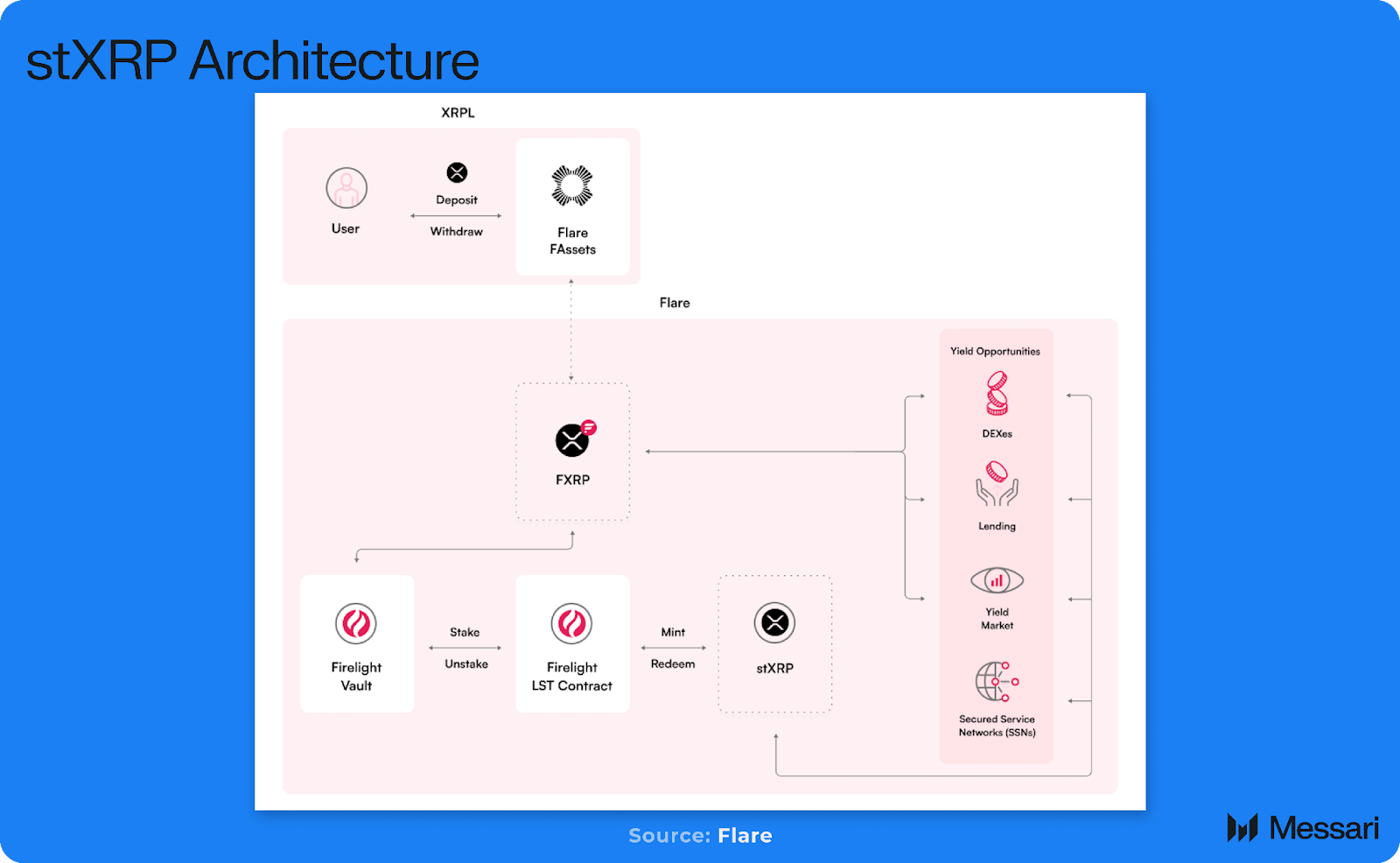
Liquid staking is coming to the XRP ecosystem through the launch of stXRP on the Firelight protocol built on Flare. Similar to how protocols like Lido offer stETH for staked ETH, Firelight will enable users to stake FXRP and receive stXRP, a liquid staking token that can be used across Flare’s DeFi ecosystem.
Users will be able to deposit FXRP into Firelight’s Launch Vault, which mints stXRP at a 1:1 exchange rate. These are ERC-20 tokens that are fully transferable, enabling participation in DEXes, lending protocols, and other yield-generating applications. Meanwhile, the FXRP would remain staked to Secured Service Networks (SSNs) to secure protocols across multiple ecosystems and earn potential rewards.
This system would allow users to benefit from staking yield without losing liquidity, unlocking new utility for XRP in DeFi. stXRP holders may also earn Firelight Points, which influence future reward allocations. Over time, these dynamics could introduce new layers of composability, with stXRP used as collateral, liquidity, or yield-bearing instruments throughout the XRPFi ecosystem.
Closing Summary
Flare stands at the forefront of a potentially transformative moment for the XRP ecosystem. By bridging the gap between XRP's substantial liquidity and the programmable world of DeFi, Flare is unlocking new utility and value for one of the largest cryptocurrencies by market capitalization.
The FAssets protocol, with its decentralized approach to bringing non-smart-contract assets into DeFi, represents an innovation in blockchain interoperability. The successful deployment on Songbird and the upcoming launch on Flare mainnet mark important milestones in this journey. With strong liquidity foundations already in place and growing institutional interest from players like Uphold and VivoPower, the stage is set for FAssets to make a substantial impact on the broader DeFi landscape.
As the XRPFi narrative continues to gain traction and new primitives like liquid staking come online, Flare is positioned to become a central hub for XRP-based DeFi activity.
This report was commissioned by Flare Network. All content was produced independently by the author(s) and does not necessarily reflect the opinions of Messari, Inc. or the organization that requested the report. The commissioning organization may have input on the content of the report, but Messari maintains editorial control over the final report to retain data accuracy and objectivity. Author(s) may hold cryptocurrencies named in this report. This report is meant for informational purposes only. It is not meant to serve as investment advice. You should conduct your own research and consult an independent financial, tax, or legal advisor before making any investment decisions. Past performance of any asset is not indicative of future results. Please see our Terms of Service for more information.
No part of this report may be (a) copied, photocopied, duplicated in any form by any means or (b) redistributed without the prior written consent of Messari®.
Jeremy is a research analyst at Messari with interests in Infra, DeFi, and Enterprise adoption. Prior to joining Messari, Jeremy worked as an analyst at Fidelity Digital Assets.
Jeremy is a research analyst at Messari with interests in Infra, DeFi, and Enterprise adoption. Prior to joining Messari, Jeremy worked as an analyst at Fidelity Digital Assets.