Filecoin: Solstice and the Shift to a Demand-Driven Service Economy

Key Insights
- Solstice shifts Filecoin's incentives from building storage capacity to driving paid customer demand. A growing share of each block reward now goes to services that bring in paying customers, rising in 5pp steps as settled payments on Filecoin Pay clear fixed targets. The miners' share ramps from 95% to 50% over about nine quarters, any service share not yet earned is burned, and total issuance stays on its existing schedule.
- Settled volume already clears the early rungs network-wide, but the ladder is steep. Periodic settlements put Filecoin Pay at a pace of ~$34K a quarter over the 30 days to October 17, above the $25.5K third rung, though only volume from registered pairs counts. Each rung is 2.7x the last, up to $3.66M for the terminal 50% share. Filecoin is pursuing that volume through four paths, Fil One for enterprises, agent tooling, IPFS migration, and Integral Spacetime.
- Fil+, the human review program that decided which storage earned a 10x reward multiplier, ends at activation. Every new sector now counts tenfold with no review step, and upgrading the ~208 PiB of legacy committed-capacity power adds about 12.7% to quality-adjusted power and locks on the order of 3M FIL in new pledges.
- Protocol Labs and Filecoin Foundation vesting concluded on October 15. Block rewards are now the only new issuance at about 21M FIL a year, a little over 2% of circulating supply.
- Solstice lays the groundwork for permissionless competition among service providers. Providers compete for network rewards on measurable payment activity rather than subjective review of data. The registry launches permissioned, with one Orchestrator and four multisigs, and is designed to open over time. The first measured gate check, around April 29, 2027, is the first test of both the demand and the attribution rules.
Introduction
In February 2026, the Filecoin team set three network-level objectives for the year:
- Increasing paid, onchain network usage.
- Improving network profitability and economics.
- Scaling adoption among flagship clients.
Those objectives depend on a flywheel linking service funding, payment volume, and issuance. Two events in the second half of the year reshaped it. In July, Filecoin introduced Solstice, a proposal to redirect part of each block reward toward storage providers and services that bring paying customers to the network. On October 15, Protocol Labs and Filecoin Foundation vesting allocations concluded, removing a primary source of token dilution and leaving block rewards and fee burns as the only forces on supply. Solstice itself was activated four days later, on October 19. This report explains what each change does and how they interact.
The Demand-Side Stack Now Live
Filecoin built its storage capacity first and is now building the paid demand to fill it. The pieces for that arrived this year. Filecoin Onchain Cloud (FOC), a set of smart contracts for buying and paying for storage onchain, reached mainnet in Q1 2026. Fil One, a storage product built on top of it, followed in Q2, and Solstice activated on October 19. Together they mean paid demand on Filecoin can be measured from chain data rather than reported by the companies selling storage, and that measurement is what Solstice reads.
Filecoin has various layers:
- Filecoin Pay handles money. A customer deposits dollars, approves a storage provider, and the contract streams payment to that provider block by block, recording every settlement onchain.
- Warm Storage handles the storage itself at $2.50 per TiB per month, with retrieval through its CDN add-on billed at $0.014 per GiB of egress.
- PDP (Proof of Data Possession) handles trust. Providers regularly prove they still hold the customer's bytes, a lighter check than PoRep, the heavy sealing proof that secures every Filecoin sector.
Developers reach all three through one software kit, the Synapse SDK. The settlement records Filecoin Pay produces are the raw material we discuss below.
Several products now sit on these rails. Fil One sells S3-compatible object storage, the interface most cloud buyers already use, in US and EU regions at $5.99 per TB per month with no egress fees, billed in US dollars. According to Filecoin, it sells through a dedicated sales team and channel partners into AI infrastructure, automotive, banking, and sovereign government workloads, and a storage-for-neocloud offering places it next to GPU compute in neocloud data centers. Integral Spacetime, a storage neocloud that launched on October 14, takes a different route. It plans to buy software businesses with large storage workloads and move that data onto Filecoin, so customers arrive with each acquisition. An IPFS migration path moves existing IPFS data onto Filecoin at $2.50 per TiB per month per copy, paid in USDFC, Filecoin's dollar stablecoin, from the customer's own wallet, and is built to be run by an AI agent rather than by hand. Filecoin says NFT platforms and institutions with legal and compliance obligations are among the first teams moving pinned IPFS data over.
Two more pieces exist but do not yet move money on mainnet. The RWA reference architecture shows how the documents behind a tokenized asset can live on Filecoin while the asset itself lives on Avalanche. Each document gets a fingerprint derived from its bytes, that fingerprint is anchored next to the onchain asset, and Filecoin stores the file under PDP proofs, so a tampered deed or appraisal fails verification in the browser. It runs on test networks only, with a synthetic property record. Agent tooling is closer to production. A command line tool, an MCP server, and two installable skills let AI coding agents fund a wallet with USDFC, create a data set, and upload through the Synapse SDK without a human in the loop. A dozen community apps have been built on top, most at hackathon scale, several aimed at the agent memory and backup use cases the 2026 strategy named as a priority. These products widen the funnel, but what they contribute to measured payment volume today is small. The two named enterprise deployments, Aurora's multi-petabyte AI data center workloads in Europe and the 375ai and Akave edge network across 40K US sites, have no published onchain footprint yet, and Akave settles on its own Avalanche-based chain.
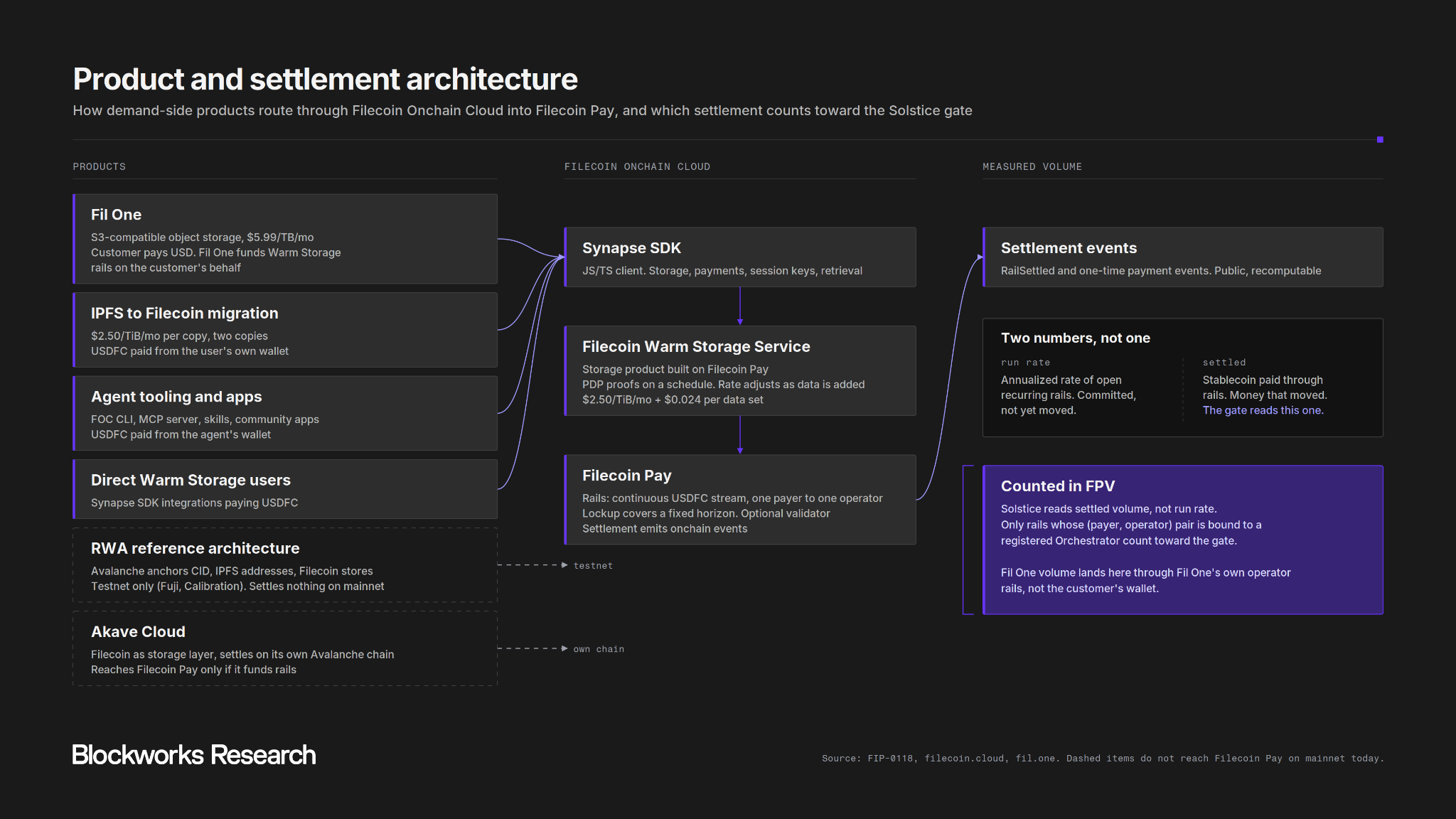
As of October 17, 2026, Filecoin Pay rails carried an annualized run rate of about $138K across 149 active payers, up from $663 and 73 payers in January, according to the Filecoin Data Portal. Of the products above, four feed that measured volume today. Direct Warm Storage users, the IPFS migration path, and agent apps all pay from their own wallets. Fil One bills its customers in US dollars and funds Warm Storage rails on their behalf, so its usage lands onchain through Fil One's own rails rather than the customer's. Those rails produce the number Solstice reads. Below we explain how the upgrade changes who gets paid from each block reward.
Three Streams, One Schedule
Every Filecoin block mints new FIL as a reward. Until now that reward went to storage providers in proportion to their storage power, with Fil+ deciding, after a human review, which storage counted tenfold. Solstice keeps the reward the same size (4.09 FIL per block today, on the existing minting schedule) and changes who receives it.
Each block reward is now split three ways by the reward actor, the protocol's built-in contract known as f02. The consensus stream pays the miner who won the block, as before. The service stream pays Orchestrators, registered organizations whose job is to bring paying customers to the network, in proportion to the customer volume each one brought in. The burn stream destroys whatever the first two do not claim. Miners still keep gas fees in full, and burned FIL is minted and destroyed in the same block, so it never touches circulating supply. The split is set by weights. The consensus weight starts at 95% and declines about 5pp a quarter to a floor of 50% over roughly nine quarters. The service weight starts at 5% and can rise 5pp a quarter, but only when settled payment volume clears a dollar target, described in the next section. Whatever sits between the shrinking consensus weight and the current service weight is burned. During the first quarter after activation, October 19 to January 18, the service weight rises to 10% automatically and nothing burns. After that it moves only when a gate clears. Two small governed contracts hold the dials. The Stream Weights Actor (SWA) sets the weights across streams, and the Service Rewards Actor (SRA) sets each Orchestrator's share within the service stream. Neither holds any money. Both write numbers into f02, and every change the SWA makes waits seven days before it takes effect.
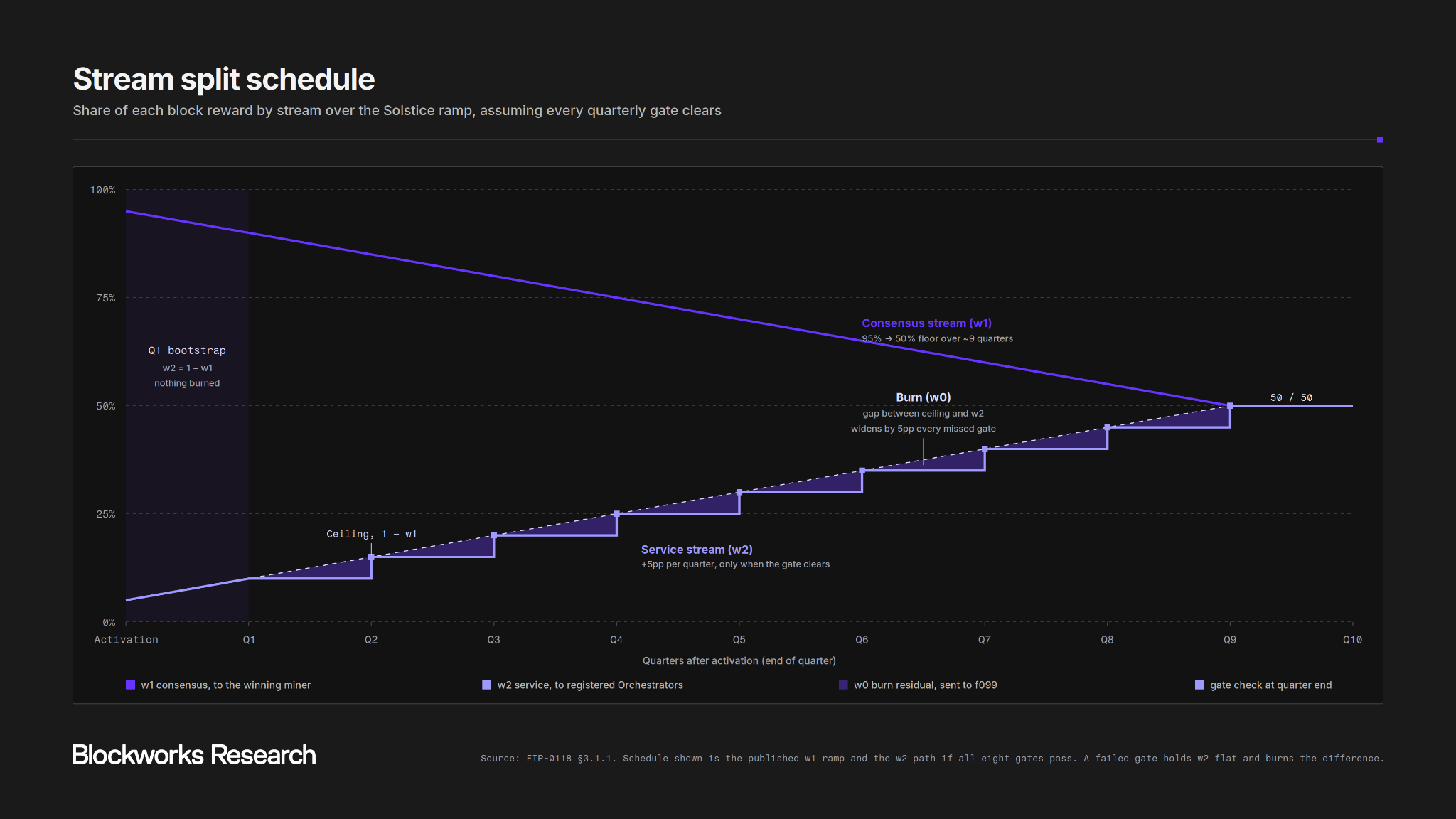
The cycle runs once a quarter. After the quarter's volume figure is final, the SWA checks it against the target and, if it clears, raises the service weight by 5pp. The SRA writes each Orchestrator's share, and Orchestrators claim their accrued FIL from f02 whenever they like. Because of the posting, verification, and timelock windows, a passed gate takes effect about 17 days into the following quarter. That lag means some burn happens even when every gate clears. The FIP expects the burn weight to swing between roughly 0.9% and 5.9% of each block reward on the all-pass path, and a missed gate adds 5pp on top.
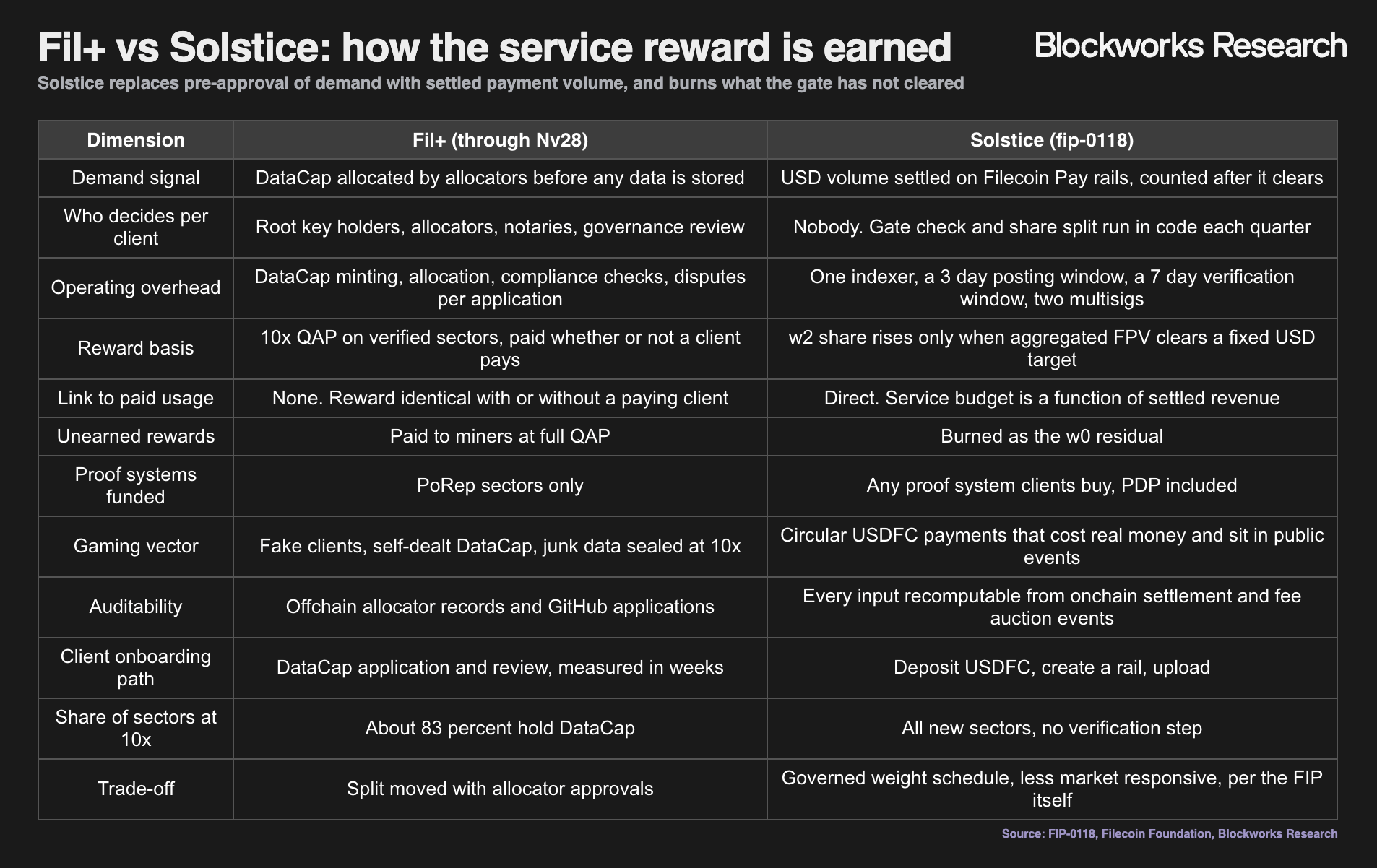
The effect is that network funding tracks commercial outcomes in a way anyone can verify. Under Fil+, governance judged whether data was useful before it was stored. Under Solstice, the service budget is a function of dollars that have already been settled, and governance's job is to confirm the number is real.
How the Flywheel Is Measured
Solstice activated on mainnet at 13:00 UTC on October 19, 2026, so the measurement system has not yet produced a result. The bootstrap quarter runs to January 18, 2027. Q2 is the first measured quarter, and its gate check becomes callable around April 29 once posting and verification close.
The number the gate reads is called Aggregated Filecoin Pay Volume (AggregatedFPV). Each Orchestrator registers the customer-and-provider pairs it brought to the network. At quarter end, software reads every Filecoin Pay settlement for those pairs and adds them up in dollars, counting stablecoin payments at face value and converting FIL payments under a rule described below. Each Orchestrator posts its total within three days. For the next seven days anyone can recompute the figure from public chain data and SRA Governance can correct a wrong one. Whatever stands when that window closes is final. An Orchestrator that posts nothing counts as zero, which lowers the total but cannot block the quarter. Volume from customers no Orchestrator has registered does not count.
Valuing FIL payments in dollars without trusting an outside price feed is the hardest part, and the FIP solves it with Filecoin Pay's own fee auctions. The contract collects stablecoin fees, and anyone can buy them by paying FIL, which is burned. Each purchase is a public price print. A FIL payment is valued at the first qualifying print after it, so nobody knows the rate when they transact. Pushing a print too high hands a free trade to anyone who notices, and pushing it down costs real FIL and shrinks the manipulator's own count. If prints stop, FIL volume waits and the gate undercounts. The guardrails are a 30% price band and a minimum lot size that scales with the prior quarter's volume.
The targets are fixed in code and rise 2.7x per step, from $3.5K of settled volume per quarter at the first gate to $3.66M at the eighth, which unlocks the terminal 50% service share. At Fil One's list price that is roughly 200 TB held for a quarter at the bottom of the ladder and roughly 200 PB at the top, about an eighth of Filecoin's current raw capacity of ~1.3 EiB. The chart below lays out each rung.
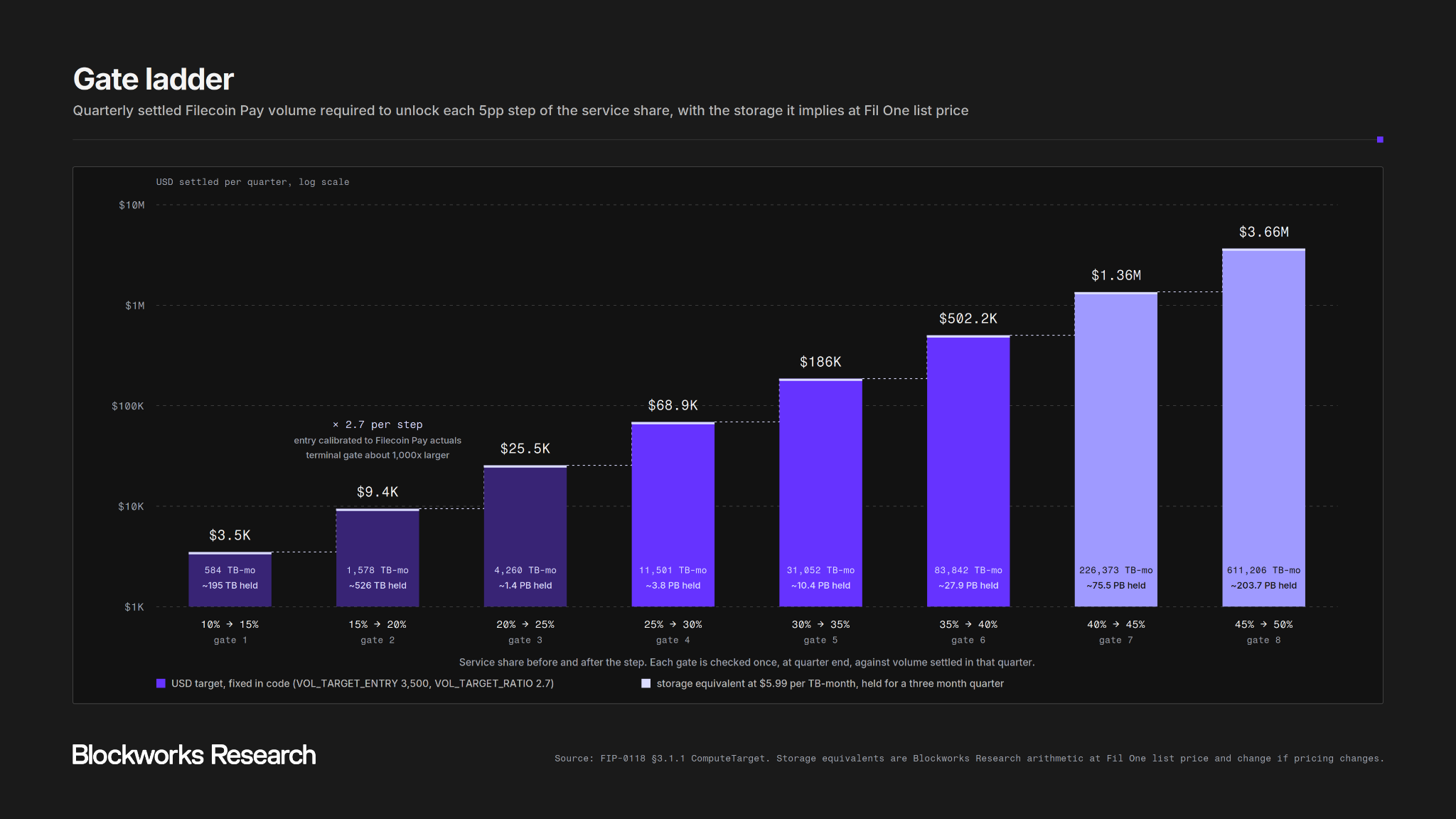
The $138K run rate cited earlier is not what the gate reads. The gate reads money that has settled, and settlement arrives in lumps. On a typical day it is ~$20, but periodic payouts of $1-4K brought the 30 days to October 17 to ~$11.2K, a pace of ~$34K a quarter. That clears the third rung network-wide, but only volume from pairs an Orchestrator has registered counts, and the bootstrap quarter is not measured.
Product eligibility depends on where payments settle. The IPFS migration path and direct Warm Storage users settle from their own wallets and count as soon as an Orchestrator registers them. Fil One counts through its own rails. The RWA architecture is on testnet and Akave settles on its own chain, so neither contributes today. For the staircase to hold, settled volume has to compound at ~2.7x per quarter for two years. The thesis fails if settlement sits below the next rung for several consecutive quarters while the consensus weight keeps falling, if verification disputes go unresolved, or if circular payments inflate the number and governance does not catch them. Demand is one side of the equation. Solstice also changes the supply side that storage providers face.
Fil+ Removal and Locked FIL
Removing Fil+ collapses a two-tier power system. Today a sector carrying DataCap, the Fil+ credit granted after notary review, earns 10x the quality-adjusted power (QAP, a sector's weight in block reward allocation) of a committed-capacity sector of the same size, and about 83% of sectors sit in the top tier. At the activation epoch, every new sector onboards at 10x with no verification step. DataCap minting, allocation, and claims all stop. Existing balances go inert, pending allocations cannot be claimed, and the verified registry becomes a historical record the miner actor no longer reads. A later upgrade can delete the f06, f07, and f080 actors once nothing calls them.
Legacy sectors get three paths:
- SnapDeals into a committed-capacity sector grant 10x without DataCap.
- A new batch method, UpgradeSectorQuality, lifts any active sector below 10x, partially verified ones included, and can extend it in the same call.
- ExtendSectorExpiration2 carries the sector's recorded multiplier forward unchanged, so a 1x sector stays at 1x, and a verified sector stays at 10x with no pledge change.
Nothing forces an operator to upgrade, and nothing retroactively changes power.
Pledge is the FIL a provider locks as collateral when it adds storage, and it follows QAP. The pledge formula is untouched, but a byte that used to onboard at 1x now onboards at 10x, so pledge per raw byte for that cohort rises in proportion. Today a committed-capacity sector pledges ~0.049 FIL per 32 GiB, or ~1.57 FIL per TiB. The same sector at 10x pledges ~16 FIL per TiB, and lifting a legacy sector means topping up the difference. Reward per sector rises by the same multiple, with a TiB of QAP earning ~0.005 FIL a day at either tier, so return on pledge is roughly preserved while total locked FIL rises with every upgrade. Network pledge collateral stands at 62.3M FIL, ~6.8% of the 921.2M in circulation.
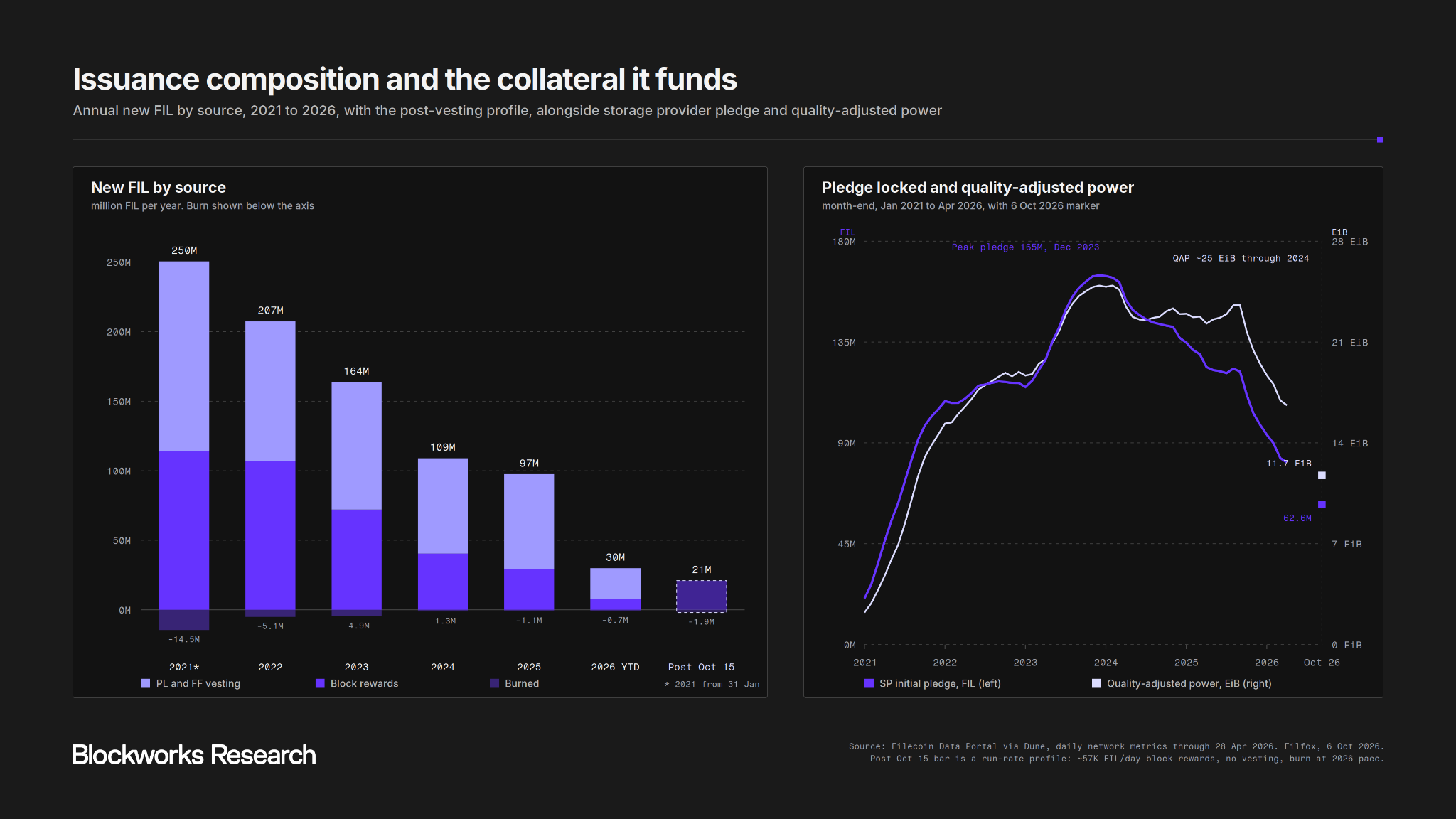
The FIP sizes the upgrade pool at ~208 PiB of raw CC power as of July. A full conversion adds ~1.9K PiB of QAP, taking the network from ~14.8K to ~16.6K PiB, a one-time rise of 12.7%, and would lock on the order of 3M FIL in added pledge at today's rate, an upper bound since per-unit consensus pledge falls as network QAP rises. Set against net QAP losses of 20-37 PiB per day at the time, the power bump buys two to three months of decline. QAP has since fallen to ~11.7 EiB, so the percentage gain is larger on today's base.
The provider cohorts face different economic outcomes. Operators who mine for consensus and serve no clients lose the non-consensus share of the block reward, 5% at launch and up to 50% at the floor, with nothing to offset it, which the FIP states is intended. PoRep operators who do serve clients take the same cut and can earn it back through deal payments, which the service stream is meant to grow. PDP and warm storage operators, who never qualified for Fil+ linked rewards because PDP sectors carry no QAP, gain a funding channel that does not care which proof system they use.
Supply Dynamics
Previously, Protocol Labs and Filecoin Foundation vesting added ~66.7M FIL a year against ~21.7M from block rewards, ~88M a year of new supply entering 2026. With vesting over, block rewards are the only new issuance, ~21M FIL a year or ~58K a day, a little over 2% of circulating supply, cutting gross issuance by about 75%.
Solstice does not change how much FIL is minted. It changes who receives it and how much is burned. Nothing burns in the bootstrap quarter. From Q2 onward the burn stream removes between ~0.9% and ~5.9% of each block reward if every gate clears, about 0.2M to 1.3M FIL a year, and 5pp more for every gate that fails. By the end of 2027 the consensus weight will have ramped down to about 75%, so the burn can sit anywhere from about 1% to 15% of block rewards depending on how many gates have passed. By late 2028, with the consensus weight at its 50% floor, a service economy that never clears a gate would burn 45% of every block reward, about 9.5M FIL a year. Gas fees burn a further ~1.9M a year at the 2026 pace. The service share itself, up to half of block rewards, is redirected to Orchestrators rather than removed.
Put together, net new supply by the end of 2027 lands between ~16M and ~20M FIL a year, or 1.7-2.2% of circulating supply, an ≥80% reduction from the start of 2026. FilecoinTLDR's simulator, which also counts pledge locking, puts daily net supply growth down 86% to 119% from August 2026 levels by the end of 2027 depending on burns and pledge, with the top of that range net deflationary. The FIP's security section adds one caveat. Total minting depends on raw power staying near the baseline, and raw power is sustained by the consensus stream, so a future cut to the consensus weight beyond the 50% floor would slow issuance for every stream.
On top of the flow effect there is a one-time stock effect. Upgrading the legacy committed-capacity pool to 10x would lock on the order of 3M FIL in added pledge, and every new sector onboards at the higher pledge from day one. Locked pledge and the QAP trend are the supply-side read on the demand thesis. If paying workloads arrive, sectors get upgraded and pledge climbs. If they do not, QAP keeps bleeding and the burn wedge does the work instead. All of that is set by code. Who can change the code is the last question.
Governance
Solstice starts governed and is designed to end permissionless. Two groups hold the levers today, one for each contract.
SWA Governance controls the split among streams. Any discretionary change (a new stream, a changed weight schedule, a retuned gate ladder, or a code upgrade) requires a published and accepted FIP, approval from both of two multisigs held by independent organizations, and a seven-day hold enforced by f02 itself. Either multisig can cancel during the hold.
SRA Governance controls the Orchestrator registry and requires no FIP for its day-to-day work. It admits and removes Orchestrators, reassigns contested payer bindings, corrects posted volumes during the verification window, and maintains the whitelist of stablecoins and Filecoin Pay contract addresses that count toward volume. Those writes bind the moment both multisigs sign, with no hold. Removal is the only sanction, and it burns the removed Orchestrator's share until the next share map rather than clawing anything back.
Everything else runs on its own. The consensus ramp is a fixed function of time. The gate check and the quarterly share update are open functions anyone can trigger, and they can only output what the code computes. If f02 is ever handed weights that add up to more than one, it mints no reward at all and pays miners gas fees only until a timelocked fix lands.
The design borrows from Bittensor. One issuance pool is split across competing destinations by governed weights, with rewards flowing to whoever delivers a measured result. The differences are that Solstice uses a single signal, settled dollars, rather than validator scoring; that weights move only upward on a fixed ladder rather than by continuous vote; and that the unearned share burns rather than redistributes.
Orchestrators compete within the service stream. Shares are proportional to each one's own settled volume, so a hot storage business and an archival business both earn by routing paying clients through registered pairs, and either loses share when the other brings more. At activation, the registry holds one Orchestrator. Phase 1 admits more at SRA Governance's discretion. Phase 2 opens registration to anyone through a standard attribution interface that a future FIP will specify. In the meantime, every Orchestrator files a quarterly report to the governance repository, with a missed filing named as a removal trigger, and the Orchestrator seated at activation must publish a disclosure on day one.
The open question is who can be trusted with the weights in the meantime. The FIP's own risk section names the sharpest case. Both Registry multisigs, acting through CorrectVolume during the verification window, could bind an inflated volume figure and force a step-up. The step is bounded to 5pp and visible for seven days, but it cannot be canceled, and reversing it takes a FIP-backed write lowering w2. Until Phase 2, the system rests on four multisigs, one indexer, and at least one party recomputing the number each quarter.
Closing Summary
Filecoin Onchain Cloud settles payments onchain, and anyone can recompute the volume it carries. Solstice ties the service share of issuance to that number, steps it up only when a fixed USD target clears, and burns the difference when it does not. Fil+ and DataCap end at the activation epoch, with every new sector onboarding at 10x. Protocol Labs and Filecoin Foundation vesting ended, leaving block rewards as the sole source of new FIL. Governance of the split starts with four multisigs and one Orchestrator, with a permissionless registry as the stated destination.
The mechanism is coherent on paper. What it has not yet shown is whether real demand will move it. Settled Filecoin Pay volume from registered pairs has to reach the entry rung on the current product set, and the quarter in which it does will be the first real signal. Who governs the weights in the interim matters as much, since the FIP names no initial Orchestrator and no multisig signers and ties the exit from governance to a future FIP rather than a date or a volume threshold. SRA Governance will also have to decide whether Fil One's first-party funding of rails counts as external demand without rebuilding the review pipeline Solstice removes. All of this resolves onchain over the coming quarters, where anyone can check it.
This report was commissioned by Filecoin. By providing this disclosure, we aim to ensure that the research reported in this document is conducted with objectivity and transparency. All content was produced independently by the author(s) and does not necessarily reflect the opinions of Blockworks. or the organization that requested the report. The commissioning organization may have input on the content of the report, but Blockworks maintains editorial control over the final report to retain data accuracy and objectivity. Author(s) submit financial conflict of interest (FCOI) disclosures on a monthly basis that are reviewed by appropriate internal parties and may hold cryptocurrencies named in this report. This report is meant for informational purposes only. It is not meant to serve as investment advice. You should conduct your own research and consult an independent financial, tax, or legal advisor before making any investment decisions. Past performance of any asset is not indicative of future results. Please see our Terms of Service for more information.

Nick leads coverage on the DePIN and Proof of Work sectors. Previously led research and engineering at a DePIN-focused accelerator.