Filecoin Onchain Cloud was formally launched on Nov. 18, 2025, at DePIN Day Buenos Aires, marking Filecoin’s transition from an archival storage protocol to a programmable, verifiable cloud platform.
The platform enables verifiable warm storage using Proof of Data Possession (PDP), supports measurable retrieval, and allows for automated, usage-based onchain settlement.
Early developer activity shows strong adoption with over 100 teams building applications across AI agents, decentralized frontends, compute pipelines, and data indexing.
Filecoin Pay is seeing measurable traction, with 180 payers, 30 payees, and over 6,570 payment rails, indicating demand for pay-as-you-go and proof-gated cloud services.
The roadmap targets onchain replication and repair, expanded SDK support, multi-chain integrations, and early verifiable compute, positioning Filecoin as a foundational data and service layer for AI, DePIN, and decentralized applications.
Introduction
As Web3 applications scale, many still depend on centralized cloud providers for storage, retrieval, and application hosting. Recent outages at major cloud providers highlighted the fragility of this model, taking down wallets, explorers, and frontends across the ecosystem. At the same time, new workloads, AI systems generating massive data volumes, autonomous agents requiring verifiable inputs, and DePIN networks coordinating globally distributed hardware, demand guarantees that traditional cloud infrastructure cannot provide.
Filecoin’s original architecture excels at cost-efficient, long-term data retention, but its sealed-storage model was not designed for real-time access, programmable services, or usage-based payments. Builders seeking trustless hosting or verifiable data pipelines have historically relied on offchain systems, reintroducing the very centralized points of failure Web3 aims to eliminate.
Filecoin Onchain Cloud (FOC) addresses this gap by extending Filecoin into a programmable, verifiable cloud. The platform introduces warm storage backed by cryptographic proofs, a retrieval market with performance-based incentives, and smart-contract–driven payment rails that support pay-as-you-go usage and automated settlement. Developer tools such as Filecoin Pay, Filecoin Beam, Synapse SDK, and Filecoin Pin enable applications to store, retrieve, and coordinate data and payments directly onchain.
With these capabilities, Filecoin Onchain Cloud positions the network as a foundational data and service layer for emerging application architectures, including AI pipelines, autonomous agents, decentralized APIs, trustless frontends, and onchain indexing.
The initiative supports Filecoin’s broader mission by enabling an open, verifiable, and resilient internet where developers own their infrastructure and cloud services operate transparently onchain.
Background
The idea behind Filecoin Onchain Cloud began to take shape in 2023–2024, when the ecosystem recognized that Filecoin’s existing markets, designed around Proof-of-Replication (PoRep) and long-term sealed storage, were not suited for emerging use cases requiring real-time access, flexible payments, and fast retrievals. Early discussions at FIL Dev Summit 4 (FDS4) in Brussels introduced an initial concept, Filecoin Web Services (FWS), envisioned as a programmable, onchain marketplace for cloud services built on top of Filecoin’s global provider network. Two technical breakthroughs anchored this vision.
The first was the launch of the Filecoin Virtual Machine (FVM) in March 2023, which enabled storage, retrieval, and service logic to run as smart contracts that could evolve without protocol upgrades.
The second was the development of a new proof system, Proof of Data Possession (PDP), in May 2025, which allowed providers to submit fast, continuous proofs for unsealed data. PDP made it possible to transform Filecoin from an archival network into a verifiable hot-storage platform suitable for active workloads.
Between FDS5 and FDS6, the community refined this direction. The goal became clearer: not to replicate AWS, but to build a composable cloud layer that lived entirely onchain. Core workstreams emerged around warm storage backed by PDP, programmable billing through Filecoin Pay, measurable retrieval via Filecoin Beam, developer tooling through the Synapse SDK, and a storage provider registry enabling onchain discoverability and SLA-driven markets.
By FDS7 in Buenos Aires, these components had matured enough for Filecoin to formally introduce Filecoin Onchain Cloud on Nov. 18, 2025, during DePIN Day, accompanied by working demos and active participation from more than 100 early builders. This launch marks Filecoin’s transition from an archival storage protocol to a programmable cloud infrastructure layer for verifiable storage, retrieval, and payments.
Technology
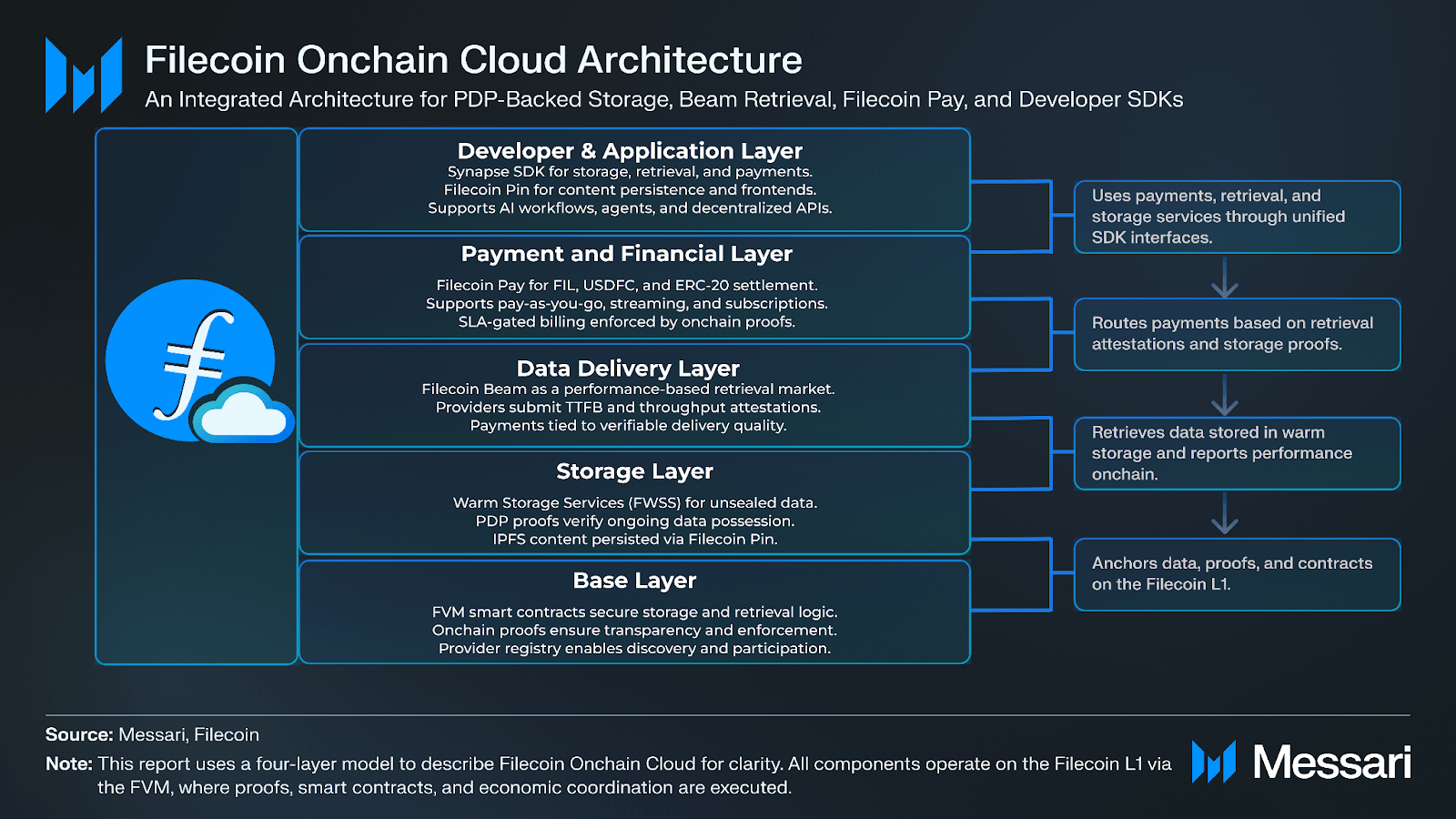
Filecoin Onchain Cloud delivers a vertically integrated stack for verifiable storage, verifiable data movement, and programmable payments. All coordination, such as storage agreements, retrieval attestations, SLA enforcement, and onchain billing, executes on the Filecoin Virtual Machine (FVM). This design enables cloud services to operate as transparent, modifiable smart contracts.
Below, these primitives are grouped into four service layers.
1. Storage Layer
The storage layer provides the foundation for verifiable, hot-access storage services. It is optimized for active workloads requiring low-latency access and verifiable guarantees.
Filecoin Warm Storage Services (FWSS)
FWSS provides fast, unsealed storage with built-in service contracts. Data is uploaded into datasets, and all parameters, including price, redundancy, duration, and allowable actions, are encoded in smart contracts. Providers supply lightweight hardware to host user datasets and must maintain availability throughout the contract period.
Proof of Data Possession (PDP)
PDP is the cryptographic mechanism enabling verifiable warm storage. Providers submit lightweight proofs at regular intervals, demonstrating ongoing possession of unsealed data.
How PDP works:
Providers store unsealed data in flexible “datasets.”
Providers submit hourly PDP onchain proofs based on the datasets.
Smart contracts automatically validate proofs, enforce SLAs, and determine whether payments should continue or halt.
Data remains accessible through IPFS tooling and the Filecoin provider network.
PDP establishes a verifiable hot-storage layer capable of supporting dynamic workloads, rapid reads, and programmable service guarantees.
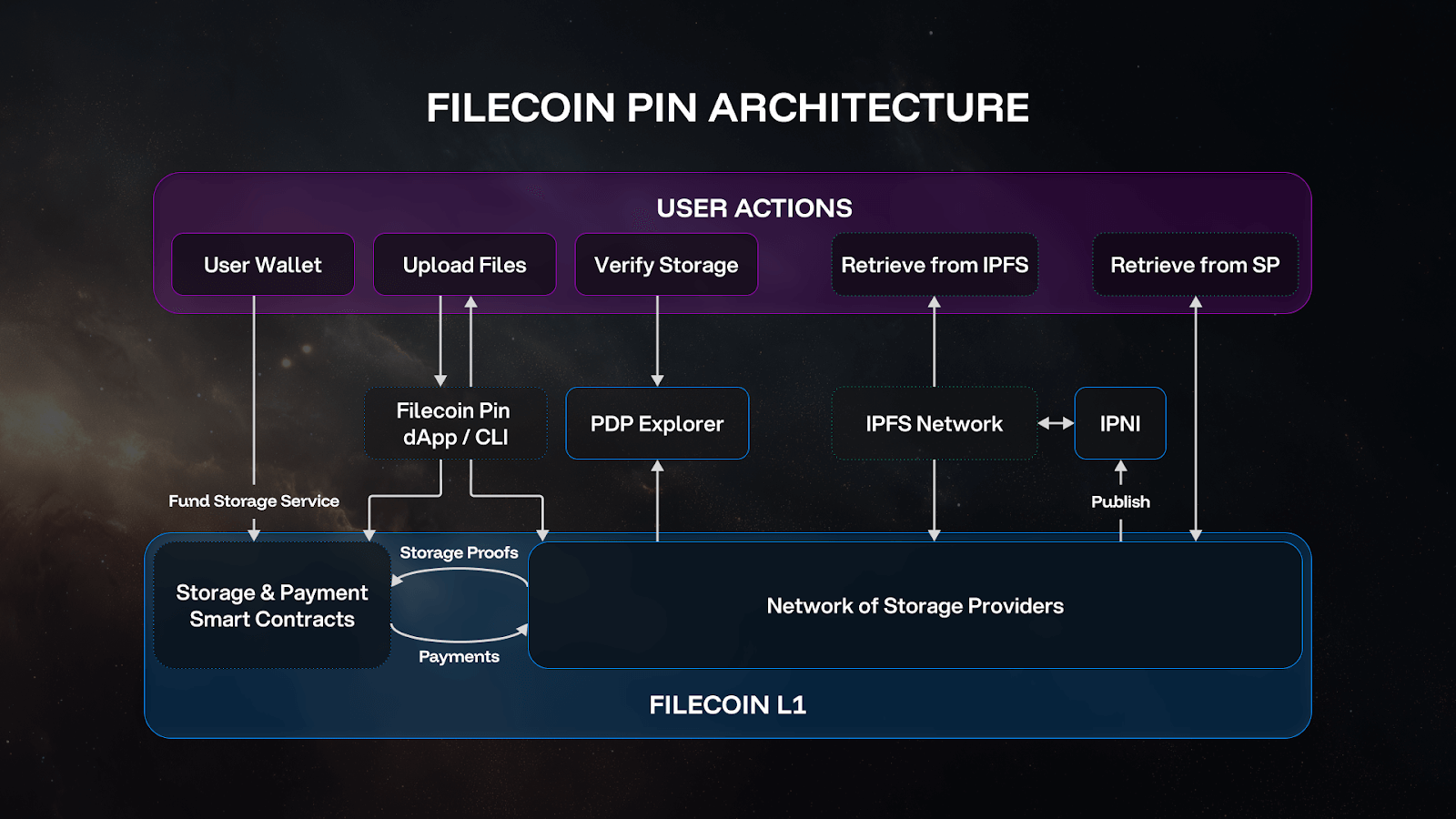
Filecoin Pin (Storage Workflow)
Filecoin Pin bridges IPFS and warm storage by persisting IPFS content with PDP-backed guarantees. Pin provides a CLI, GitHub Action, and web interface for managing content, ensuring websites, metadata, agent files, and other IPFS assets remain durable, tamper-resistant, and auditable.
The retrieval layer ensures stored data can be delivered efficiently and transparently across the network. This layer is crucial for applications that require fast access, such as media, dApps, AI pipelines, and agent systems.
Filecoin Beam
Filecoin Beam converts retrieval into an onchain, performance-based market. When an application requests data through the Beam SDK or API:
The request is routed to participating providers or caching nodes.
Providers serve the data and produce cryptographic attestations that include: time-to-first-byte (TTFB), throughput, success or failure, and total data delivered.
Beam’s verifier contract checks the attestations.
Filecoin Pay automatically settles payments according to the provider’s performance.
Beam creates transparent incentives for high-quality retrieval, enabling a competitive, measurable, and programmable retrieval layer.
3. Payment and Financial Layer
The financial layer handles economic coordination across all Filecoin Onchain Cloud services. Payments are fully onchain, transparent, and conditional on verified service delivery.
Filecoin Pay
Filecoin Pay is the programmable billing and settlement rail for all storage and retrieval services. It supports FIL, USDFC, and any ERC-20 token deployed on Filecoin, enabling:
pay-as-you-go usage models
streaming and epoch-based payments
subscription and recurring billing
retrieval-based reward flows
automatic SLA enforcement through proof-gated payments
fully transparent onchain accounting and balances
Proofs from PDP or Beam trigger (or halt) payment flows automatically, eliminating the need for centralized billing systems or offchain metering and enabling new monetization models for decentralized cloud services.
Developers are already exercising Filecoin’s programmable billing rail through usage-based and proof-gated settlement flows. As of December 10, Filecoin Pay has processed 180 unique payers, 30 payees, and 6,570 payment rails, with over 3,000 still active. Approximately 70,000 nanoFIL has been burned through service transactions.
4. Developer and Application Layer
The developer layer provides the tools and abstractions needed to interact with the Filecoin Onchain Cloud. It hides the complexity of proof systems, contract execution, and payment coordination, enabling familiar development workflows.
Synapse SDK
Synapse SDK is the primary interface for developers using Filecoin Onchain Cloud. It provides high-level APIs for:
uploading data to warm storage
retrieving data through Beam
managing Filecoin Pay balances and permissions
querying provider performance
integrating IPFS workflows via Filecoin Pin
composing custom cloud workflows
Synapse supports browser-based development, Node.js, and other environments, with more language SDKs in development.
Filecoin Pin
Within the developer layer, Filecoin Pin acts as a toolkit built on Filecoin Onchain Cloud. It simplifies Interplanetary File System (IPFS) content persistence and versioning by enabling developers to:
deploy and version websites directly on Filecoin
use GitHub Actions to automatically persist IPFS content onto Filecoin warm storage
host decentralized frontends via ENS + Safe + warm storage
persist agent metadata, NFT assets, and application data with verifiable guarantees
What Developers Can Build Now
Filecoin Onchain Cloud enables builders to:
Create fully onchain data workflows with storage, retrieval, proofs, and payments coordinated through smart contracts.
Launch new cloud services by forking or extending markets for storage, retrieval, or billing.
Deploy decentralized frontends using ENS, Safe, warm storage, and Pin.
Support AI-native workflows where models, datasets, and inference logs are stored and accessed with verifiable guarantees.
Build decentralized APIs and pay-per-use systems composed of Beam attestations and programmable payments.
These capabilities expand Filecoin from an archival layer to a programmable cloud alternative suited for AI, agents, and decentralized applications.
Ecosystem Activity
Filecoin Onchain Cloud is seeing rapid early adoption across AI systems, L1/L2 infrastructure, decentralized frontends, and emerging agent ecosystems. More than 100 teams are experimenting with Filecoin Onchain Cloud, reflecting strong early demand for verifiable, programmable cloud primitives.
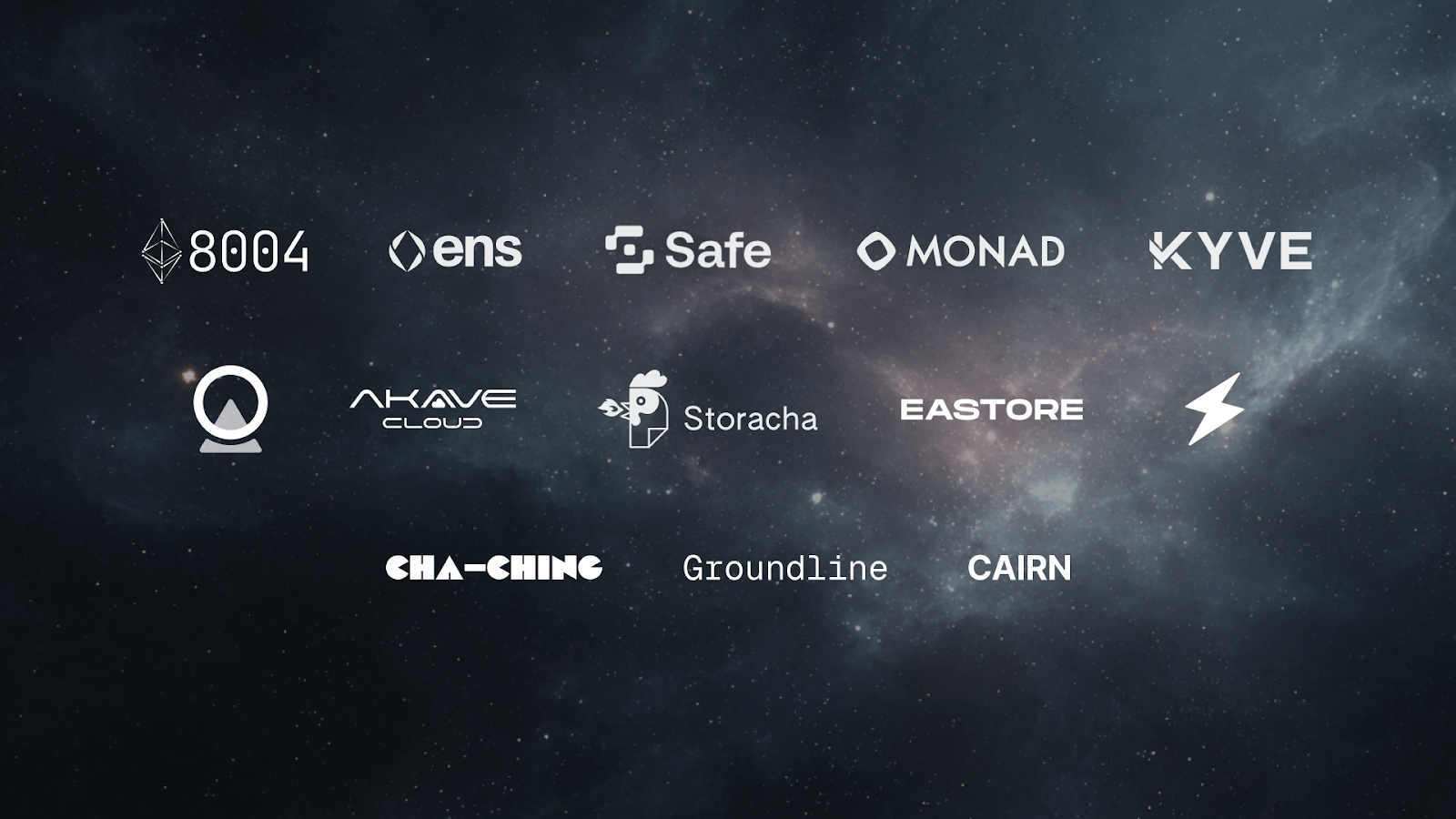
ERC-8004: Onchain agent identity and metadata, ERC-8004, a standard for trustless autonomous agents, and Agent0, its reference SDK, use Filecoin Pin to persist agent identity, metadata, and fingerprints. Storing these elements on Filecoin ensures that agents remain discoverable, tamper-resistant, and interoperable without centralized catalogs.
Frontends and User Interfaces
Ethereum Name Service (ENS)+ Safe: ENS, a decentralized naming protocol, provides human-readable naming and resolution for applications, while Safe, a multi-sig smart account platform, manages governance, versioning, and deployment workflows.
By pairing ENS and Safe with Filecoin Onchain Cloud’s warm storage and verifiable persistence, teams can host UI assets, metadata, and application state without relying on AWS, Cloudflare, or other centralized infrastructure. This stack enables developers to deploy resilient frontends with decentralized naming, governance, and storage.
Blockchain Data & Indexing
KYVE: a decentralized data validation and archiving protocol, uses Filecoin Onchain Cloud’s warm storage to persist chain data from Celestia and Story Protocol, improving validator syncing performance and long-term dataset durability. FOC’s verifiable proofs strengthen KYVE’s transparency guarantees and make archived datasets easier to audit.
Compute & High-Performance Infrastructure
Monad: a high-throughput EVM L1 capable of 10,000+ TPS, integrates FOC as the storage and settlement layer for AI and compute-heavy applications. Through its AI Blueprint program, developers store models, inference logs, and agent state directly on Filecoin, with support for MCP-based Filecoin endpoints inside Monad apps.
Storage Providers and Cloud Services:
Akave Cloud: an S3-compatible decentralized storage provider, uses Filecoin Onchain Cloud’s warm storage to offer a verifiable, auditable storage tier optimized for AI/ML datasets, compliance workloads, enterprise archives, and IoT telemetry. By anchoring integrity proofs onchain, Akave provides cryptographic guarantees that extend beyond what traditional cloud tiers deliver.
Storacha (Forge): a high-throughput IPFS-compatible storage service, delivers warm storage backed by UCAN access control, onchain PDP proofs, and $5.99/TB pricing. By settling verification and billing through Filecoin Onchain Cloud, Forge enables durable, owner-controlled storage for organizations operating at scale.
Geo Podcasts: a discovery platform built on Geo’s knowledge-graph protocol, relies on Filecoin Onchain Cloud to store podcast metadata, topic graphs, and media files. This ensures that Geo’s content remains verifiable, tamper-resistant, and portable across applications without dependence on centralized storage.
Alpha Builder Cohort
Teams in the Alpha program are building early applications and infrastructure atop Filecoin Onchain Cloud. Representative projects include:
Eastore: a decentralized, encrypted user-drive system that gives individuals private, client-side–encrypted storage anchored on warm storage. Filosign: a verifiable e-signature platform that stores signed documents and proofs immutably on Filecoin. Cha-Ching: an incentives tool that rewards developers and AI agents for provable GitHub contributions using onchain attestations. Groundline: a verifiable knowledge-graph database for AI teams to store, query, and monetize graph-structured data. Cairn: a reproducibility platform for AI research that uses Filecoin Pay to reward verified, repeatable experiments.
Roadmap & Future Direction
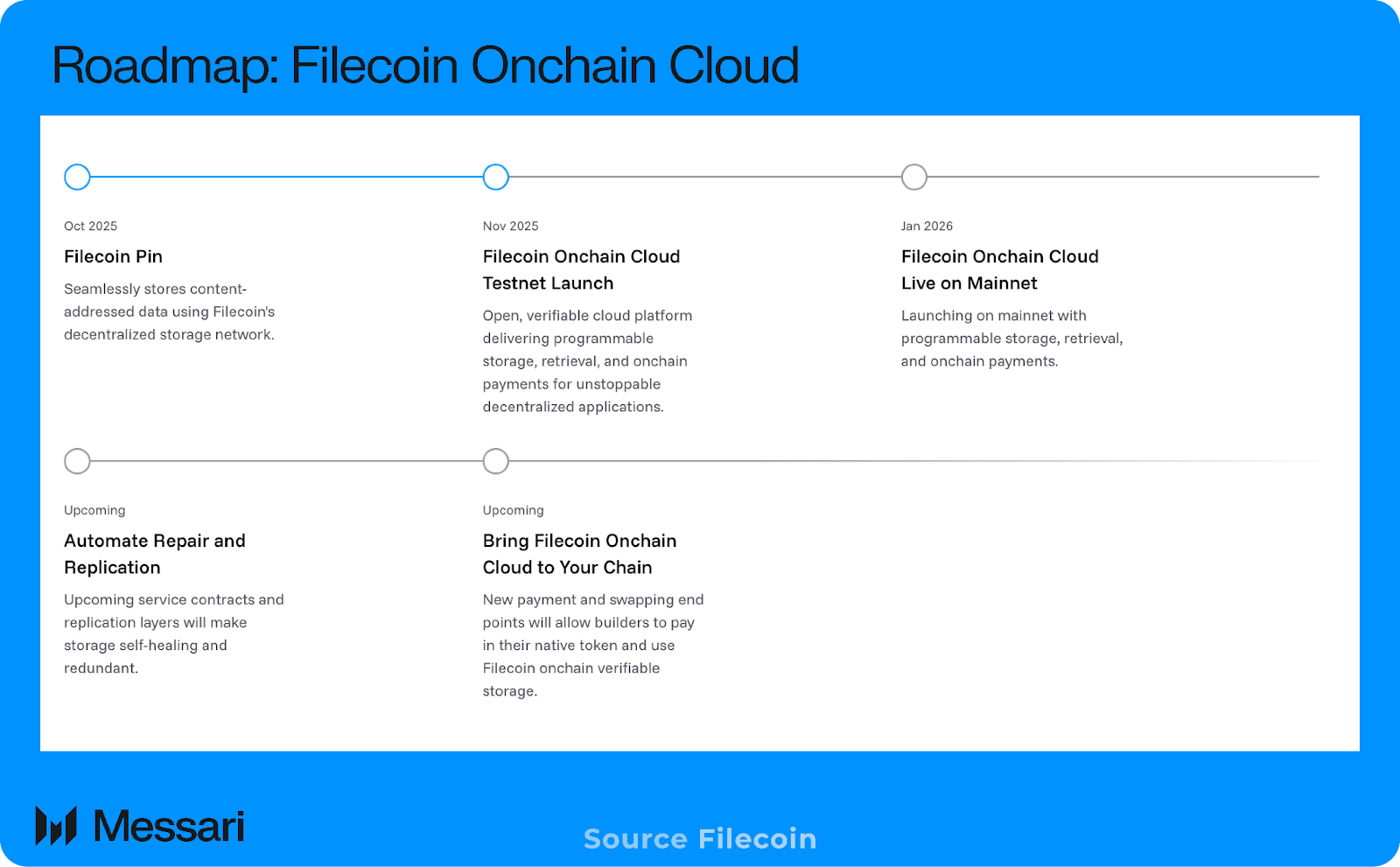
Filecoin Onchain Cloud represents the first step in Filecoin’s expansion from a decentralized storage network to a programmable, multi-service cloud platform. Over the next year, development will focus on bringing core primitives into production live on mainnet.
In 2026, the Filecoin ecosystem is expected to introduce onchain replication and repair, expanded SDK support (including Python and Go), and additional integration pathways for L1 and L2 ecosystems. These upgrades will also support the emergence of SLA-driven storage and retrieval markets, enabling service providers to compete on performance with transparent, enforceable guarantees.
In the near term, Filecoin Onchain Cloud is expected to extend into verifiable compute and decentralized API services, allowing applications to prove computation outcomes, inference results, and data delivery directly onchain. This phase will also support the development of programmable DePIN markets such as sensor networks, indexing services, and bandwidth providers and enable deeper integrations with enterprise systems that require auditability and compliance guarantees. Autonomous AI agents are likely to become an increasingly important user class as they rely on Filecoin for persistent state, verifiable data loops, and usage-based settlement.
Longer term, Filecoin aims to serve as a verifiable data and service layer for the open internet. In this model, AI systems depend on Filecoin for trusted data flows, DePIN networks use it as a coordination substrate, and decentralized applications operate without centralized points of control. This architecture enables new categories of cloud-native businesses built on programmable storage, retrieval, compute, and payments delivered through an open, onchain marketplace rather than a proprietary cloud provider.
Closing Summary
Filecoin Onchain Cloud, launched on November 18, 2025, expands Filecoin beyond archival storage into a programmable cloud platform offering warm storage, verifiable retrieval, and onchain, proof-gated payments. Early usage reflects growing demand: more than 100 teams are building with FOC, and Filecoin Pay has processed 180 payers, 30 payees, and over 6,500 payment rails.
The roadmap focuses on production-ready services in 2026, followed by onchain replication and repair, broader SDK support, and integration paths for additional L1s and L2s. FOC is expected to extend into verifiable compute and decentralized API services, enabling auditability, automated settlement, and new service markets. Collectively, these upgrades position Filecoin as a verifiable data and service layer for AI systems, DePIN networks, and onchain applications.
This report was commissioned by Filecoin Foundation. All content was produced independently by the author(s) and does not necessarily reflect the opinions of Messari, Inc. or the organization that requested the report. The commissioning organization may have input on the content of the report, but Messari maintains editorial control over the final report to retain data accuracy and objectivity. Author(s) may hold cryptocurrencies named in this report. This report is meant for informational purposes only. It is not meant to serve as investment advice. You should conduct your own research and consult an independent financial, tax, or legal advisor before making any investment decisions. Past performance of any asset is not indicative of future results. Please see our Terms of Service for more information.
No part of this report may be (a) copied, photocopied, duplicated in any form by any means or (b) redistributed without the prior written consent of Messari®.
Armita is a protocol researcher with a robust background in technology and blockchain. Before her role at Messari, she distinguished herself as a tech entrepreneur, executive, and advisor for various blockchain startups. Armita holds two master's degrees, one in Computer Engineering and another in Business Management, as well as a double major undergraduate degree in Physics and Pure Mathematics.
Armita is a protocol researcher with a robust background in technology and blockchain. Before her role at Messari, she distinguished herself as a tech entrepreneur, executive, and advisor for various blockchain startups. Armita holds two master's degrees, one in Computer Engineering and another in Business Management, as well as a double major undergraduate degree in Physics and Pure Mathematics.