FATF and Privacy Coins

This post was originally published on July 02, 2019, and sent to Messari Pro subscribers.
Following yesterday’s G20 acceptance of FATF’s crypto guidelines and the ongoing regulatory blowback over Facebook’s Libra, some are getting more worried we’re about to enter a global financial panopticon; a world where every single transaction is closely monitored by either the state or large corporations. You shouldn’t have to think twice about why this an undesirable outcome. Bitcoin was originally praised as a potential solution, a truly private, global transaction network. However, we now know better. It is nothing of the sort, and blockchain analytics firms can use certain heuristics to discern who owns what and how they are spending it. There are bitcoin developers working to prevent this dystopian future. Most notably those working towards the implementation of Schnorr signatures in Bitcoin Core, which would mark an important step towards improving anonymity in Bitcoin.
What is Schnorr?
First, you need to know more about bitcoin’s signature scheme, the Elliptic Curve Digital Signature Algorithm (ECDSA). Many cryptographers will tell you ECDSA is an abomination, but it works for Bitcoin because its lightweight properties make it desirable for a digital money. Currently, multi-sig transactions are enabled on bitcoin through P2SH. However, it is a computationally expensive transaction since each signer needs to produce an individual signature. It also requires all signers to have addresses starting with 3, which not only makes P2SH transactions identifiable but exposes individuals within the multi-sig.
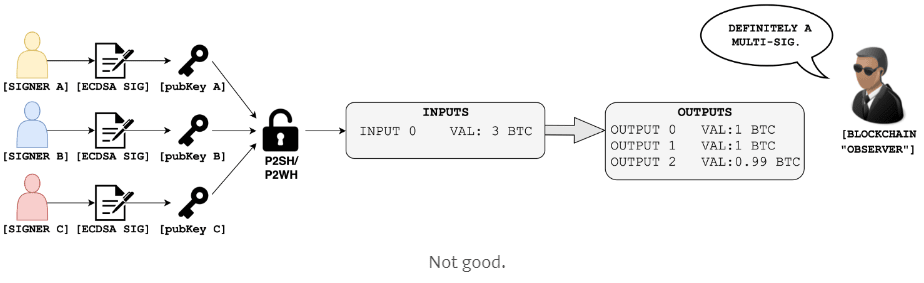
Source: Digital Asset Research - Schnorr Signatures and The Inevitability of Privacy in Bitcoin
Schnorr is a new signature scheme that can aggregate multiple signatures into one that’s indistinguishable from regular transactions, increasing the default privacy and efficiency of validation. Schnorr transactions are the same size, take the same time to verify, and do not reveal the original set of signers or even the number of signers. Schnorr could also enable smart contract solutions such as Taproot, which could improve the effectiveness of mixing transactions through tools such as CoinJoin, an important feature that breaks the direct link between senders and receivers (à la Monero and its ring signatures. That would be a big win for Bitcoin privacy.
