Cosmos IBC: Unlocking the Blockchain Multiverse

On March 29, Cosmos Hub stakeholders approved a proposal to enable Inter-Blockchain Communication (IBC) transfers, allowing users to send tokens between different Cosmos chains for the first time. The upgrade marked the realization of the vision set out by Cosmos’ founders over five years ago. The Cosmos ecosystem now has the foundation to break down the barrier of siloed blockchains and become a system of interconnected networks. In other words, IBC transfers bring the Cosmos ecosystem and ATOM tokens to life.
IBC: Cross-Chain Communication
The cosmos ecosystem requires an interoperability framework like IBC due to its design. Unlike Ethereum, Cosmos doesn’t rely on a single root chain to facilitate data and asset transfers. Instead, it consists of various independent chains that build their base infrastructure using a modular toolkit called the Cosmos SDK. This development tool comes with a series of pre-built modules (building blocks) that developers can select on an as-needed basis when building a new chain.
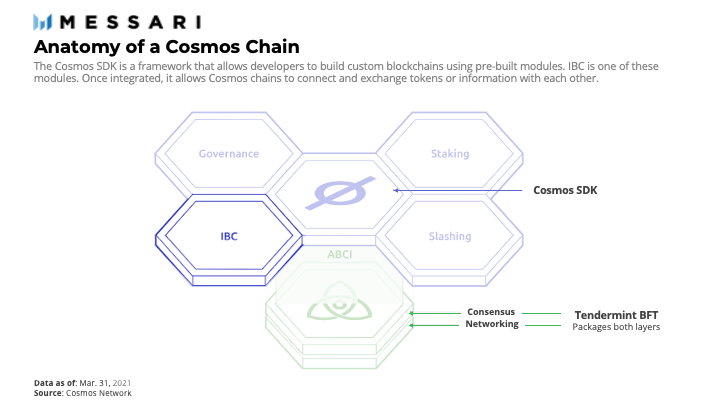
IBC is one of these modules. Once integrated, it allows Cosmos chains to send tokens and arbitrary data between each other. These chains connect and communicate through a two-way peg, the same mechanism used to move tokens from Ethereum to sidechains like xDai or Polygon. When a user submits a valid cross-chain transaction to an IBC endpoint, the origin chain freezes (effectively burning) the tokens being sent while the receiving chains mint an equal number of voucher tokens. Users can send these voucher tokens back to the original at any time to reclaim their “real” tokens. It’s a relatively cumbersome but secure process. Tokens can travel in either direction, but only one set of tokens is transferable to keep the total supply in check.
Establishing an IBC connection with every Cosmos chain individually would be a massive undertaking. In response, the Cosmos ecosystem has adopted a hub and spoke topology (although it’s not a true one since there can be multiple “hubs”) to minimize the number of hops between chains. Most Cosmos chains, called zones, are either application-specific and offer one primary function, or they provide a more general platform for application development like Ethereum. A select few have optimized to be communication hubs, with the Cosmos Hub being the primary example. Cosmos zones can plug into hubs, which route and validate the information passed between different chains in exchange for fees.

Wilson Withiam was a Senior Research Analyst at Messari. Previously, he worked at Circle Research where he conducted research on cryptoassets. He graduated with a B.Sc. in Kinesiology and Exercise Science before studying computer science and economics at UConn.