Celestia – The Fault in Our Stars


Primer
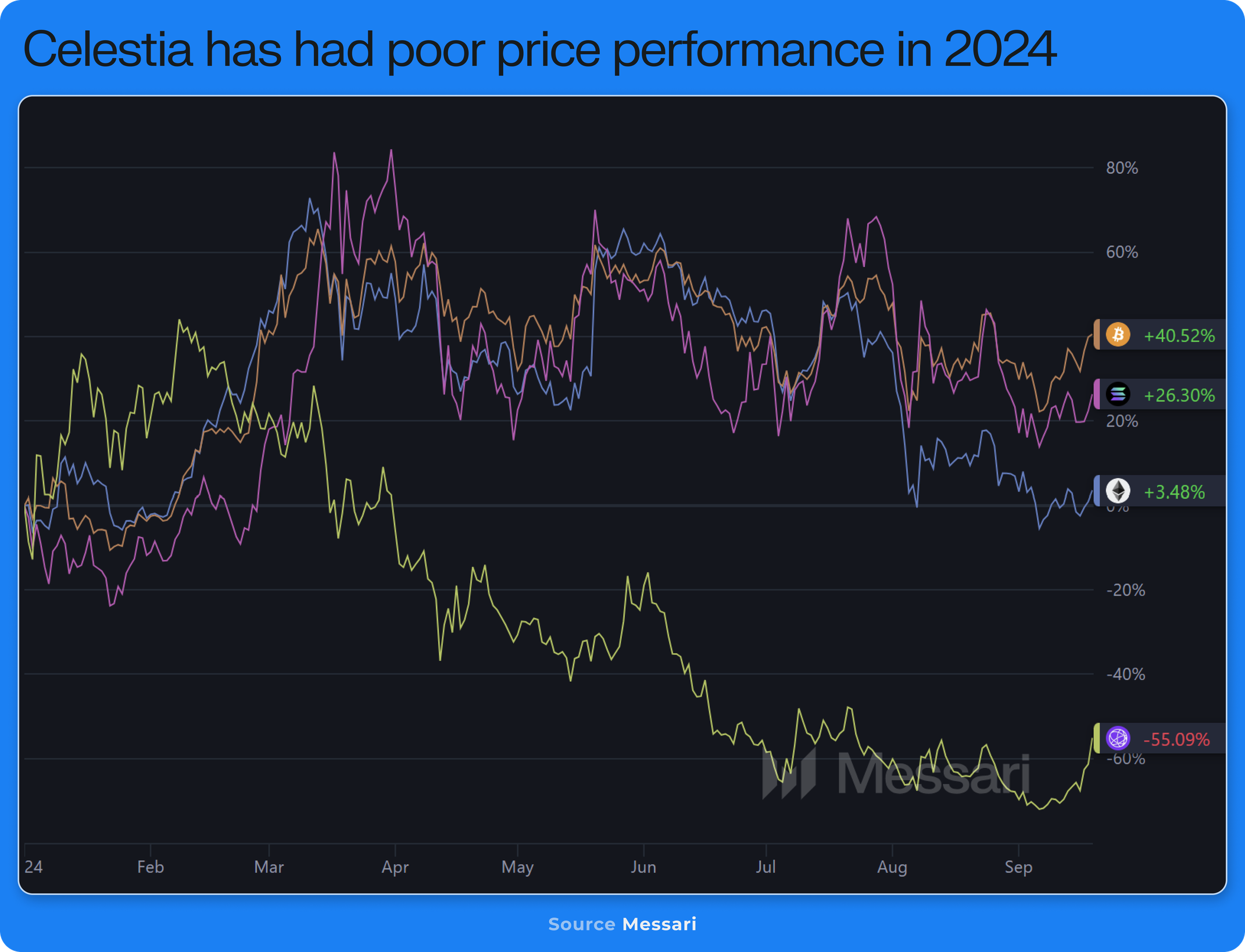
Celestia has not had a great 2024. The native token, TIA, is down a whopping 55% YTD, while other major assets like BTC and SOL are comfortably up by 25-40%. While a part of the underperformance may be explained by period bias – TIA had a significant run-up in Nov-Dec 2023 – more importantly, its data availability (DA) narrative has suffered.
The consensus view on data availability has become that it is commoditized and, as such, will never receive a premium. Additionally, competition has heated up with multiple major launches, including EigenDA and Avail. Even Ethereum, with its large network effects, multiple major rollups, and limited throughput, has not been making much money from DA, so what hope do other DA layers have?
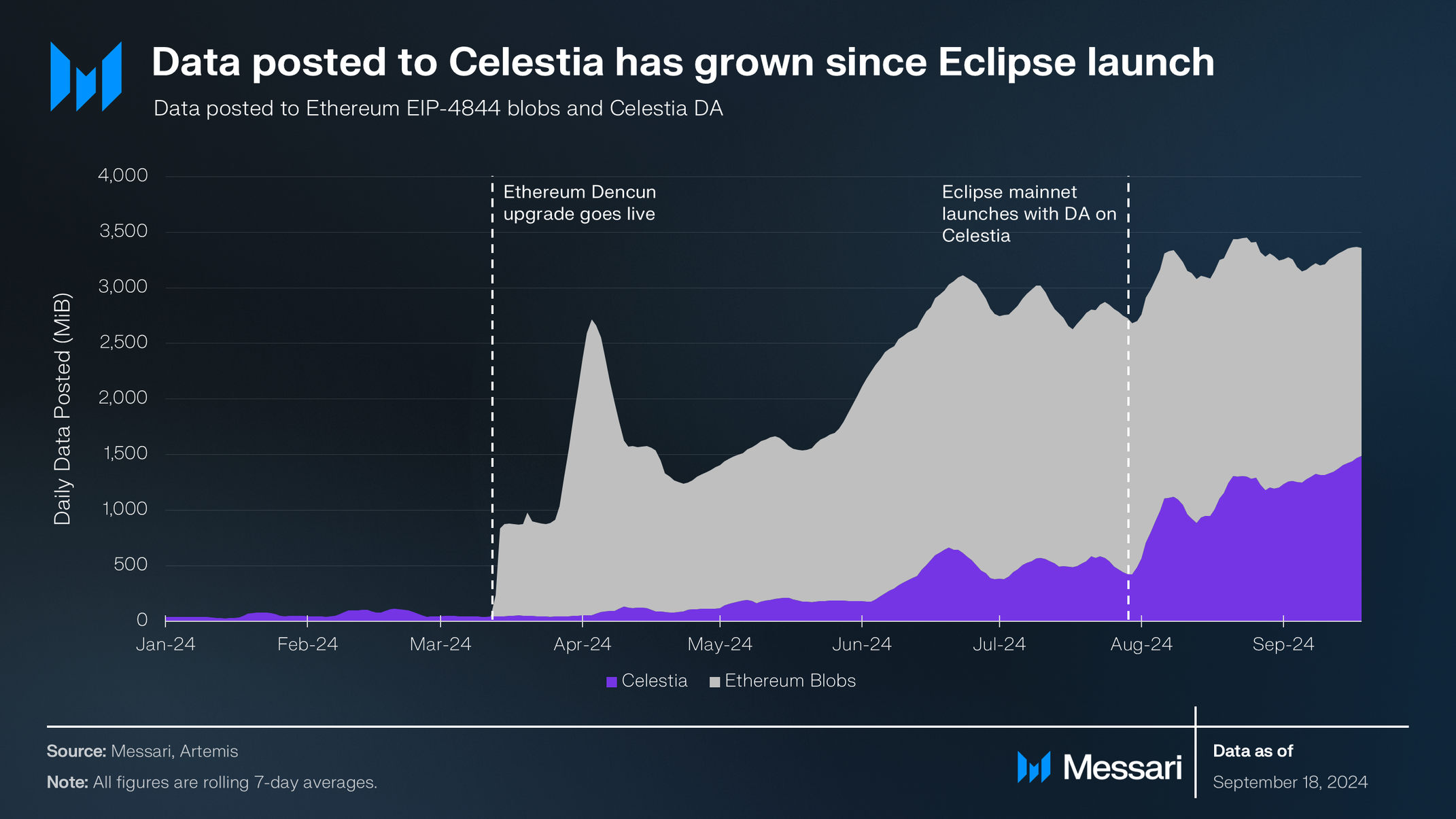
That’s the narrative, at least. On fundamentals, Celestia has grown its DA “business”. Since the launch of Eclipse’s mainnet, the amount of data posted to Celestia has grown significantly. Celestia now rivals Ethereum on the amount of data posted. However, this has not translated to higher fees – Celestia's daily fees still average less than $1,000.
Going forward, there are two opposing forces acting on Celestia’s narrative –

Prior to joining Messari, Andrew was an equity trader at a proprietary trading firm. His primary interests are understanding market dynamics, riding trends, and finding the occasional onchain winner.

Prior to joining Messari, Seth worked in traditional finance software and services, and has a MSc in Applied Mathematics. Seth is a Senior Research Analyst on the Enterprise Research team, and focuses on infrastructure, verifiable compute, and the AI x Crypto intersection.

Kinji formerly covered crypto at Morgan Stanley. His primary interests are DeFi, Ponzi's and unstable stablecoins.

Kunal previously worked in equity research and now considers himself a financial analyst in crypto. He specializes in valuation and bottom-up analysis for Layer-1 and DeFi protocols because he has yet to learn of a way to value NFTs.