
Key Takeaways
- Agents could change who directs capital and how financial products compete for it. An investor's mandate could guide repeated comparisons, purchases of specialist information and reallocations across eligible products. Lower research and switching costs would pressure issuers to compete on net returns, disclosure and access to cash. That could make capital more responsive to better offers, provided agents act within enforceable investor permissions and each product's terms.
- Most investment-agent functions can be built with wallets and applications. Existing standards support delegated permissions and fee sponsorship. Pharos is targeting the bottleneck that can arise when many transactions share one fee sponsor. Its proposed reserve rules would be worthwhile if they make investment tasks more reliable or cheaper after accounting for committed capital and added complexity.
- Pharos has financial products and settlement activity around which developers can build recurring agent services. Axil Prime Credit (APC) paid about 35M USDC across over 10K withdrawal requests on October 21. Agents could track those payments, then use Harbor's product listings and Pharos's tools to prepare the next eligible investment for wallet approval. That would connect existing financial activity to recurring allocation, with cost and reliability still to be tested.
- Agent Economic Activity should separate what investors gain from what agent providers and the network earn. Less idle cash after settlement, decisions consistent with investor limits and repeat use would show progress beyond transaction counts. Separating investor benefits, service delivery costs and network earnings would reveal where value accrues and whether it persists without subsidies.
Introduction
Pharos's opportunity is to support software that repeatedly directs capital and purchases services on an investor's behalf. An agent given limits on risk, liquidity and spending could compare products, obtain specialist advice and act when funds become available. With these standing instructions, agents could make ongoing investment decisions, changing how issuers compete for capital and creating customers for specialist services.
Pharos is an Ethereum virtual machine (EVM) compatible layer-1 focused on real-world finance. Its Sep 30 announcement connects that foundation to agent-native execution. Circle's USDC stablecoin provides a settlement asset, with infrastructure for moving it between supported blockchains. This report considers how agents could change the economics of tokenized markets, which capabilities belong in wallets or the network and how Pharos could bring them together.
From Tokenized Assets to Agent-Driven Markets
Agents become economic participants when they make authorized choices about where money goes and which services to buy. The relevant shift is from automating a single deposit to repeatedly allocating across eligible products. Pharos's financial ecosystem provides examples of the information, permissions and settlement steps such a mandate would require. Four potential market changes follow:
- Competition for capital: Agents that compare and allocate across products could gain influence over which issuers attract investment. Issuers would have stronger reasons to publish comparable terms and compete on returns after fees, risk and access to cash. APC's rewards and overlapping exposures show why those selection rules matter. Cheaper discovery could help smaller issuers reach investors, while widely used allocation agents could become new gatekeepers.
- Recurring allocation: An agent could prepare replacement investments before a withdrawal settles, then allocate within its mandate once cash arrives. APC's request and payment stages make that timing material. Shorter idle periods could increase the share of capital earning returns, while predictable withdrawal terms become part of product competition. Software cannot make the underlying credit mature earlier.
- Markets for specialist services: A treasury agent could buy product data from one provider and an exposure assessment from another before preparing an investment. Providers could sell a narrowly defined service to many agents, spreading delivery costs across customers. This creates a potential source of demand for financial information and verification, provided buyers can assess the quality of what they receive.
- Smaller economical positions: Reusing research and monitoring across accounts could lower the cost of serving each investor. That could expand demand for smaller products and let issuers reduce minimums where servicing costs drive them. Eligibility requirements and investment risk remain product constraints.
ZAN's USDC payment service on Pharos provides a component for those specialist-service purchases. The image below shows how an agent could buy specialist inputs, compare eligible products and reinvest after cash arrives. The combined agent workflow remains a proposed application.
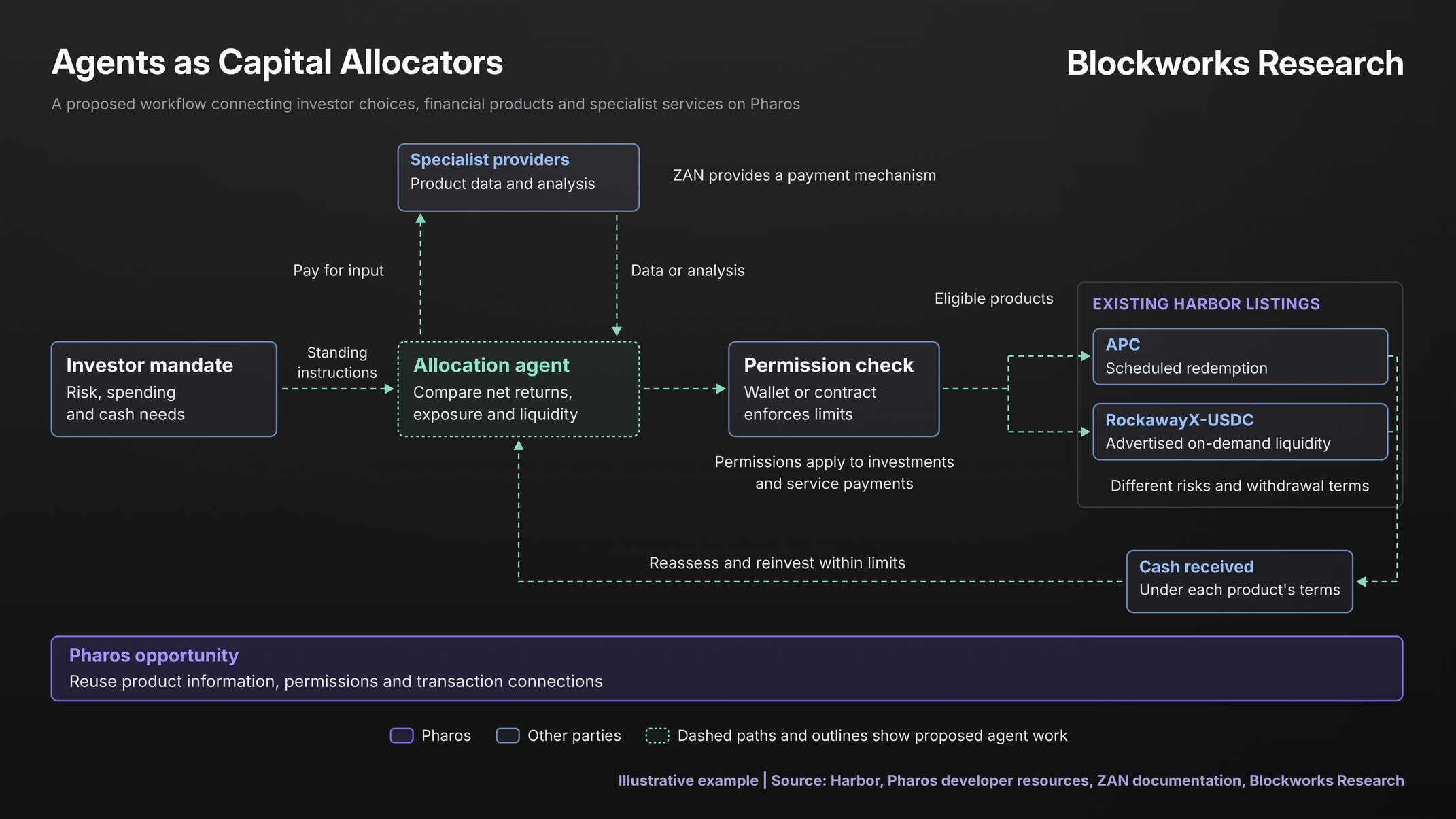
The opportunity also changes where concentration risk sits. Agents using the same data or selection rules could direct capital toward the same issuers or request withdrawals together. Better distribution therefore depends on independent inputs, clear product disclosures and limits on correlated exposure, alongside lower operating costs.
These activities require ongoing permission to act within investor-set limits, with the ability to withdraw that permission. The next question is which parts developers can build today and where Pharos's network design can improve the result.
What Actually Makes Blockchain Infrastructure Agent-Native
Most of an investment agent belongs in applications, wallets and financial contracts. Applications choose products and assess their terms, while wallets and contracts enforce what the investor has authorized. Native infrastructure is most relevant where transactions share network resources, including fee accounting and execution. This division lets developers build services now while targeting protocol changes at specific bottlenecks.
An investor could allow an agent to buy data within a budget, prepare allocations and request withdrawals under separate limits. Those rules need enforcement outside the model, while product eligibility and settlement remain the responsibility of the relevant financial contracts and providers. An L1 can support execution without determining which credit strategy suits the investor.
Axil Prime Credit (APC), a private-credit vault on Pharos, illustrates this division. Its CoreVault source code lets investors delegate withdrawal requests while settlement requires separate authority. Developers can add spending and timing limits around that existing permission:
- Amount and duration: Add limits and expiry through a wallet or contract, since APC's operator approval does not set them.
- Decision conditions: Specify when a withdrawal is permitted, so an authorized action also follows the investor's liquidity plan.
- Revocation: Withdrawing operator approval stops new requests and cancellations under that approval. Pending requests remain in place.
Developers can implement these controls on existing blockchains, leaving Pharos's native design to address shared execution costs. MetaMask's delegation toolkit documents capped permissions enforced by smart contracts. Wallets can enforce each investor's rules while the blockchain processes the resulting transactions. Two Ethereum ecosystem standards clarify the boundary:
- ERC-4337: Supports smart-contract wallets and lets a third party pay transaction fees, without changing the blockchain's consensus rules.
- ERC-7715 (draft): Defines how applications request permissions from wallets to act on a user's behalf. The wallet or account implementation must enforce those permissions.
Native sponsorship is also not unique to Pharos. Sui separates the transaction sender from the gas owner, allowing a sponsor to fund execution. The competitive question is how Pharos's design changes coordination and cost for its financial workloads. In either approach, an application or another sponsor supplies the funds.
In its October 1 design note, Pharos proposes reserving sponsor collateral per block to reduce bottlenecks when many transactions share one fee payer. Advance reserves could reduce fee-accounting conflicts across many sponsored tasks. Both approaches require funds to be committed in advance, so the comparison should include that cost as well as transaction fees. To test whether Pharos improves recurring investment services, we would compare:
- Completion time and failed transactions per task.
- Total operating cost, with sponsor-paid gas counted once.
- Collateral committed, with its financing cost reported separately.
The trade-off is less shared-sponsor accounting work against capital reserved in advance and additional protocol complexity. It does not remove conflicts when transactions update the same vault. Pharos's status page lists gas substitution on testnet and Agent Authority/KYA under research, while its roadmap targets mainnet sponsorship in H1 2027.
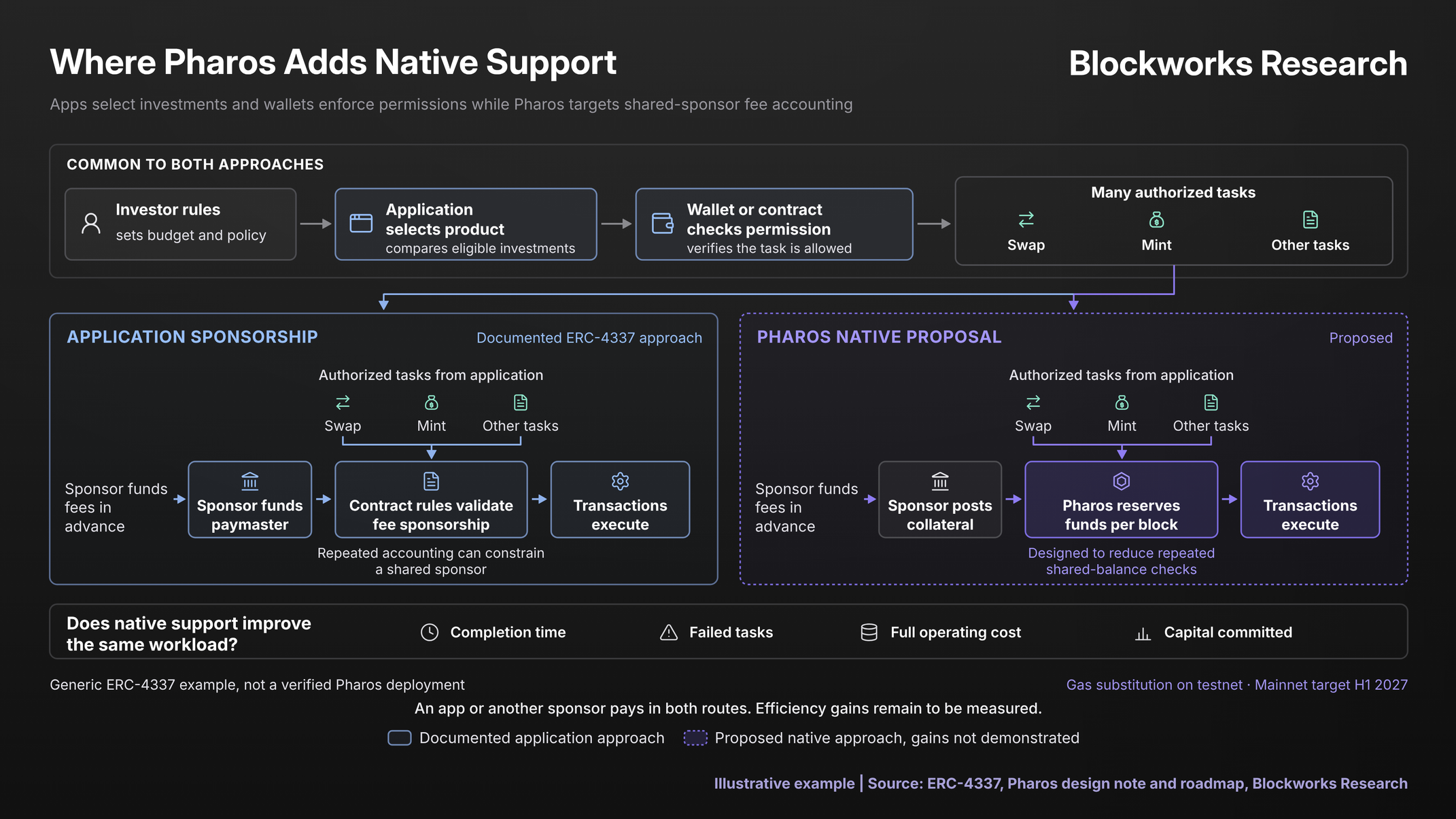
The image above compares application-based sponsorship with Pharos's proposed reserve rules. In the application route, a paymaster is the contract a sponsor uses to cover users' fees. That route is illustrative, not a verified Pharos deployment, and native performance gains remain to be measured.
Why Pharos and What Needs to Be Proven
Pharos could compete by making financial services easier to build around products investors can already access. Harbor brings credit, lending and other strategies into one interface, while Port places APC investment controls alongside an Anvita chat integration. This provides an entry point for agent-assisted distribution. The work still required is turning product terms, investor permissions and settlement events into a dependable service across products.
Base offers a concrete alternative. Coinbase's AgentKit supports Morpho vault deposits and withdrawals, and Coinbase Developer Platform provides sponsored transactions and x402 data payments. Those components show that investment agents can be built through applications on an existing network.
The structural opportunity for Pharos is to make each additional financial product cheaper to support. Reusable product information and compatible permissions could let a service compare issuers and redirect eligible capital without rebuilding every connection. Harbor's distribution interface and existing vaults provide a place to develop that model. Native sponsorship targets a separate scaling cost when many transactions share a fee payer. Product access is established, while lower integration costs and better execution remain advantages to validate.
The workflow and its components
A treasury deciding where to hold its cash illustrates the choice across products. On October 26, Harbor advertised on-demand liquidity for RockawayX-USDC, while APC uses scheduled redemption. An agent could compare those terms against upcoming cash needs, permitted exposure and returns after fees, buying specialist inputs where useful.
APC makes the allocation problem concrete. Its July 14 launch announcement names OKX Wallet, Binance Wallet, KuCoin Wallet and TopNod as access points. Harbor's October 24 listing advertised 13.8% APY, including 0.8% rewards, and displayed 12.5% after its performance fee. Without rewards and assuming the base return is unchanged, that becomes 11.7%. An agent comparing products should use consistent fee, reward and liquidity assumptions.
Pharos provides APC's base chain and settlement, R25 supplies vault infrastructure and Axil manages the credit strategy. Hosted PharosMCP provides read-only chain data, Pharos's Skill Engine supplies task instructions and Port's embedded Anvita Flow integration can request wallet approval. These tools could support the allocation workflow pictured earlier. Ongoing investment decisions additionally need reliable product information and contract-enforced permissions.
What an agent can handle
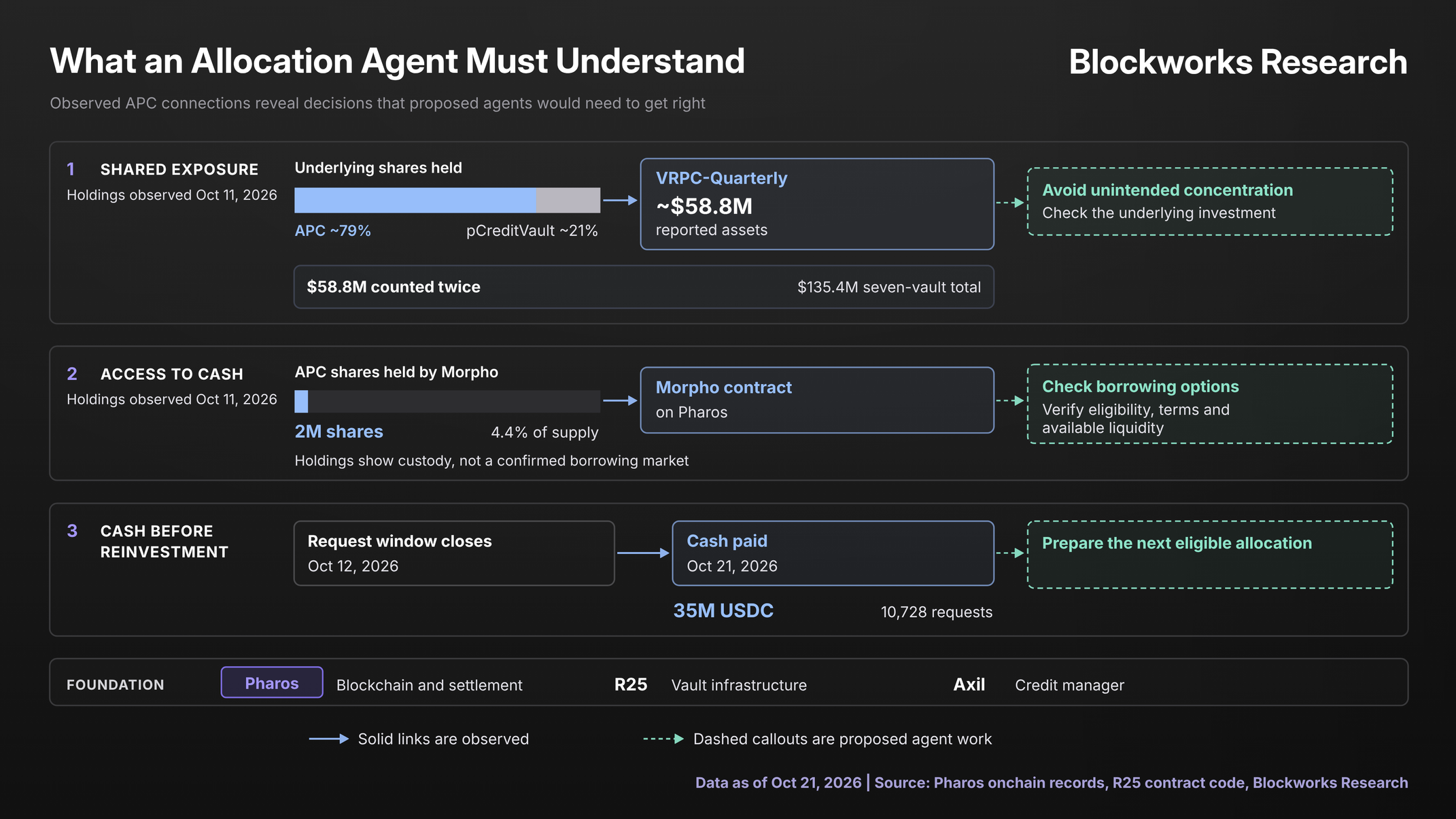
Our onchain investigation shows what an allocation agent would need to understand before moving capital. The image below connects the observed October 11 holdings and October 21 payment with three proposed agent tasks:
- (1) Compare underlying exposure. On October 11, APC and pCreditVault held virtually all shares in VRPC-Quarterly. The $135.4M reported across seven R25 vaults therefore included about $58.8M twice. An agent applying an issuer or exposure limit should recognize the shared investment before allocating to both wrappers.
- (2) Assess access to cash. On October 11, a contract for Morpho, a lending platform, held 2M APC shares, or 4.4% of supply. That connection prompts a useful allocation question. Could the investor borrow against the position, on what terms and at what cost? Holdings establish the connection, while an agent must verify an available borrowing market before treating collateral as accessible cash.
- (3) Coordinate reinvestment with payment. APC's first withdrawal window closed on October 12, and the vault paid about 35M USDC across over 10K requests on October 21. An agent could compare eligible destinations before payment and prepare the next allocation once funds arrive. The economic benefit would be less unwanted idle cash, measured separately from the vault's own settlement schedule.
On October 24, APC reported about $70M in assets against its $100M cap, with 61% of outstanding shares in the withdrawal contract. Requests can be cancelled during the permitted window, and the next withdrawal date was listed as January 21, 2027. An allocation agent must therefore distinguish a pending request from a final exit decision or cash available to invest.
What would validate it
The next evidence should show whether Pharos makes a service spanning financial products cheaper to build and run. A useful comparison would give agents the same investor instructions, first using existing wallets and applications and then adding Pharos's native features. Holding risk, liquidity and service requirements constant would distinguish better execution from simply taking more investment risk.
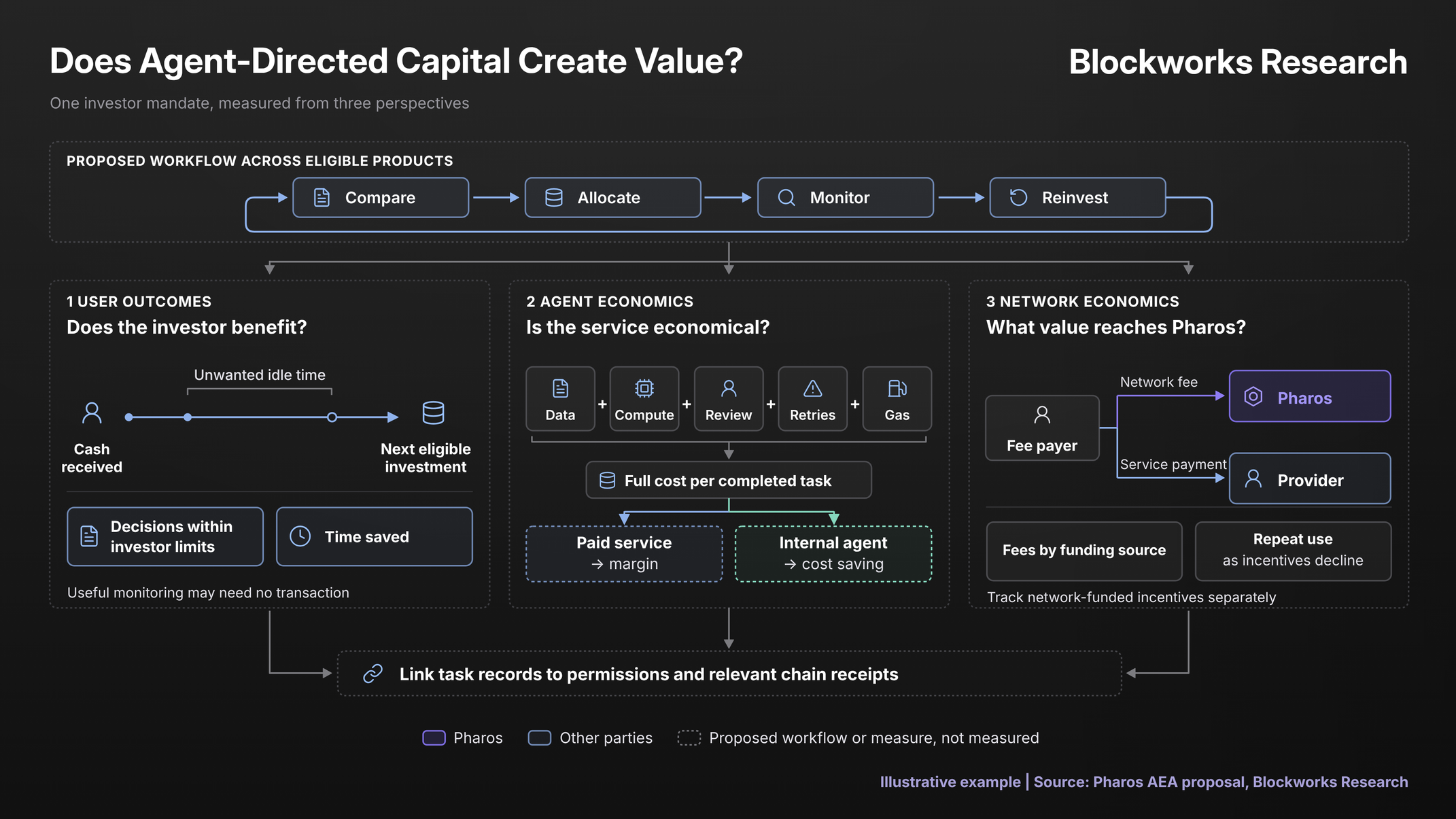
Agent Economic Activity (AEA) can test both the market thesis and Pharos's role in it. Alongside TVL and transaction counts, records should show what capital was managed, which services were purchased and whether the resulting work was economical. Three measures distinguish benefits to investors, costs for agent operators and fees earned by the network:
- User outcomes: Measure time saved, mandate compliance and unwanted idle cash after settlement. Track whether agents compare eligible alternatives and explain allocation decisions using consistent risk, fee and liquidity assumptions. Monitoring can be useful without producing a transaction.
- Agent economics: Count data purchases, computation, human review, failures and gas once in delivery cost. For paid providers, measure margins and repeat customers after subsidies. For internal treasury agents, compare cost with the manual workflow instead of requiring service revenue.
- Network economics: Measure fees from attributable investment and service-payment tasks, identify the payer and track repeat use as incentives decline. Distinguish the provider's payment from the network fee. Useful allocation decisions can create substantial investor value with little additional fee revenue.
Task records must link the investor's mandate to inputs, decisions and relevant chain receipts. A paid data request alone does not establish delivery of a useful assessment, and an ordinary transaction does not identify an AI decision. Evidence of recurring allocation requires a completed workflow, including the permission used and the resulting investment or payment.
The image below shows how to judge whether those repeated investment decisions create value. The strongest signal would be recurring allocation decisions that meet investor mandates, economical service delivery and repeat settlement on Pharos. Measuring those outcomes separately reveals whether growth benefits users, operators and the network.
Conclusion
Agents could make onchain capital more responsive to investment terms and create customers for specialist financial services. Pharos's live products provide a practical setting for that transition, with APC showing why net returns, shared exposure and cash availability must inform allocation. The opportunity is to turn those inputs into repeatable decisions under an investor's mandate, extending the market beyond users managing each position manually.
Pharos can build on that distribution and settlement base by making product information, permissions and transaction tools reusable across its ecosystem. Wallets and applications already handle much of the investor's authority. Its native sponsorship proposal addresses a different problem: coordinating many transactions funded by the same sponsor. The case becomes stronger as more products use those connections and recurring tasks cost less to deliver, giving investors better service and Pharos' repeated economic activity.
This report was commissioned by DPLabs Co. Limited By providing this disclosure, we aim to ensure that the research reported in this document is conducted with objectivity and transparency. All content was produced independently by the author(s) and does not necessarily reflect the opinions of Blockworks. or the organization that requested the report. The commissioning organization may have input on the content of the report, but Blockworks maintains editorial control over the final report to retain data accuracy and objectivity. Author(s) submit financial conflict of interest (FCOI) disclosures on a monthly basis that are reviewed by appropriate internal parties and may hold cryptocurrencies named in this report. This report is meant for informational purposes only. It is not meant to serve as investment advice. You should conduct your own research and consult an independent financial, tax, or legal advisor before making any investment decisions. Past performance of any asset is not indicative of future results. Please see our Terms of Service for more information.