

Key Insights
- Virtually all blockchains make money from blockspace, while most stablecoin issuers make money from reserves, and very few businesses have exposure to both. With USDG, Arbitrum becomes one of them, retaining its upside to fee-based revenue should onchain activity recover, while adding a stablecoin revenue line that does not depend on it.
- Stablecoin issuers are a bigger and more durable business than blockchains. Tether and Circle generated $9.56 billion in revenue over the past twelve months, 6.2x the $1.55 billion generated by blockchains, and their revenue volatility has stayed between 2% and 11% since mid-2023 and sits at just 3% today, versus 19% for blockchains.
- Tether and Circle make more money from Arbitrum than Arbitrum does. We estimate the two issuers earned $97.8 million over the past twelve months from USDC and USDT0 held on Arbitrum, 4.2x Arbitrum's own income. USDG gives Arbitrum its first chance to capture a piece of that revenue.
- In our base case, USDG supply on Arbitrum could reach $615 million by October 2027, or 15% of its stablecoin supply, and as much as $918 million in our bull case. Robinhood Chain bootstrapped $700 million in USDG in about two months, though with heavy incentives.
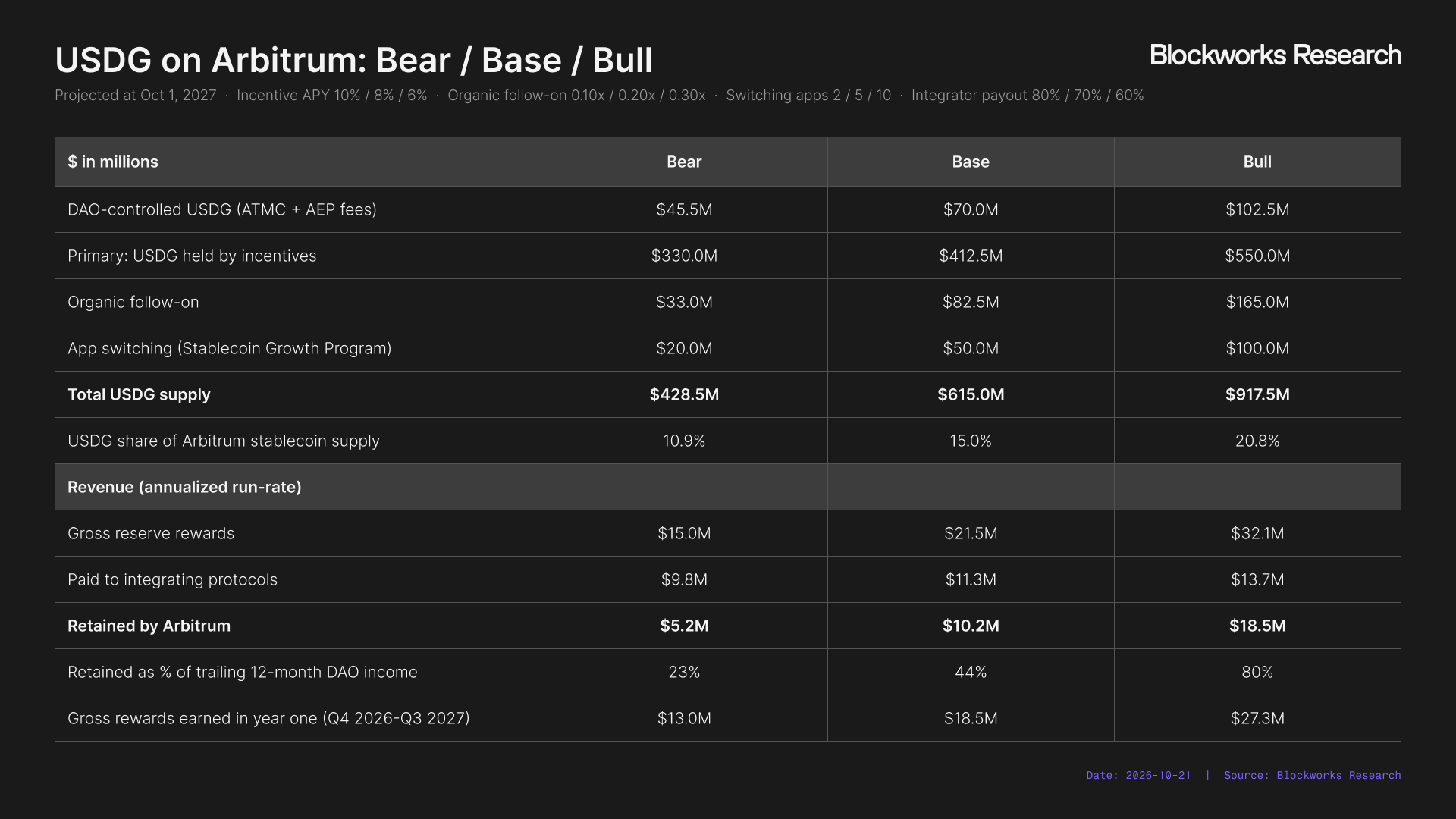
- In our base case, USDG could grow Arbitrum’s income by more than 40%. That supply would generate $21.5 million in annual reserve rewards, of which $10.2 million stays with Arbitrum after paying integrating protocols, equal to 44% of Arbitrum’s income over the past twelve months. In our bull case, retained revenue reaches $18.5 million, or 80% of Arbitrum’s trailing income.
Introduction
On October 6, Arbitrum announced that USDG, the stablecoin issued by Paxos and backed by the Global Dollar Network (GDN), is now live on Arbitrum One. On the surface, this may not seem like much. Arbitrum already hosts over $4 billion in stablecoin supply, and one more stablecoin hardly seems like cause for a report. The difference, however, lies in who keeps the USDG’s reward mechanism.
With stablecoins like USDC and USDT, the interest earned on the reserves backing each token accrues to Circle and Tether, respectively, while the chain hosting those tokens receives nothing. USDG works differently. Rather than concentrating reserve income at the issuer level, GDN shares that income with the network partners that mint, custody, and accept USDG. According to the GDN website, partners can receive up to 100% of the rewards on the reserves backing the USDG held on their platform.
Under the arrangement, Arbitrum has joined the GDN and USDG is minted directly on Arbitrum One. USDG rewards are paid to Arbitrum based on USDG utility, and according to the accompanying governance proposal from Entropy Advisors, most of those rewards will be recycled into incentives, integrations, and partnerships for builders while USDG is still scaling, with net proceeds flowing to the DAO's treasury management portfolio.
Alongside the launch, the proposal asks the DAO to add 100 million ARB to its DRIP incentive program, lifting DRIP's total budget to roughly 165 million ARB, allow the Arbitrum Treasury Management Council (ATMC) to mint USDG and seed protocol-owned liquidity from its roughly $66 million portfolio, and convert incoming Arbitrum Expansion Program (AEP) licensing fees into USDG. USDG also launched with integrations across Morpho, Maple, GMX, Fluid, Uniswap, and Kraken, among others.
If this sounds familiar, it should. Robinhood ran the same playbook when it launched Robinhood Chain, itself built on Arbitrum's technology stack, in July. Rather than defaulting to USDC or USDT, Robinhood made USDG the chain's native stablecoin and, in doing so, created a revenue stream that has nothing to do with blockspace. Arbitrum is now attempting to do the same for itself.
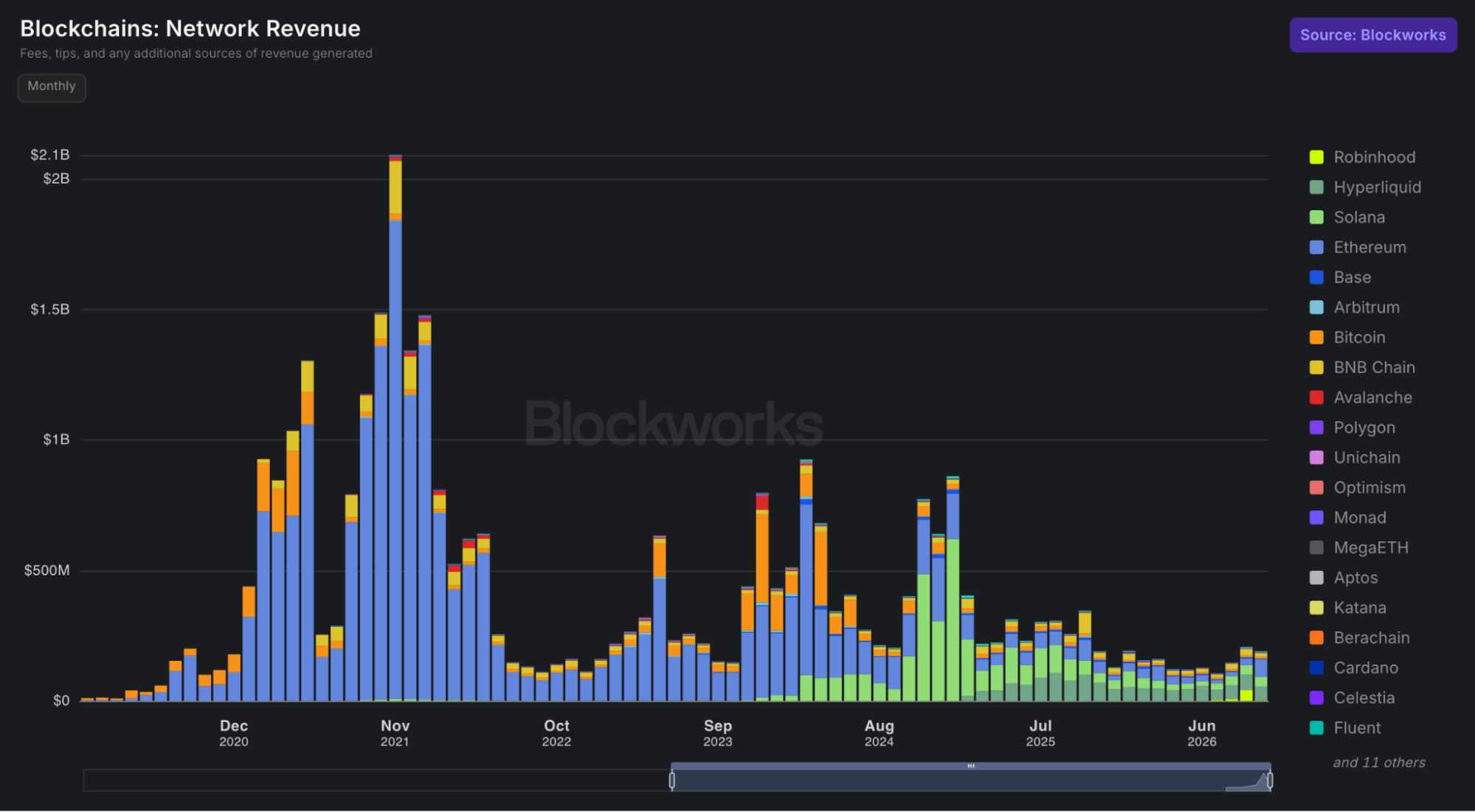
The timing is hardly a coincidence as network revenue across the industry is in structural decline. The blockchains tracked by Blockworks generated $2.78 billion in revenue over the past twelve months, down 48% from $5.39 billion the year prior. Arbitrum has also been impacted by this structural decline as its income has fallen from $57.3 million in 2023 to $23.0 million over the past twelve months.
This leaves Arbitrum in a unique position. Virtually all blockchains make money from blockspace, while most stablecoin issuers make money from reserves, and very few businesses have exposure to both. With USDG, Arbitrum becomes one of them, retaining its upside to fee-based revenue should onchain activity recover, while adding a stablecoin revenue line that does not depend on it.
Importantly, USDG is not a pivot away from blockspace, as Arbitrum is not repositioning itself as a stablecoin company, but rather adding another lever that makes it better at what it already does, selling high-quality blockspace to builders. Today, the reserve income generated by stablecoins on Arbitrum is extracted by Tether and Circle and put to work elsewhere. With USDG, that income is reinvested into incentives, integrations, and partnerships for the builders on Arbitrum, which in turn grows activity on its blockspace. Since those rewards can fund the very programs that attract more USDG, Arbitrum’s incentives partly pay for themselves, and each new dollar of supply adds revenue at little extra cost beyond what goes to integrators. In other words, blockspace growth and USDG growth now feed the same flywheel, giving Arbitrum a stronger pitch to builders than chains that rely on blockspace alone.
The key question is whether USDG can give Arbitrum a more durable business, and just how much it can realistically contribute.
More Sustainable Revenue
To understand why USDG matters, it helps to first look at how Arbitrum makes money today. Since March 2023, Arbitrum has generated $142.5 million in total income across five business lines: transaction fees, Timeboost, treasury management, Arbitrum Chain licensing fees, and partner revenue share. Of that total, $124.6 million, or 87%, came from transaction fees.
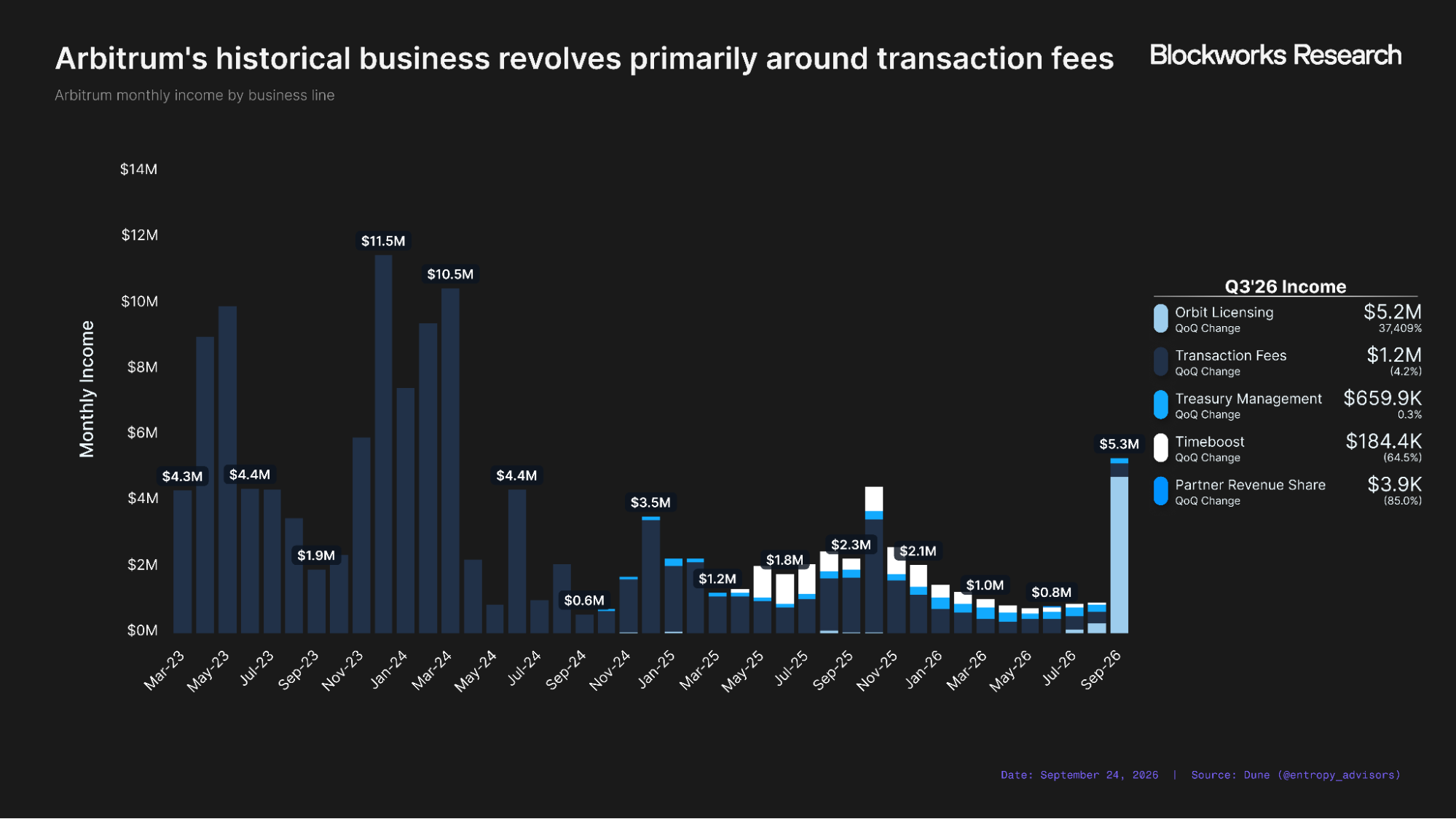
Transaction fees peaked at $11.5 million in December 2023. By September 2026, they had fallen to just $613,000, a 95% decline. Much of this decline was by design, as Ethereum’s scaling roadmap, most notably EIP-4844, sharply reduced the cost of posting data to Ethereum and, with it, fees across every L2, not just Arbitrum.
Arbitrum has, to its credit, diversified its income over this period. Over the past twelve months, transaction fees accounted for 46% of income, followed by Arbitrum Chain licensing (24%), Timeboost (17%), and treasury management (13%).
Yet this diversification is still centered mainly around blockspace. Timeboost is an auction for transaction ordering rights. Arbitrum Chain licensing and partner revenue share are derived from activity on other Arbitrum-based chains. Like transaction fees, all three are ultimately a function of demand for blockspace. Only treasury management is not. In other words, roughly 87% of Arbitrum's income over the past twelve months still depended on demand for blockspace.
The same is true of Arbitrum's two most notable recent developments. Arbitrum Chain licensing fees jumped to $5.4 million in Q3, up from just $13,700 in Q2, with $5.0 million arriving in September alone. The entire jump came from Robinhood Chain. Meanwhile, Timeboost's recent upgrade to priority gas auctions (PGA) and Fast Feed, which opens transaction ordering to a much wider set of participants, generated nearly $200,000 in its first two and a half weeks, a pace that would roughly match everything Timeboost earned over the past twelve months. Both are welcome boosts, but both are still blockspace revenue, whether generated on Arbitrum or on someone else's chain.
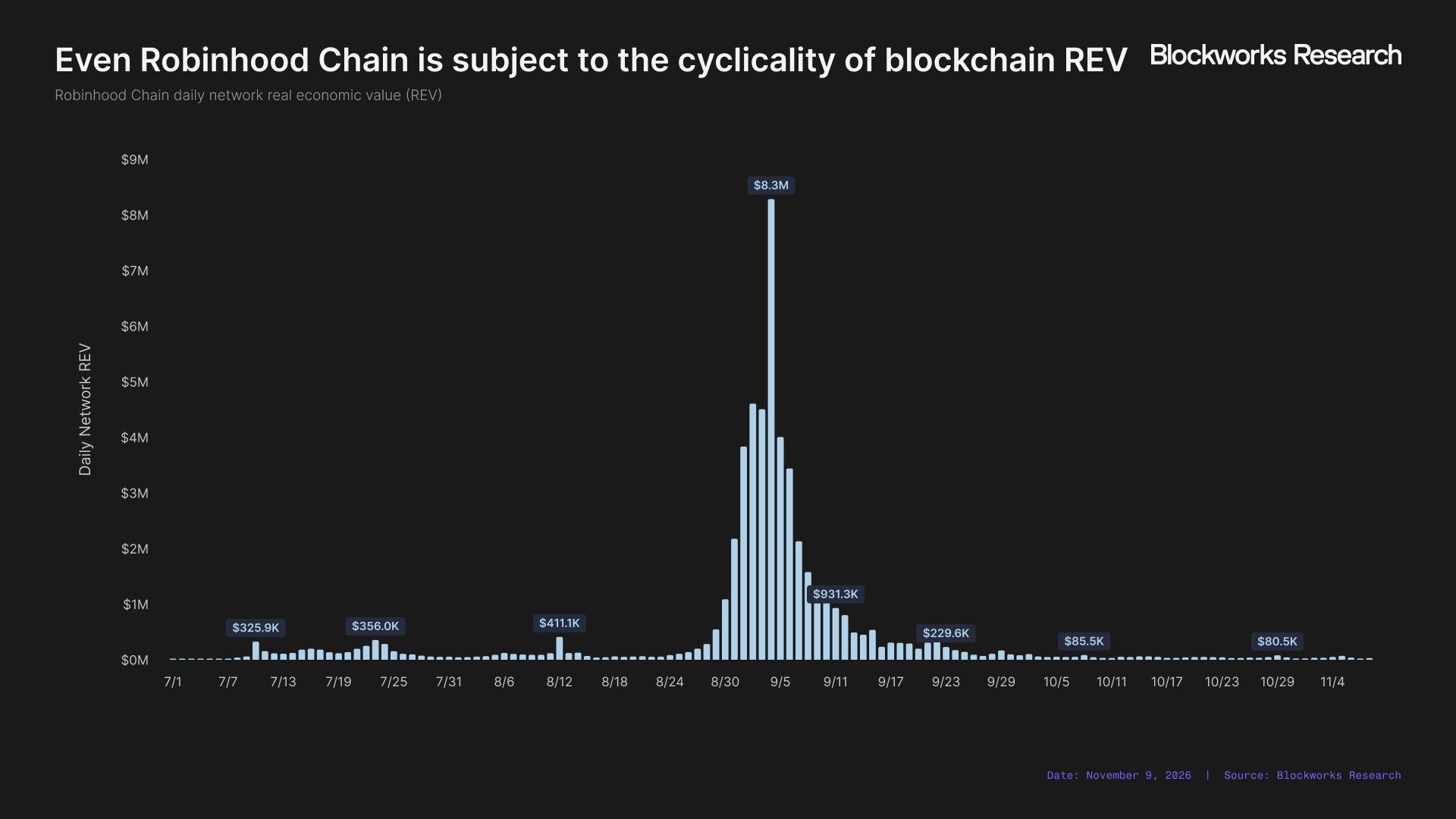
Furthermore, Robinhood Chain is subject to the same cyclicality as every other blockchain. Although it helped propel Arbitrum to its highest-income month in two and a half years, the size of that increase may be somewhat overstated, as daily REV on Robinhood Chain has already fallen more than 99% from its highs. This doesn't mean Robinhood Chain won't be extremely fruitful for Arbitrum, but rather that it alone is not enough to sustain a healthy income line.
What’s important to understand is that crypto’s total addressable market is not shrinking, but rather, moving up the stack away from infrastructure. Blockspace has become increasingly commoditized, and the revenue it generates has shrunk accordingly. Meanwhile, the businesses sitting on top of that blockspace have thrived.
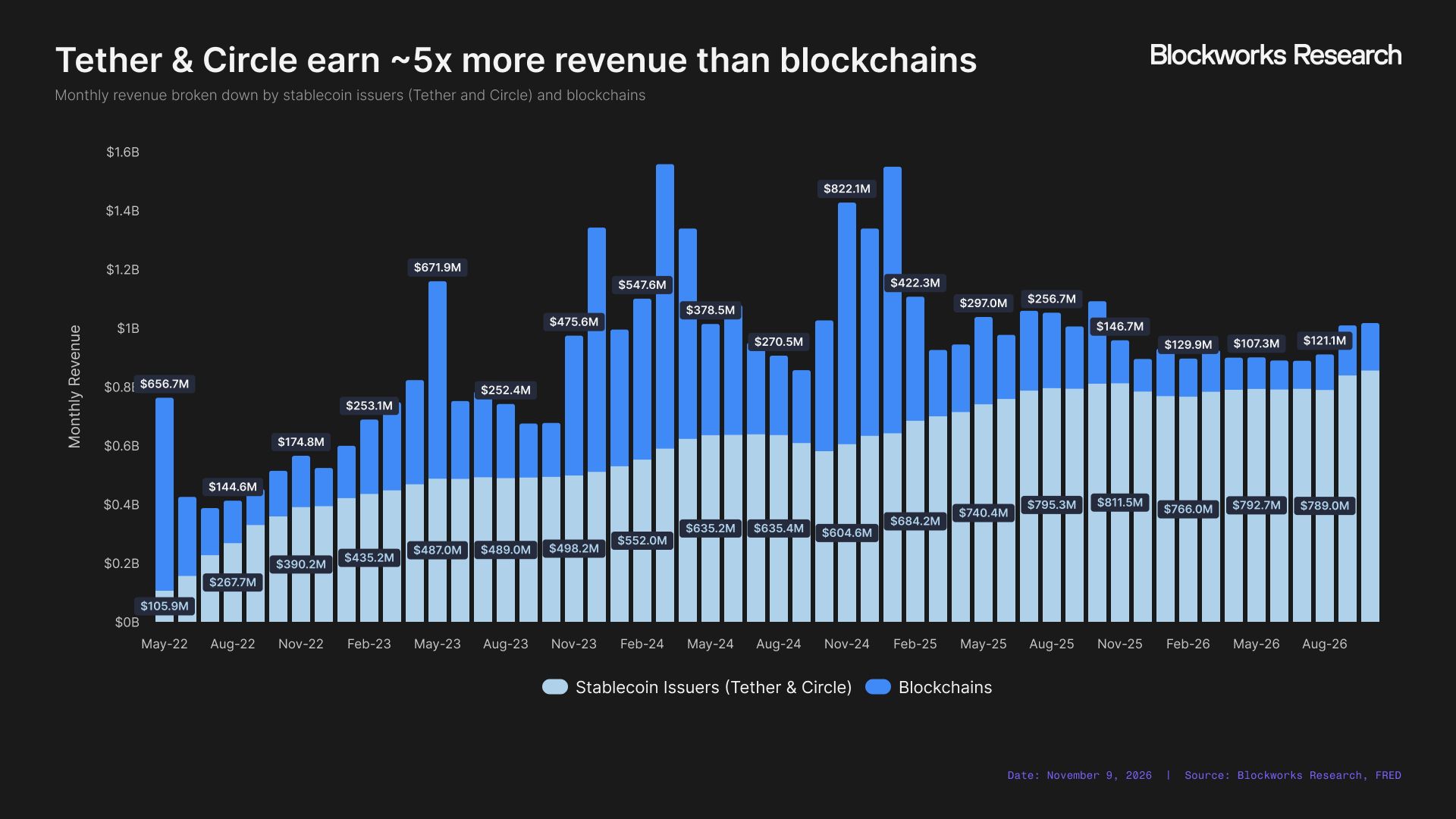
For example, over the past twelve months, Tether and Circle generated $9.56 billion in gross revenue, 6.2x the $1.55 billion generated by blockchains. Stablecoin issuers have out-earned blockchains in 45 of the past 54 months, including every month since February 2025.
Stablecoin issuer revenue is not just larger, it is also far more stable. Blockchain revenue is tied to onchain activity, which rises and falls with speculation. Stablecoin issuer revenue is tied to stablecoin supply and interest rates, both of which fluctuate far less frequently.
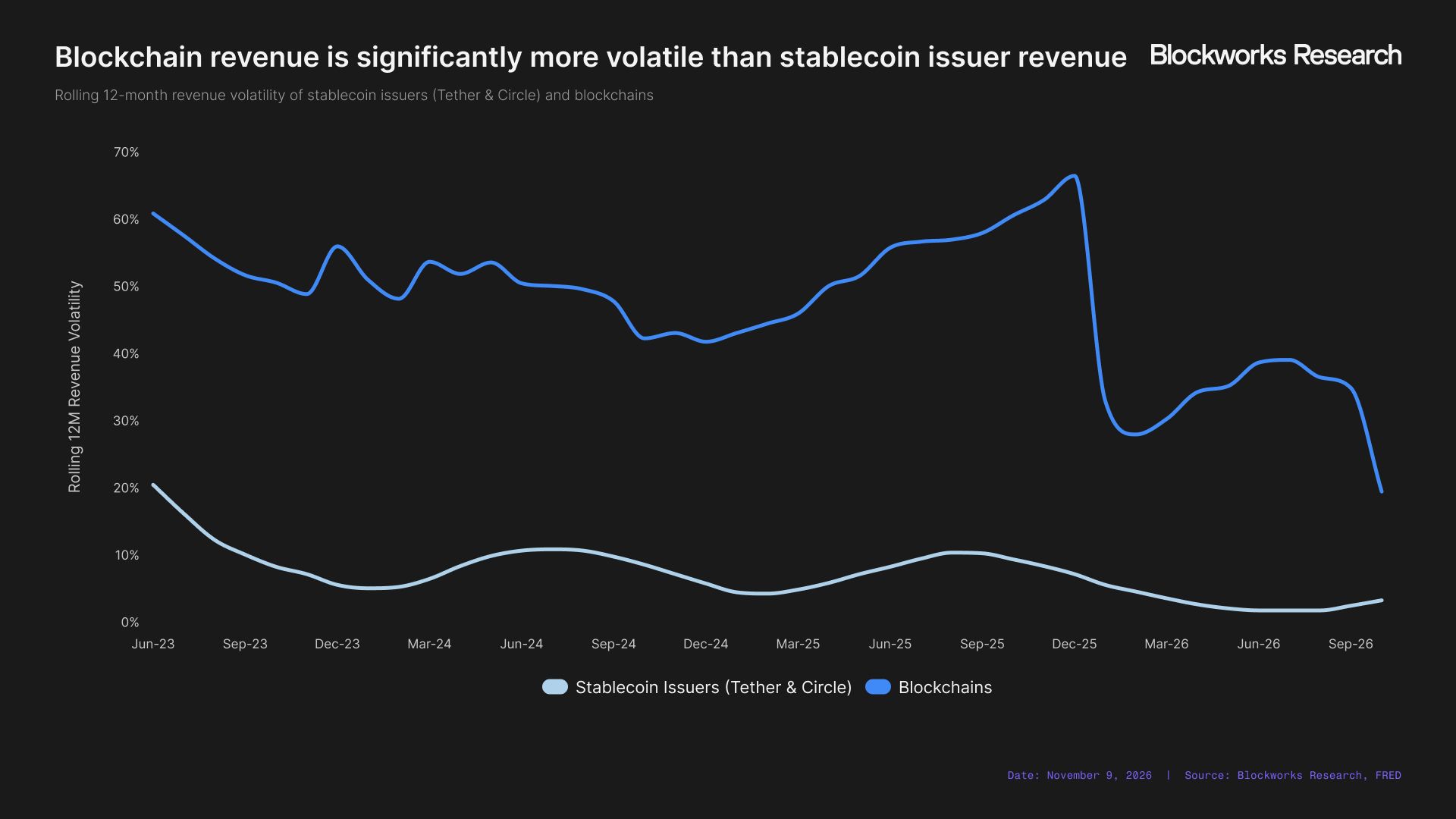
Since mid-2023, the rolling 12-month volatility of stablecoin issuer revenue has held between 5% and 7%. Blockchain revenue volatility, by comparison, peaked at 65% in April 2024 and still sits at 24% today, roughly 4x that of issuers. Put differently, since June 2022, the worst single month for stablecoin issuers was an 11% decline. For blockchains, it was a 60% decline.
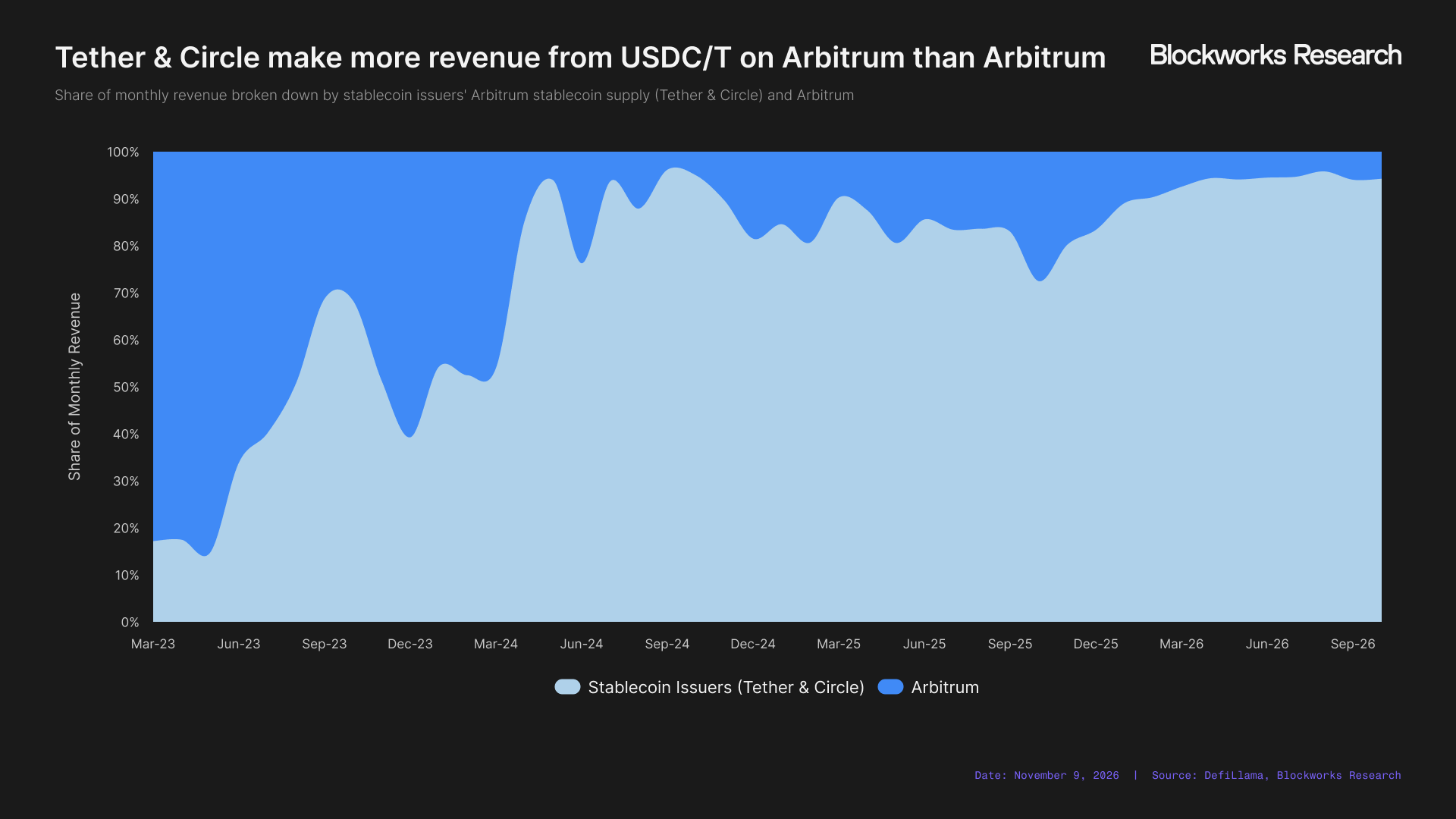
This dynamic is not just an industry-wide phenomenon, either, as it plays out on Arbitrum itself. By applying Arbitrum's share of total USDC and USDT supply to Circle's and Tether's revenue, we estimate the two issuers earned $97.8 million over the past twelve months from stablecoins held on Arbitrum, 4.2x Arbitrum's own income of $23.0 million. In March 2023, Arbitrum earned nearly three times as much as Tether and Circle did from its stablecoins. In August 2026, the issuers captured 89% of the combined total, and even in September, when Robinhood Chain's first licensing payment arrived, they still captured 60%.
In simpler terms, the most valuable business on Arbitrum is not Arbitrum but the stablecoins sitting on top of it, which depend on Arbitrum’s blockspace yet, until now, returned none of their value to it. USDG lets those two businesses reinforce each other rather than leaving one to capture the value the other creates.
Admittedly, stablecoin revenue is not without risk. It is a direct function of interest rates, and every rate cut compresses the economics earned on reserves. But a slow, predictable decline in that is a far easier risk to manage than a 60% drop in monthly revenue. Ultimately, the stablecoin business is simply a better business than operating a blockchain, which is why Arbitrum is adding one alongside the other rather than choosing between them.
Just How Impactful is this Revenue Line?
Before sizing USDG's potential on Arbitrum, it is worth looking at how quickly USDG has been bootstrapped before. Robinhood Chain offers the clearest precedent.
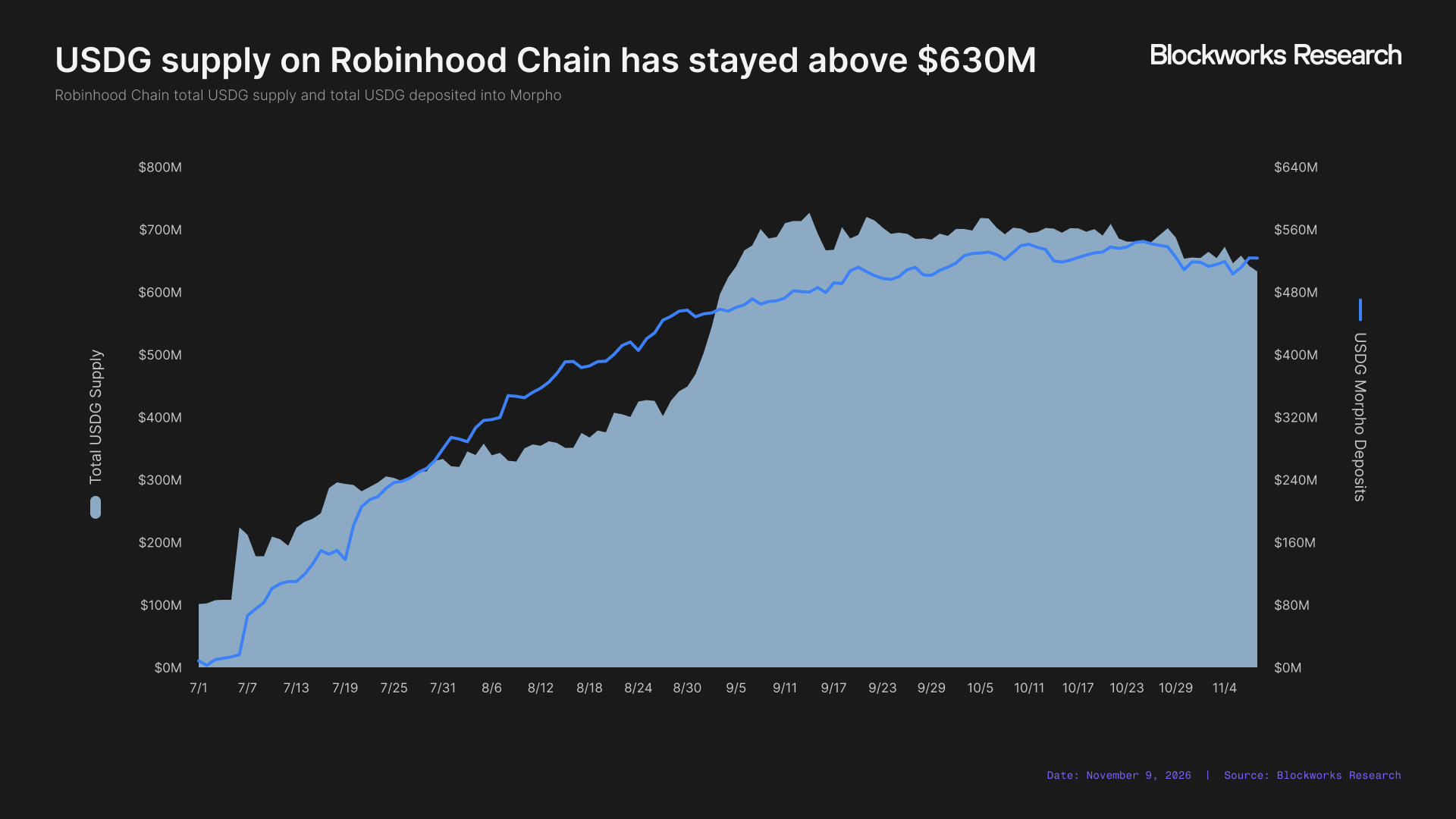
USDG launched alongside Robinhood Chain on July 1 with $101.2 million in supply. Within five days, supply had more than doubled to $223.6 million. By the end of July, it stood at $333.1 million, and by the end of August, $468.3 million. Then, in the first week of September, supply surged again, crossing $700 million on September 8, just over two months after launch. As of October 6, USDG supply on Robinhood Chain sits at $718.3 million.
An important lesson to be learned from this is the power of incentives. The largest driver of USDG growth on Robinhood Chain has been the Robinhood Morpho partnership. Through this partnership, Robinhood users can lend USDG through Morpho powered vaults, with Robinhood supported incentives pushing the return on those vaults to an estimated 7%. This design has driven USDG growth, with Morpho USDG deposits at $534 million.
The growth of USDG will depend heavily on the incentive programs and partnerships behind it. Arbitrum has both, with the DAO's roughly 165 million ARB DRIP budget funding adoption from launch, but it lacks the built-in retail distribution Robinhood had through its own app. What it does have, which Robinhood Chain did not at launch, is an existing stablecoin base of roughly $3.5 billion in USDC and USDT0, along with some of the deepest DeFi liquidity of any L2.
Launch Partners
On that front, USDG launched with integrations across several of Arbitrum's largest DeFi protocols, each targeting a different part of the stablecoin stack:
- Morpho: USDG earn vaults curated by Gauntlet and Steakhouse.
- Maple: syrupUSDG, a reward generating product built on USDG, live at launch.
- GMX: a USDG-specific liquidity offering, anchored by its flagship GLV(USDG) vault, which uses USDG as its only stablecoin.
- Fluid: USDG DEX liquidity at launch, with a lending program to follow.
- Uniswap: USDG liquidity, powered by Uniswap’s StablePair Hook, live at launch.
- Kraken: direct deposits and withdrawals of USDG on Arbitrum, with LayerZero's Stargate handling transfers between Arbitrum and other chains.
On launch day, USDG supply on Arbitrum stood at $21.3 million across 150 holders. Our model sizes these programs by their incentive budgets rather than by individual partner balances, so it includes the DAO's roughly 165 million ARB DRIP budget but excludes partners that have not disclosed incentive budgets, which may include GMX, Maple, Fluid, and Uniswap, which makes each case conservative.
How We Built the Model
To size the opportunity, we started with the stablecoins already on the network. As of October 6, Arbitrum One held $2.66 billion in USDC and $838 million in USDT0, or $3.50 billion in total. Mapping the top 200 holders of each token, we found that $970 million, or 28%, sits with holders unlikely to switch, such as Hyperliquid's deposit bridge, exchanges with prior obligations like Binance and Bybit, token-specific bridges, and Circle's smart contracts. That leaves roughly $2.53 billion in supply that could convert to USDG, which we build toward from four sources: (1) incentive programs, (2) the organic adoption that follows them, (3) apps that switch to USDG as their primary stablecoin, and (4) USDG held by the DAO itself.
The first and largest layer comes from incentives, as we assume DRIP's roughly 165 million ARB budget, the 100 million ARB top-up plus roughly 65 million ARB left from its original budget, is deployed over its one-year mandate, funding roughly $33 million in USDG incentives at $0.20 per ARB in all three cases. Each program holds USDG in proportion to its budget, with supply equal to annual incentive spend divided by the APY needed to attract and keep deposits. We use 10%, 8%, and 6% in the bear, base, and bull cases, bracketing the roughly 7% incentivized APY Robinhood users earn on USDG through Morpho. At 8%, every $1 per year in incentives holds $12.50 in USDG.
The second layer is organic adoption, as some holders adopt USDG without incentives once liquidity and integrations exist. On Robinhood Chain, USDG held outside lending markets ran near zero in August, jumped to roughly $0.50 for every $1 in lending deposits in mid-September, and stood at $0.36 on October 5, averaging roughly $0.24 since August. Arbitrum is unlikely to replicate the speculative trading activity that drives Robinhood Chain, but it can make up much of the difference through its more established DeFi base and additional incentive programs beyond DRIP, whether from the DAO or from protocols themselves. As a result, we assume $0.10, $0.20, and $0.30 of organic USDG for every $1 of incentivized USDG in the bear, base, and bull cases.
The third layer comes from apps that switch to USDG through the Arbitrum Stablecoin Growth Program, which Arbitrum introduced on October 15. The program offers performance-based incentives and ecosystem support to apps with at least $1 million in stablecoin balances that make USDG their primary stablecoin on Arbitrum, along with 200,000 ARB each to the first 10 teams to reach $10 million in USDG TVL, measured as a 30-day average. Unlike incentive programs, which attract new deposits by paying yield, the program asks apps to convert balances they already hold, so we size it by the number of apps that switch rather than by incentive spend. Anchoring to the prize pool’s threshold, we assume 2, 5, and 10 apps each hold $10 million in USDG by October 2027 in the bear, base, and bull cases, adding $20 million, $50 million, and $100 million in supply. Because the Foundation has not disclosed a budget for the performance-based incentives, and the 2 million ARB prize pool is a one-time payout rather than an ongoing incentive, we exclude both from the incentive layer. There is likely some overlap between app-switched and incentivized supply, as switching apps may also draw on DRIP or partner incentives, but we chose not to model it out.
We also include USDG held by the DAO itself, as the proposal allows the ATMC to convert part of its roughly $66 million portfolio into USDG, along with all AEP licensing fees after the Arbitrum Developer Guild's 20% cut, including the roughly $5.7 million already accrued. We assume the ATMC converts 50%, 75%, and 100% of its portfolio and that AEP fees run at $10 million, $20 million, and $40 million per year in the bear, base, and bull cases, respectively. Because the ATMC’s tokenized money market funds already earn roughly the same amount as USDG’s rewards, those conversions add supply but little incremental revenue. AEP fees, by contrast, arrive in volatile tokens that earn nothing, so every dollar converted adds new revenue. Altogether, DAO-owned USDG adds $46 million, $70 million, and $103 million to the three cases.
On the revenue side, we assume USDG can provide rewards up to 3.5% and that 100% of the resulting rewards are paid to Arbitrum, the maximum that partners can receive according to the GDN website. Arbitrum does not keep all of them, however, as protocols that integrate USDG receive a share of the rewards on the USDG they hold, at a rate that rises with the size of their holdings. Since incentive programs and switching apps both hold USDG through integrating protocols, while organic USDG by definition sits outside lending markets, we assume integrators earn 80%, 70%, and 60% of the rewards on incentivized and app-switched USDG in the bear, base, and bull cases, with large integrators negotiating richer terms in the bear case. Organic and DAO-held USDG pay no integrator share, leaving Arbitrum with 29%, 43%, and 54% of the rewards on all USDG outside the ATMC. We treat these integrator payouts purely as a cost rather than as a driver of supply.
Bear Case
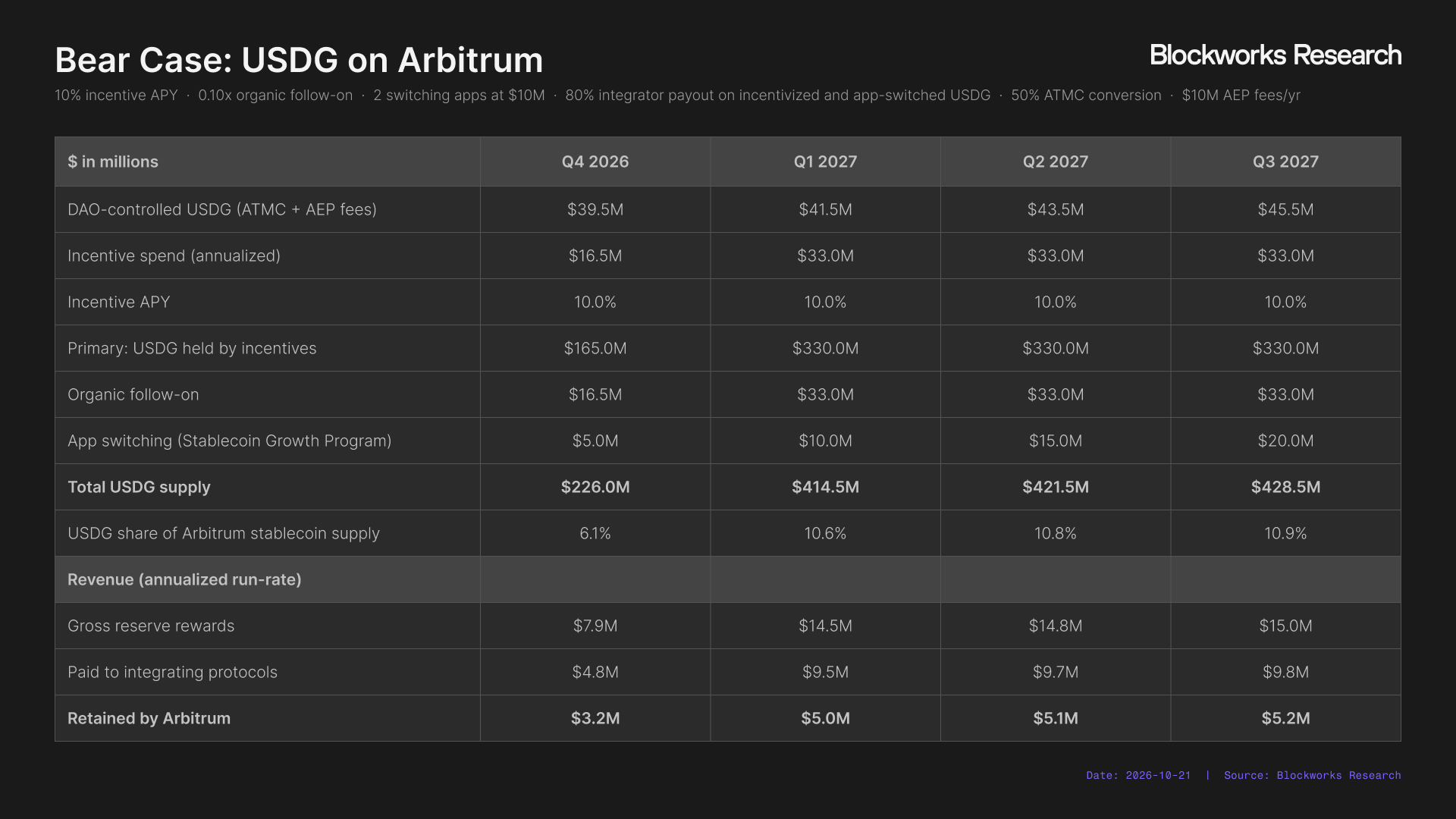
In the bear case, incentives must pay a 10% APY to hold USDG, so the same budget attracts less supply, organic adoption reaches just $0.10 per incentivized dollar, and only two apps switch through the Stablecoin Growth Program. USDG supply reaches $429 million, or 11% of Arbitrum's stablecoin supply, generating $15.0 million in annual rewards, of which $5.2 million stays with Arbitrum after integrators take 80% of the rewards on the incentivized and app-switched USDG they hold. Even this outcome would be meaningful, equal to 23% of Arbitrum's income over the past twelve months.
Base Case
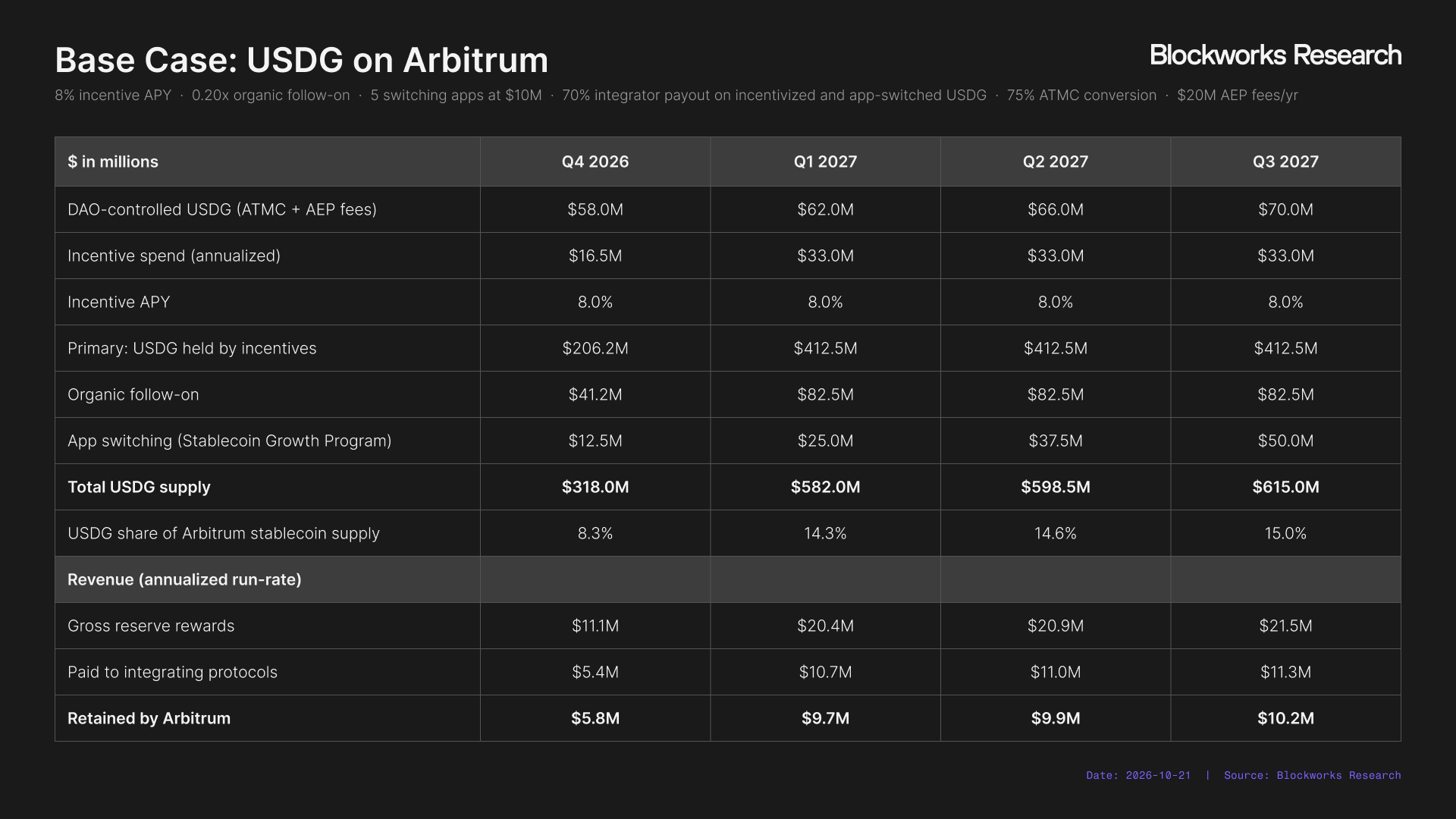
In the base case, an 8% incentive APY, $0.20 of organic USDG per incentivized dollar, and five switching apps bring USDG supply to $615 million, or 15% of Arbitrum's stablecoin supply. That generates $21.5 million in annual rewards, with $10.2 million retained by Arbitrum, equal to 44% of its income over the past twelve months. Put simply, USDG alone could grow Arbitrum's business by more than 40%, before counting any partner incentives that have yet to be disclosed.
Bull Case
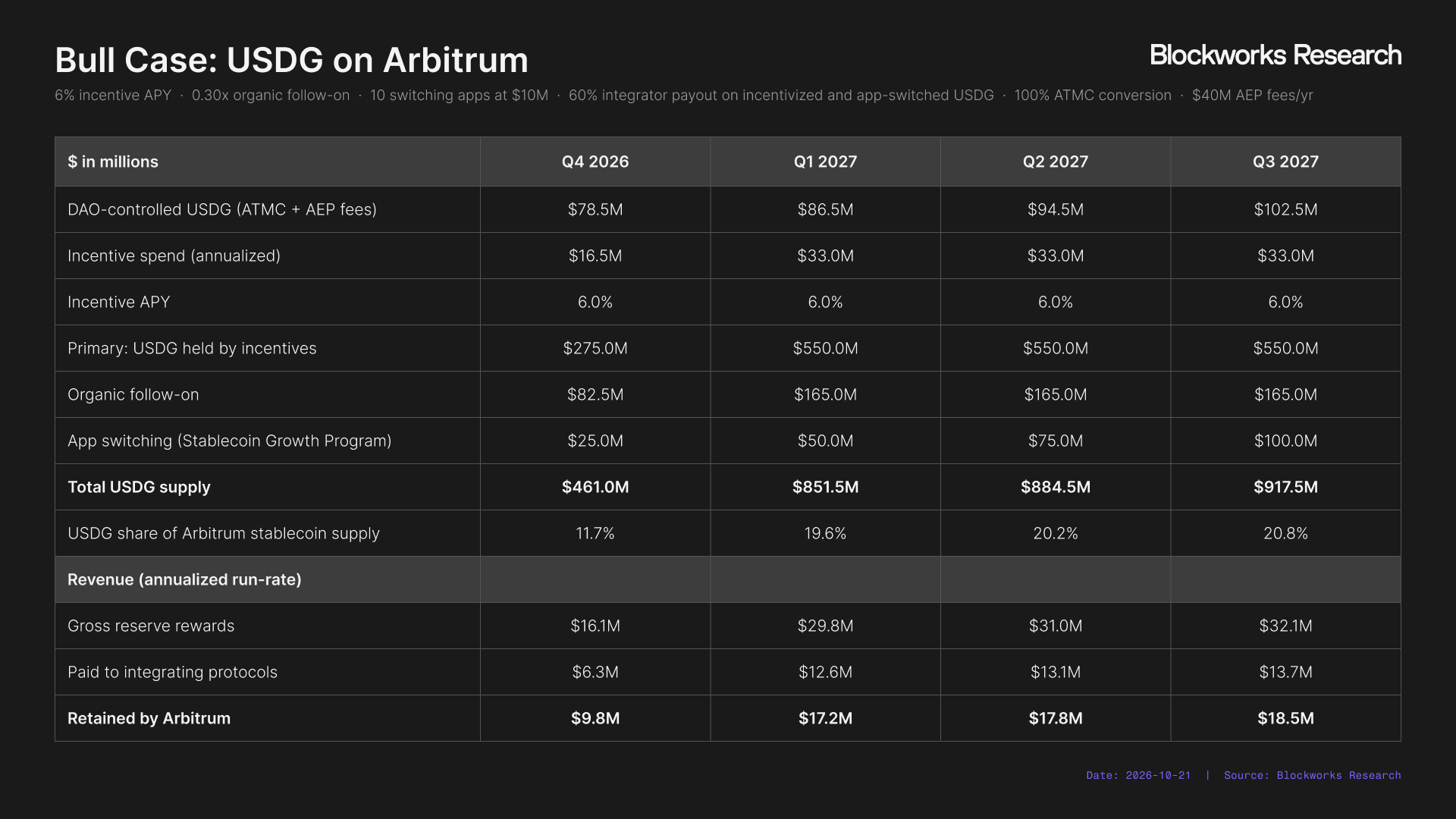
In the bull case, USDG becomes a genuine alternative across Arbitrum, with incentives needing to pay just 6%, organic adoption reaching $0.30 per incentivized dollar, and all 10 prize pool slots in the Stablecoin Growth Program filled. USDG supply reaches $918 million, or 21% of Arbitrum's stablecoin supply, generating $32.1 million in annual rewards, with $18.5 million retained by Arbitrum, equal to 80% of its income over the past twelve months, as integrators earn just 60% of the rewards on the incentivized and app-switched USDG they hold. For context, gross rewards would still be roughly a third of the $97.8 million Tether and Circle earned from Arbitrum stablecoins over the same period. These figures are highly sensitive to interest rates, as every 25 basis point cut in reserve income lowers retained revenue by roughly 7%.
Closing Thoughts: Beyond the Model
We return to the original question of this report: whether USDG can give Arbitrum a more durable business, and just how much it can realistically contribute. On the first half, the answer is yes, as USDG adds a revenue line that, unlike blockspace, tends not to rise and fall with speculation. On the second, our base case has USDG growing Arbitrum’s income by more than 40% by October 2027, and we view even that figure as conservative.
Ultimately, models can only take you so far, and ours projects USDG supply from just four sources (incentive programs, the organic adoption that follows them, apps that switch to USDG, and USDG held by the DAO itself). Those are not the only ways USDG will grow. Had we used the same approach to project USDC supply on Arbitrum in early 2023, it would have entirely missed Hyperliquid, which went on to bring billions of dollars in USDC to Arbitrum.
Arguably, the hardest part to project is also the most meaningful. All it takes is one breakout application to render a supply model moot, as Hyperliquid would have done to any USDC forecast. Because there is no reliable way to model when or where that application appears, we have left it out of every case, but that does not mean we expect it to be absent. Arbitrum is well positioned to host one, with an existing base of builders and some of the deepest DeFi liquidity of any L2, now paired with incentive dollars flowing toward those who build around USDG. Admittedly, it may take longer than a year, and predicting which application it will be is harder still.
Zooming out, the first year is likely the least representative period for USDG on Arbitrum. Our model captures the upfront push from incentives, but not what happens once the flywheel takes hold. Reserve rewards will fund more programs, those programs then attract more USDG, and more USDG generates more rewards. If that cycle gains momentum, USDG growth should continue well beyond our one-year horizon and may even accelerate.
This report was commissioned by the Arbitrum Foundation. By providing this disclosure, we aim to ensure that the research reported in this document is conducted with objectivity and transparency. All content was produced independently by the author(s) and does not necessarily reflect the opinions of Blockworks. or the organization that requested the report. The commissioning organization may have input on the content of the report, but Blockworks maintains editorial control over the final report to retain data accuracy and objectivity. Author(s) submit financial conflict of interest (FCOI) disclosures on a monthly basis that are reviewed by appropriate internal parties and may hold cryptocurrencies named in this report. This report is meant for informational purposes only. It is not meant to serve as investment advice. You should conduct your own research and consult an independent financial, tax, or legal advisor before making any investment decisions. Past performance of any asset is not indicative of future results. Please see our Terms of Service for more information.