Are GPU Compute Networks Supply or Demand Constrained?


Primer
GPU compute networks like Render and Akash are two-sided markets consisting of a supply of physical compute resources and demand-side users who consume the compute resources. To grow, the networks need to scale the demand from paying users as well as the supply of compute resources to attract and service customers. In practice, it is a bit of a chicken-and-egg-type problem, where suppliers need revenue to incentivize them to join, while at the same time, the demand side needs enough compute suppliers to handle their jobs.
In practice, growth comes in oscillating spurts of both demand and supply growth. And, one can assess the current state of compute networks and hypothesize whether the networks are waiting for demand growth or supply growth. Put another way, are the growth constraints for compute networks currently on the supply side or the demand side?
To give a sense of the current state of compute networks, Akash has nearly 1,200 open resource leases (demand) across 4,000 CPUs and 66 GPUs (supply). That represents a roughly 40% utilization rate of the 10,000 CPUs and 170 GPUs supplied to the network. More granularly, for highly demanded AI-focused A100 GPUs, Akash has nearly 100% utilization across 22 GPUs.
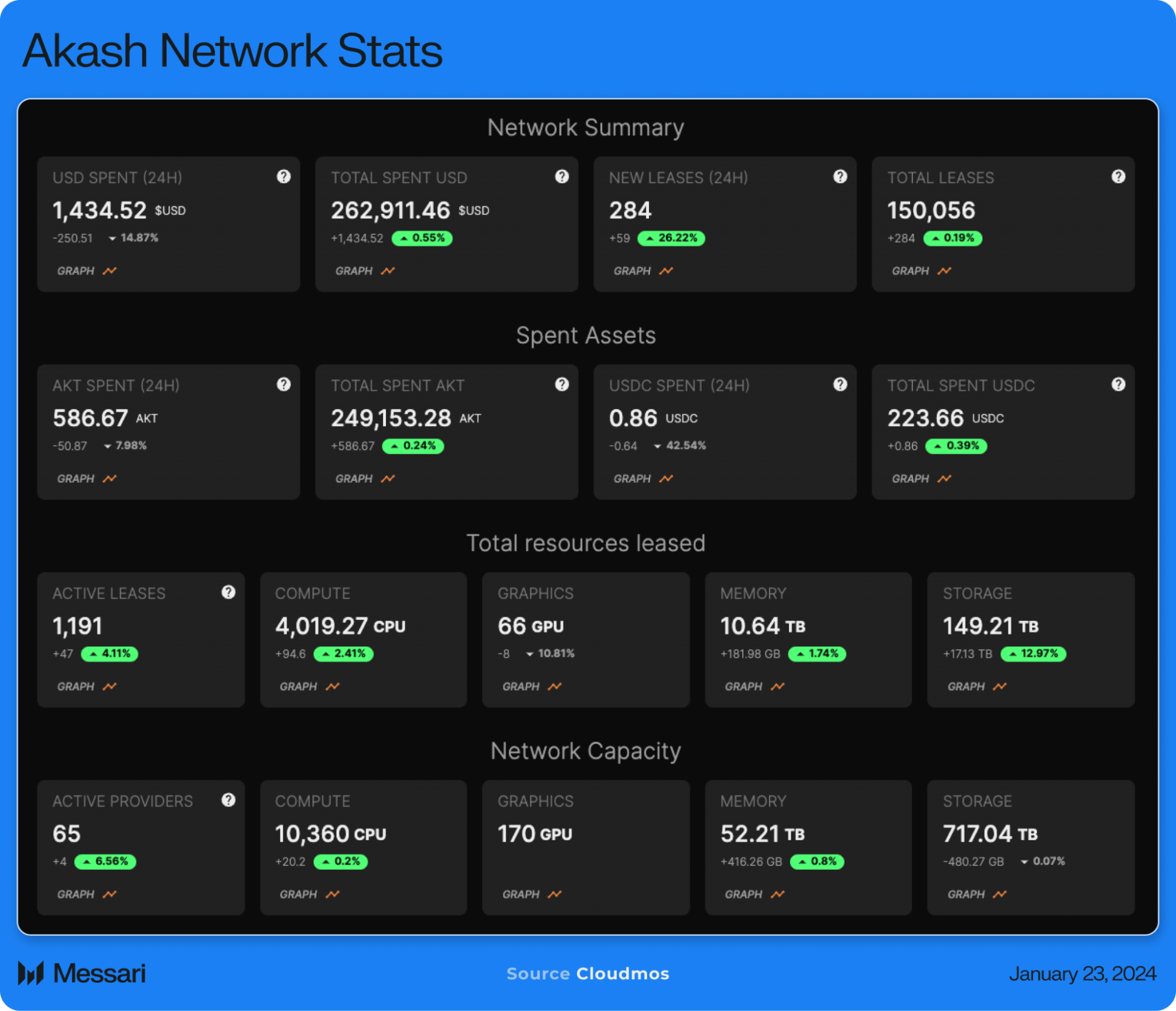
Across other GPU markets like Render, Nosana, and Livepeer, there are similar levels of lagging supply. Render is one of the largest with over 3,000 GPUs while Livepeer has an estimated 400 of weaker GPUs for transcoding and Nosana has over 60 GPUs specific for AI inference tasks.
Analyst Thoughts

Sami Kassab is an Enterprise Research Analyst focusing primarily on Web3 Infrastructure and Bitcoin. Sami previously spent 5 years as an Aerospace Engineer designing aircraft engines and missile & defense systems.

Toe is a technical research analyst at Messari specializing in DeFi coverage. Before joining Messari, he worked as a data scientist at both Celsius Network and IBM. Toe graduated from the University of Michigan School of Information.

Prior to joining Messari, Seth worked in traditional finance software and services, and has a MSc in Applied Mathematics. Seth is a Senior Research Analyst on the Enterprise Research team, and focuses on infrastructure, verifiable compute, and the AI x Crypto intersection.

Dustin was previously the Enterprise research director at Messari. He has a broad focus across crypto with a particular interest in AI x Crypto, Consumer financialization, DeFi, and general infrastructure.