Trading card games are functionally offchain NFTs, and Azuki is building the infrastructure to bring them onchain with the IP, chain, platform, and tokenized distribution mechanics already in place.
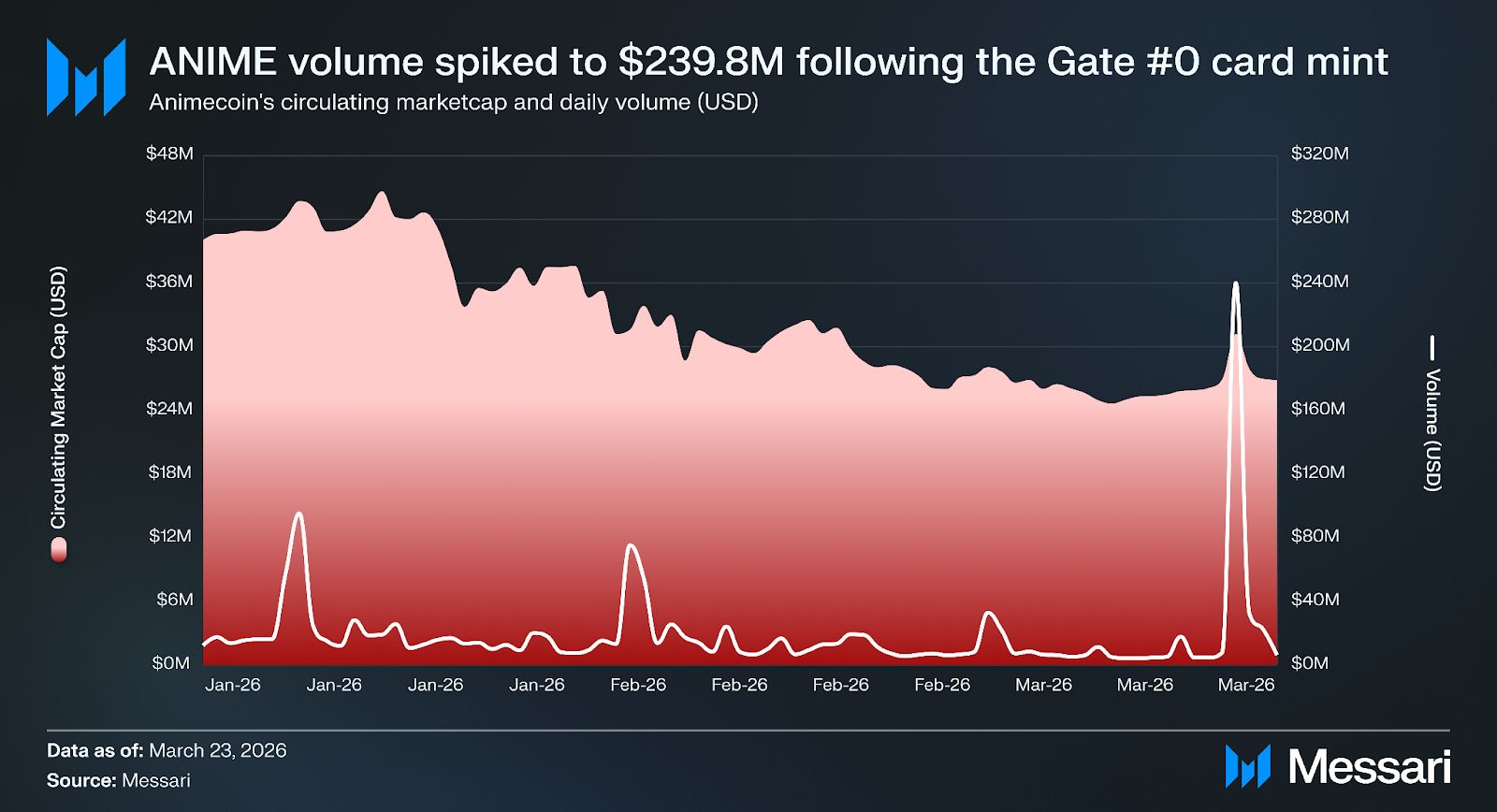
The free Gate #0 mint generated over 900K transactions in a single day and 615K card mints, driving $239.8 million in volume on Animechain.
The Phygitals Collector's Pass sold out within 90 minutes on April 9, 2026, becoming the first revenue-generating mint on Animechain, and proved that users will pay $ANIME for collectibles.
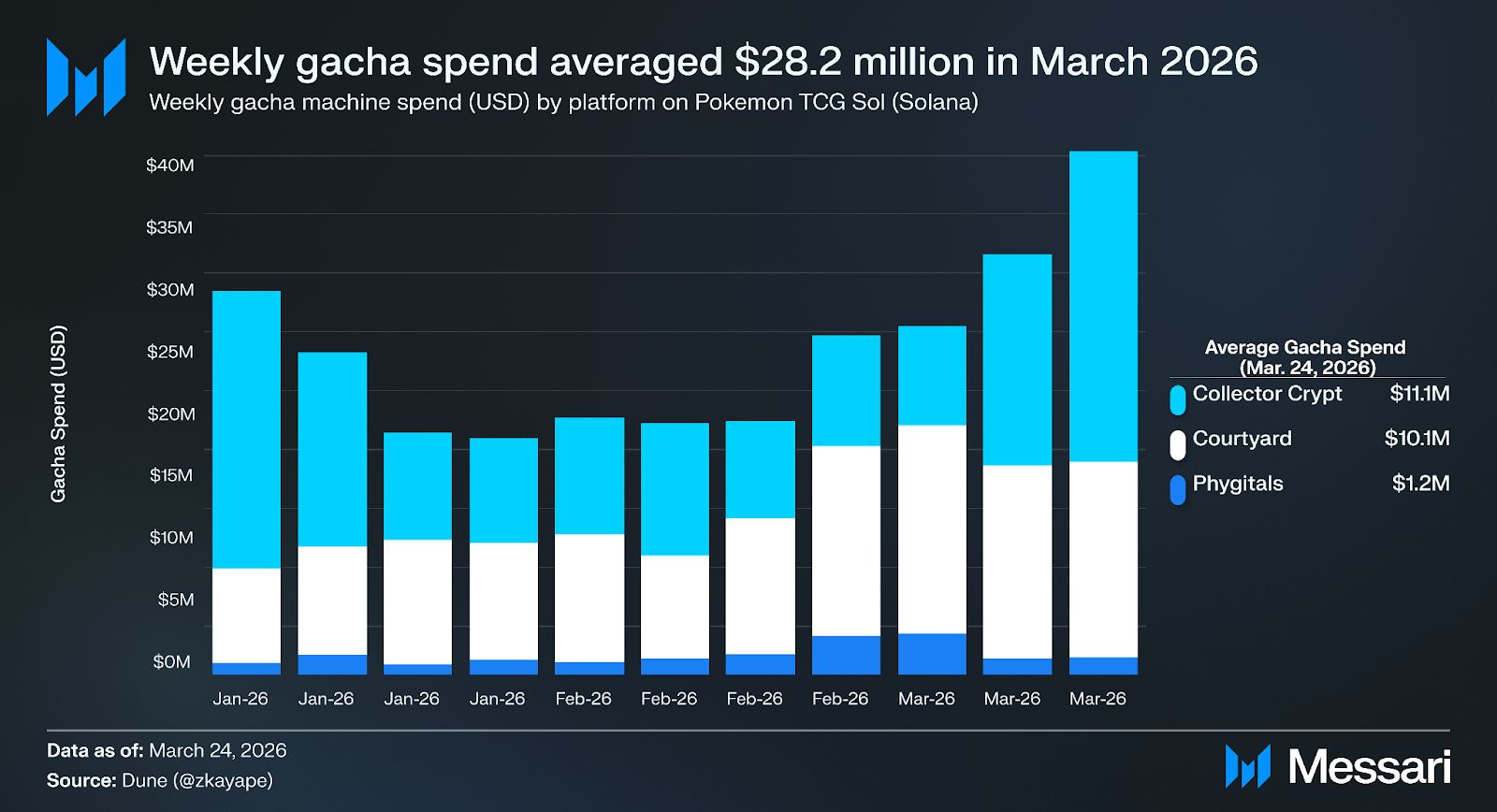
The gacha machine creates a recurring demand loop where every roll is an $ANIME transaction on Animechain. Pokémon TCG on Solana has generated $233.8 million in cumulative gacha spend on Solana since January 2026, proving demand is real.
The ecosystem is designed to onboard users through consumer products first, keeping blockchain branding out of the pitch entirely. Chain interaction becomes a byproduct of engaging with content rather than the entry point.
Introduction
Animecoin's origins trace back to the rise of flagship NFT collections that merged anime storytelling with digital ownership. Projects such as Azuki, Beanz, and Elementals created lore-driven communities that demonstrated anime-inspired intellectual property (IP) could thrive in Web3, cultivating global followings and commanding trading volumes. For many fans, Azuki represented the first bridge between anime and crypto, showing that emotional resonance could be expressed through tokenized ownership.
Animecoin builds directly on this foundation, scaling from NFT collections into a unifying culture coin designed to serve as the currency of anime's digital ecosystem. The token now functions as the entry point into a broader ecosystem that includes distribution platforms (Anime.com), creative production studios (Studio Azuki), infrastructure development (Animechain), and collectible economies in the form of trading card games (TCG). Trading card games are functionally offchain NFTs, and someone will eventually bring that model onchain, leveraging tokenization to deliver a better gaming and collecting experience. Azuki is attempting this by unifying the IP, a purpose-built chain, a consumer platform, and tokenized distribution into a single ecosystem.
Animecoin operates as the entry point to the anime economy, designed to circulate across these verticals and empowering fans to transact, discover, and interact with anime in new ways. This integrated model also introduces infrastructure through Animechain, a Layer-3 (L3) blockchain, community governance via AnimeDAO, and integration into commerce and payments (e.g., Shopify integration via DePay). Together, these components extend anime's cultural footprint into a tokenized economy spanning distribution, identity, and fan-driven engagement. For a full primer on Animecoin, refer to our Initiation of Coverage.
The latest Animechain launch, collect.anime.xyz operates on a gacha machine mechanic, Animechain's digital equivalent of Japan's capsule toy vending machines. In this system, users spend ANIME to receive a randomized collectible card, with rarer pulls carrying higher value. The gacha machine is the primary distribution and burn mechanic on Animechain, permanently removing supply from the system with each roll to create scarcity. This design connects competitive demand directly to onchain transactions without requiring users to identify as crypto participants or understand the underlying infrastructure.
Azuki TCG: Gates Awakened is the first set in the Azuki Trading Card Game. The competitive circuit is backed by a $100K prize pool and organized by CoreTCG, the official tournament organizer. For context, CoreTCG organizes events for Yu-Gi-Oh and Bandai nationally. The inaugural tournament season kicks off in Summer 2026, with invitational events already held in New York. For comparison, Pokémon Worlds pays $50,000 to the TCG Masters winner alone, so $100,000 across a full inaugural season is a meaningful but early-stage commitment.
The Gate #0 TCG Mint served as Animecoin's first proof of concept. Released on March 17, 2026, Gate #0 was a free commemorative digital card celebrating the TCG launch. It is not a playable TCG card, but rather the first real onboarding event for Animechain and the first transaction that gave ANIME holders a reason to bridge onto the network. Over 615,000 Gate #0 cards were minted natively on Animechain through OpenSea in a single day, generating 912,000 transactions and $239.8 million in volume (USD), representing more activity than the chain had seen in its entire prior history.
As the competitive scene grows and players roll more frequently, Animechain generates consistent daily transaction volume since every gacha roll is an ANIME transaction. None of this requires players to care about crypto; they just need to want competitive cards and rare collectibles.
The gacha model is already proven onchain with Pokémon TCG RWAs, a Solana-based trading card game, generating $233.8 million in cumulative gacha spend since January 2026. This equates to an average of $21.3 million per week and spiked to over $35.2 million in the week of March 16, 2026. Collector Crypt and Courtyard, the two largest gacha machines on the platform, each exceeded $110 million in total spend across the same period. The demand shows that when the cards are desirable and the competitive loop is real, players spend. The gacha machine is designed to replicate this mechanic on Animechain, with ANIME as the transaction currency. As the gas and transaction token on Animechain, every gacha roll, OpenSea trade, and card redemption on the chain settles in ANIME.
At the GAMA trade show, a TCG reviewer placed the gameplay as comparable to Bandai card games. If the Azuki TCG can attract and retain competitive players through gameplay, the demand loop is self-reinforcing.
Animechain as infrastructure
Animechain is the settlement layer of the Animecoin ecosystem, a Layer-3 (L3) built on Arbitrum Orbit and purpose-built for anime IP, collectibles, and consumer commerce. To date, the chain has processed over 1.82 million transactions across 701,000 wallet addresses.
The initial wave of consumer chain launches absorbed developer attention and grant capital through 2024 and early 2025, but momentum has faded. Abstract's bridge deposits peaked near $90 million in late 2025 before declining roughly 57% to around $39 million by March 2026. With less capital and fewer developers competing in the consumer chain space, Animechain can capitalize on its product offering, existing community, and IP relationships that took years to build.
The first third-party deployment came on March 17, 2026, when OpenSea went live on Animechain alongside the Gate #0 commemorative card mint. Beyond Azuki's own products, builders are already deploying licensed IP on the chain. Phygitals, a platform bridging physical and digital collectibles, is bringing licensed One Piece and Pokémon cards to Animechain through collect.anime.xyz, extending the chain's collectible footprint beyond Azuki IP. Relationships with major anime franchises require trust, legal infrastructure, and brand alignment that take years to build. If Animechain accumulates additional anime IP licenses over time, it will develop a catalog where fans arriving for one franchise encounter others on the same platform, compounding the chain's defensibility.
On April 9, 2026, the Phygitals Collector's Pass became the first revenue-generating mint on Animechain. Sold through OpenSea for 9,800 ANIME per mint (~$45 USD), the 300-item mint sold out in approximately 90 minutes after the whitelisted mint opened. Holders of Azuki, Elementals, Beanz, and Moonbirds NFTs received priority access, with each wallet limited to two passes. Each pass is redeemable for a Base Pack worth $50 on collect.anime.xyz, with a 1-in-300 chance at a Gold Collector's Pass and one Plus Ultra Pass redeemable for $1,000 in physical collectibles. Where Gate #0 proved Animechain could handle transaction volume, the Collector's Pass proved users will pay for it. The mint generated roughly $13,500 in revenue for ANIME from 300 mints.
Offchain-first Distribution
The Animecoin ecosystem is not being marketed as a crypto product to its target audience. Instead, the team has deliberately kept blockchain branding out of the pitch to anime and TCG fans. Research on brand NFT campaigns has found that crypto associations damage consumer perception of the parent brand, and 70% of Americans remain unfamiliar with NFTs. Crypto branding causes the target demographic to categorize the product as a scam rather than a game or collectibles experience.
Azuki's brand already addresses this perception gap and commands notable attention in mainstream channels. The team debuted TCG-character-based fashion on the runway at Paris Fashion Week in January 2026 through a collaboration with 424, and the Elements of Time watch collection with H. Moser & Cie. placed Azuki IP in the luxury market. These efforts serve an offchain-first logic where the anime and collectibles audience needs to take the brand seriously before encountering any onchain interaction.
Anime.com is the consumer-facing surface for the ecosystem. The platform has accelerated its feature release pace through early 2026, launching the Animecoin Top 40 Anime Chart with Parrot Analytics, the first global demand-based anime ranking system, and partnering with Aniplex of America to bring Fate/strange Fake digital collectibles to the platform, marking the first licensed non-Azuki IP on Anime.com. Recent additions include digital collectible rooms where users can display and curate their collections, and a collector score system that rewards engagement. Anime.com is designed as the consumer-facing surface for the Animechain, with many features like wallet abstraction already live on Animechain and further web3 integrations planned for H2 2026.
The bridge between offchain fans and onchain activity is intentional product architecture. Users discover anime.com, engage with the TCG or collectible rooms, and when they want to acquire specific cards or redeem physical collectibles, they interact with Animechain through a Privy wallet integration that is streamlined enough to feel like a traditional payment rather than a blockchain experience. The design does not require users to identify as crypto participants or understand the underlying infrastructure. To date, >1M unique Anime.com users have created an Animechain wallet through this integration.
Precedent exists at scale. Pudgy Penguins sells physical toys at over 3,000 Walmart locations with QR codes linking to onchain experiences, where the chain interaction is a byproduct of engaging with a product rather than the featured experience. Azuki is following the same template.
Conclusion
Azuki is building a vertically integrated anime media brand where blockchain infrastructure sits underneath consumer products rather than in front of them. Anime.com, the TCG, and licensed IP partnerships are designed to acquire users through content and culture first, with Animechain handling settlement in the background. Gate #0 generated over 900K transactions in a single day on Animechain, suggesting the architecture has real potential to scale. The TCG has a committed tournament circuit with a $100K prize pool, third-party builders like Phygitals are already deploying licensed IP on the chain, and anime.com's integration path to Animechain is planned for H2 2026.
While the gacha machine has not launched and anime.com's Animechain integration is not expected until H2 2026, the demand pattern from Pokémon TCG Sol on Solana shows what happens when the cards are desirable, and the competitive loop is real. Everyone is writing off NFTs and blockchain gaming, while the biggest consumer trend of the past year has been the rise of trading card games. Someone is going to crack this onchain, and Azuki is making the most credible attempt.
This report was commissioned by Animecoin Foundation. All content was produced independently by the author(s) and does not necessarily reflect the opinions of Messari, Inc. or the organization that requested the report. The commissioning organization may have input on the content of the report, but Messari maintains editorial control over the final report to retain data accuracy and objectivity. Author(s) may hold cryptocurrencies named in this report. This report is meant for informational purposes only. It is not meant to serve as investment advice. You should conduct your own research and consult an independent financial, tax, or legal advisor before making any investment decisions. Past performance of any asset is not indicative of future results. Please see our Terms of Service for more information.
No part of this report may be (a) copied, photocopied, duplicated in any form by any means or (b) redistributed without the prior written consent of Messari®.