ANIME functions as a culture coin that blends symbolic affinity with transactional utility. It circulates across distribution, governance, content, and collectibles to unify anime fandom into a tokenized economy.
Animechain, adedicated Layer-3 blockchain built on Arbitrum Orbit, provides the settlement layer for microtransactions and fan-driven applications. It enables low-cost, high-frequency engagement aligned with anime-native use cases.
Anime.com serves as the protocol’s discovery and engagement hub, integrating ANIME into content access, community-driven charts, and gacha-style mechanics, bridging traditional media distribution with Web3-native participation.
In August 2025, Animecoin partnered with GameSquare to expand the token’s role in digital asset treasuries, adding a new layer to its applications across gaming ecosystems.
Introduction
Anime has evolved from subcultural fandom into a mainstream force, shaping digital communities and intellectual property.
Against this backdrop, Animecoin emerges as a culture coin whose value proposition rests less on technical novelty and more on cultural resonance; ANIME allows users to transact across the anime ecosystem and take part in a shared medium of participation within the anime industry. The token becomes a vehicle for fans to express their affinity for the anime industry, while simultaneously gaining access to digital experiences, collectibles, and community-driven economies.
Importantly, Animecoin functions as the entry point into a broader ecosystem that includes distribution platforms (Anime.com), infrastructure development (Animechain), and collectible economies in the form of trading card games (TCG). The token is designed to circulate across these verticals, empowering fans to transact, discover, and interact with anime in new ways. This integrated model reframes Animecoin as more than a standalone currency; it is the connective protocol binding together the components of a digitally native anime economy.
Background
Ethos and Historical Context
Animecoin’s origins trace back to the rise of flagship NFT collections that merged anime storytelling with digital ownership. Projects such as Azuki, Beanz, and Elementals created lore-driven communities that demonstrated anime-inspired intellectual property (IP) could thrive in Web3, cultivating global followings and commanding trading volumes.
For many fans, Azuki represented the first bridge between anime and crypto, showing that emotional resonance could be expressed through tokenized ownership. NFTs proved anime fandom could sustain financialized participation; Animecoin builds directly on this foundation, scaling from NFT collections into a unifying culture coin designed to serve as the currency of anime’s digital ecosystem.
Animecoin also represents an upgrade to this model. Beyond collectibles, it introduces a broader infrastructure layer through Animechain (Layer 3 blockchain), community governance via AnimeDAO, and integration into commerce and payments (e.g., Shopify integration via DePay). Together, these components extend anime’s cultural footprint into a tokenized economy spanning distribution, identity, and fan-driven engagement.
Core Contributors
The Animecoin Foundation oversees governance, infrastructure, and ecosystem growth. The foundation’s efforts expand anime’s cultural and financial presence onchain by funding community initiatives, scaling infrastructure, and guiding Animecoin’s evolution as a cultural currency.
Azuki Labs, the team behind Web3’s iconic anime-inspired NFT collection, serves as a core contributor to Animecoin by building products such as Anime.com and Azuki TCG to drive ANIME adoption.
Technology and Products
Animecoin is structured around an integrated ecosystem that connects infrastructure, distribution, content creation, and collectibles under a single token economy. At the foundation sits Animecoin (ANIME), which anchors transaction flows, governance, and access rights across the network. Ecosystem platforms such as Anime.com serve as industry discovery and distribution hubs. Azuki IP-inspired trading card games (TCG) and merchandise drops extend the protocol into further consumer engagement.
Animechain: Layer 3 Infrastructure
Animechain is under development as a Layer 3 blockchain built on top of Ethereum and Arbitrum Orbit. It is envisioned as specialized infrastructure for the Animecoin ecosystem, designed to handle high-volume transactions tied to digital collectibles, fan economies, and anime-native applications. While still in early rollout, Animechain represents the settlement layer that will enable Animecoin to move beyond symbolic value and function as a currency embedded in day-to-day fan interactions.
General-purpose L1 and L2 networks often face congestion and higher fees, limiting support for low-cost, high-frequency activity. A Layer 3 design provides a baseline framework for crypto economies that rely on microtransactions. By leveraging Arbitrum Orbit, Animechain inherits Ethereum’s security guarantees while benefiting from Arbitrum’s scaling model and can tailor execution logic to the unique requirements of anime applications. This architecture enables lower fees, faster confirmation times, and a user experience aligned with consumer-grade engagement.
As a vertically-integrated L3, Animechain’s proposed functions include:
Collectibles: Onchain issuance and exchange of trading cards, NFTs, and anime-inspired items.
Payments: A medium for in-app purchases across platforms such as Anime.com.
Identity and Reputation: Support for anime-native identity primitives like Anime ID, which track engagement and onchain reputation across fan communities.
Community Governance: A venue for AnimeDAO proposals and decision-making, embedding community alignment directly at the infrastructure layer.
As of September 2025, Animechain has not launched on mainnet, though testnet development is underway with a roadmap that emphasizes low-cost microtransactions and third-party dApp integrations.
An Overview of ANIME
Historically, fans have engaged with anime through streaming, merchandise, and events, while investors accessed the sector indirectly through media companies with anime exposure. Animecoin reframes this relationship by introducing a tokenized instrument that captures sector-wide activity. ANIME is a culture coin within the Animecoin ecosystem that encapsulates the identity and collective participation of anime fandom while also functioning as a financial instrument for the industry.
The central proposition of Animecoin is that anime can be treated not only as cultural output but also as an asset class with investable qualities. Its value is derived from four functional pillars: media distribution, governance, commerce, and community.
On Anime.com, the token facilitates discovery-driven engagement. Collectibles, such as Azuki’s trading card game (TCG), are purchasable with ANIME, embedding transactional demand into fan economies. Animechain, a Layer 3 blockchain built on Arbitrum, provides the settlement layer for these activities with low-cost, high-speed execution tailored to anime applications.
Animecoin’s role also extends into commerce and payments, with integrations such as Shopify via DePay, allowing ANIME to be used across both Web2 and Web3 merchants. The token anchors digital collectibles, supported by partnerships with platforms such as OpenSea, further reinforcing its role in NFT issuance and trading.
Tokenomics & Unlock Schedule
Animecoin held its Token Generation Event (TGE) in January 2025, distributing an initial 5.5 billion ANIME into circulation. Early distribution included airdrops to Azuki NFT holders and partner communities, anchoring the token’s launch in existing fan networks.
Within governance, Animecoin is embedded within the AnimeDAO, which manages 13% of the total supply (1.3 billion tokens) for community cultivation. AnimeDAO empowers fans and creators to propose and vote on funding allocations, ranging from grants for artists to partnerships with Web3-native projects such as Hyperliquid and KaitoAI. Unclaimed tokens from Azuki distributions may be redirected to this pool, ensuring continuous resourcing for grassroots initiatives and community-driven innovation.
Community and Governance: Governance is coordinated through AnimeDAO and Azuki sub-communities, with resources allocated via the Community Fund. Token holders shape funding, incentives, and ecosystem priorities, reinforcing Animecoin’s position as a fan-aligned currency.
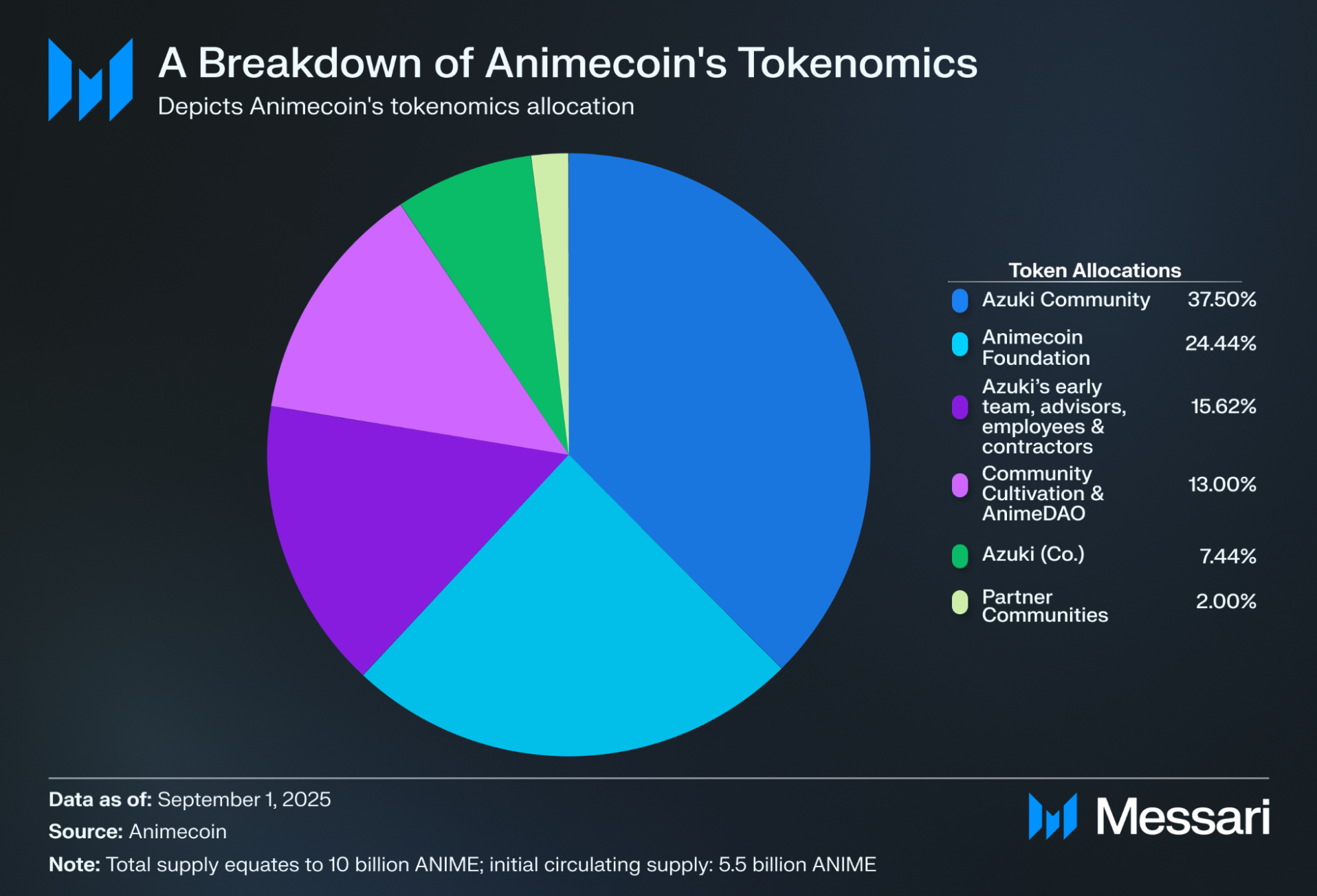
Animecoin has a fixed supply of 10 billion ANIME, with an initial circulating supply of 5.5 billion ANIME. The allocation is as follows:
Azuki Community (37.50%): Allocated to Azuki, Beanz, and Elementals holders as early supporters. Any unclaimed tokens revert to the Community Cultivation pool.
Animecoin Foundation (24.44%): Allocated to ecosystem growth, including grants, launch operations, and ongoing foundation initiatives.
Team and Advisors (15.62%): Allocated to Azuki employees, contractors, and advisors with a one-year cliff followed by linear vesting over three years.
Community Cultivation and AnimeDAO (13.00%): Managed by ANIME holders through AnimeDAO to fund incentives and initiatives.
Azuki Co. (7.44%): Allocated to Azuki as a continuing contributor and adopter of Animecoin. Tokens vest over three years with a one-year cliff.
Partner Communities (2.00%): Allocated to aligned partners such as Hyperliquid (HYPE stakers), Kaito, Arbitrum communities, and other anime-native projects. Fully unlocked at launch.
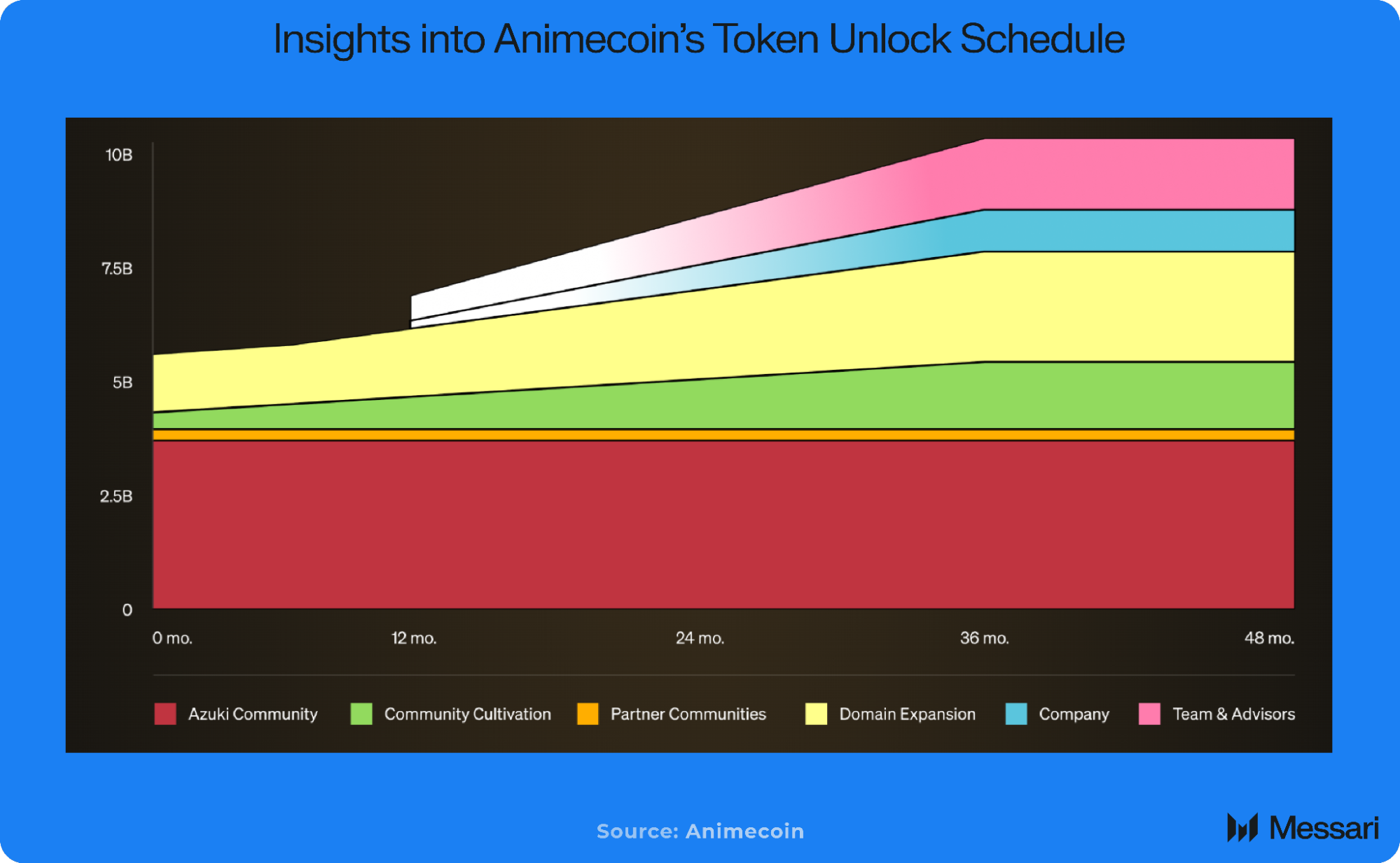
ANIME’s token unlock schedule allows for the gradual release of tokens into circulation, as follows:
At launch: Azuki Community (100% of allocation), Partner Communities (100% of allocation), Community Cultivation (25% percent of allocation), and ANIME Foundation (51.7% of allocation).
After one year: Team and Advisor, and Azuki Co. allocations begin vesting after a 12-month cliff.
Over three years: Remaining Community Cultivation tokens vest monthly. Team and Advisor tokens and Azuki Co. tokens vest monthly after the one-year cliff.
Over 30 months: Remaining Foundation tokens vest monthly after a six-month cliff.
By the end of year four, all 10 billion ANIME will be unlocked, with distribution balanced across community, foundation, and contributor allocations.
Anime.com Platform
Anime.com is envisioned as the distribution and discovery hub of the Animecoin ecosystem. Rather than serving as a standalone streaming site, it is designed as a fan-facing discovery and engagement hub, offering catalog navigation, media participation, and token-based integration. Its purpose is to address a structural challenge in the anime industry, such as fragmented rights across regional distributors and production committees, which force fans to manage multiple subscriptions and platforms. Anime.com positions itself as a platform that complements different stakeholders within the industry, such as Crunchyroll. By curating catalogs, promoting titles, and layering community engagement, Anime.com seeks to streamline the distribution of anime.
Anime.com distinguishes itself from traditional streaming platforms through its integration with ANIME, shown in several different ways:
Access to premium or exclusive content for ANIME holders.
Participation in community-driven rankings (e.g., the “Animecoin Top 40 Anime Chart”).
Gacha-style engagement with collectibles linked to anime titles. The “Gacha Grab” game allows users to spend ANIME for randomized digital rewards, mirroring the mechanics of Japan’s popular capsule-toy machines.
Anime.com also acts as a bridge between traditional media and Web3-native applications. By embedding transactional rails directly into content discovery, Anime.com moves beyond passive consumption toward interactive engagement.
Azuki Trading Card Game
An illustrative example of Azuki’s IP strategy is its trading card game (TCG). Initially conceived as a standalone product, the game has evolved into a strategy linking casual fans to the broader Animecoin economy. Players who begin by purchasing physical or digital cards are drawn deeper into the ecosystem through collectibles and exclusive drops. TCG products are purchasable through ANIME, directly tying fan enthusiasm to token demand.
In practice, Animecoin’s extension into trading card games illustrates how anime fandom and culture can further extend into both physical and digital formats. The game diversifies adoption touchpoints beyond Anime.com, anchoring Animecoin in a global community of players and collectors. Azuki’s TCG demonstrates how anime IP can be successfully leveraged across various formats. Characters and narratives introduced through Azuki lore are reinterpreted as playable cards, extending their reach and deepening attachment. Unlike static collectibles, cards evolve through gameplay, community trading, and digital tie-ins. This dynamic keeps IP active across multiple media while preserving a unified identity.
Ecosystem Overview
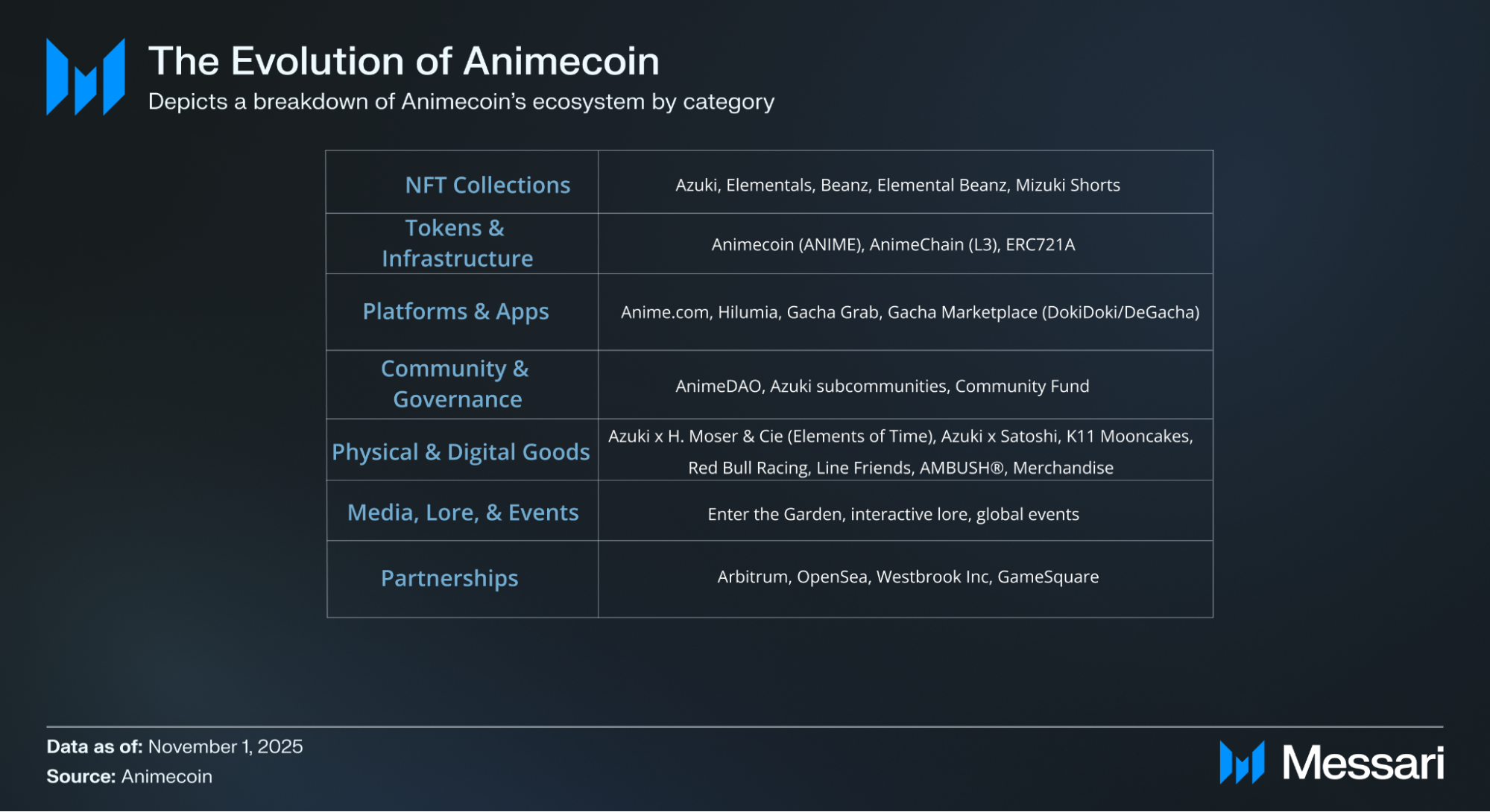
The Animecoin ecosystem spans infrastructure, distribution platforms, governance frameworks, and cultural products, with each component feeding into Animecoin’s utility as a transactable culture coin. By combining NFTs, gaming, identity, and content distribution under a single framework, Animecoin positions itself as the connective layer of a digitally native anime economy.
Beyond core elements, Animecoin’s broader ecosystem includes a range of cultural products, identity tools, and strategic partnerships that extend its reach across both Web3 and traditional entertainment sectors.
Physical and Digital Goods: Animecoin extends into commerce with merchandise and hybrid products, including past Azuki collaborations with AMBUSH, Red Bull Racing, and Line Friends. The protocol has even run adjacent to the luxury watch industry, shown in Azuki’s collaboration with H. Moser & Cie through Elements of Time.
Partnerships: Strategic collaborations with Arbitrum, OpenSea, Westbrook Inc. (entertainment VC founded by actor Will Smith and his wife, actress Jada Pinkett Smith), and others expand Animecoin’s reach across both crypto-native and mainstream entertainment channels. Importantly, announced in August 2025, the protocol’s partnership with GameSquare is a highlight of Animecoin’s initiatives in the digital asset treasury (DAT) space, positioning the protocol at the intersection of esports, gaming, and onchain treasury management.
This presence is amplified through Animecoin’s partnership with Parrot Analytics, which launched the industry’s first official Global Top 40 Anime Chart. The chart provides monthly rankings of the most in-demand anime worldwide, establishing Animecoin as a co-branded authority in the entertainment data landscape.
Closing Summary
ANIME is firmly positioned as the first anime culture coin, a token designed to unify fandom, commerce, and governance into a single digital economy. Built on the foundation of Azuki’s NFT ecosystem, which proved anime-inspired IP could thrive in Web3, Animecoin expands this model into a standardized ecosystem that represents both cultural identity and financial utility.
The protocol’s design centers ANIME as the connective currency across ecosystem verticals: Animechain as the infrastructure, Anime.com as a discovery platform, and fan-driven initiatives such as Azuki’s trading card game.
By tying these components together under one token, ANIME consolidates the anime industry’s fragmented landscape into a unified token where cultural participation and financial utility converge.
This report was commissioned by Animecoin Foundation. All content was produced independently by the author(s) and does not necessarily reflect the opinions of Messari, Inc. or the organization that requested the report. The commissioning organization may have input on the content of the report, but Messari maintains editorial control over the final report to retain data accuracy and objectivity. Author(s) may hold cryptocurrencies named in this report. This report is meant for informational purposes only. It is not meant to serve as investment advice. You should conduct your own research and consult an independent financial, tax, or legal advisor before making any investment decisions. Past performance of any asset is not indicative of future results. Please see our Terms of Service for more information.
No part of this report may be (a) copied, photocopied, duplicated in any form by any means or (b) redistributed without the prior written consent of Messari®.