An Update on zkEVM Progress and Development

Top of Mind
zkEVMs have the ability to help scale Ethereum while maintaining its security and decentralization guarantees. They are architectured to deliver a significant reduction in transaction cost and an increase in throughput, surpassing the capabilities of the fully EVM-compatible Optimistic Rollups. Developing zkEVMs has been a challenging task because the EVM does not natively support Zero-Knowledge proofs, which makes the upcoming mainnets highly anticipatory events. Several zkEVMs are actively developing toward mainnet, with many already on testnet. Most of these projects are on track to launch on mainnet sometime in 2023.
zkEVM Progress Report
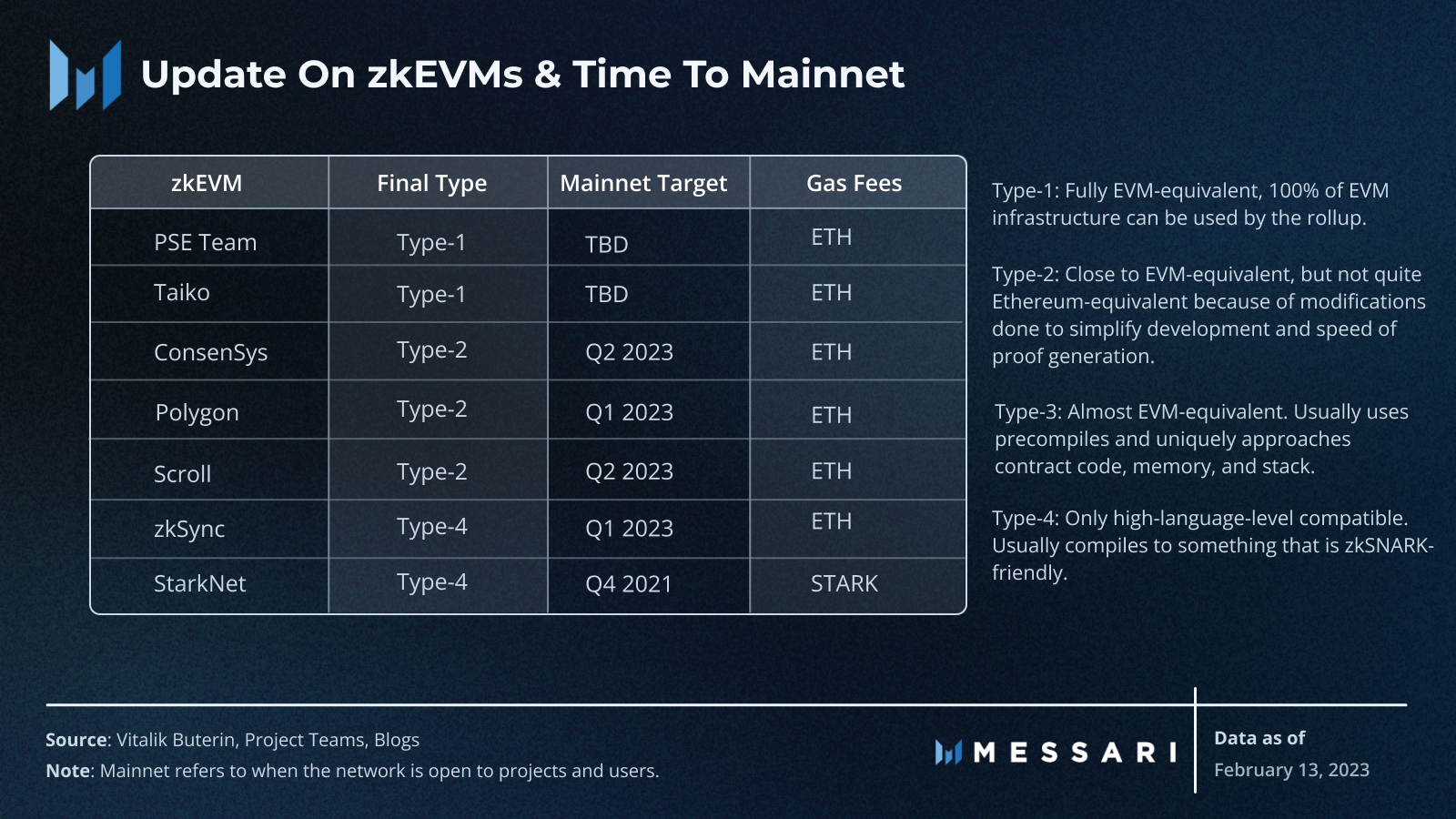
We use Vitalik's zkEVM classifications to map the projects according to EVM equivalency. Type-1 is exactly Ethereum-equivalent, which means that the rollup can re-use 100% of EVM infrastructure. Type-2 and Type-3 fall in the middle of the spectrum, trading some minor changes for compatibility. Type-4 is the least EVM compatible, striving to compile some EVM code but sacrificing compatibility with most Ethereum apps.
Type-1
The Ethereum Foundation’s Privacy and Scaling Explorations (PSE) team and Taiko chose to take on the hefty task of building a Type-1 zkEVM. Type-1 zkEVMs make no compromises in achieving equivalency. Even after completing the implementation and auditing process will probably take a minimum of several months to complete.

Eshita is a Research Analyst at Messari focused on Web3 topics. Previously, she was a Venture Fellow at Bloomberg Beta and prior to that was working on data at Shareworks by Morgan Stanley.