
Executive Summary
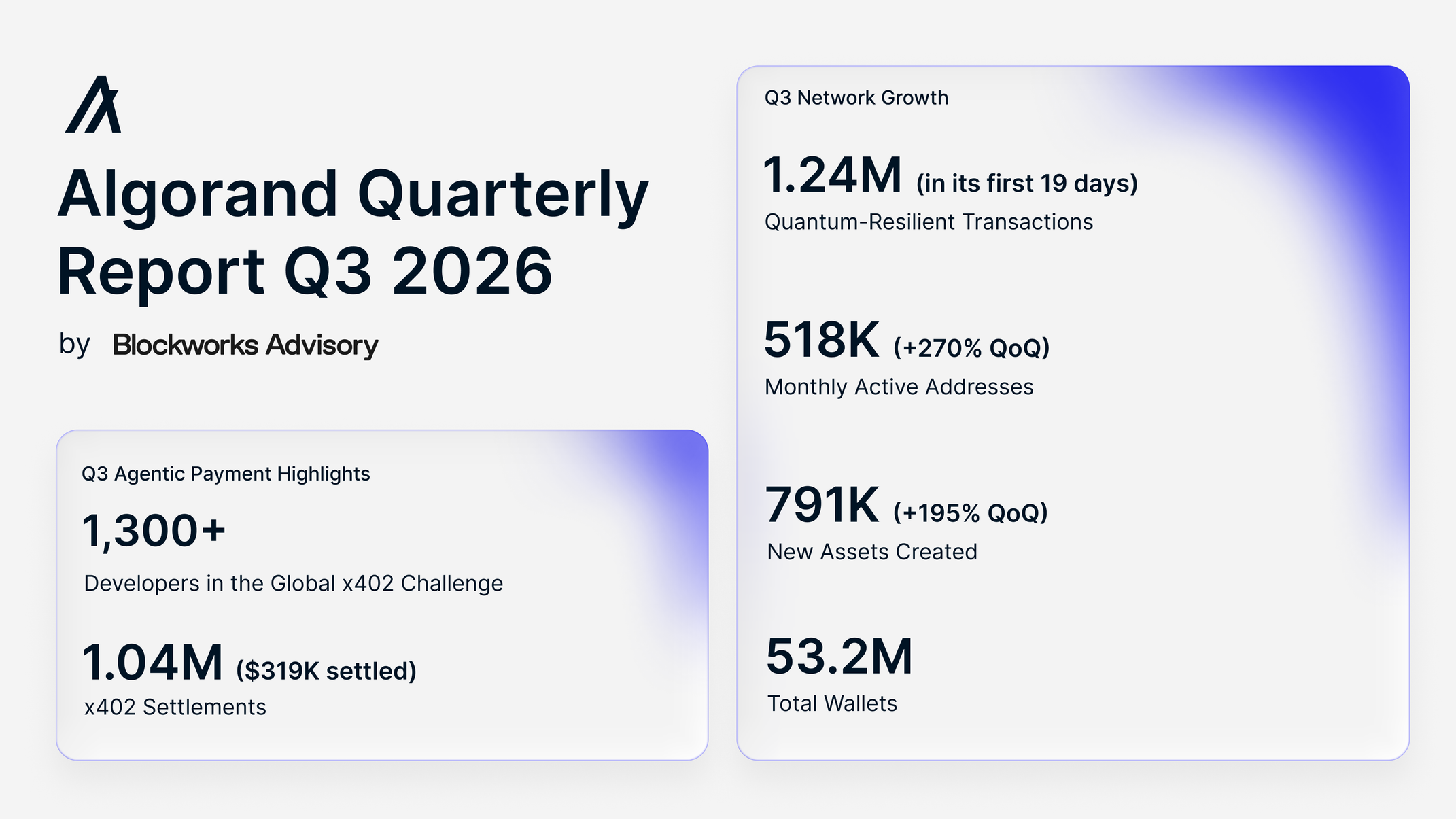
Algorand shipped the first deliverable of its post-quantum roadmap in Q3. Algorand 5.0 made Falcon-1024 accounts a native part of the protocol in late August. In its first 19 days, the network recorded 1,800 quantum-resilient accounts and 1.24 million quantum-resilient transactions, and Pera Wallet attributes more than 500,000 of August's post-quantum transactions to its commemorative NFT campaign.
Algorand also changed leadership. William Herkelrath became chief executive of Algorand on August 31, succeeding Staci Warden after nearly five years, and he has made self-sustainability the first priority of what the company calls Algorand 2.0. His stated plan is to sell services the market will pay for, then use that revenue to become a net buyer of ALGO and raise payouts to node operators.
Agentic payments became measurable over the same quarter. x402 payments settled through the GoPlausible facilitator on Algorand reached 1.04 million successful settlements and $319,000 in settled volume, although daily activity fell sharply after the first week of September.
On the real-world side, HesabPay serves more than 1 million users and moves about $183 million a month on Algorand, according to the company. Algorand also partnered with Flow Traders to give institutional counterparties access to ALGO.
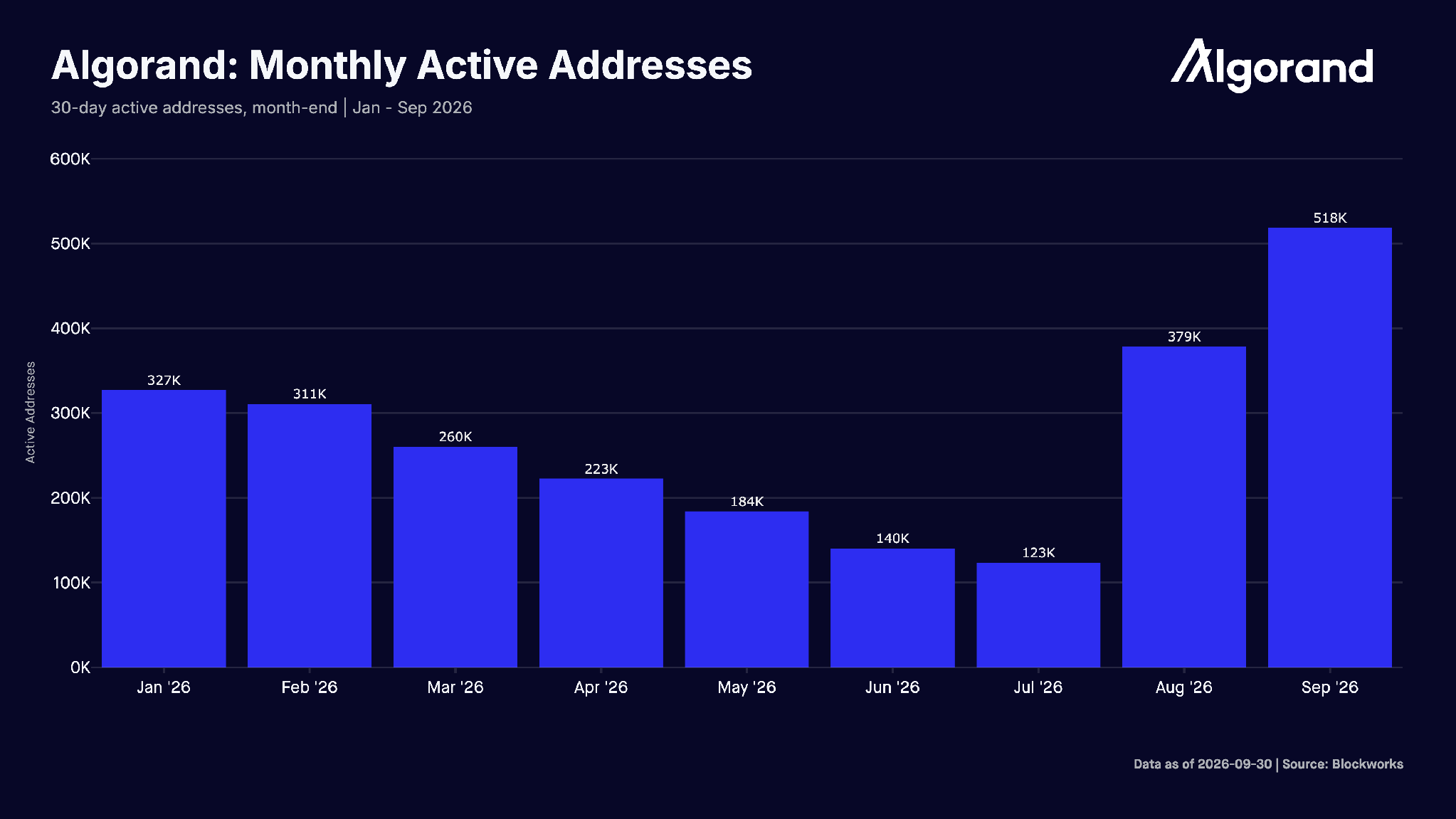
Network usage softened. Transactions totaled 104.9 million, down 13.8% from Q2, and fees at Pact, Alpha Arcade, and Haystack roughly halved to $17,500. Consensus security held. At the end of September, 1.97 billion ALGO was staked, with the community holding 80.1% of it. Monthly active addresses climbed from 140,000 at the end of June to 518,000 at the end of September, and builders created roughly 791,000 new assets, up from 268,000 in Q2, though most were short-lived tokens.
Native post-quantum multisignature support for institutional and treasury operations comes next on the roadmap, planned by the end of 2026. The Global x402 Challenge, which closed submissions on September 30, held its finals virtually in October.
Network & Financial Overview
Consensus and staking economics
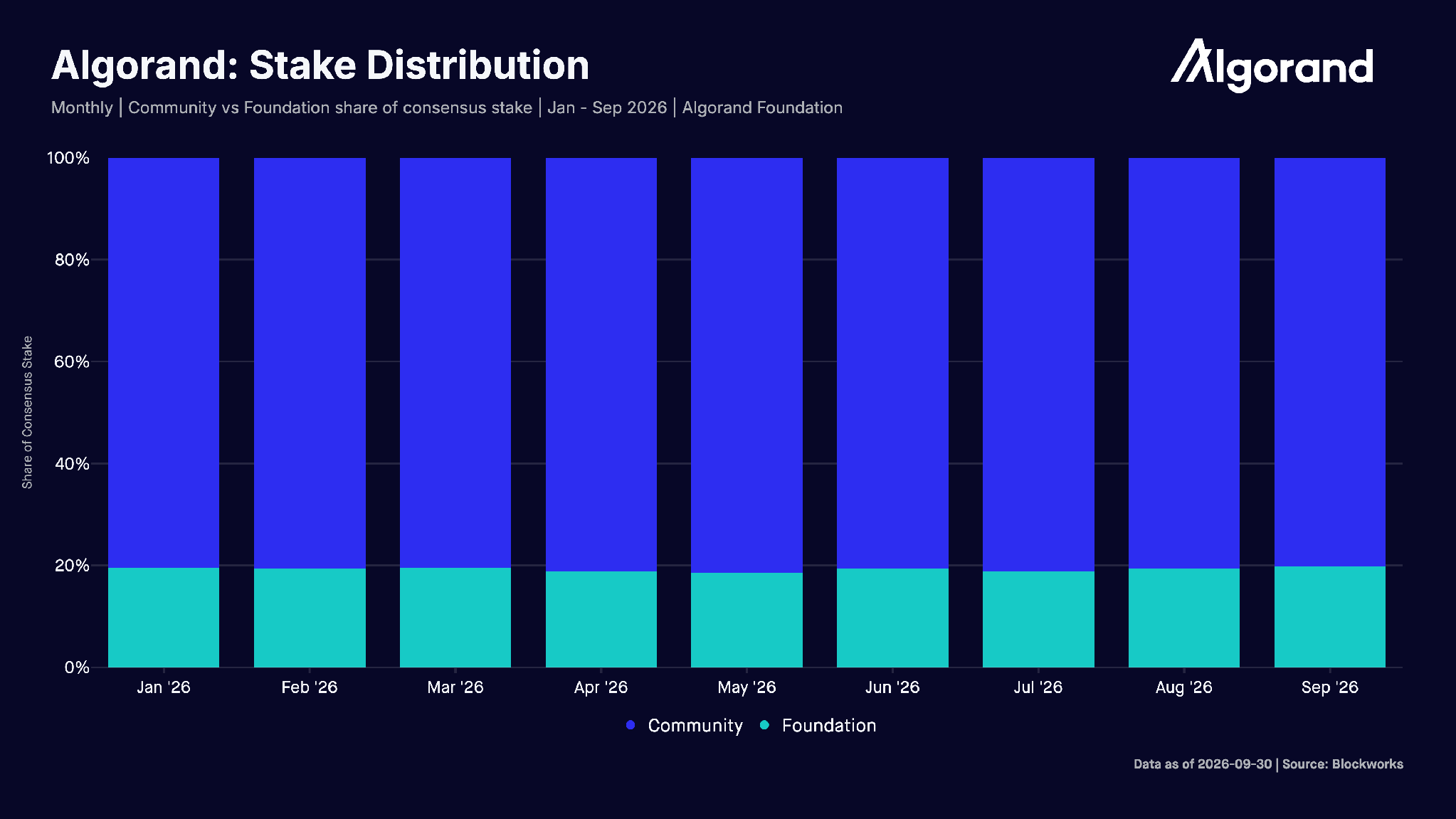
Stake committed to Algorand's Pure Proof-of-Stake (PPoS) consensus held near first-half levels. Total ALGO staked moved from 2.07 billion in July to 2.02 billion in August, and 1.97 billion in September. The community's share held between 81.1% and 80.1%, with Algorand’s own stake steady at about 392 million ALGO. The community has carried more than 80% of stake in every month reported this year. Circulating supply reached 9.06 billion ALGO at the end of September, 90.6% of the maximum, and three digital-asset treasury companies held about 6.38 million ALGO, unchanged through the quarter.
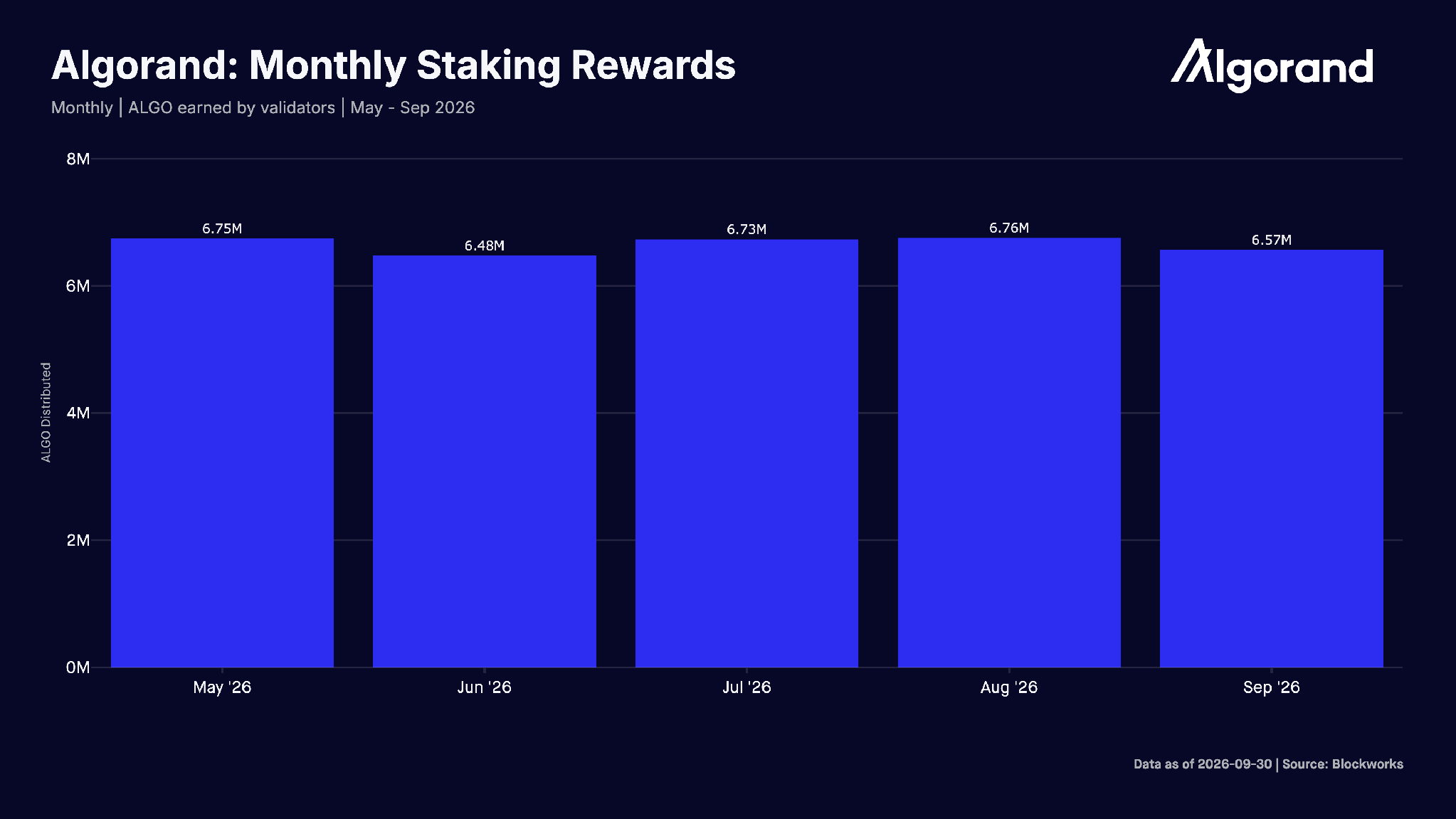
Validators earned 20.06 million ALGO in staking rewards in Q3, between 6.57 million and 6.76 million a month. Those rewards ran roughly 180 to 220 times the network's monthly fee income. Algorand pays the rewards from its own holdings, which stood at 1,036 million ALGO on June 30 after 20.1 million ALGO of staking rewards went out in Q2. It has committed to extend its support for bonus staking rewards for another year, to January 2028.
The validator count rose 3.3% during the quarter, from 1,530 at the end of June to 1,580 at the end of September, after falling from 1,711 in January.
Network Activity and Fees
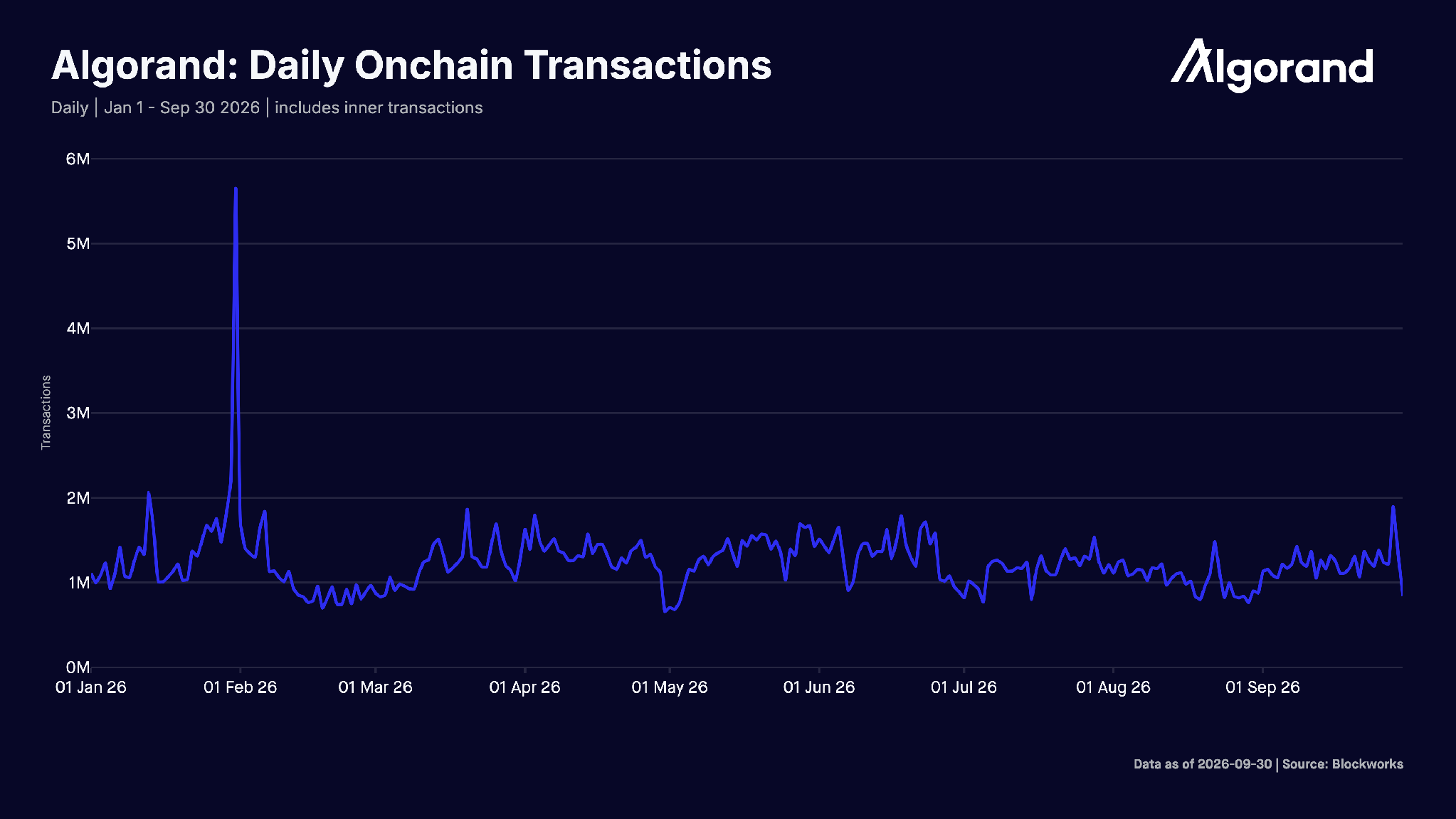
Onchain activity fell from its Q2 pace. The network processed 104.9 million transactions in Q3, including inner transactions, against 121.6 million in Q2. Daily activity averaged 1.14 million transactions, down from 1.34 million. The low point came in late August, and activity recovered through September to a quarterly peak of 1.89 million transactions on September 28.
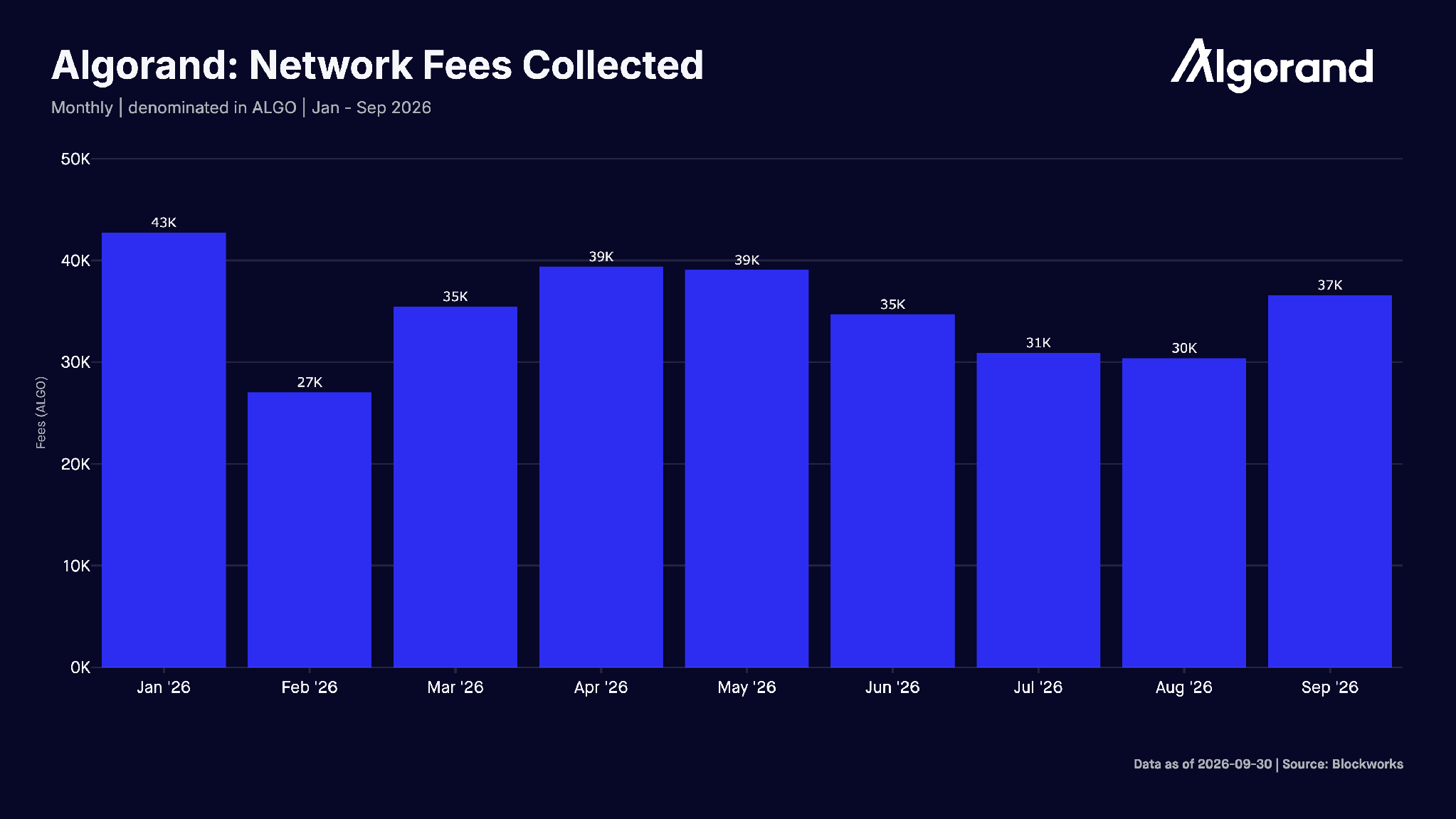
Fees stayed small. The network collected 98,000 ALGO in Q3, down from 113,000 ALGO in Q2, with 30,900 ALGO in July, 30,400 ALGO in August and 36,600 ALGO in September. Algorand 5.0 replaced the flat 0.001 ALGO fee with resource-based pricing. An ordinary transaction still costs one minimum fee, while large notes, bigger programs and arguments, and post-quantum signatures cost more, and the extra fees flow to the fee sink that funds node-runner payouts. Algorand committed that no transaction legal before the upgrade would cost more under the new rules, and August fees, which include the first days of the new model, came in below July's. Herkelrath has said there are no plans to raise transaction fees and that charging more for higher-value services at the application layer may be explored instead.
DeFi and Application-Layer Activity
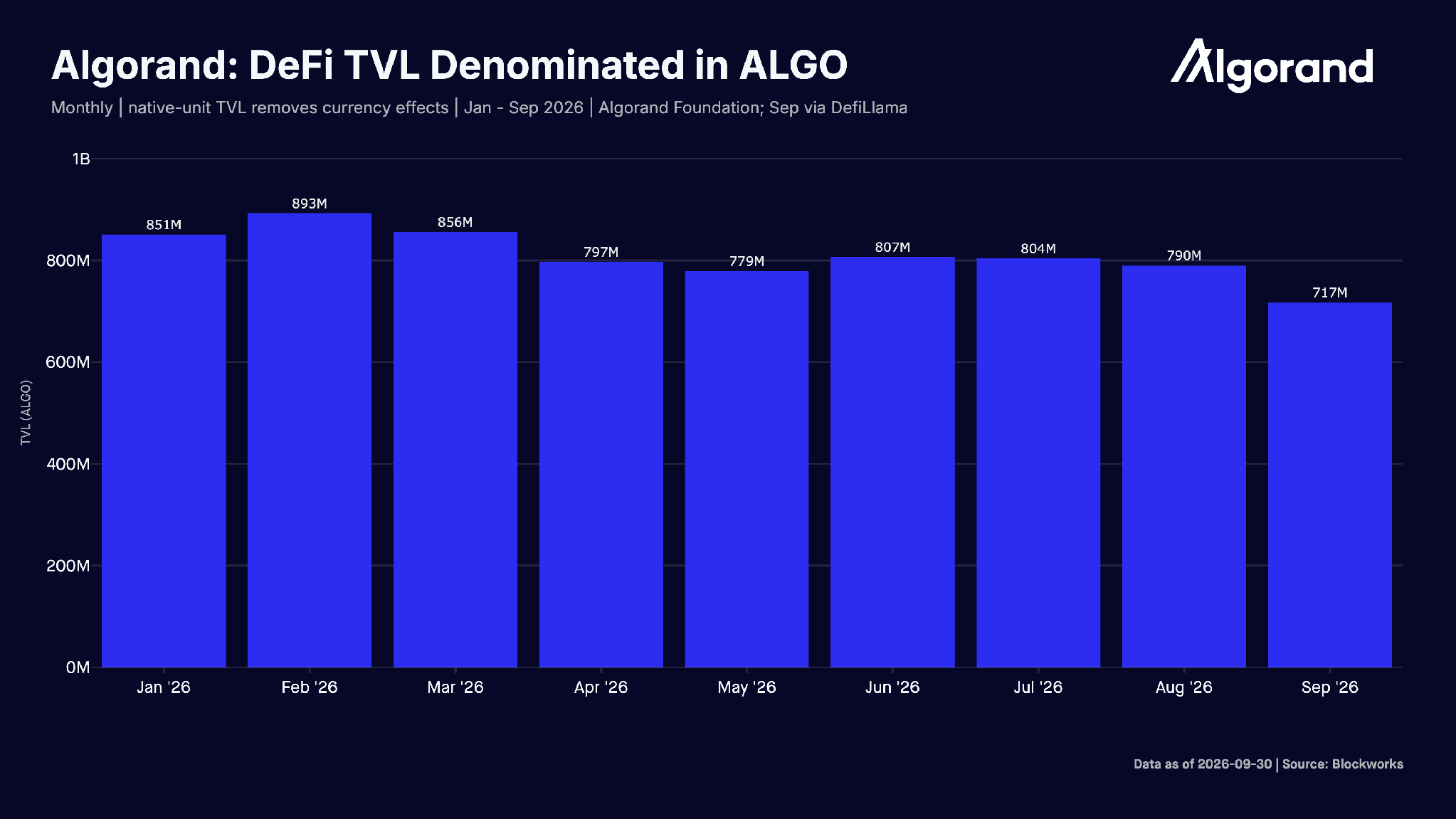
Measured in ALGO, which holds the unit of account constant, DeFi deposits edged lower through the quarter, with the decline steepening in September. On Algorand’s measure, ALGO-denominated TVL moved from 807 million ALGO in June to 790 million in August and 717 million in September.
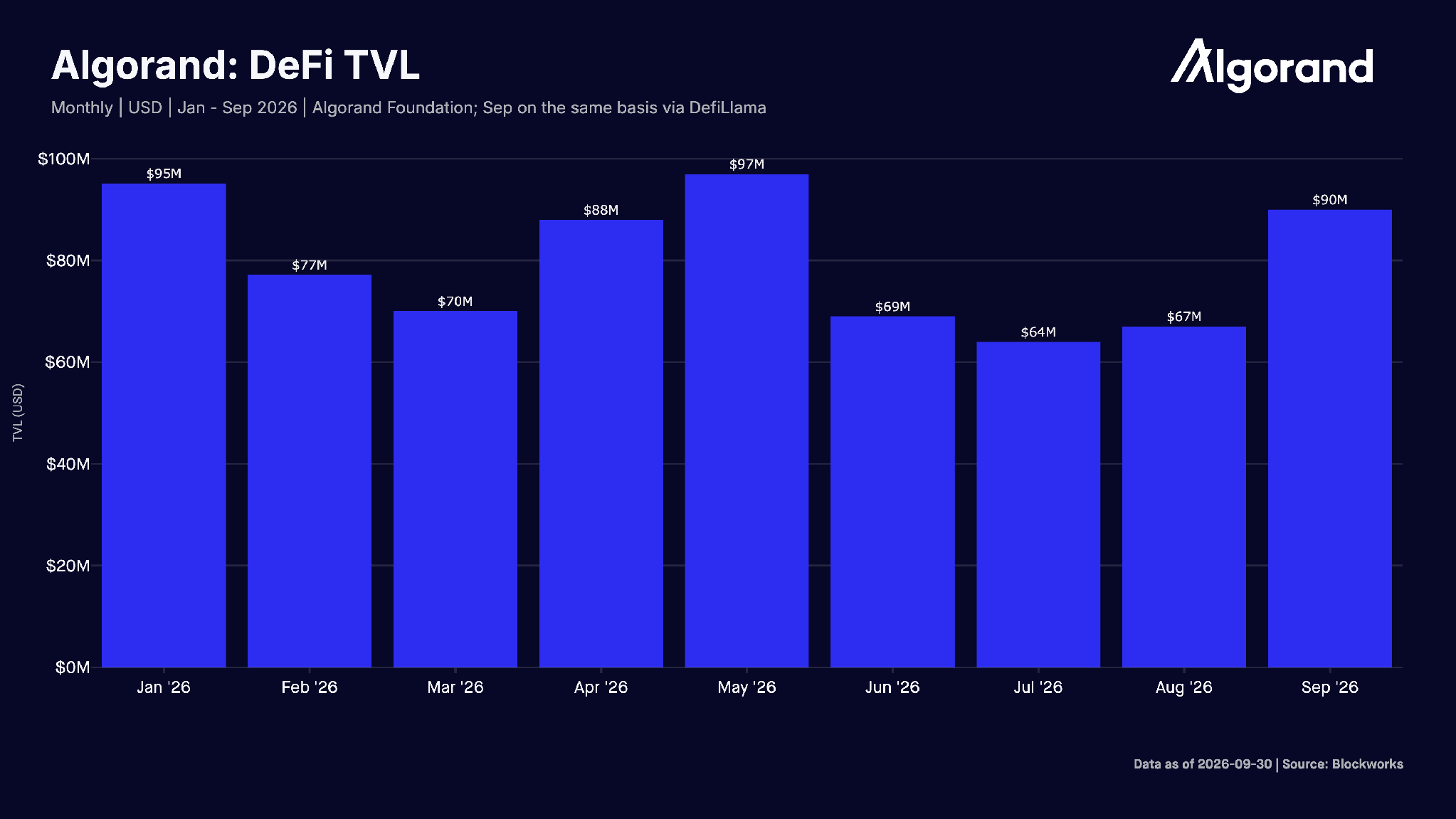
In dollar terms, TVL on the same measure was $69 million in June, $67 million in August and $90 million at the end of September. Because the dollar figure moves with the token's value, the ALGO-denominated series is the cleaner read on deposits. DefiLlama's Algorand series runs at less than half the company’s level. It ended the quarter at $37.7 million in dollar terms, up from $31.0 million on June 30, after falling in July and recovering part of that in August; it peaked at $40.1 million on September 29.
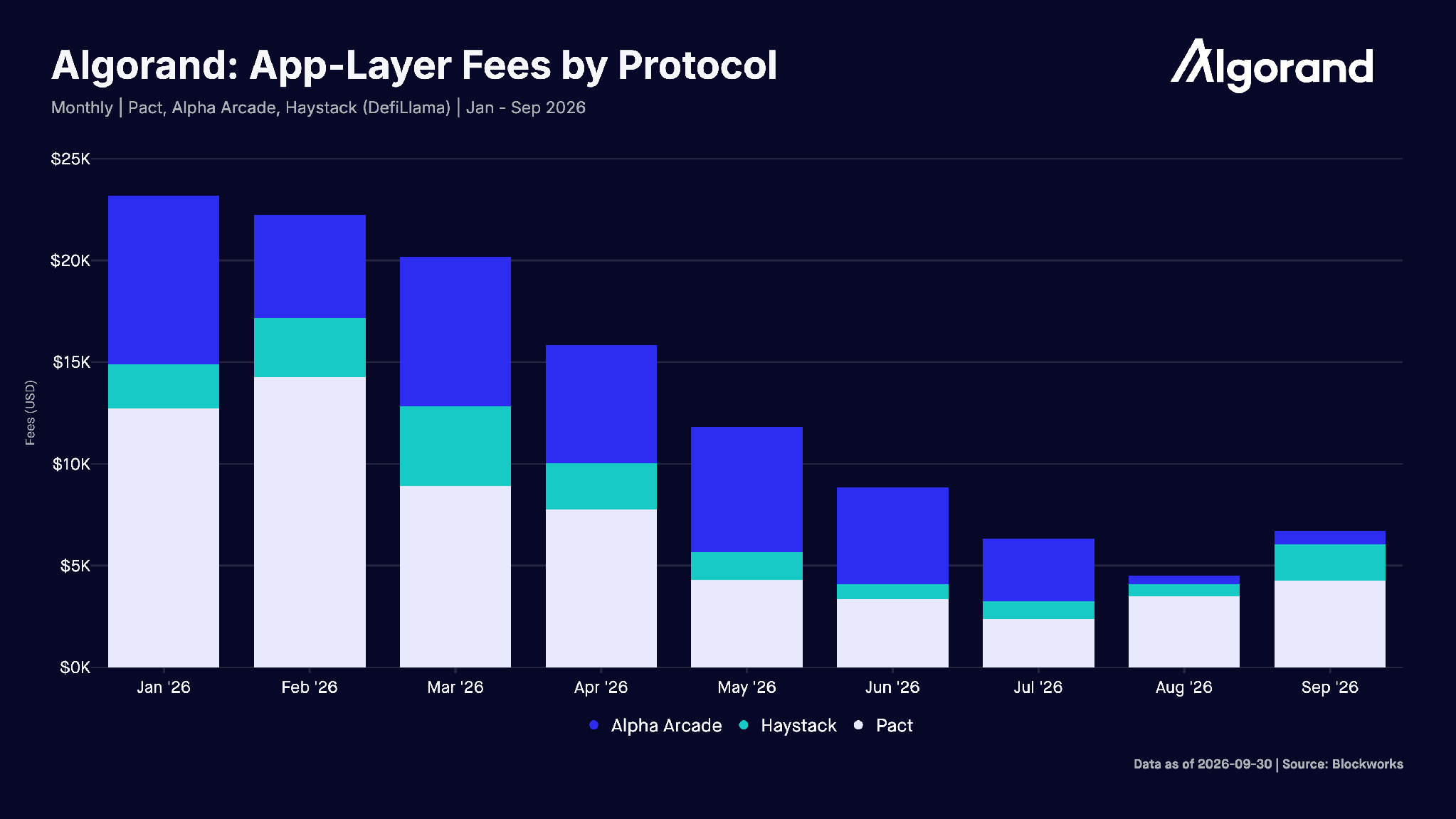
Fees across the AMM Pact, prediction market Alpha Arcade, and liquidity aggregator Haystack totaled $17,500 in Q3, down from $36,500 in Q2. Alpha Arcade's fees fell from $16,700 to $4,100, while Pact earned $10,100 and Haystack $3,300. Pact recovered within the quarter. Its fees reached a low in July after declining through the first half, then rose in August and again in September.
Strategic Initiatives
Post-Quantum Resilience
Algorand 5.0 delivered the first item on the post-quantum roadmap Algorand published in June. Falcon-1024 accounts no longer need a LogicSig wrapper; post-quantum authorization is now a first-class way to sign for an account, on the same footing as an Ed25519 signature or multisig. A post-quantum address is a 32-byte value that is deliberately not a valid Ed25519 curve point, so no Ed25519 private key could ever control it, even if elliptic-curve cryptography is someday broken. A post-quantum signature adds two minimum fees of usage, so a post-quantum transaction costs three minimum fees against one for an ordinary transaction.
In the first 19 days after quantum-resilient accounts went live on August 20, the network recorded 1,800 quantum-resilient accounts and 1.24 million quantum-resilient transactions, which Algorand presents as an early adoption signal for a partial window. Wallet support arrived in the same weeks. Pera Wallet launched Quantum Accounts on August 26, letting users create a Falcon-1024 account or rekey an existing one, and Lute Wallet added native post-quantum accounts. Pera said in mid-September that it had helped Algorand cross 1 million post-quantum-resilient transactions, and that its commemorative NFT campaign, which unlocks collectibles at 1, 100, and 1,000 post-quantum transactions, contributed more than 500,000 of them in August alone. Pera Wallet is a subsidiary of Algorand Foundation Ltd.
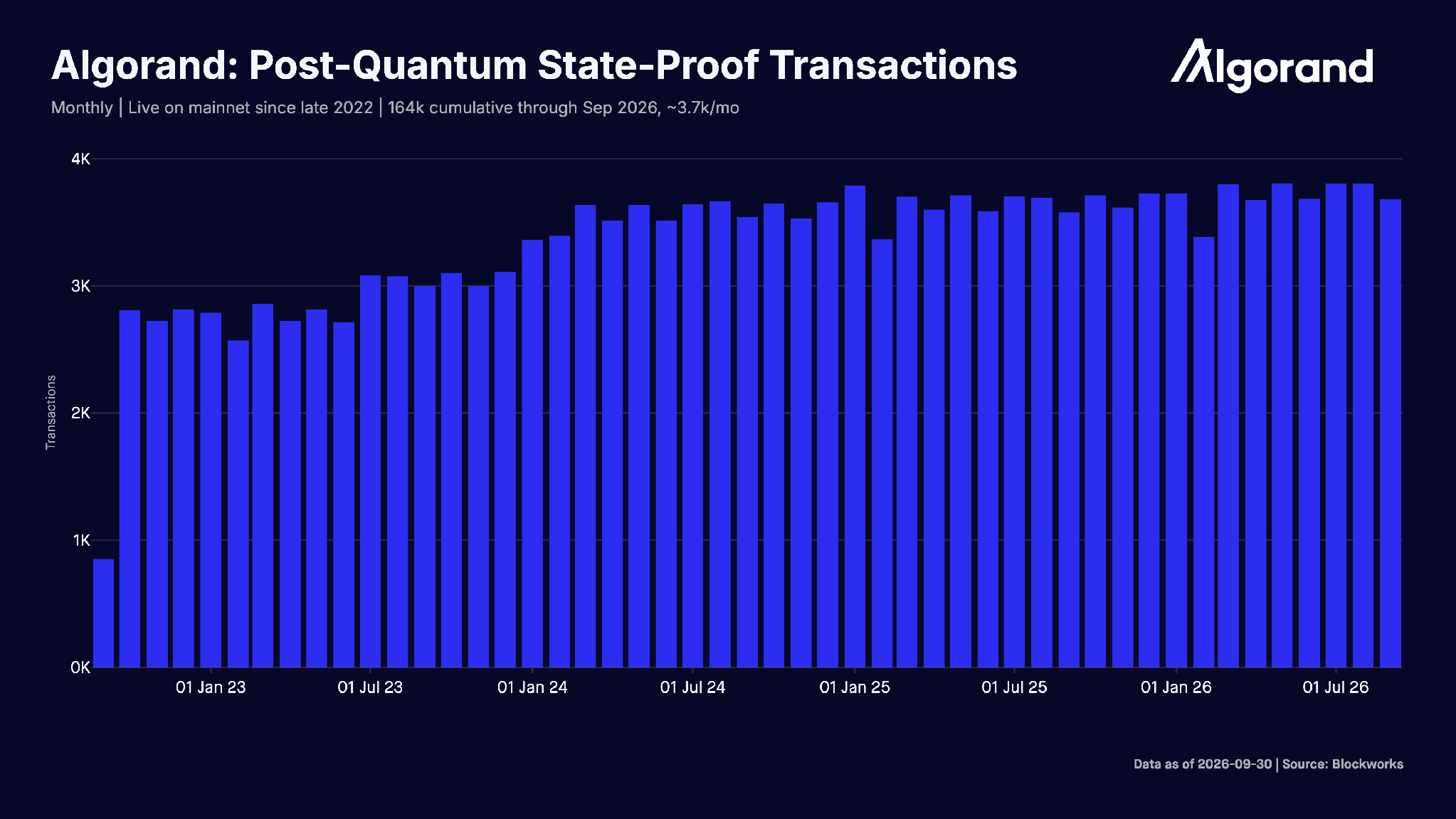
The new accounts sit on an older base. State proofs, signed with Falcon since 2022, attest to the ledger every 256 blocks. They generate roughly 3,700 transactions a month, more than 163,000 through September. Research into a post-quantum VRF for consensus committee selection is under analysis, with a paper expected in early 2027 if results are positive, and consensus signatures are the open item after that. In the June roadmap announcement, Algorand said it was on track for broad quantum resilience by the end of 2027.
Agentic Commerce and AI
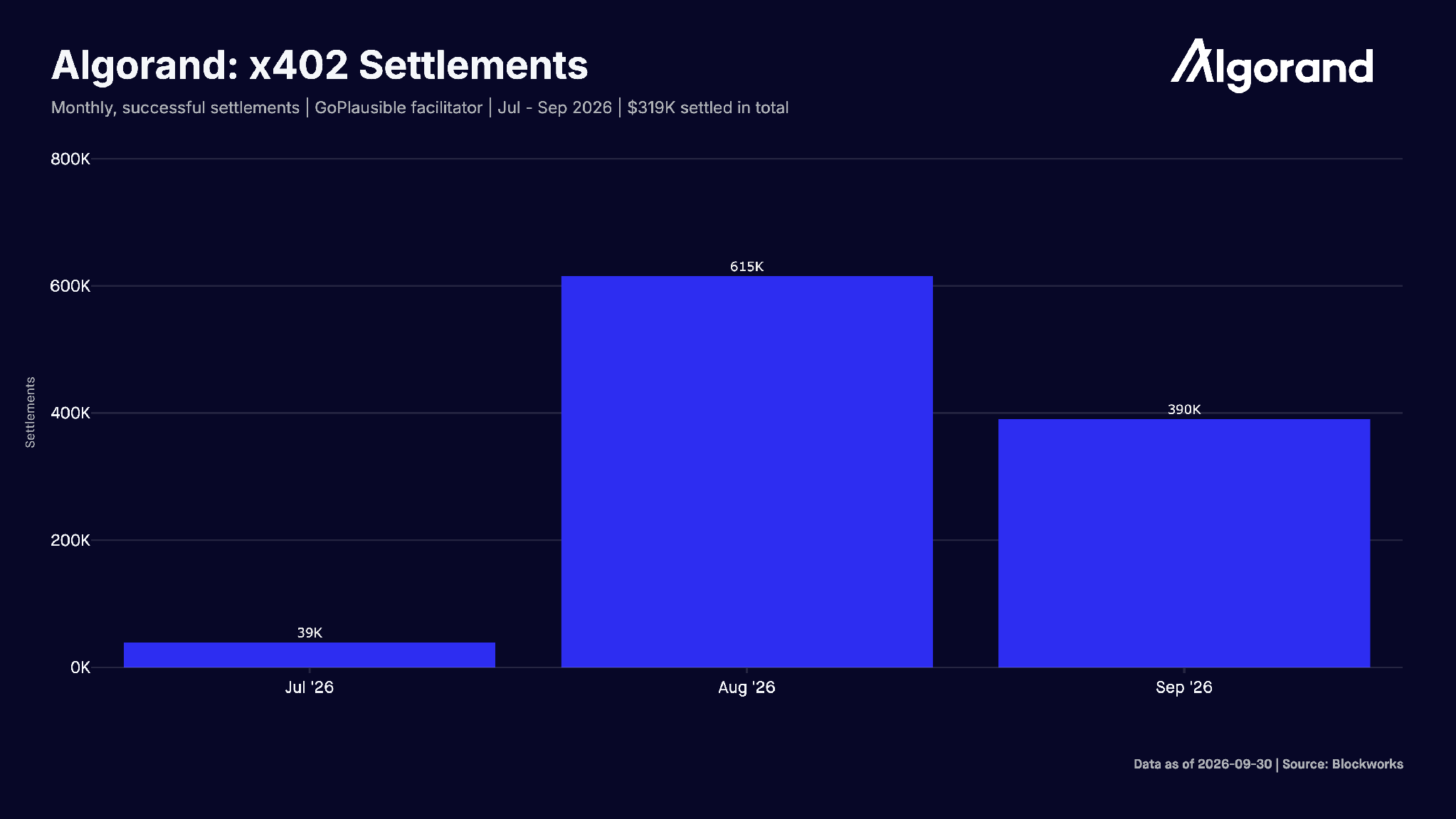
x402 has been supported on Algorand mainnet since February, and settlement activity through the GoPlausible facilitator was built in mid-July. With instant finality, each payment settles as it is made. For the quarter, the facilitator recorded 1.04 million successful settlements and $319,000 in settled volume on Algorand, with a 99.8% success rate. August was the peak, at 615,000 settlements and $174,000, an average of about $0.28 per payment. Daily settlements ran near 37,000 through the first nine days of September, then fell below 3,000 a day from September 10, leaving September 37% below August on settlements and 76% below on volume. Value is also concentrated. A single day in early August accounted for nearly a third of the quarter's settled volume.
Algorand also launched AC2, the Agentic Communication and Control protocol, on August 25. AC2 gives every agent action a cryptographic proof that a human approved it. Each approval is a hardware-bound FIDO2 passkey signature, and the agent never holds the user's keys or credentials. AC2 is open and blockchain-agnostic, and it went live on ClawHub, where agents can request signatures and pay for x402 resources on Algorand with each action approved from the user's phone.
The Global x402 Challenge turned the rails into a developer program. More than 1,300 developers registered before registration closed on September 1, Sabre joined as a partner, and project submissions closed on September 30. The competition ran through October, with ten finalists presenting virtually on October 30. Hackathon teams in India and Berlin built working x402 applications during the quarter, from a resume-screening service that charges per analysis to a spending guard that rides inside the x402 payment group.
Tokenized Assets and RWAs
Algorand published a technical walkthrough of D-ASA, the Debt Algorand Standard Application, a proof-of-concept framework for issuing and executing ACTUS-compliant debt instruments on the Algorand Virtual Machine that took second place in the 2026 global ACTUS competition. It covers the debt value chain from issuance and KYC through secondary trading, payments, and oversight, built on asynchronous settlement trackers, native atomic delivery-versus-payment, and post-quantum-secured history. Lofty, the real-estate platform issuing property equity as Algorand Standard Assets, passed $100 million in total value locked for the first time on July 2, according to Algorand, and launched its first international property, in the Dominican Republic, in September.
Humanitarian Aid Payments
Takeaways published from the third Humanitarian Payments Council, held in July alongside the annual Treasurers Roundtable, call for moving beyond isolated pilots to payment solutions that deliver aid faster and more transparently at scale. Speakers came from Circle, Mercy Corps Ventures, World Vision International, the World Food Programme, Visa, and Mastercard. Participants pointed to foreign exchange as one of the most promising areas for innovation and named on- and off-ramp infrastructure as a significant bottleneck in the regions where humanitarian organizations operate most. They also acknowledged that the sector still lacks rigorous end-to-end data comparing stablecoin rails with traditional systems. The Council's priorities for the coming year follow from that: better evidence, closer coordination across donors and implementers, refined messaging for key stakeholders, and continued trust-building. HesabPay, the Algorand-powered payments platform behind UNHCR's reloadable-card assistance in Afghanistan, now serves more than 1 million users and moves about $183 million a month on Algorand, according to the company.
Stablecoin Settlement
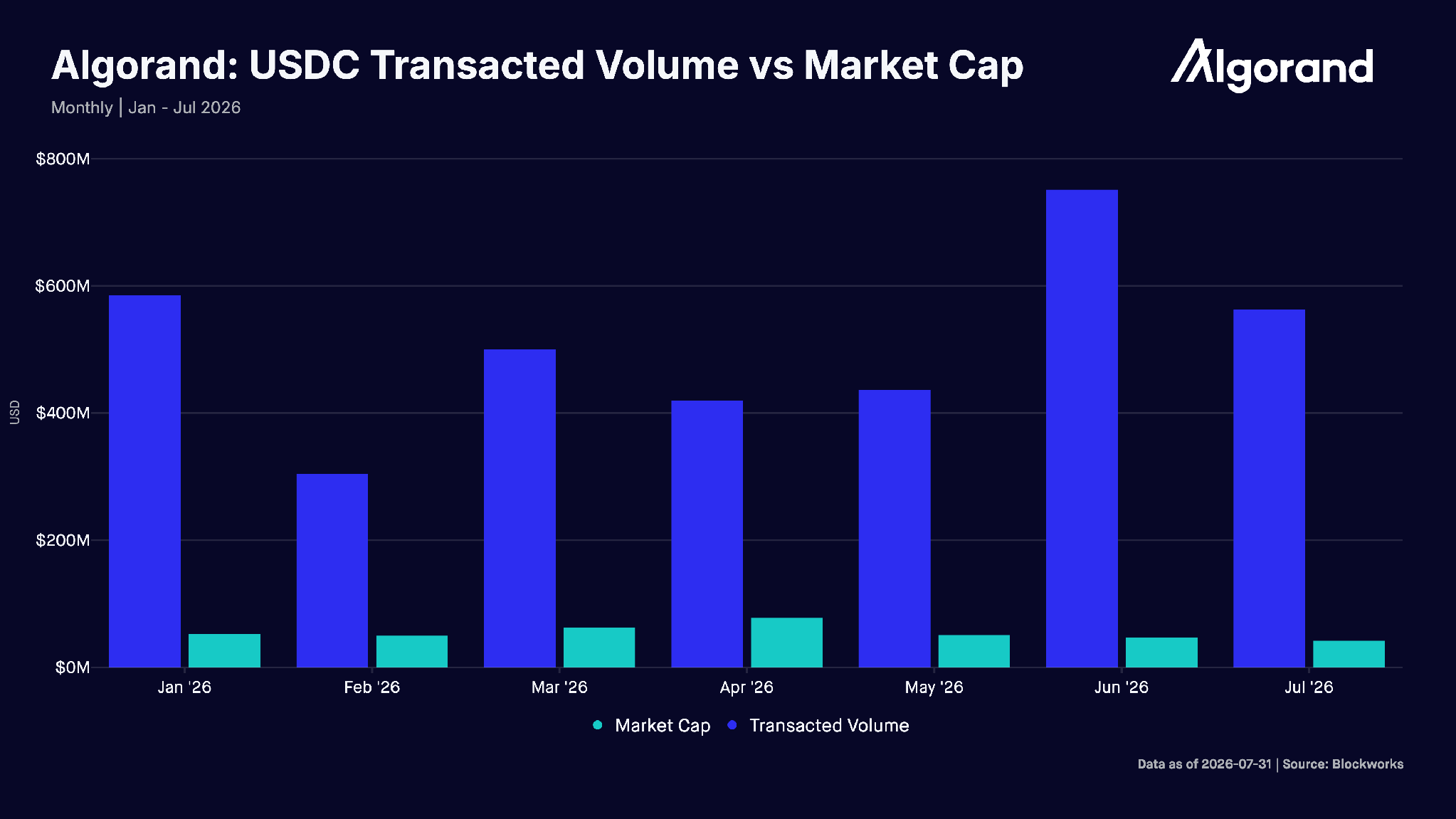
USDC turnover stayed high into the third quarter even as volume eased. In July, the latest month available, $563 million of USDC was transacted on Algorand against $42 million in circulation, down 25% from June's record but above Q2's monthly average of $536 million. That is a turnover of about 13 times supply. Total stablecoin supply on the network eased from $49 million in June to $43 million in August, then edged up to $46 million in September.
Ecosystem & Roadmap
Leadership and Governance
William Herkelrath took over as chief executive of Algorand on August 31, succeeding Staci Warden, who stepped down after nearly five years leading Algorand. He brings two decades of experience across AI, enterprise software, institutional finance, and blockchain infrastructure, most recently as co-founder of K3 Labs, an AI-first automation platform, after leadership roles at Chainlink and Curv. The board changed as well. Herkelrath and Alex Fowler, Chief Strategy Officer at Nexus Laboratories, joined it, and Rebecca Rettig and Michael Mosier departed.
His agenda puts self-sustainability first. He believes it is achievable in under five years and has placed every existing initiative and partnership under review against that goal. The plan is to deliver services the market will pay for, then use that revenue to become a net buyer of ALGO and increase payouts to node operators. Herkelrath calls network security Algorand's biggest competitive advantage. He plans to offer post-quantum security services to other chains, and he has said enterprises will soon be able to use the network without touching ALGO directly. Multi-chain support, led by cross-chain bridging, swapping, and messaging, is core to the 2027 strategy, with detail expected early in Q1 2027. The institutional push has started. Algorand partnered with Flow Traders to give institutional counterparties access to ALGO through Flow Traders' execution infrastructure, with settlement in fiat or stablecoins.
Algorand 5.0
Algorand 5.0 also reworked the platform for developers. Algorand calls it the largest protocol upgrade since staking rewards launched in January 2025, and after its release on August 12 it passed the 90% node-runner support threshold on August 15 and activated in late August. Programs can now reach 16,384 bytes, double the previous limit, while apps can opt into shared box storage, existing apps can upgrade in place without a full rebuild, and new opcodes, including SHA512 and Poseidon2, add native support for zero-knowledge applications. A new congestion signal previews future network-health tooling and has no effect on fees today. Vote compression has already cut bandwidth requirements for participation nodes, with block compression for archival nodes in the pipeline.
Developer and Ecosystem Activity
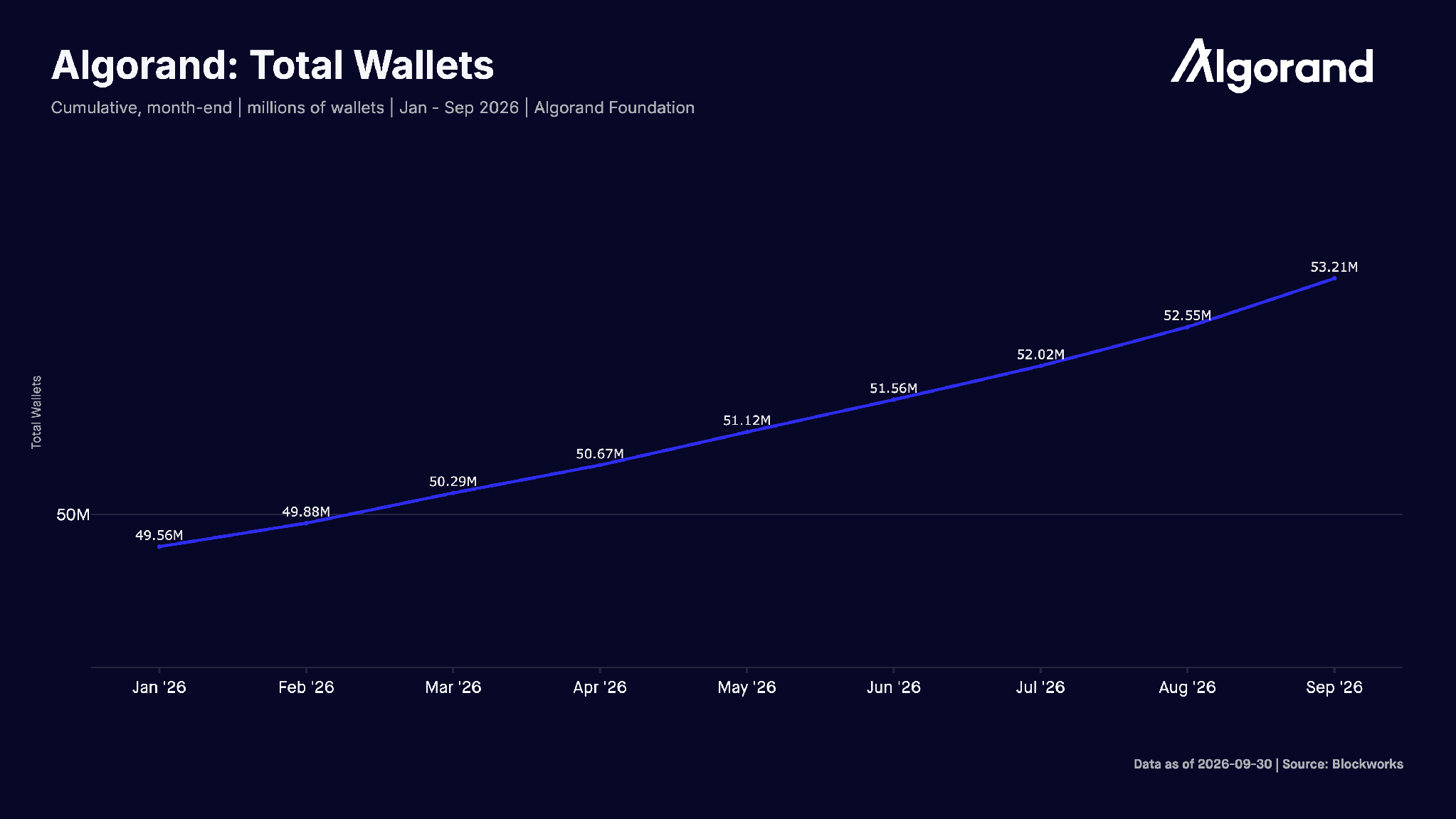
The user base widened even as transaction counts dipped. Total wallets reached 53.21 million at the end of September, up from 52.55 million in August and 51.56 million in June.
Monthly active addresses dipped to 123,000 at the end of July, then climbed to 379,000 at the end of August and 518,000 at the end of September, the highest month-end reading of 2026. Daily active addresses averaged 29,000 in September, against 11,000 in July. Addresses holding ALGO rose from 21.71 million to 22.15 million over the quarter.
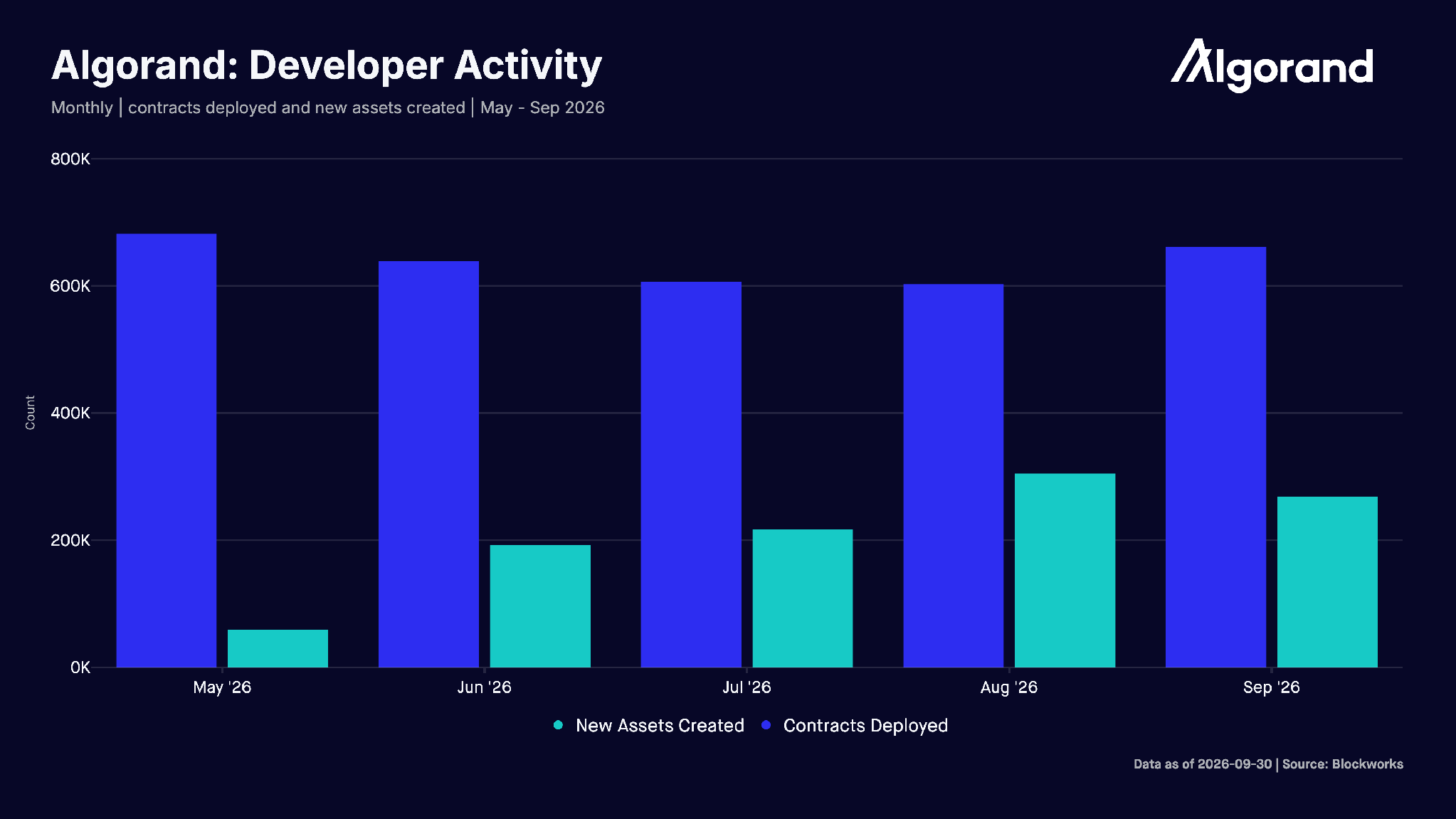
Asset issuance accelerated. Builders created roughly 791,000 new assets over the quarter, up from 268,000 in Q2, though the large majority were short-lived tokens that were soon deleted. Contracts deployed ran between 603,000 and 661,000 a month, with September the highest.
Wallet infrastructure was rebuilt during the quarter. Pera Wallet 7.0 shipped on August 11. It is a ground-up rebuild that added native staking. Rocca is now live as a white-label wallet framework. It first appeared on Algorand's roadmap in 2025 as part of its long-term wallet strategy, and its first two products are Pera Wallet 7.0 and the AC2 Wallet. Other teams build their own branded wallets on Rocca, which handles secure key storage, decentralized identity, and passkey support.
Roadmap
Native post-quantum multisignature support is planned by the end of 2026, and Algorand has said that until it arrives, expanded LogicSig budgets let institutions and Algorand itself demonstrate post-quantum multisig custody. Algorand’s planned migration of its own treasury to post-quantum accounts is still ahead. Falcon-512, already sketched in the source code, can be expected in the next consensus upgrade, and a paper on the post-quantum VRF research is expected in early 2027 if results are positive. Algorandhas said more capital-efficient DeFi infrastructure is coming, including clMM and PMM market makers and perpetuals, to improve USDC liquidity and reduce slippage on larger positions.
Closing Summary
Q3 settled the first of the four second-half tests identified in H1. Native Falcon-1024 accounts shipped in Algorand 5.0, and within 19 days the network recorded 1,800 quantum-resilient accounts and 1.24 million quantum-resilient transactions. The second test is due next. Native post-quantum multisig for institutional and treasury operations is planned by the end of 2026, with Algorand’s migration of its own treasury to post-quantum accounts still ahead. The third now has an uneven baseline, with x402 recording 1.04 million settlements and $319,000 in settled volume on Algorand in Q3 before daily activity fell sharply after early September, while the Global x402 Challenge moves from submissions to an October measurement period and then to finals , where ten finalists present and winners are announced. On the fourth, HesabPay serves more than 1 million users and moves about $183 million a month on Algorand, according to the company.
The new chief executive adds a commercial measure. Herkelrath has made self-sustainability the first priority, with a plan to fund the network from services the market pays for and to direct that revenue toward ALGO purchases and higher node-operator payouts. Post-quantum security services for other chains are one route he has named. On usage, transactions fell 13.8% from Q2 and fees at Pact, Alpha Arcade, and Haystack roughly halved, while active addresses and asset creation grew and staking participation held steady.
Security economics sit at the center of that goal. Staking rewards of about 6.7 million ALGO a month ran roughly 180 to 220 times fee income in Q3, and Algorand pays them from its own holdings, which stood at 1,036 million ALGO at the end of June. Algorand calls resource-based fees, introduced with Algorand 5.0, the first step toward a more sustainable network. Algorand enters the fourth quarter with a dated technical roadmap and a stated commercial objective.
This report was commissioned by the Algorand Foundation. By providing this disclosure, we aim to ensure that the research reported in this document is conducted with objectivity and transparency. All content was produced independently by the author(s) and does not necessarily reflect the opinions of Blockworks. or the organization that requested the report. The commissioning organization may have input on the content of the report, but Blockworks maintains editorial control over the final report to retain data accuracy and objectivity. Author(s) submit financial conflict of interest (FCOI) disclosures on a monthly basis that are reviewed by appropriate internal parties and may hold cryptocurrencies named in this report. This report is meant for informational purposes only. It is not meant to serve as investment advice. You should conduct your own research and consult an independent financial, tax, or legal advisor before making any investment decisions. Past performance of any asset is not indicative of future results. Please see our Terms of Service for more information.