The 2Q’21 was a tale of two halves in one of the most eventful quarters of the Currency sector’s history.
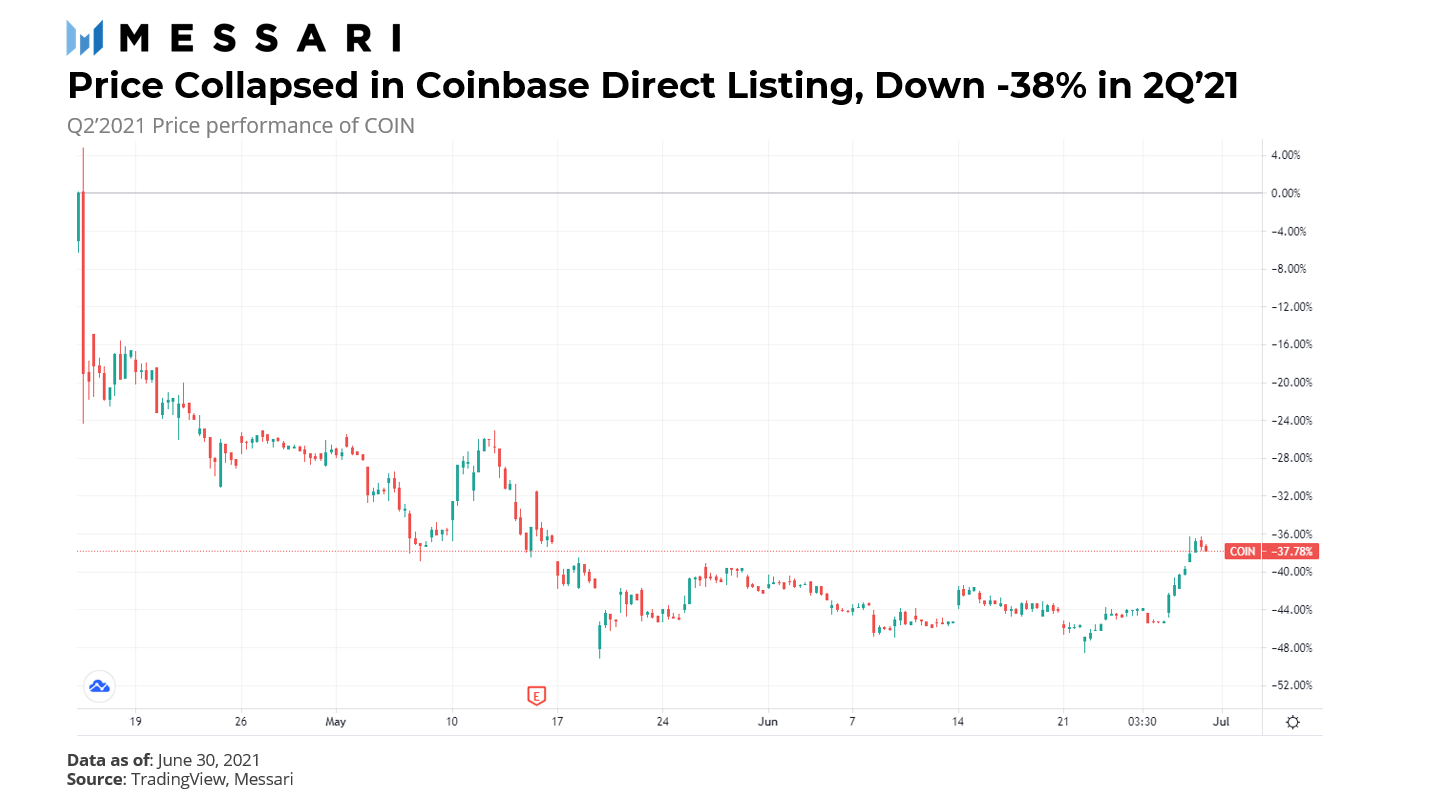
The first half of the quarter was full of jubilations as Coinbase (COIN) employees popped champagne during the company's direct listing on April 14, 2021. Bitcoin reached all time highs (ATHs) of over $60,000, and there were more eyes on crypto than ever before. Institutional investors and banks moved to announce their involvement in the digital assets sphere, pouring equity capital and launching new initiatives to get their clients onboard. Even State Street, the second oldest bank in the US with $3.1 trillion in assets under management, announced it will be building a crypto trading platform.
We also saw speculative mania of DOGE reaching $0.74 on the back of Elon posing as the Dogefather on Saturday Night Live (SNL). ASS, SHIBA and CUMMIES also saw the limelight, though meme coins rarely warrant mainstream media attention. Mark Zuckerberg even announced the names of his two goats, Max and Bitcoin, perhaps hinting to the world that he’s a Bitcoin maximalist.
Bitcoin 2Q’21
While Bitcoin’s price rallied +10% in the first part of April, its price ended the month down by -9%. The sudden drop in value should’ve raised a few red flags but markets ignored warning signs of a major reversal or market fatigue since Bitcoin had seen six consecutive positive months, a first since 2012. In retrospect, there were indeed signs of market fatigue. The COIN direct listing saw the price collapse by -20% in the first days of trading, and Tesla also announced it had sold 10% of their Bitcoin position for treasury management reasons. Nevertheless, all indications still pointed to a bull run as the remainder of the crypto market diverged from Bitcoin’s price performance. In April, ETH was up +44%, DOGE continued its winning streak up +463%, and even late-cycle ETC was up 146%.
In mid-May, Bitcoin’s price began to reverse seeing the largest reversal as its third-worst performing month in history, down -38%. This finally ended narratives that this rally was just like the 2017 bull market.
It wasn’t even like the 2013 bull market either, as investors found themselves in uncharted waters. Never before had a four-year cyclical top been so tame and never before had a mid-bull run reversal been so severe.
The month of May also brought an onslaught of sequential negative news events in a FUD (fear, uncertainty, and doubt) bath. Market participants began to wonder if this attack on Bitcoin was coordinated. Negative news included Tesla ceasing to accept Bitcoin for purchases, citing Environmental, Social and Corporate Governance (ESG) concerns. This resulted in mainstream media frequentlyreporting on Bitcoin’s coal usage and impact on global warming. Even the Pope commented on the detriments of technology based on “highly polluting fossil fuels”. Most importantly, Tesla’s announcement sparked Elon Musk’s damaging verbal diarrhea on Bitcoin, even after agreeing that Bitcoin incentivizes renewable energy.
Many valid ESG rebuttals (here, here, here, and here) were provided but were largely ignored by mainstream media. Michael Saylor even championed a North American Bitcoin Mining Council to collect renewable usage data. As soon as it seemed that Bitcoin was heading in the right direction with ESG, the public outcry ceased by mid-June, as quickly as it started. The Bitcoin ESG FUD would be shelved for another day. For Q2’21, the Bitcoin Mining Council reported that the Bitcoin Mining energy usage only amounted to 0.12% of the World’s total energy consumption.
In the US, the sector also saw one of the busiest months of regulatory headwinds. The US Senate Banking Committee urged the new Office of the Comptroller of the Currency (OCC) Head to review past favorable crypto rulings and the OCC, FDIC and the Fed was reportedly in talks about an interagency crypto policy team. The FDIC, in its capacity as a federal banking regulator, was issuing requests for information from banks on crypto usage. The IRS was reportedly cracking down on crypto tax evasion. The IRS was also, along with the US Justice Department, investigating the world’s largest exchange, Binance. Additionally, New York State introduced a Senate Bill to halt Bitcoin mining for three years while it assessed the environmental impact. The Treasury called for crypto transfers above $10,000 to be reported to the IRS. Secretary of the Treasury Janet Yellen called the US crypto regulatory framework inadequate and pushed for a new framework and SEC Chair Gary Gensler stated greater investor protection is needed on crypto exchanges. Most damaging of all could have been the slew of fake news and unsubstantiated claims.
Separately, growing institutional adoption of Bitcoin could have meant that macroeconomics played a role in this selldown. On May 12 2021, the Consumer Price Index (CPI) printed +4.2%,the highest inflation print since September 2008. In light of signs of overheating in the market, though mitigated by bad jobs numbers, the Fed’s meeting minutes hinted that they were beginning to think about, thinking about tapering. This led to a knee jerk reaction of US real yields rising +9bps though traditional financial markets remained relatively calm. Markets already knew that inflation numbers were high due to a low base effect from COVID-19. However, Bitcoin, at the extreme end of the risk curve for traditional institutional investors, saw a major selldown. The month after, the CPI print of 5% was even higher but it didn’t warrant a market reaction. As expected, the Fed will patiently wait for economic data to decide if they will bring forth tapering from the expected Q1’22E. Concerns of tapering subsided, but Bitcoin’s price failed to recover.
In China, the Vice Premier Liu announced a crackdown specifically on crypto mining and trading. It was nothing new -- China had banned securities companies from engaging in Bitcoin since 2013, and also banned trading in 2017. However, never before had the announcement come from someone so senior in the China Communist Party, the chair of the State Council’s Financial Stability and Development Committee. And never before had Bitcoin mining and trading been specifically stated. The government newspaper, Xinhua, also published articles citing a series of crypto-related scams, with 1,100 people arrested for money laundering through crypto. Reasons cited by the public focus on social stability, especially important before the Communist Party’s 100th anniversary on July 1.
This resulted in Chinese search engine Baidu removing Binance, Huobi and OKEx. Weibo, a prominent social media platform, blocked major exchanges and key opinion leaders. BTC market data was also removed from security trading platforms like Tencent-backed Futu and Tiger Securities. Additionally, companies highlighted that their plans to launch crypto trading services would target non-China domiciled clients. Major crypto exchanges Huobi and OKEx scaled back on leveraged trading, from a maximum of 125x to less than 5x. Furthermore, new clients wouldn’t have access to the leverage trading function.
On the mining front, the Inner Mongolia region was the first to comply, followed by more important regions such as Xinjian, the most important mining region during the dry season. As miners packed up, the total hash rate, an indicator of the computing power in the network, halved from mid May to the end of the quarter. While Bitcoin’s hash rate has not recovered yet from the largest sustained percentage decline, perhaps the worst is already behind us in terms of the impact of China’s crackdown on Bitcoin mining. We expect hash rate to recover over the course of the year, as miners find other venues of electricity and restart their operations. Many of the miners from Inner Mongolia, Xinjiang, Qinghai, Sichuan are reportedly moving to various locations including Kazakhstan, Texas and Norway.
Just as suddenly as the noise around environmental concerns rapidly died off towards the end of June -- so did concerns of China’s mining shutdown. Overall, these are net long-term positives for Bitcoin as what doesn’t kill it only makes it stronger. Indeed, as the world becomes more environmentally friendly and no institutional investors want to run afoul of the ESG movement, Bitcoin will need to pivot towards renewable energy to gain global adoption. Also, false narratives that Bitcoin is a “Chinese financial weapon” or that Bitcoin is a threat to US national security -- the code is literally open sourced -- can finally be put to bed as mining hashpower will more evenly be distributed throughout the world.
Towards the end of the quarter, El Salvador became the first country in the world to adopt Bitcoin as legal tender in an effort to de-dollarize and reduce the cost of remittances. The government also announced a $30 airdrop for all adults through its own digital wallet. While Bitcoin’s global penetration is ~2%, El Salvador’s Chamber of Commerce’s data indicates that 21-25% of the population would use BTC. While there was no meaningful impact on Bitcoin’s price, it was a global step towards wider adoption. Furthermore, it could be the first of several countries to adopt Bitcoin as Paraguay also announced a bill that would make Bitcoin legal tender.
In terms of markets, derivatives were punished this quarter. Markets started strong, with ETH touching $3,000 on May 3 only to have $246 million of open interest in the ETH call $5,000 strike the day after. However, by the end of the quarter, given the waterfall of liquidations, Bitcoin Futures open interest reset to levels seen at the start of the year.
From the peak of April 14, open interest declined -56%. The first large liquidation happened April 18, with $9.3 billion of longs liquidated (mostly from Binance) but the market recovered after. Despite the April wipe out, on May 19, liquidiations reached $7.6 billion (mostly from Huobi, Bybit and OKEx), crashing the market further as leveraged hands were forced to sell.
Despite the aggressive liquidations, and subsequent spot selling, large holders (100 to 1,000 BTC) actually accumulated during the selldown:
It also seemed as if traders in the US time zone were more bearish than those in Asia, a reversal of the 90-day period prior to mid-May.
Currency: 2Q Outperformers
Dogecoin (+325%), Ethereum Classic (+268%), XRP (+12%) and Ethereum (+3%) had a positive quarter.
DOGE benefited from its primary champion, Elon Musk, with no less than 13 tweets mentioning “Doge”. To his 57 million followers, Musk also tweeted that he’s “working with Doge devs to improve system transaction efficiency” which baffled most crypto investors who noticed there had been no development for the past several years. However, the social media prowess of DOGE is strong and the price rallied to an ATH of $0.74 on May 8, the time that SNL’s Dogefather aired. From the beginning of the month, DOGE’s price had multiplied by 12x at that time, before ending the quarter at ‘just’ 5x. Separately, Coinbase also listed DOGE on June 3 (in addition to an Ethereum-based dog coin SHIBA on June 15).
However, even before the SNL run-up, DOGE rallied 500% over a week in mid-April, nearly flipping Binance Coin (BNB). Ahead of the Coinbase listing, Reddit’s wallstreetbets moderator reversed their ban on crypto -- allowing the discussion of BTC, ETH and DOGE. In less than 24 hours, they regretted the decision and reiterated its crypto ban on the subreddit. The DOGE pump that ensued was a demonstration of the power-of-the-people. While the price dropped -66% from its ATHs by quarter-end, DOGE’s outperformance over the quarter showed its meme sway remained strong.
Ethereum Classic (ETC) also saw a strong run up in the quarter. (ETC) is the legacy chain that split from Ethereum following a contentious hard fork, known as The DAO fork, in Jul. 2017. On May 7ths, ETC saw a $55 billion 24h volume while its market cap was just $17 billion. Messari’s clean volume of vetted exchanges just showed $414 million in volumes, indicating that there could have been a lot of fake volumes on ETC. Nevertheless, ETC had several status updates this quarter, publishing a roadmap and 2021 budget and introducing new software releases and network upgrades.
XRP continued to outperform (+12%), following its Q1’21 +164% rally. This was on the back of easing concerns after a -30% selldown following the SEC's enforcement action in Dec-2020. Their General Counsel maintains that regulatory uncertainty is deliberately maintained by the SEC and that XRP is unjustly singled out as a security, while BTC and ETH roam free.
Last but not least, ETH ended the quarter up +13%. Ethereum had a strong first half of the first quarter, with talks of a supercycle and flippening. Deribit, an options platform, saw $5,000 calls with a notional value of $331 million by May 11. Crypto loves a good narrative and Ethereum had many. Layer 2 scaling solutions were just kicking off, with Polygon taking the lead. Ethereum implemented the Berlin upgrade on April 15 and the upcoming EIP-1559 was also going to solve some of the pain of the high transaction fees. Furthermore, ETH’s supply was about to become deflationary in supply. ETH was also unscathed from ESG critics of Bitcoin mining as it was moving towards ETH 2.0 with a Proof of Stake consensus mechanism. Furthermore, decentralized finance (DeFi) was reaching new highs for on-chain activity.
However, in a Bitcoin selldown, gravity takes over and every token is correlated and this time was no different. ETH has still outperformed Bitcoin overall, after diverging around mid-April but gave back 16% of the performance in June.
Ethereum’s market share is still minor but climbing. Though DOGE, ETC and XRP’s market share in the currencies sector is still small. Bitcoin dominance in the Currencies sector fell from 79% to 65% this quarter:
Dash was initially released as a fork of Bitcoin, but had a strong marketing narrative as it was focused on the payments use case. They released a couple of software and on-chain upgrades this quarter, that will cumulate to their July 15 hard fork. Their underperformance this quarter could be attributed to its strong run up of +109% in Feb-2021.
Stellar (XLM), a fork of the Ripple protocol, made two major network upgrades. While XRP and XLM were correlated last quarter, XLM underperformed this round. It could be a testament to the importance of the size of the community during a selldown.
Bitcoin SV (BSV) is a Bitcoin Cash (BCH) hard fork prioritizing what the creators consider strict adherence to Satoshi Nakamo's original Bitcoin client. It continued to underperform after just rallying +28% in 1Q’21. There have been no major announcements or upgrades from BSV this quarter. However, its primary founder has chosen to take further legal action in April on bitcoin.org to remove the Bitcoin whitepaper from its website. The website did not launch a defense, in order to protect its founder’s anonymity.
Bitcoin Dominance
Bitcoin’s overall cryptocurrency dominance dropped to 40% on May 18th, the day of the $7.6 billion liquidation, reaching levels unseen since July 2018. While Bitcoin’s price peaked on April 14th at $64,654, the altcoin total market cap peaked a month later on May 11th. This was similar to the pattern seen in Dec-2017 where BTC peaked a month before other currencies.
Currency Sector: Regulations
April
Stablecoin issuer Paxos gets a federal trust charter through the OCC, becoming the third federally regulated crypto bank. The company also raised $300 million at a $2.4 billion valuation
The European Union’s investment arm hired Goldman Sachs, Banco Santander and Societe Generale to sell EUR100 million bonds, registered on the Ethereum network. Santander and Societe Generale have issued bonds on the public Ethereum blockchain but this marks the first time for Goldman
Appointments: Gary Gensler, who had a blockchain class at MIT, is confirmed as the Chair of the SEC. The former OCC Head Brian Brooks was hired as the CEO of Binance US and the former CFTC Chair Chris Giancarlo is appointed to BlockFi’s board
May
China reiterates a crackdown on Bitcoin mining and crypto trading, leading to an exodus of miners and a resulting drop in hash rate
June
The Basel committee, a global banking regulator, urges the toughest capital rules for crypto. This is no different from DeFi protocols that require at least full collateralization on loans. Regulatory clarity should help institutional adoption in the longer term
Brazil lists the first Bitcoin ETF in Latin America. QR Capital’s ETF had received approval earlier this year in March 2021
Institution & Social Adoption
April
State Street, the second oldest bank in the US with $3 trillion in assets under management (AUM) announces its starting a trading platform and may also trade on it
Germany’s Fund Location Act, was proposed in April and approved by parliament, permitting special funds to invest up to 20% of their portfolios in crypto. The addressable market is up to $415 billion and the law is enforced July 1 2021
Venmo launches crypto purchases, but not withdrawals
Morgan Stanley files to give private wealth clients access to Bitcoin
CI Global Asset Management, with an AUM of $230 billion, launches North America’s first Bitcoin mutual fund
New York Digital Investment Group (NYDIG) raised $100 million primarily from insurance companies like Liberty Mutual Insurance and Starr Insurance among others. This is a top up after raising $200 million the month prior. NYDIG is a Bitcoin platform, a subsidiary of Stone Ridge, a $10 billion alternative asset manager.
Wealthfront, US Bank, Goldman Sachs announces they will be offering crypto products in the future
Coinbase lists on NASDAQ
Thodex, a Turkish exchange, was charged with fraud, freezing $2 billion in client money. Just a week prior, Turkey’s central bank had banned crypto as a means of payment. In March 2021, Turkey printed an inflation rate of 16%, though economists say the true number is higher
May
Ray Dalio said he owns Bitcoin, after saying “I like the diversification of this kind of asset. It should be party of any portfolio. It’s got merit” just the month prior. Famed activist trader, Carl Icahn, said he wants to get into crypto in a big way.
Citibank, Millennium and Point 72 announced they would be entering the space
MoneyGram plans to allow Bitcoin purchase at 12,000 US retail locations while NYDIG partners with the FIS to enable banks to offer Bitcoin trading directly in bank accounts, using their license. This could have a reach of 24 million customers
Framework Ventures raises a $100 million crypto venture capital fund
Galaxy Digital acquires custodian BitGo for $1.2 billion, after talks of a PayPal acquisition fell through last December
Tether revealed a breakdown of their reserves, claiming to hold 76% of their reserves in cash and cash equivalents
PayPal and Venmo plan to allow crypto withdrawals to third-party venues
The “laser eye” movement to $100,000 takes Twitter by storm, including Paris Hilton, Tom Brady and US Senator Cynthia Lummis
June
Standard Chartered Bank, together with crypto-native platform OSL, announces a crypto exchange called Zodia. This comes after SCB announced a custody solution with one of the world’s largest custodians, Northern Trust, last December
BC Group (OSL’s parent) raised $70 million from GIC, Singapore’s sovereign wealth fund with a AUM of $488 billion. This comes after a $90 million fundraising in January, done by Morgan Stanley
El Salvador makes Bitcoin legal tender and Paraguay also announced a bill to follow suit. El Salvador is reportedly in talks with the IMF for a nearly $1 billion financing agreement, and has reassured the IMF that it’s not abandoning the USD.
Andreessen Horowitz raises a $2.2 billion crypto venture fund. Blockchain Capital’s venture fund raised $300 million, notably from Visa and PayPal
TP ICAP, the world’ largest interdealer broker, plans to launch a crypto trading platform with Fidelity and Zodia, the JV between Standard Chartered Bank and OSL
Interactive Brokers plans to offer crypto trading by the end of summer 2021
Compound Finance and Coinbase offer 4% interest rate product on US dollars
Citigroup launches crypto unit to offer digital assets to private wealth clients
Currency: Notable Trades
April
Gaming giant, Nexon, bought $100 million of Bitcoin on its balance sheet. They also own Korbit, a Korean crypto exchange
Tesla sells $272 million of Bitcoin, or 10% of their balance sheet holdings
Microstrategy purchase $15 million worth of Bitcoin
May
Globant IT firm ($9 billion market cap) discloses it had purchased $500,000 worth of BTC in Q1’21
MicroStrategy purchases $25 million worth of BTC
June
MicroStrategy raised $500 million in secured debt and purchases $489 million of Bitcoin
Soros Fund Management begins trading Bitcoin
Final Thoughts
Since BTC metrics are still fairly mid-cycle, this quarter’s dramatic selldown caught many investors by surprise. If markets don’t recover from here, expectations are of a mild bear market since the rally was rather mild -- a 3.2x from the prior Bitcoin ATH instead of a 20x return. Furthermore, during the 2018 bear market, investors were still bullish and hopeful in the first half of 2018. However, this time around, sentiment instantly flipped bearish -- perhaps an indication that investors were hoping to front run any risk of a bear turn. Many investors have been traumatized by the 2017 and 2013 blow-off tops and subsequent deep and prolonged bear markets, so they could have been quick to pull the sell trigger. What we can conclude is that -- this rally, perhaps due to the wider institutional adoption of Bitcoin, is like no other in the past.
Bitcoin, and the crypto sector, had also never before seen an onslaught of attacks from all corners before. The neverending China ‘ban’ and ESG concerns reared its head at the same time, though these narratives have been long-standing sources of FUD for Bitcoin. However, the two largest headwinds for BTC in 2Q’21 were two of the largest tailwinds for ETH -- as Proof-of-Stake makes it harder to geographically locate and censor miners, and no institutional investor wants to seem irreverent to the ESG narrative. While these FUD narratives have been addressed and even falsified, Bitcoin and the crypto community will be stronger in continuing to take measures to evolve the ecosystem.
Learn more from Mainnet 2021
Watch main stage programming from Messari's annual summit Mainnet 2021 to learn more about this exciting topic. Hear Mike Novogratz, Mike Belshe, and Dan Roberts discuss these topics during, "Mainnet 2021: The Herd has Arrived, Now What?". See more programming on the event portal.
On December 22, 2020, the U.S. Securities & Exchange Commission stated that XRP is a "digital asset security." A couple notes: (1) Messari does not provide financial or trading advice - our services are for informational purposes only; and (2) Messari's services are impersonal - do your own due diligence. Please refer to our Terms of Service for more info.
All content was produced independently by the author(s) and does not necessarily reflect the opinions of Messari, Inc. Author(s) may hold cryptocurrencies named in this report. This report is meant for informational purposes only. It is not meant to serve as investment advice. You should conduct your own research and consult an independent financial, tax, or legal advisor before making any investment decisions. Nothing contained in this report is a recommendation or suggestion, directly or indirectly, to buy, sell, make, or hold any investment, loan, commodity, or security, or to undertake any investment or trading strategy with respect to any investment, loan, commodity, security, or any issuer. This report should not be construed as an offer to sell or the solicitation of an offer to buy any security or commodity. Messari does not guarantee the sequence, accuracy, completeness, or timeliness of any information provided in this report. Please see our Terms of Service for more information.
No part of this report may be (a) copied, photocopied, duplicated in any form by any means or (b) redistributed without the prior written consent of Messari®.
Mira was a Senior Research Analyst at Messari. Prior to joining Messari, Mira was a Senior Portfolio Manager for a US$6 billion Asia Pacific equities fund at APG Asset Management. Mira received a BA in Economics and Mathematical Methods in the Social Sciences from Northwestern University.
Mira was a Senior Research Analyst at Messari. Prior to joining Messari, Mira was a Senior Portfolio Manager for a US$6 billion Asia Pacific equities fund at APG Asset Management. Mira received a BA in Economics and Mathematical Methods in the Social Sciences from Northwestern University.