
General
01What is the function or purpose of the project?
Bitcoin’s foundational documentation describes the project as a “peer-to-peer electronic cash system,” intended to enable online payments to be sent directly from one party to another without going through a financial institution.
02What is the function or purpose of the asset (if applicable)?
BTC is the unit used by the protocol to (i) denominate the Proof-of-Work (PoW) block subsidy paid to miners and (ii) pay transaction fees to miners for block inclusion.
03Project Background
Bitcoin’s origins, as supported by the provided sources, are anchored by (i) publication of the Bitcoin whitepaper and (ii) the start of block production, followed by an ongoing upgrade process formalized through Bitcoin Improvement Proposals (BIPs).
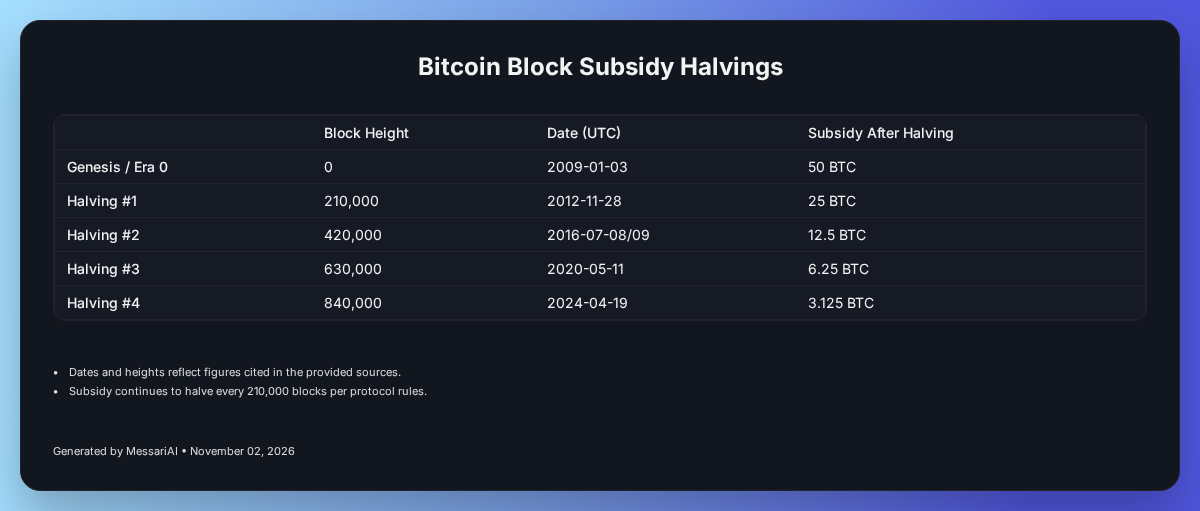
Key milestones (chronological):
- 2008-10-31: Whitepaper publication (“Bitcoin: A Peer-to-Peer Electronic Cash System”).
- 2009-01-03: Genesis-era launch period referenced by sources discussing the initial issuance (50 BTC block subsidy at inception).
- 2011: Introduction of the BIP process as a mechanism to propose and standardize changes.
- 2012-11-28: Halving #1 at block 210,000 (subsidy 50 → 25 BTC).
- 2016-07-08/09: Halving #2 at block 420,000 (25 → 12.5 BTC).
- 2020-05-11: Halving #3 at block 630,000 (12.5 → 6.25 BTC).
- 2024-04-19: Halving #4 at block 840,000 (6.25 → 3.125 BTC).
04What’s the URL to the project whitepaper?
- Bitcoin whitepaper (published 2008-10-31): https://bitcoin.org/bitcoin.pdf
05Is the project sponsored or supported by a centralized entity?
The provided sources characterize Bitcoin as having no formal foundation, corporate sponsor, legal entity, or central governing body controlling the protocol or its development.
06When was it founded or originated?
Based on the provided sources, Bitcoin originated with (i) the publication of its whitepaper on 2008-10-31 and (ii) the inception-era launch period referenced as 2009-01-03 in sources discussing the genesis-era block subsidy and issuance.
07Where is it based or operating (if applicable)?
Not applicable in the conventional sense. The provided sources describe Bitcoin as lacking a centralized governing body or sponsor; accordingly, they do not identify a single operating base for the project.
08List of core team members or leaders (include LinkedIn and Twitter profiles).
Not available in the provided sources. The materials provided discuss governance roles (developers, miners, node operators, exchanges) but do not provide a named roster of individuals with LinkedIn/X profiles.
09Does the project team have a relevant background, experience, or expertise in relation to the development of the project?
Not available in the provided sources, as no specific individuals (with verifiable pre-project histories) are identified as the “project team.”
Token Usage and Economics
01How does the asset work? Provide a description of the primary use(s) of the asset in the network or protocol.
BTC’s protocol-level uses described in the provided sources are:
- Block subsidy (issuance): New BTC enters circulation as a block subsidy paid to miners, beginning at 50 BTC per block and halving every 210,000 blocks.
- Transaction fees: Transaction senders pay fees (denominated in BTC) to compensate miners and to prioritize block inclusion.
02Do users or token holders earn fees, additional tokens, or any form of compensation by interacting with the network or in relation to holding the token (such as dividends, interest, liquidity rewards, or similar distributions)?
BTC holders do not receive protocol-defined “dividends” or “interest” simply for holding BTC in the base protocol, based on the provided sources. Instead, the sources describe compensation mechanisms tied to mining (block subsidy plus transaction fees) rather than passive holding.
2.1. If so, how?
- Mining compensation: Miners receive newly minted BTC (block subsidy) and transaction fees as compensation for securing the network and producing blocks.
03What are the typical ways users can acquire this asset (e.g., ICO, airdrop, purchase on an exchange, in-game rewards, reward for using a service, etc.)?
- Mining: BTC is issued through PoW mining via the block subsidy described above.
- Secondary acquisition routes (e.g., purchasing on exchanges): Not described in the provided sources.
04Does the network have a staking or liquidity provision mechanism?
Bitcoin’s base-layer consensus is described in the provided sources as Proof-of-Work, not staking.
4.1. If yes, how does it work?
Not applicable (PoW described; staking not described).
4.2. What are the eligibility requirements?
Not applicable.
4.3. Is delegation available or required?
Not applicable.
4.4. Are there minimums or maximums concerning node count, funds staked, number of delegators, etc.?
Not applicable.
4.5. How are rewards paid?
Miners are paid through (i) the block subsidy and (ii) transaction fees, as described in the provided sources.
4.6. Where do they come from (fees, inflation, foundation, etc.)?
Rewards come from (i) newly minted BTC as block subsidy per Bitcoin’s issuance schedule and (ii) transaction fees paid by users.
05Is the asset primarily used on an associated platform or access point? If yes, what is the URL?
Not available in the provided sources. The sources discuss protocol mechanics (mining, fees, BIPs, Bitcoin Core), but do not specify a single official “platform” URL as an access point for using BTC beyond documentation/code repositories.
06Do token holders have any claims on capital, voting rights, share of profits, or other legal or publicly claimed rights in the issuer (e.g., the centralized entity supporting the project, if any)?
The provided sources state Bitcoin has no centralized sponsoring entity controlling the project. The provided sources do not describe BTC as conferring legal claims on capital, profits, or an issuer.
07Are there any burning or token buyback mechanisms currently featured or planned in the future?
Not available in the provided sources.
08Date(s) of the burn or buyback event(s).
Not applicable (not available in provided sources).
09Are these efforts executed algorithmically or completed by the Project Team?
Not applicable (not available in provided sources).
10Is the asset a stablecoin?
No. The provided sources describe BTC as an asset with fixed issuance rules and a capped supply schedule (halvings), not as a pegged asset.
10.1. If so, explain what it is pegged to, how it is backed, and what mechanism(s) are used to maintain that peg.
Not applicable.
10.2. Is it redeemable for the asset that it is pegged to, on a 1:1 basis or otherwise?
Not applicable.
11Does the asset have privacy characteristics or does it anonymize transactions in any way?
At the base layer, the provided sources describe Bitcoin as operating on a transparent public ledger (UTXO model) and not providing protocol-native mixing or confidentiality features.
11.1. If yes, how so?
Not applicable for protocol-native anonymization per provided sources.
11.2. If no, are there any future plans to implement privacy or anonymization technology?
Not available in the provided sources.
11.3. If yes, how would it work and how far along are these plans?
Not applicable.
12Is there notable concentration among nodes or validators? If yes, explain.
Not available in the provided sources (no node-count or concentration statistics are provided).
12.1. Is there notable concentration among wallet addresses? Include the percentage held by the top 10 addresses and the owner or function of these addresses (if available). Link to all relevant block explorers.
Not available in the provided sources (no top-10 holder concentration figures or explorer links are provided).
12.2. Are there superusers or other network privileges that allow one or more users to modify transactions or holdings of tokenholders?
The provided sources state that Bitcoin has no protocol-level admin keys, backdoor controls, or “superuser” permissions; rule changes require broad social/technical consensus and voluntary adoption through fork mechanisms.
12.3. Are there contributors outside of the project team that are compensated for working on the project? If so, how are they compensated (from a central entity, grant programs, onchain treasury spends, etc.)? Are there any contributors that are not compensated for their work?
The provided sources describe an ecosystem in which independent entities support development through funding programs (e.g., grants, fellowships):
- Brink: described as a non-profit R&D center focused on funding/mentoring/training open-source Bitcoin developers.
- OpenSats: described as a non-profit public charity that provides long-term financial support/grants for open-source maintainers. The provided sources do not provide a comprehensive accounting of compensated vs. uncompensated contributors.
12.4. Does the network have a governance process? If yes, please describe.
Yes, in the sense described by the provided sources: protocol changes are proposed and standardized through the BIP process, then implemented (or not) via voluntary adoption across stakeholders.
- Parameters/components impacted: BIPs can include consensus changes, standards, and process changes.
- Who can propose: The provided sources state any community member can draft a BIP.
- Who can vote: The provided sources describe miner signaling mechanisms used for soft fork activation (e.g., version bits), and the role of full nodes in enforcing consensus rules, rather than a token-based governance vote.
12.5. Can proposals be implemented without the project team’s consent, or does the project team have the ability to override proposals and unilaterally make changes?
The provided sources describe Bitcoin governance as decentralized: maintainers can merge code into Bitcoin Core, but cannot force adoption; miners signal for certain upgrades, and full-node operators can reject blocks that do not follow consensus rules.
12.6. Please provide any additional details on current and future project decentralization.
The provided sources characterize Bitcoin as having no central governing body controlling the protocol and as relying on multiple stakeholders (developers, miners, node operators, exchanges/market infrastructure) whose interactions determine adoption of changes.
Technology
01Is the project open-source? If so, under what license?
Yes. Bitcoin Core is described as open-source and released under the MIT License.
02Where is the primary source code or repository located? Provide links as applicable.
Primary repository referenced in the provided sources: https://github.com/bitcoin/bitcoin
03Is the asset built on its own network, or on top of another? Is the asset’s underlying network a fork of another network? Include the token standard(s) as applicable.
The provided sources describe BTC issuance and fees as native to the Bitcoin protocol (block subsidy and transaction fees are denominated in BTC and paid to miners), and describe Bitcoin’s PoW consensus and related parameters. The provided sources do not address whether Bitcoin is a fork of another network, and do not describe BTC as a token-standard asset (e.g., ERC-20).
04Provide links to the relevant token contract(s) as applicable. Are these contracts verified?
Not applicable for BTC on Bitcoin L1.
The provided sources do note that “wrapped” or bridged BTC representations exist on other networks (e.g., WBTC, cbBTC, cirBTC, tBTC) as separate contracts/tokens on those networks, but the sources provided do not include contract addresses or verification links.
05What is the accounting standard of the asset’s underlying network (UTXO, account, etc.)?
Bitcoin uses the UTXO (Unspent Transaction Output) model.
06Are there contracts outside of the core token contract that are key to the platform’s operation? If yes, provide links to the contract code and describe the role of the contract.
Not available in the provided sources.
07Has the project received any technical audits? If yes, provide links to audits and mention what the audits covered (token contract, economic model, staking contracts, etc.).
Not available in the provided sources.
08Is the asset supported by any wallets or browser extensions like Ledger, Trezor, MetaMask, etc.?
The provided sources list multiple supported wallets, including:
- Hardware wallets: Ledger, Trezor, Foundation Passport.
- Software wallets: Sparrow, BlueWallet, Electrum, Phoenix.
09Does the asset’s underlying network have a Rosetta implementation or a custom API reference? Provide links as applicable.
The provided sources describe Bitcoin as using RPCs (Remote Procedure Calls) for API interactions and as documenting standard API calls as RPCs. The provided sources do not provide a Rosetta link.
10Are there plans to migrate the asset to another network?
Not available in the provided sources.
Legal and Regulatory
01Project funding details. Include token sales and equity rounds:
The provided sources state Bitcoin had no ICO, pre-mine, or initial token sale.
1.1. Date of funding.
Not applicable per provided sources.
1.2. Number of tokens sold (and percentage of the total supply allocated to the sale).
Not applicable per provided sources.
1.3. Price of the token at sale.
Not applicable per provided sources.
1.4. Amount raised.
Not applicable per provided sources.
1.5. Known participants (VC firms, hedge funds, etc.).
Not applicable per provided sources.
1.6. Details on restrictions, the platform used, KYC/AML requirements, etc.
Not applicable per provided sources.
02Did the project team allocate a share of tokens to themselves? Are employees, directors, or advisors compensated in whole or in part with tokens or based on the price of tokens? If the overall token allocation has been made public, provide a link to the breakdown.
The provided sources state there was no pre-mine and that coins entered circulation through standard PoW block rewards; they do not describe a team allocation schedule, employee token compensation policy, or an official allocation breakdown.
03Did the project team discuss or publicize the listing of the asset on secondary trading platforms before such listing took place? Include instances where the project team discussed listing generally, even if not on a specific platform.
Not available in the provided sources.
04Are all contemplated features of the asset fully available, partially available, or not available at all? Please describe if more features may be added in the future.
The provided sources indicate Bitcoin evolves through the BIP process and soft fork activations, including documented activation mechanisms for SegWit and Taproot. The provided sources do not provide a complete “feature roadmap” list to classify all contemplated features as fully/partially/not available.
05Are the asset and platform designed for or have similar characteristics to gambling or lottery-like games, illicit drugs, pornography, or anything similar?
Not available in the provided sources as a design-intent statement. The provided sources do, however, document historical use of Bitcoin as a payment mechanism on the Silk Road darknet market (2011–2013).
06Is the asset used on potentially illicit sites such as darknet markets, online casinos, etc.?
The provided sources document Bitcoin’s historical use on the Silk Road darknet market (2011–2013). The provided sources also cite blockchain-analytics reporting that illicit transactions represent a small fraction of overall crypto activity (well under 1%).
07Are the management team or the project subject(s) of publicly announced past or ongoing criminal or civil litigation?
The provided sources document notable civil litigation connected to claims about Bitcoin’s authorship and developer obligations:
- COPA v. Craig Wright (High Court of England and Wales): Judgment issued March 2024 finding Craig Wright is not Satoshi Nakamoto and did not author the Bitcoin whitepaper; appeals were dismissed later in 2024, alongside cost orders and related restraints.
- Tulip Trading Ltd. v. Bitcoin Association for BSV & Others (High Court of England and Wales): Litigation asserting developers owed duties to assist recovery of allegedly lost BTC via a patch; the claims against the 12 Bitcoin developers were later dropped by Tulip/Craig Wright per the provided sources.