Valuing SushiSwap - The Grassroots Decentralized Exchange


Decentralized Exchange (DEX) volumes are soaring to start 2021. With a few days remaining in the month, DEXs have already blown past their previous record set in September 2020, having done more than $47 billion in volume. By the end of the month DEXs will likely have facilitated $56 billion in volume - more than double their previous record. With clear product market fit, accelerating volumes, and significant earnings potential, DEXs -- and in particular automated market makers -- have quickly become the most successful DeFi protocols to date.
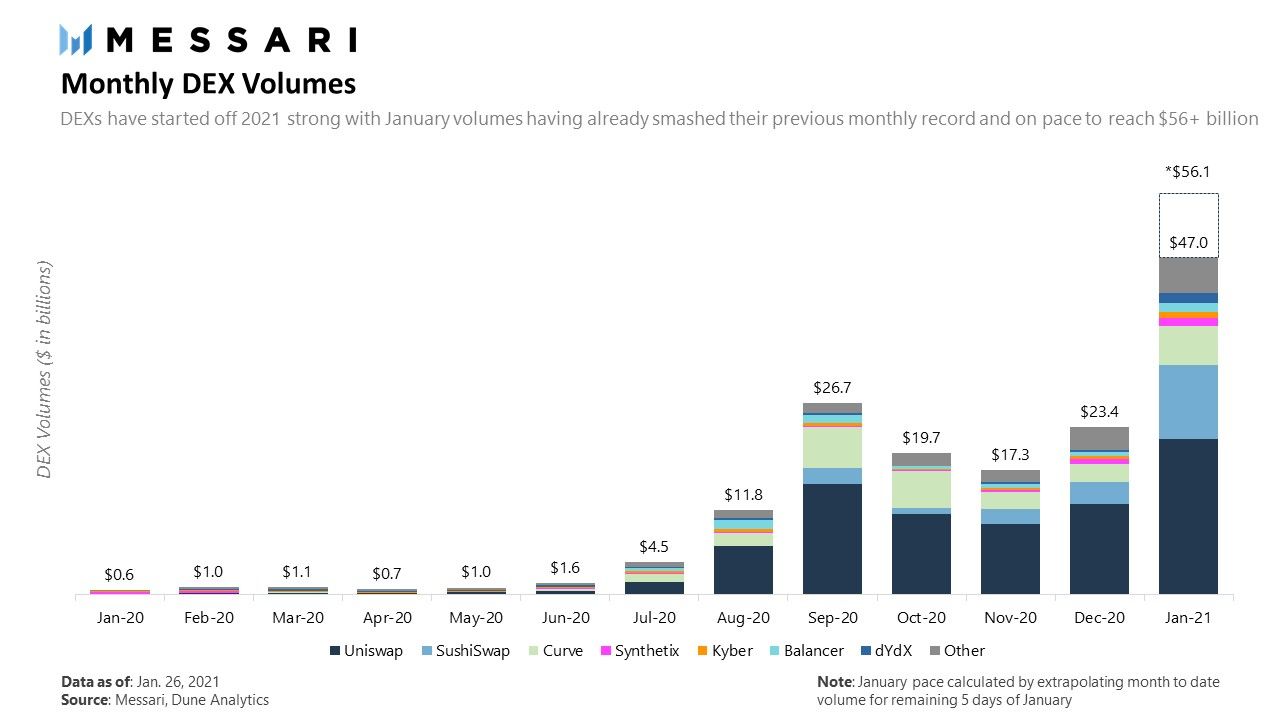
In our second piece in a series on DEX valuations, we look at SushiSwap - the once controversial Uniswap fork that is now staking out its own path and innovating in its own right driven by its grassroots community.
SUSHISWAP: OVERVIEW
Once upon a time SushiSwap was a controversial fork of Uniswap. It infamously launched in August 2020 with its high profile vampire mining attack in which it attempted to steal Uniswap’s liquidity and introduce a new native token called SUSHI. At the time Uniswap did not have a token, and the core idea, inspired by YFI’s fair launch, was to introduce a token that would be distributed more equitably among community members than a venture-backed token.
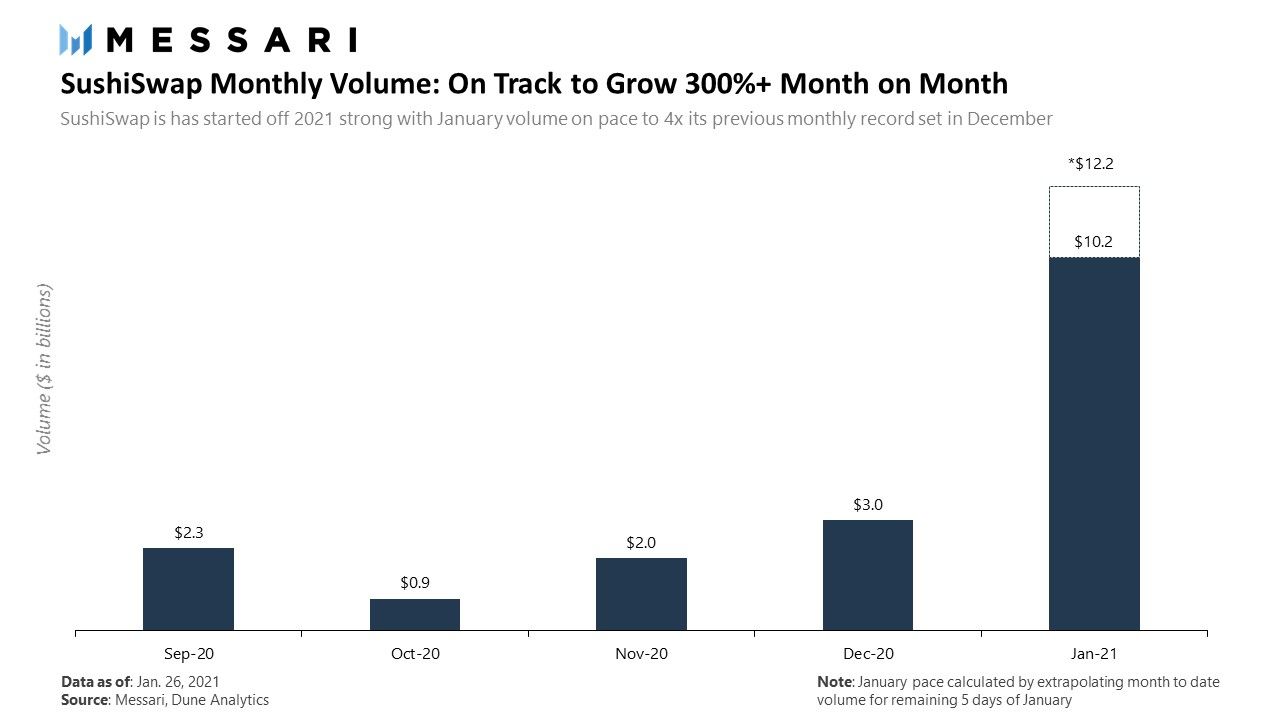
SushiSwap struggled early with respect to its contentious launch and the controversial decisions made by its initial founder. However, in the months since then SushiSwap has reinvented itself and emerged as a serious competitor on the strength of new project leaders, innovative new features, and a merger with Yearn. SushiSwap has offered a more community-driven, grassroots alternative to venture capital-backed projects, which has attracted high-profile contributors and resulted in surging volumes.

Mira was a Senior Research Analyst at Messari. Prior to joining Messari, Mira was a Senior Portfolio Manager for a US$6 billion Asia Pacific equities fund at APG Asset Management. Mira received a BA in Economics and Mathematical Methods in the Social Sciences from Northwestern University.
Ryan Watkins was a Senior Research Analyst at Messari. Previously, he worked at Moelis & Company as an Investment Banking Analyst where he worked on deals in the technology, telecom, and fintech sectors. Ryan graduated Magna Cum Laude from the Gabelli School of Business at Fordham University.