Prividium extends ZKsync beyond public scaling by enabling private, permissioned chains anchored to Ethereum. Prividium keeps execution and state private while still producing validity proofs that are settled on Ethereum, providing public verifiability.
The Atlas upgrade improves end-to-end settlement, not just throughput. It targets 15K+ TPS, ~1-second ZK finality, and ~$0.0001 proving cost per transfer by tightening integration between execution, proving, and Ethereum verification.
Atlas-enabled Interoperability reduces the “cold start” problem by letting ZK Chains interact natively with Ethereum DeFi. This provides Prividiums with a path to access Ethereum liquidity and external settlement venues without giving up its own governance, privacy, or execution environment.
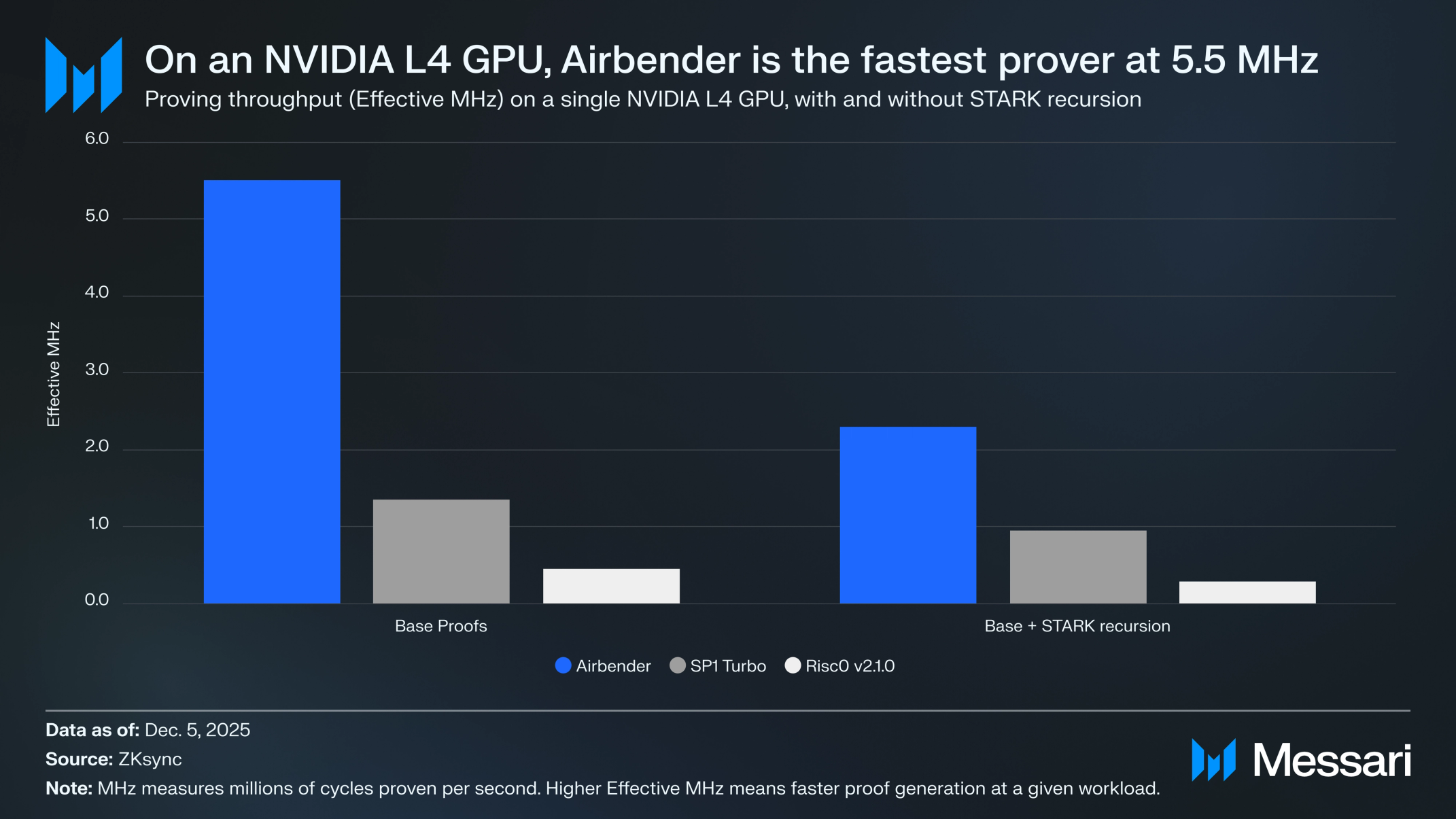
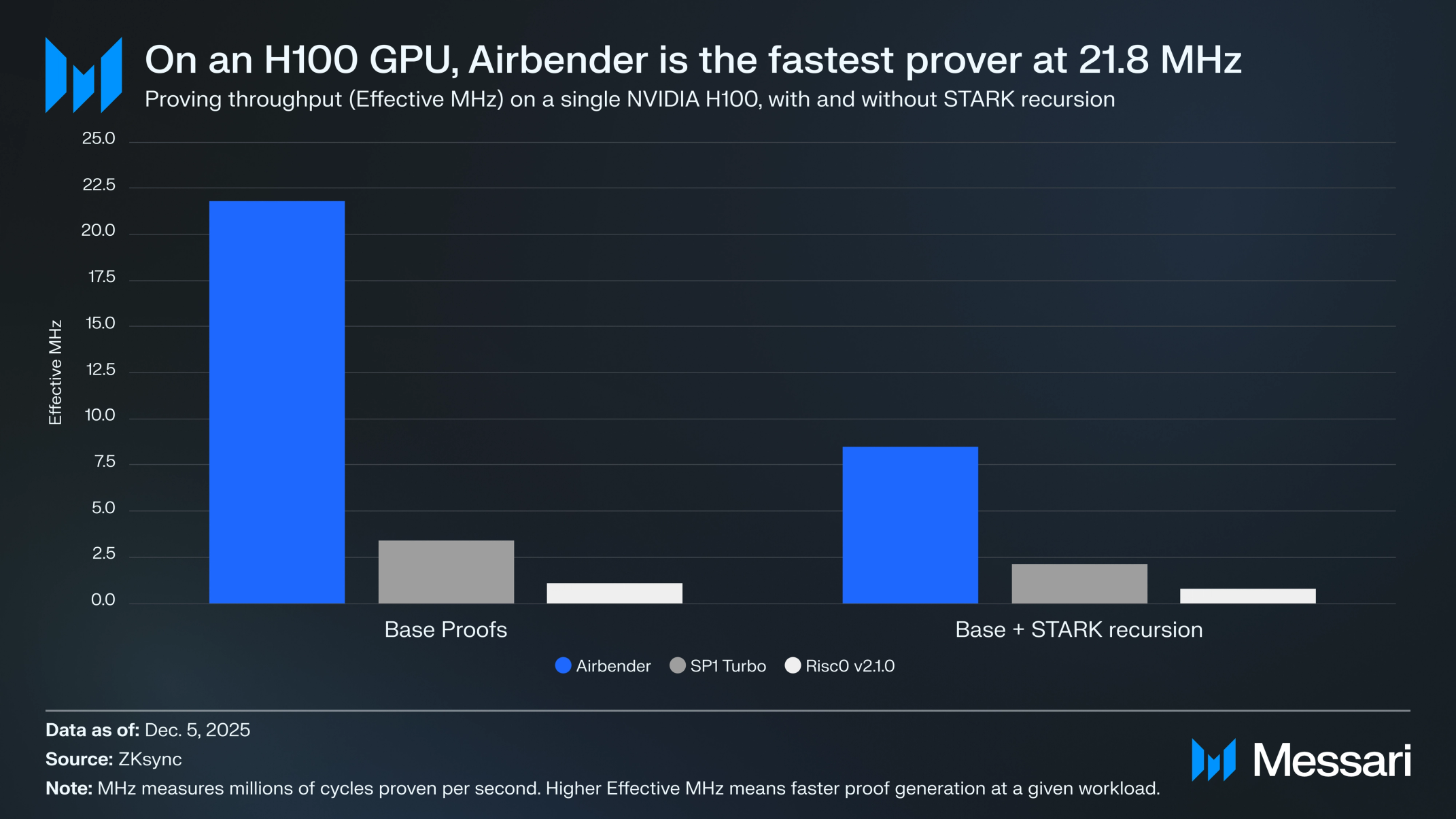
The new Airbender prover reduces proving time and hardware needs for Ethereum-verified finality. It is a state-of-the-art open source RISC-V prover, 6 times faster than competing zkVMs, using only a single GPU.
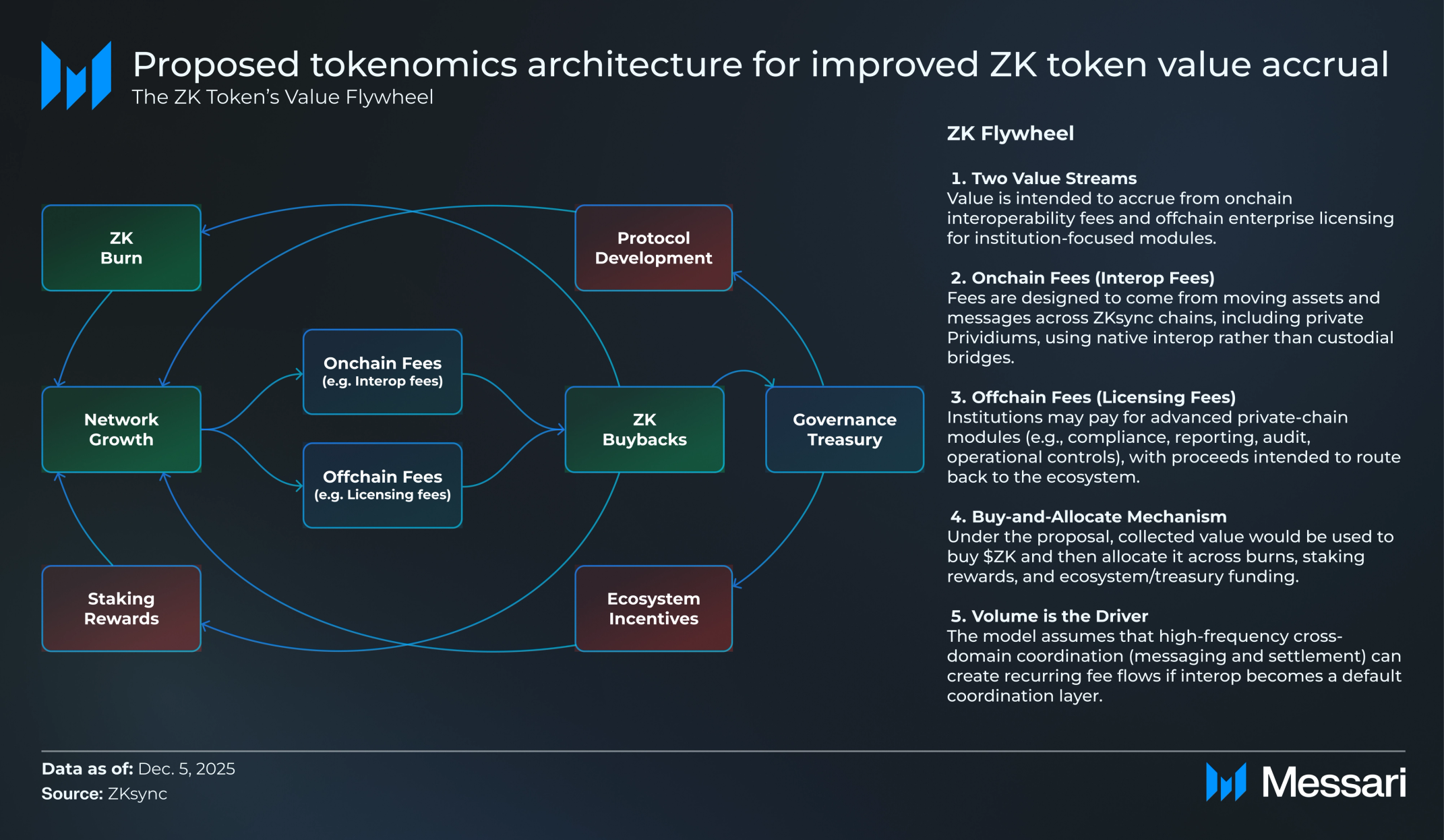
Governance proposals on tokenomics plan to route value back to the ZK token. If implemented, fees and licensing proceeds would flow into buy-and-allocate mechanisms that can burn $ZK, fund staking rewards, and support ecosystem spend.
Managed Services offer a true L2-as-a-Service for institutions. Institutions can rely on the Matter Labs team responsible for building the ZK Stack to support the best experience in designing, launching, and managing their environment.
Primer
ZKsync (ZK) is expanding beyond public L2 scaling solutions by enabling institutions to launch private blockchains using the ZKsync Stack. ZKsync introduced its private chain framework, known as Prividums, a permissioned validium deployment that runs inside an organization’s infrastructure or cloud, keeping transaction data and state offchain in an operator-controlled database, and anchoring correctness to Ethereum through validity proofs. The result is a private execution environment that retains an Ethereum-verified settlement path without making internal activity publicly observable.
Prividiums are designed for regulated or operationally sensitive workflows such as internal trading, settlement, investment strategies, payments, and asset issuance. Its enterprise permissioning layer enforces identity, access, and data visibility, with support for Okta and Azure, among others. It also provides contract and function-level controls via a Proxy RPC, as well as selective disclosure for audit or reporting needs. Recent ZK Stack upgrades, including Airbender (June 24, 2025) and Atlas (Oct. 7, 2025), shorten the path from private execution to Ethereum-verified finality by improving proving performance and end-to-end settlement latency.
From a network perspective, Prividiums matter as an adoption vector for ZKsync’s shared settlement and interoperability layer. ZKsync’s governance proposals (Part I, Part II) aim to link growing cross-chain coordination, including communication between private chains and public environments, to potential ZK token utility and value accrual via interoperability fees and select enterprise licensing routed through buy-and-allocate mechanisms, contingent on adoption and final implementation details.
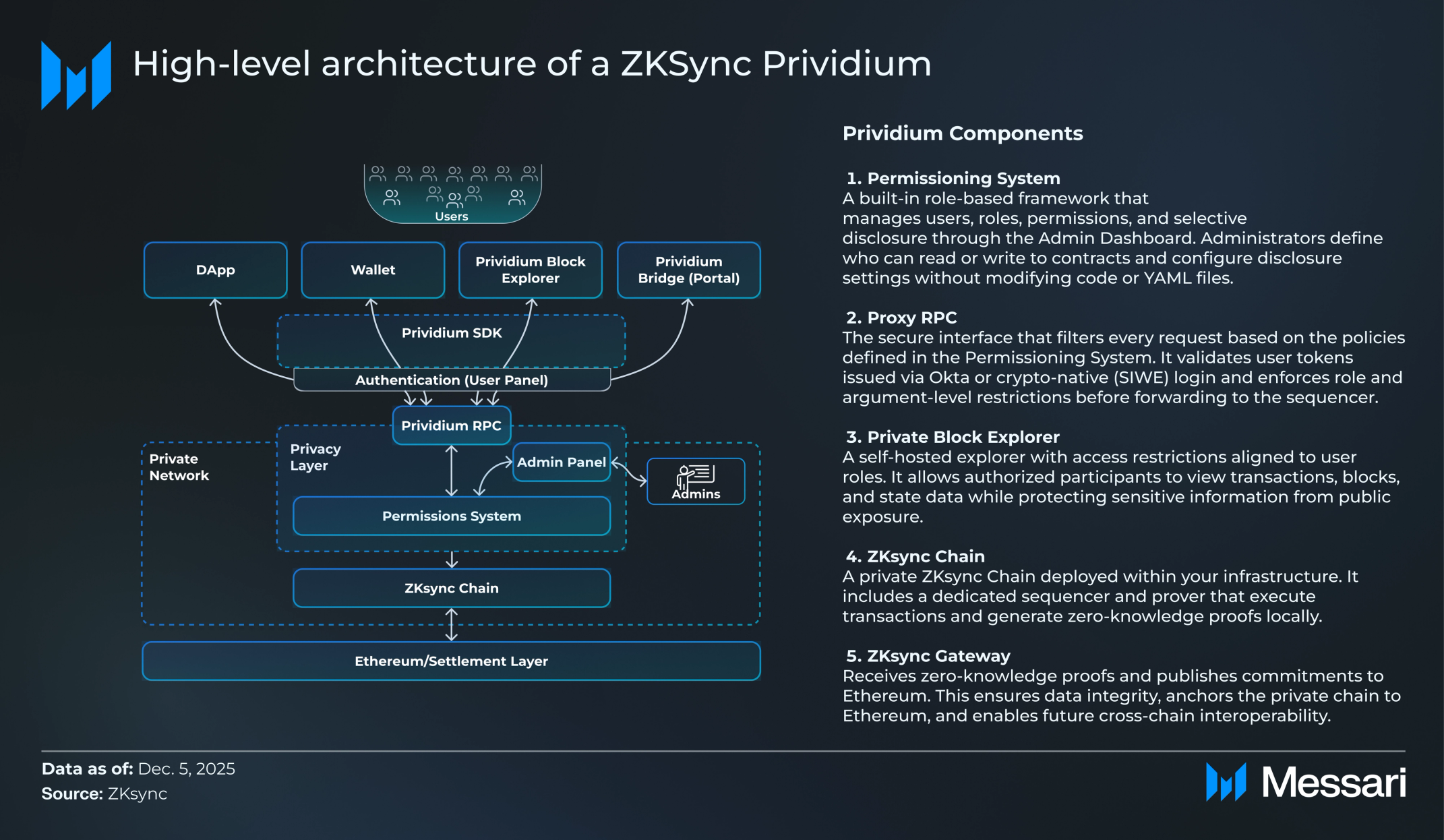
A Prividium is a private execution environment built with the ZKsync Stack that inherits Ethereum as its settlement and verification layer. It operates as a permissioned chain that stores all enterprise data on-prem or cloud, meaning transaction inputs and state are not posted publicly; however, the chain still ensures public verifiability on Ethereum through zero-knowledge (ZK) proofs. ZKsync’s use of ZK-STARKs derives security from hash-based cryptography, which is widely recognized as a quantum-resistant primitive, positioning Prividiums as more resilient to future cryptographic shifts than pairing-based systems, even as user signatures remain dependent on Ethereum’s current cryptography. This structure is intended to preserve confidentiality while maintaining a verifiable settlement path that does not depend on trusted auditors reconstructing private state transitions.
Each Prividium operates as an independent ZKsync chain with its own sequencer, prover, and state database. The chain’s security model is centered on proof production and verification, rather than public data availability. For institutional deployments, this supports high-throughput internal operations without disclosing balances, trades, or operational activity to public observers.
Enterprise Permissioning and Identity Controls
Prividiums incorporate a permissioning layer that governs identity, access, and data visibility. All reads and writes are routed through a Proxy RPC that enforces contract-level and argument-level permissions defined by the operator through the Permissions API and Admin Panel. Authentication supports enterprise SSO via Okta, Azure, as well as crypto-native sign-in with an Ethereum wallet, enabling institutions to align blockchain access with existing compliance frameworks.
Selective disclosure provides controlled data sharing when needed. Rather than making a ledger public, operators can reveal specific contract information, such as token supply or bytecode hashes, without exposing the underlying ledger. This allows organizations to meet audit or reporting requirements while maintaining confidentiality for sensitive operations and client data.
Interoperability and Settlement
While Prividiums are private by default, they also support interoperability with Ethereum and other ZKsync chains. Interoperability refers to protocol-level connectivity where chains exchange messages and assets through a shared settlement and proof framework with cryptographic verification. Unlike a bridge, which typically depends on separate bridge contracts, offchain relayers, or external validator sets and often requires liquidity to be siloed per route, a Prividum’s interoperability is enforced directly by the protocol and anchored to a common settlement layer. Interoperability is achieved through the shared proof system and settlement flow that all ZKsync chains use. Prividium batches are finalized on Ethereum through STARK proofs submitted to the ZKsync Gateway, which provides tamper-resistant verification for each state update. Because all chains in the ZKsync ecosystem rely on the same settlement layer, they can exchange assets or messages with cryptographic assurances, rather than relying on trust-based handoffs.
For institutions, interoperability is valuable because it preserves their private daily operations while retaining optional connectivity for distribution, settlement, or liquidity access. Further, this ensures that all assets are free to move around, rather than being locked in a close environment, or relying on 3rd party bridges to move. This structure keeps execution and state isolated within the Prividium environment, while still enabling verifiable coordination when workflows require interaction with external counterparties or public infrastructure.
Additionally, L1 Interop allows ZKsync chains to interact directly with Ethereum-based DeFi while retaining independent governance, private execution, and their own operating environments. When combined with Prividiums, this is the leading architecture that gives institutions private systems and direct access to public-market liquidity:
Private access to Ethereum liquidity and markets
Streamlined credit, treasury, and funding operations
Advanced trading and risk systems
Airbender Proof System
Airbender was introduced on June 24, 2025, as ZKsync’s next-generation proving system and zkVM. It was presented as a response to scaling constraints in proof generation as ZKsync expands from a single public chain into an ecosystem of chains, including private Prividium deployments. Airbender was designed to improve proving speed and efficiency while lowering the hardware requirements needed to produce proofs, which is directly relevant for operators that must run proving infrastructure inside controlled environments.
At a high level, Airbender generates STARK proofs for RISC-V bytecode execution and is the proving foundation for future ZKsync chains. For Prividiums, the relevance is straightforward: when most execution data remains private, externally verifiable assurances depend on the prover’s ability to generate proofs quickly and reliably. Faster proofs narrow the gap between internal finality and Ethereum-verified settlement, enhancing predictability for workflows that require precise confirmation and reconciliation windows. The jump in proving efficiency also reduces the compute and power footprint required to operate ZK infrastructure, which can support enterprise sustainability and ‘green’ mandates compared with heavier consensus models and less efficient proving systems.
Performance Improvements
Benchmark results show Airbender outperforming other open-source zkVMs across both base proving and recursive proving. Reported measurements include strong base proving throughput on H100 GPUs and continued performance advantages on smaller L4 GPUs, with end-to-end proving gains persisting under recursion. In the same benchmarks, faster proving is associated with per-transfer proving costs around $0.0001 and sub-second block proofs for typical ZKsync workloads.
Airbender is also benchmarked on proving the execution of an average Ethereum block using a single H100 GPU when paired with ZKsync OS. Results show roughly 17 seconds to generate a proof before recursion and about 35 seconds end-to-end with recursion. Relative to comparable proving targets that are typically demonstrated with large GPU clusters, these results imply a materially smaller proving footprint. However, differences in execution environments and storage models limit direct comparisons across zkVM systems.
Proving footprint matters because it directly affects who can operate provers and how frequently chains can settle to Ethereum. Lower hardware intensity can reduce operational complexity for chain operators, improve redundancy by widening the set of viable proving participants, and support tighter proof submission cadences. For private deployments like Prividiums, faster and more accessible proving primarily translates into shorter, more predictable windows between private execution and Ethereum-verified finality, without requiring transaction data to be made public.
The Atlas Upgrade
Airbender reduces the cost and footprint of proof generation, but proving performance is only one part of the settlement process. Atlas is the ZK Stack upgrade introduced on Oct. 7, 2025, that bundles changes across execution, proving integration, and interoperability, to shorten the path from transaction inclusion to Ethereum-verified finality. Rather than treating scaling as merely “more TPS,” Atlas is centered on tightening the full loop from sequencing to proof generation to onchain verification.
This matters more for Prividiums because privacy shifts what external parties can observe. When transaction data and full state remain inside an operator-controlled environment, externally verifiable assurances depend on the cadence at which commitments are proven and finalized on Ethereum. Atlas is designed to shorten those cycles and improve the predictability of proof-based settlement while keeping Ethereum as the verification and finality layer. The upgrade is most clearly described through its stated targets and the stack changes intended to reach them.
What Atlas Introduces and Why it Matters for Prividiums
Atlas is defined by a set of system targets and the stack changes intended to reach them. It pairs ZKsync OS with Airbender and sets three explicit targets: 15K+ TPS, roughly 1-second ZK finality, and around $0.0001 in proving cost per transfer. Atlas is less about a single optimization and more about reducing end-to-end settlement time through tighter integration between execution, proving, and Ethereum verification. Alas targets shorter proof and verification cycles, thereby tightening the window between private execution and Ethereum-verified finality, and supporting faster, more predictable verifiable handoffs when assets or messages must cross boundaries, such as transitioning from internal execution to public settlement or interacting with other ZKsync chains.
Institutional Prividiums and the ZK Token
Prividium Interoperability
Prividiums plug into the same Ethereum anchoring and interoperability framework as other ZKsync chains. This creates a path for optional coordination with Ethereum and other ZKsync chains when a private workflow requires external settlement, distribution, or access to liquidity. The key point is that cross-environment connectivity is additive and use-case driven, rather than a default exposure of internal activity. As more Prividiums come online, the amount of cross-chain coordination routed through shared settlement and interoperability can expand, which is the primary linkage to discussions of long-term ZK token utility.
Implications for the ZK Token
Prividiums share the same settlement and interoperability architecture as other ZKsync chains, making network-level activity the clearest surface for potential token utility. That context underpins a two-part ZK token utility proposal from Alex Gluchowski, co-founder and CEO of Matter Labs, which shifts the token’s framing from governance-only toward a model where protocol usage can generate recurring value flows back to the ecosystem as interoperability and private institutional chains move closer to production use.
Part I of the ZK Token Proposal outlines a utility model with two value vectors. The onchain vector is interoperability fees tied to moving assets and messages across ZKsync chains, including Prividiums. The offchain vector is enterprise licensing for institution-facing modules, such as compliance, reporting, audit, or operational tooling. Under the proposal, both revenue streams route into a governance-controlled mechanism that buys the ZK token and allocates it across staking rewards, token burns, and ecosystem funding, with parameters set and adjusted through governance.
Part II of the ZK Token Proposal expands the thesis by focusing on the coordination burden embedded in financial messaging. It describes global finance as high-volume but fragmented systems that cannot verify each other natively, driving reconciliation overhead, exception handling, and settlement friction across payments, treasury, securities, and compliance workflows. Within that framework, interoperability serves as a shared cryptographic coordination layer across public chains and private Prividiums, and the fee model from Part I is positioned as the mechanism that links this coordination activity to ZK by charging for interop verification and settlement. The magnitude and timing of any ZK-linked value accrual is contingent on adoption and final implementation details.
Policy Signals for ZK-Based Privacy
As private chains begin coordinating with public settlement layers, the core issue is no longer whether privacy can exist on public blockchains, but how privacy can be preserved without sacrificing accountability. Recent regulatory discussions reflect this shift, emphasizing the need to move away from indiscriminate data collection toward systems that can verify compliance through cryptographic proofs without exposing full transaction histories.
Recent SEC Crypto Task Force remarks echo this direction, emphasizing that indiscriminate data collection is inconsistent with a system that values privacy, while explicitly mentioning that zero-knowledge proofs can “shield private information while proving, for example, that someone is permitted to conduct a given transaction.” The task force’s remarks also point to an emerging compliance model where regulated activity can be verified without exposing an individual’s full transaction history, highlighting mechanisms such as selective disclosure and proof-based attestations rather than full transparency. Prividiums align directly with this approach by making privacy the default execution environment while still anchoring to Ethereum through ZK proofs, and by pairing permissioning and selective disclosure modules with the ability to prove compliance, settlement finality, or eligibility conditions when a workflow needs to coordinate with external counterparties or public liquidity.
Closing Summary
ZKsync’s Prividium extends the ZKsync Stack into private, permissioned enterprise-chain deployments that keep transaction data and state stored within the enterprise’s infrastructure while still anchoring state updates to Ethereum through validity proofs. This model shifts the core trust assumption toward proof production and verification, since external assurance comes from the cadence and reliability of Ethereum-verified commitments rather than public data availability. Airbender, introduced on June 24, 2025, and Atlas, introduced on Oct. 7, 2025, are positioned as the key stack upgrades that tighten this loop, with Airbender reducing proving cost and footprint, and Atlas targeting faster end-to-end settlement through deeper integration between execution, proving, and verification.
As more Prividiums come online, interoperability becomes the practical coordination surface between private execution environments, Ethereum, and other ZKsync chains. That connectivity underpins Alex Gluchowski’s two-part ZK token utility proposal, which links potential ZK utility to network-level activity via onchain interop fees and offchain enterprise licensing routed through governance-controlled buy-and-allocate mechanisms. The magnitude and timing of any ZK-linked value accrual are contingent on adoption and final implementation details. Institutions evaluating private, Ethereum-anchored execution for regulated or operationally sensitive workflows can engage with the Matter Labs team to discuss deploying a Prividium, either through a self-hosted setup or a managed services model where Matter Labs deploys and operates the chain on the institution’s behalf.
This report was commissioned by ZKsync. All content was produced independently by the author(s) and does not necessarily reflect the opinions of Messari, Inc. or the organization that requested the report. The commissioning organization may have input on the content of the report, but Messari maintains editorial control over the final report to retain data accuracy and objectivity. Author(s) may hold cryptocurrencies named in this report. This report is meant for informational purposes only. It is not meant to serve as investment advice. You should conduct your own research and consult an independent financial, tax, or legal advisor before making any investment decisions. Past performance of any asset is not indicative of future results. Please see our Terms of Service for more information.
No part of this report may be (a) copied, photocopied, duplicated in any form by any means or (b) redistributed without the prior written consent of Messari®.
Hayden is a Research Analyst specializing in the intersection of crypto-economic incentive mechanisms and their role in DeFi, DePIN, and AI ecosystems. Prior to joining Messari, Hayden worked as a Research Analyst at The Block and as a Venture Associate at a crypto-native venture capital fund.
Hayden is a Research Analyst specializing in the intersection of crypto-economic incentive mechanisms and their role in DeFi, DePIN, and AI ecosystems. Prior to joining Messari, Hayden worked as a Research Analyst at The Block and as a Venture Associate at a crypto-native venture capital fund.