ZkSync: A Peek into the Future of Ethereum

ZkSync 1.0, launched by Matter Labs in 2020, is a zero-knowledge rollup (ZKR) that relies on Ethereum for security and is mostly used for token swaps or transfers. It does not support smart contracts, so the products available on zkSync 1.0 today are limited, leading to inferior adoption relative to other Ethereum scaling solutions. The Matter Labs team is hoping to fix that by launching their alpha zkSync 2.0, a zkEVM, on mainnet on October 28th. Furthermore, Matter Labs announced it will be launching an L3 on testnet by Q1 of 2023.
ZkSync 1.0
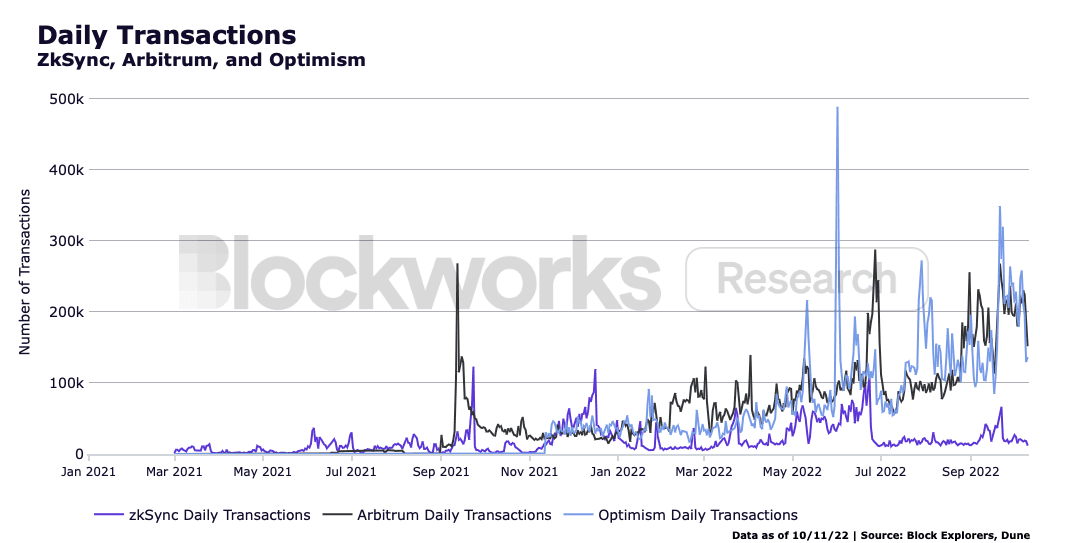
ZkSync 1.0 has managed to attract over $54M of capital despite the lack of support for smart contracts. A majority of the TVL on zkSync is ETH and various stablecoins due to the lack of utility on the network beyond token transfers and swaps, and NFT minting which has failed to garner significant traction. Many users with funds on the rollup could be prepositioning for the inevitable token airdrop that should capture the future growth of the zkSync economy. Optimism and Arbitrum, two of the most popular Ethereum scaling solutions, see far more user activity given the fact that they already support smart contracts. While daily transactions are not a perfect metric, it provides some insight into the amount of activity zkSync is missing out on by not yet supporting smart contracts.
All funds on zkSync are secured in a smart contract on Ethereum with computation and storage performed off-chain. Transactions are rolled up into a batch which is settled on Ethereum to amortize gas costs across all L2 transactors which are then simultaneously settled. All of the state changes that occur on the rollup are posted to Ethereum as calldata along with a SNARK proof that ensures the state changes are valid. The calldata posted to Ethereum empowers anyone to reconstruct the L2 state and is significantly cheaper than storing the entire L2 state on the EVM. SNARKs are able to verify large batches of transactions in a cost efficient and timely manner (instantly confirmed and 15 minutes to finality) and provide a huge boost to transaction throughput for zkSync when compared to the Ethereum base layer (e.g. ~2,000 and ~15 tps respectively).
ZKR’s provide many advantages over other scaling architectures. ZKR’s inherit the security of Ethereum, whereas sidechains like the Ronin Network are subject to vulnerabilities in their own validator set. ZKR’s also don’t rely on fraud proofs like Optimism or Arbitrum, whereby an honest third party must be monitoring blocks for malicious transactions and require a 7-day challenge period that delays fund withdrawals. Additionally, funds on ZKR’s are always retrievable by their rightful owners regardless of the status of a validator set, unlike the case with plasma chains where the validators are required to safely monitor withdrawals.
The Opportunity for zkEVMs

Sam leads coverage on Ethereum, L2s, Aave, Compound, as well as NFTs and gaming. Previously worked on a hedge desk at UGC.