ZK Compression: Rollups, Stateless Client, or a Secret Third Thing?


Primer
Two of the largest constraints on blockchain systems are the costs associated with computation and state management.
Every onchain transaction (e.g., token swaps, NFT mints, contract deployment, etc) has to be validated and executed by nodes on the network. The cost of this computation varies from network to network. On one extreme is Ethereum mainnet, where a simple token swap currently costs ~$10; alternatively, transactions on Solana are usually well under a fraction of a cent.
State management typically refers to managing the impact of a blockchain's ever-growing state. As new users are onboarded onto a network via collecting NFTs, buying/selling tokens, or deploying new contracts and applications, the state of a blockchain grows. Broadly speaking, there is not necessarily an upper bound on the size of the state since its growth is a direct consequence of and driven by the activity and growth of the network itself. Solana, for example, explicitly charges users for this cost via a rental fee.
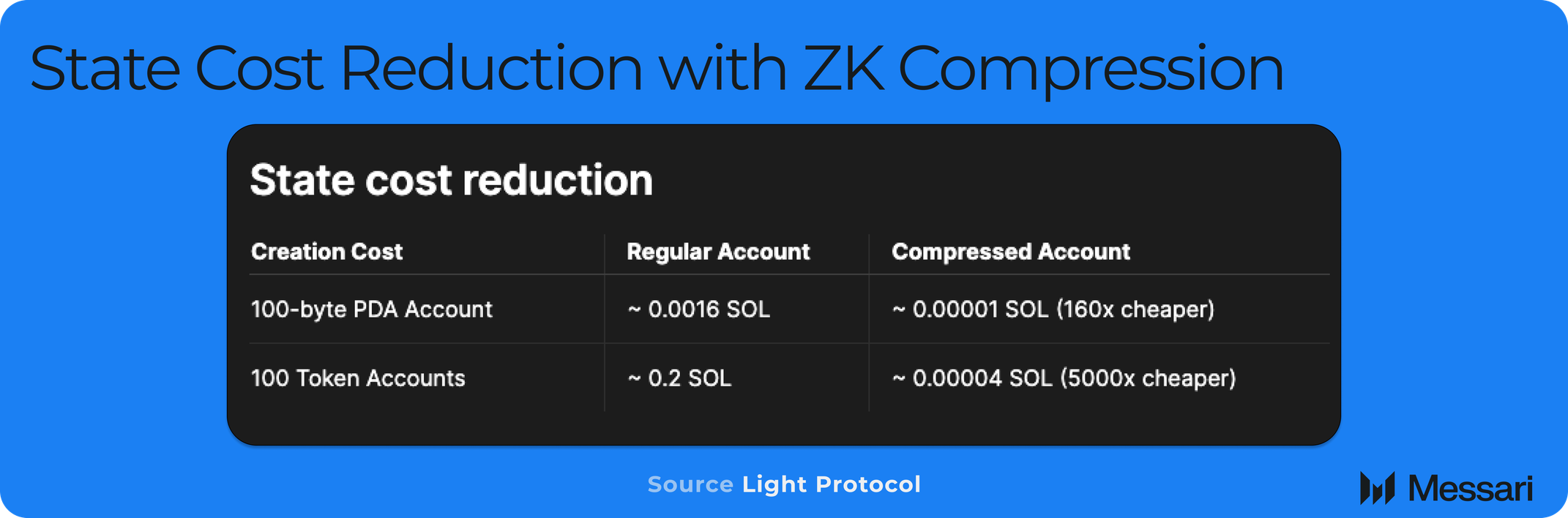
As noted above, Solana is largely unconstrained by computation costs due to its low transaction fees. However, the costs associated with state are still relatively expensive. To address the high costs associated with Solana state, Helius and Light protocol introduced ZK compression.
At a high level, Solana’s ZK compression allows a large set of accounts (e.g., user addresses and a specific token balance) to be securely represented onchain by a relatively small identifier. This compression technique leads to dramatically reduced state costs.

Kunal previously worked in equity research and now considers himself a financial analyst in crypto. He specializes in valuation and bottom-up analysis for Layer-1 and DeFi protocols because he has yet to learn of a way to value NFTs.

Prior to joining Messari, Seth worked in traditional finance software and services, and has a MSc in Applied Mathematics. Seth is a Senior Research Analyst on the Enterprise Research team, and focuses on infrastructure, verifiable compute, and the AI x Crypto intersection.