YAM farmers are betting $400 million on a successful v2

YAMs took the DeFi world by storm last week after announcing the launch of their token economic experiment that combined a fluctuating supply asset with a fair launch through liquidity mining. To everyone’s surprise, this experiment amassed $750 million locked up as opportunistic traders looked to capitalize on outsized yields. In an interesting turn of events, a bug was found that rendered the governance process obsolete preventing updates from being made, an implied death sentence for the short-lived project.
But is there more than meets the eye here?
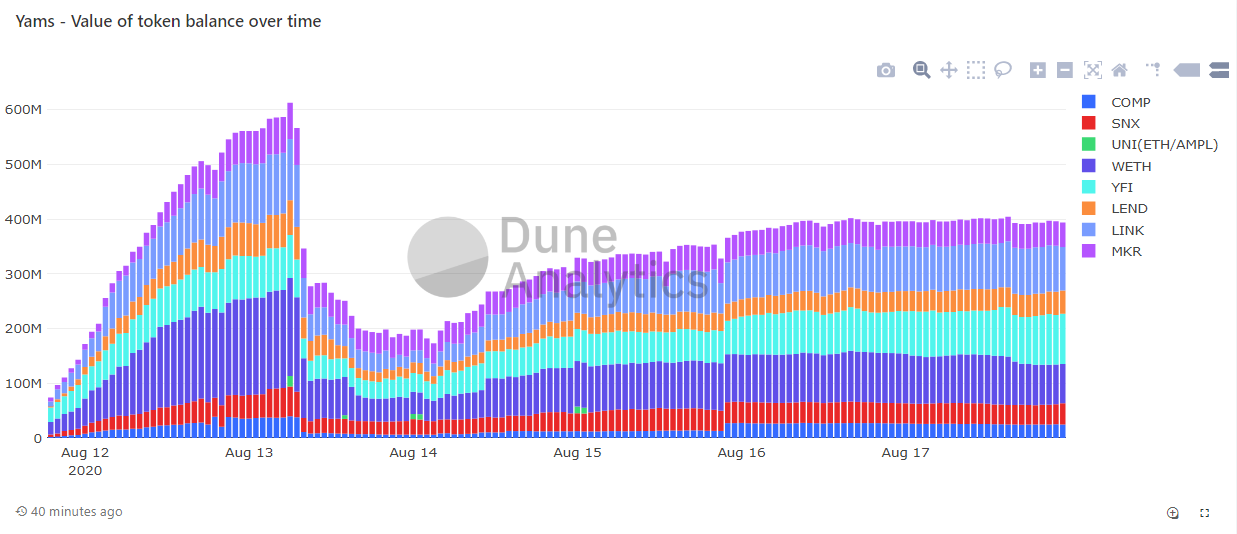
Source: Dune Analytics
After the community seemed to have thrown in the towel, a good portion of the funds remained locked in the contracts. Not only that but over the course of a few days doubled to over $400 million making it the 7th largest by total-value-locked. So despite the protocol not functioning as intended, its evident that people still believe there is value in using funds to farm YAMs. In fact, people are even buying them on the open market as the price is even up 60% in the last 24-hours.
Why would anyone do this?
The YAM team released a migration plan that outlined a process for redeploying the protocol that includes a 1:1 migration of old tokens to the new ones. Therefore, anyone that believes there is value in a fully community-owned, rebasing asset with a built-in treasury can capitalize on that belief by partaking in the failed v1 to share in the potential upside of v2.
Whether that upside is driven by the short-term profit of yield-farmers looking to make a quick buck at the expense of others or if this experiment can actually become a useful financial primitive remains to seen. But one thing is for certain, these experiments are not going away. Money is a great motivator and people are making a lot of it. One can only hope we’re not increasing the risk of a DAO-like hack that brings the system to its knees.
