Wormhole connects over 40 blockchains and has processed more than $70 billion in cumulative cross-chain volume and one billion cross-chain messages, making it one of the most widely used interoperability protocols in crypto.
Wormhole’s NTT (Native Token Transfers) standard aims to replace fragmented wrapped assets with canonical multichain representations, consolidating liquidity, preserving issuer control, and simplifying risk management.
NTT is already in production across multiple deployments, including Ripple’s RLUSD rollout, Dogecoin’s canonical DOGE implementation, M0’s multichain M token, and Monad’s native bridge.
Wormhole Portal has evolved from a standalone bridge interface into a multichain gateway, integrating cross-chain swaps via Mayan.
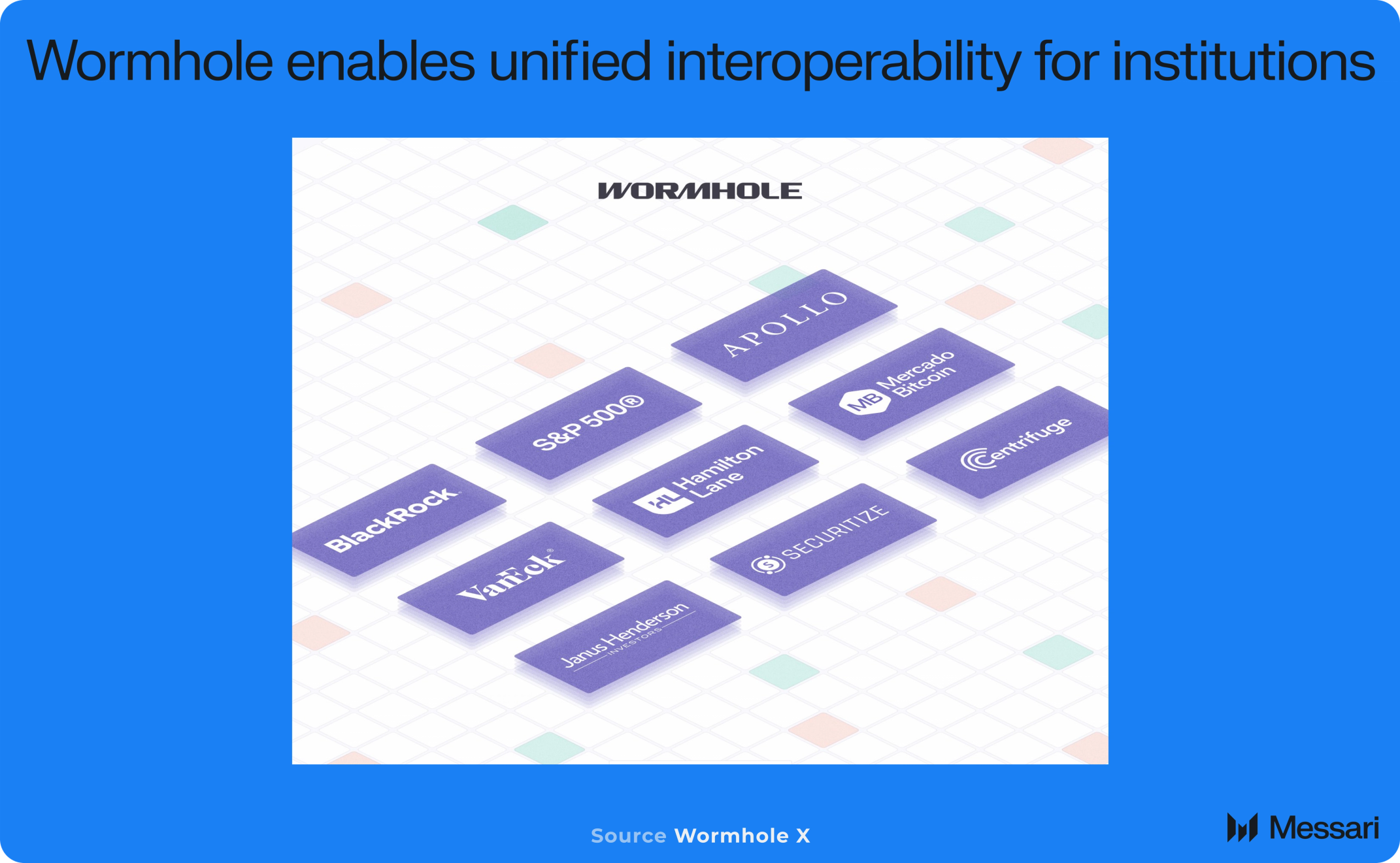
Institutional adoption spans tokenization and real-world asset platforms (e.g., BlackRock, Ripple, Apollo, Hamilton Lane, Mercado Bitcoin, Centrifuge, Securitize), which use Wormhole for cross-chain distribution of tokenized funds, tokenized private credit, and stablecoins.
Introduction
Wormhole is a decentralized interoperability protocol that enables cross-chain asset transfers and generalized message passing across more than 40 EVM and non-EVM blockchains. The protocol provides a chain-agnostic communication layer that allows applications on one network to securely move value and coordinate state changes on another. This functionality supports use cases ranging from token bridging and cross-chain swaps to governance, oracle updates, and tokenized assets.
The protocol launched in 2020 as the first token bridge between Solana and Ethereum, supported by a small engineering team and a grant from the Solana Foundation. This early bridge helped catalyze Solana’s DeFi ecosystem by enabling ETH and ERC-20 capital to move onto Solana, supplying liquidity to many of the network’s earliest DeFi protocols.
Since launching, Wormhole has broadened from a wrapped-asset bridge into a full interoperability stack:
Messaging Layer: Delivers authenticated messages between chains.
At scale, Wormhole has facilitated over $70 billion in cumulative bridge volume and processed more than one billion cross-chain messages. For a complete primer on Wormhole, refer to our Initiation of Coverage report.
Early cross-chain bridges largely relied on lock-and-mint mechanisms, where tokens are locked on a source chain and wrapped representations are minted on a destination chain. Over time, this model led to multiple wrapped versions of the same asset existing on a single network, fragmenting liquidity, increasing operational complexity for integrators, and exposing the ecosystem to significant security risks that have resulted in multiple large-scale bridge exploits.
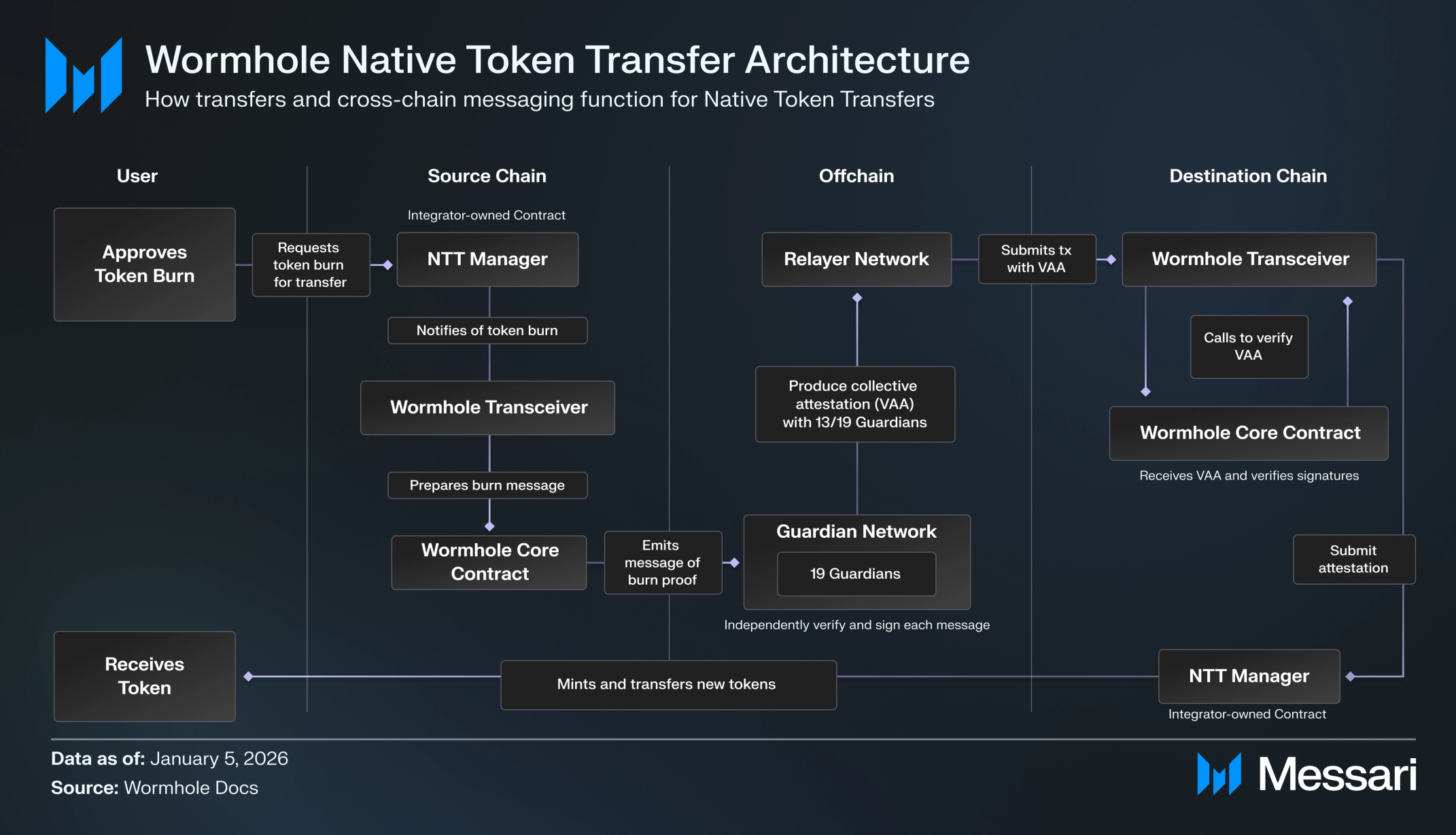
Wormhole continues to support wrapped token transfers through its WTT framework, but NTT (Native Token Transfers) introduces an alternative model for multichain asset issuance. Rather than producing multiple unrelated wrapped assets, NTT defines a canonical token representation controlled by the original issuer or contract administrator and governed by a single multichain supply policy.
How NTT Works Conceptually
NTT is designed as an open framework for multichain asset issuance rather than a rigid token standard. It provides standardized interfaces for cross-chain distribution while leaving key design choices to token issuers. Most deployments follow either hub-and-spoke or burn-and-mint architectures, but the framework is permissionless and flexible enough to support any configuration that uses locking and burning mechanisms.
Hub-and-spoke (locking): The original token supply remains on a designated primary chain, while equivalent tokens are issued on destination chains through issuer-controlled contracts. Unlike traditional bridges, this model standardizes issuance through a single, canonical interoperability setup rather than multiple independent third-party wrapped tokens.
Burn-and-mint (burning): Tokens are burned on the source chain and minted on the destination chain, ensuring a single circulating supply is maintained across networks at any given time.
Beyond these models, a defining feature of NTT is end-to-end configurability. Issuers retain control over contract upgrades, token parameters, and verification logic, allowing deployments to be tailored to regulatory, compliance, or architectural requirements and adjusted over time without redeploying core infrastructure.
NTT Adoption
Adoption of Wormhole’s NTT framework is already visible across both regulated, institutional deployments and crypto-native ecosystems.
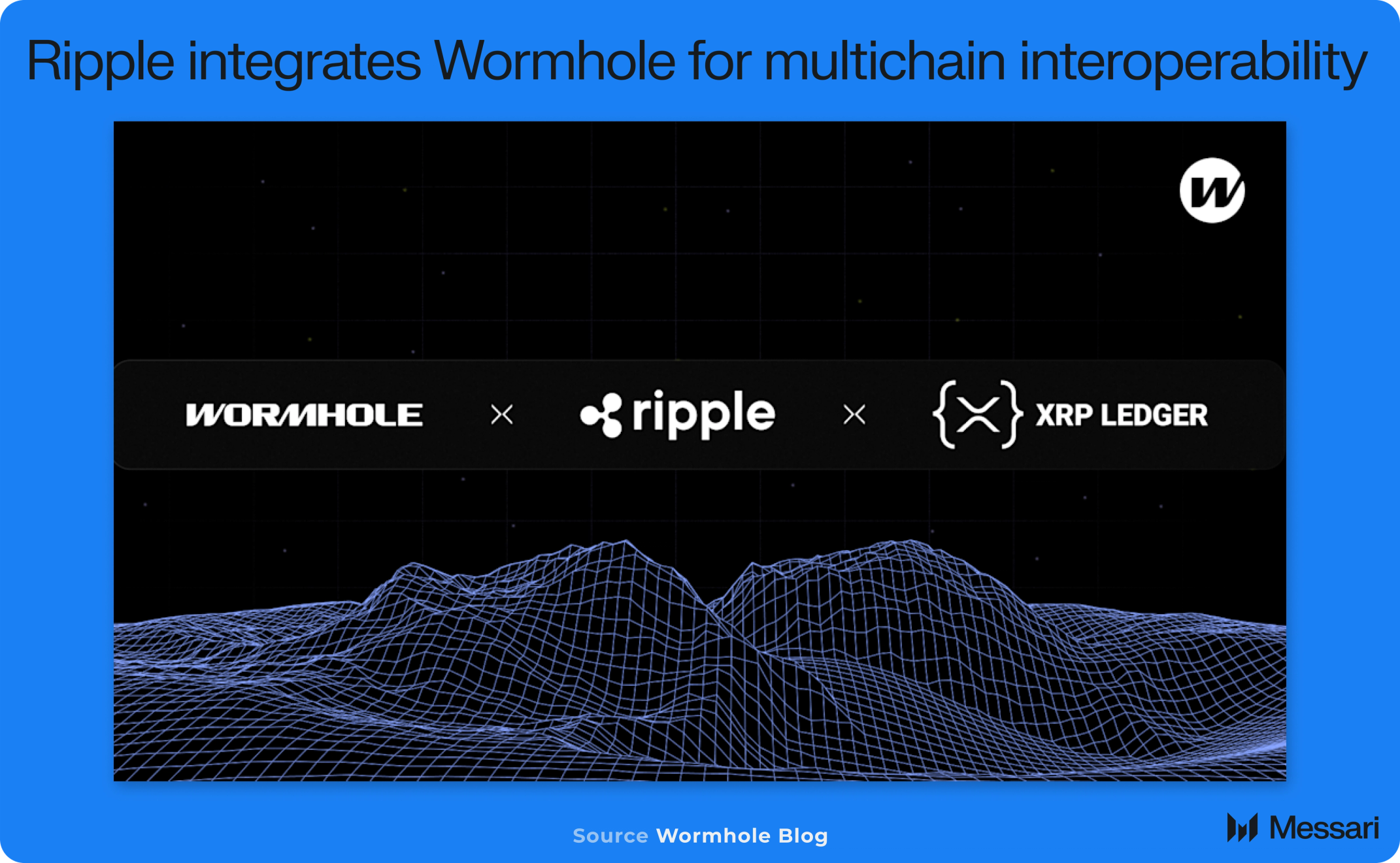
Ripple’sintegration of Wormhole’s NTT framework provides a clear example from a regulated payments context. Ripple announced plans to expand Ripple USD (RLUSD), a U.S. dollar stablecoin issued under a New York Department of Financial Services (NYDFS) Limited Purpose Trust Company, beyond the XRP Ledger and Ethereum to multiple Ethereum Layer-2s (L2s), including Optimism, Base, Ink, and Unichain. Using NTT allows RLUSD to remain natively issued and issuer-controlled while accessing liquidity and applications across chains. Ripple has positioned RLUSD as the first DFS-regulated, trust-issued stablecoin to operate on these L2 networks, framing the deployment as a convergence of regulatory oversight and onchain efficiency. The multichain rollout is also designed to strengthen shared liquidity with XRP, enabling RLUSD and wrapped XRP to function as primary liquidity pairs across supported chains.
Beyond RLUSD, NTT has been adopted across a range of ecosystem-level deployments. Dogecoin uses NTT to extend its UTXO-based network into Solana-native applications, avoiding fragmented third-party wrapped representations. M0 uses NTT to issue the M token across multiple blockchains under a single canonical supply, while Monad’s native bridge is built on Wormhole NTT to support assets such as MON and ETH. Together, these deployments illustrate how NTT enables canonical multichain assets to be integrated across applications and venues, laying the foundation for user-facing routing, swapping, and activity coordination through Wormhole Portal.
Wormhole Portal
Portal originated as Wormhole’s primary token bridge interface for transferring wrapped assets between Solana, Ethereum, and other networks. Historically, Wormhole Foundation kept Portal deliberately separated from the core protocol brand, reflecting a cautious approach to foundation-operated frontends amid regulatory uncertainty and a desire to preserve neutrality at the infrastructure layer. During this period, Portal primarily facilitated WTT flows and functioned as a bidirectional bridge between Ethereum and Solana, before later expanding to additional networks.
Over the past year, Portal has been more explicitly rebranded as Wormhole Portal. The updated branding aligns the frontend more closely with the underlying protocol and reflects a shift toward treating Wormhole Portal as a long-term product surface rather than a basic bridge UI. The current interface presents Wormhole Portal as a Wormhole-powered gateway for cross-chain activity, with dedicated functionality for transfers, swapping, and earning. This approach provides the ecosystem with a clear frontend, while still allowing third parties to deploy alternative interfaces tailored to specific regulatory or user requirements.
Portal Swap
In October 2025, Wormhole launchedPortal Swap, a DEX feature integrated directly into Wormhole Portal and powered by Mayan Finance. Portal Swap extends Wormhole Portal beyond asset transfers by enabling cross-chain swaps within a single interface, removing the need for users to bridge assets before trading.
Mayan serves as the underlying cross-chain swap infrastructure, handling routing and execution across supported networks. By embedding swaps directly into Wormhole Portal, Wormhole positions the interface closer to a generalized money transfer and routing UI, where users specify source and destination assets and chains while the underlying interoperability stack manages execution.
Institutional Adoption and Partnerships
Institutional investors, asset managers, and payment companies increasingly operate across multiple blockchains, but cross-chain activity introduces a distinct security challenge. Tokenized funds may be issued on one network, stablecoin liquidity distributed across others, and client access mediated through platforms spanning multiple chains.
Wormhole ensures that cross-chain actions only occur after they have been independently verified. Events on a source chain are observed by a decentralized network of independent validators, known as Guardians, composed of 19 established infrastructure providers operating full nodes for supported chains. A cross-chain message becomes actionable only after a supermajority of Guardians have produced matching attestations, and destination contracts verify those signatures onchain before execution. This design makes the security model transparent, allowing institutions to clearly understand how cross-chain actions are authorized and verified when managing regulated assets and risk.
Security is further reinforced through a layered design. Guardians observe and validate cross-chain events, while message delivery is handled by a separate relayer layer, reducing correlated risk. On top of this structure, protocol-level controls such as global accounting and native rate limiting allow integrators to define and adjust risk parameters to meet internal compliance and exposure requirements.
Taken together, this architecture has made Wormhole a recurring choice for institutional multichain distribution and settlement, where security assumptions must be explicit, auditable, and adaptable over time.
Wormhole also supports multichain access for tokenized investment vehicles beyond credit and cash. VanEck’sVBILL fund uses Wormhole to enable cross-chain mobility of tokenized fund shares, while Hamilton Lane’s Senior Credit Opportunities fund exposure (HLSCOPE) is issued natively on Ethereum and Optimism, with Wormhole providing the interoperability layer between networks.
Beyond individual fund launches, Wormhole has been integrated into broader tokenization and distribution platforms. Centrifugeutilizes Wormhole as the multichain infrastructure layer for Centrifuge V3, enabling native asset issuance and transfers across multiple EVM chains. Building on this foundation, Centrifuge launched the Janus Henderson Anemoy S&P 500 Index Fund Token (SPXA), a licensed tokenized S&P 500 index product, initially deployed on Base with planned multichain expansion enabled by Wormhole.
Wormhole’s role in regulated distribution also extends to regional venues. Mercado Bitcoin has integrated Wormhole into its tokenized assets platform to support cross-chain distribution of a large portfolio of regulated digital assets, reflecting demand for interoperability beyond U.S. and European capital markets.
Taken together, these integrations position Wormhole as a recurring interoperability layer across institutional tokenization stacks, supporting multichain issuance, transfer, and distribution of treasuries, private credit, index exposure, and other regulated assets.
Closing Summary
Interoperability has become a prerequisite for meaningful participation in DeFi, tokenization, and institutional onchain finance. As liquidity, users, and applications spread across an expanding set of blockchains, the ability to move assets and coordinate state securely between networks has shifted from a convenience feature to core infrastructure. Wormhole’s evolution from an early Solana-Ethereum bridge into a generalized cross-chain messaging protocol reflects this shift, with security and verifiable execution positioned as foundational design requirements.
This focus is evident across Wormhole’s architecture and product stack. Native Token Transfers enable canonical, issuer-controlled multichain assets that avoid the fragmentation and operational complexity associated with wrapped tokens, while Wormhole Portal extends this infrastructure into a user-facing gateway for cross-chain transfers, swaps, and activity coordination. Together, these layers support consistent asset movement across applications and venues without sacrificing control, security, or composability.
Wormhole’s growing role in institutional tokenization further reinforces its positioning as long-term interoperability infrastructure. Adoption across tokenized funds, stablecoins, private credit, and real-world assets highlights demand for cross-chain systems with explicit security models, auditable verification, and flexibility to meet regulatory and operational constraints. As multichain activity continues to scale, Wormhole’s ability to combine secure messaging, standardized asset frameworks, and neutral infrastructure will remain central to its relevance across both crypto-native and institutional markets.
This report was commissioned by the Wormhole Foundation. All content was produced independently by the author(s) and does not necessarily reflect the opinions of Messari, Inc. or the organization that requested the report. The commissioning organization may have input on the content of the report, but Messari maintains editorial control over the final report to retain data accuracy and objectivity. Author(s) may hold cryptocurrencies named in this report. This report is meant for informational purposes only. It is not meant to serve as investment advice. You should conduct your own research and consult an independent financial, tax, or legal advisor before making any investment decisions. Past performance of any asset is not indicative of future results. Please see our Terms of Service for more information.
No part of this report may be (a) copied, photocopied, duplicated in any form by any means or (b) redistributed without the prior written consent of Messari®.
Jake is a Research Analyst on the Protocol Research team. He previously worked as an Investment Analyst at an AI-driven crypto research platform and as a Venture Analyst at a digital assets venture fund. He advised multiple RWA tokenization projects on tokenomics. Jake graduated from the University of Southern California, where he studied Philosophy and Finance.
Jake is a Research Analyst on the Protocol Research team. He previously worked as an Investment Analyst at an AI-driven crypto research platform and as a Venture Analyst at a digital assets venture fund. He advised multiple RWA tokenization projects on tokenomics. Jake graduated from the University of Southern California, where he studied Philosophy and Finance.