What to Consider When Choosing an eth2 Provider

Choosing a secure and reliable infrastructure provider is critical for participating in eth2 successfully. Here are three things to keep in mind when making a decision, and several best practices all providers should follow.
Highlights and Key Takeaways
- Due to eth2’s network conditions in the early phases of the protocol, choosing a secure and reliable infrastructure provider capable of serving current and future needs is critical.
- Slashing in Phase 0 can result in loss of holdings and an inability to earn future rewards as that validator’s deposited ETH will be frozen until Phase 1.5.
- The generous rewards in the early stages of Phase 0 create a very attractive opportunity for the brave early adopters that choose to swim alongside the innovators because rewards are shared between fewer validators.
The rollout of eth2, which went live on December 1st, presents a historic moment for the industry and Ethereum’s most significant protocol upgrade to date. Moreover, it presents a unique opportunity for enterprises to provide their retail or institutional customers the ability to earn rewards in exchange for turning their ETH into a productive, participatory asset.
Rewards are designed to incentivize early validators and decrease gradually as more ETH is staked to secure the chain. At the time of writing, 983,362 ETH has been staked in the contract and the reward rate is expected to be around ~16%. Anyone considering participating on eth2 benefits from running their validator as early as possible.
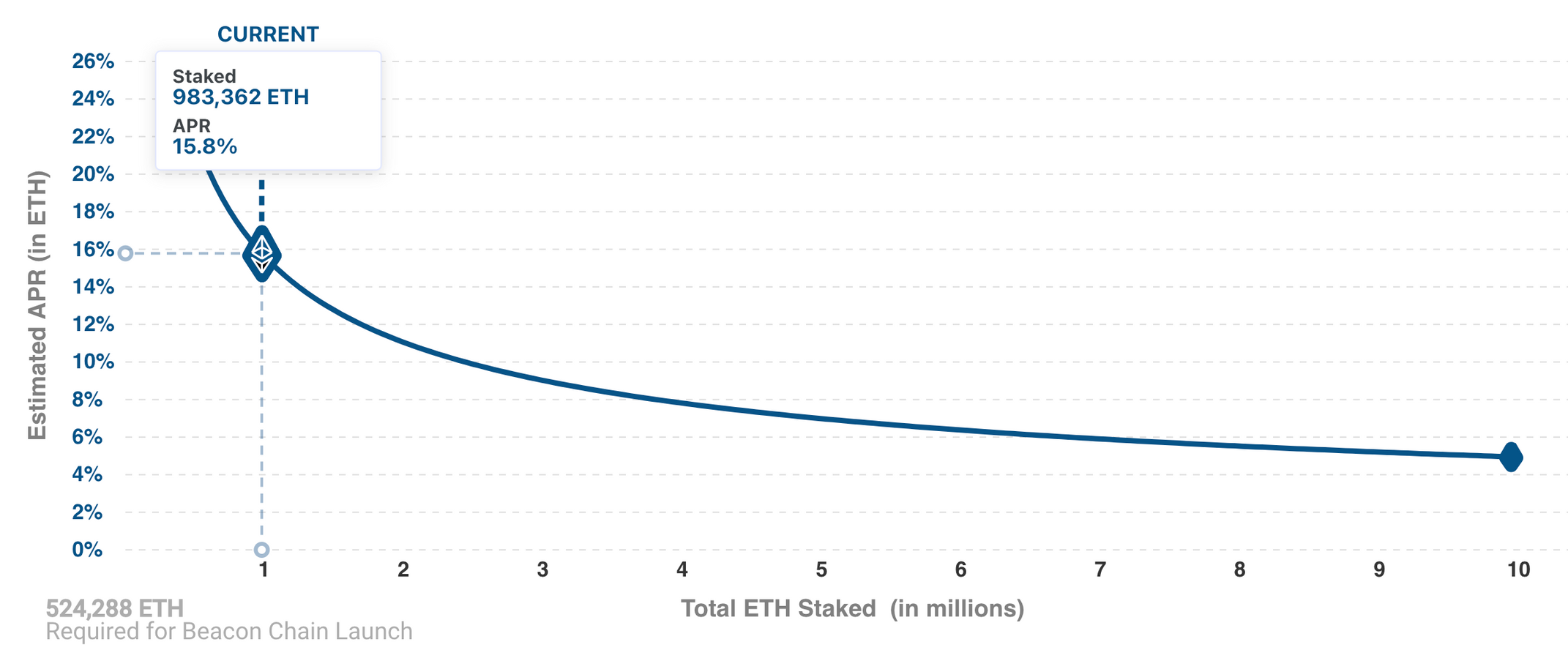
Source: Eth2 Launch Pad
Here are three things to keep in mind when evaluating a potential infrastructure provider for eth2.
1. Choosing a provider is a long-term commitment
Phase 0 is live, and users (or custodians) are able to deposit ETH in the deposit contract and will be credited with the same amount of ETH on the Beacon Chain to begin validating and earning rewards on eth2. In order to reduce complexity in the early phase of eth2, both initial deposits and accrued rewards will be transfer-restricted and non-withdrawable until the launch of Phase 1.5 or later. This one-way bridge is expected to last 12 to 24 months, which is also the time commitment one should be comfortable with when choosing an infrastructure provider.
Once set up, validators will remain active on-chain until they exit. Exits can be done voluntarily, or involuntarily as a result of maintaining an insufficient balance (less than 16 ETH per validator) or incurring slashing.
Slashing is a core protocol function and mechanism enabler in proof of stake networks. In crude terms, if block rewards are the “carrot,” slashing is the “stick" – a disincentive to keep network participants from misbehaving.
If a provider is unable to maintain secure and reliable infrastructure, resulting in slashing, or is forced to cease operations due to insolvency issues, their hosted validators may be required or forced to exit the system. Even if a validator exits, its owner will be unable to withdraw their ETH or rejoin the eth2 network until Phase 1.5 or later, leaving that ETH idle and unproductive.
As a result, it is important to choose a provider that is financially secure, experienced, and capable of making a long-term commitment to providing reliable eth2 infrastructure.
2. Switching providers later on is a risky endeavor
Each eth2 validator has two sets of key pairs that are generated during the deposit process. The user’s private withdrawal key, which they should store with the highest degree of caution and security, is responsible for actioning transfers and withdrawals of ETH. The second key is the private validator key, which is required for signing and proposing blocks on the Beacon Chain.
If a validator needs to switch infrastructure providers before Phase 1.5, the provider will need to transfer the private validator keys from the old provider to the new one. Transferring this private validator key is a risky endeavor because this would require the keys to exist in multiple systems at the same time with no guarantees that the original provider deletes them.
Because this can expose the validator to a heightened risk of getting slashed, few professional providers are likely to take on this added risk. If a double signing occurred, it would be impossible to identify which set of keys, and which provider, is responsible.
3. Finding a provider with the right feature set is important
Eth2 has been designed with anti-correlation mechanisms to incentivize running validators on independent systems. Simply put, the more validators that incur simultaneous downtime or a slashable event, the higher the penalty. As a result, diversification and redundancy through a multi-cloud, multi-region, and multi-client node infrastructure setup is critical for risk mitigation and reward consistency.
What to look for:
Different providers serve different markets and offer differentiated feature sets, but the underlying requirements for all eth2 validators remain the same. Here are several best practices to consider when selecting a provider, or building an in-house solution.
- Maximize uptime and resiliency with multi-region and cloud support. Eth2 infrastructure should run across multiple availability zones and cloud providers to reduce risks of correlated slashing and downtime.
- Proper key management ensures private validator keys are secure from theft and prevents accidental double signing, which can lead to slashing. Providers should explain how they handle these keys.
- Providers should have experience running early validators on the first eth2 client testnet and have participated in various testnets for the past year.
- Fast response times and swift incident resolution – missed blocks are missed rewards.
Enterprises can get early access to the Bison Trails eth2 Pioneer Program and start building on the Beacon Chain!
Disclaimer: This article reflects the opinions of Bison Trails and may not represent the opinions of Messari, Inc., or its employees. Third-party advertisements and links to other sites where products and services are advertised are not endorsements or recommendations by Messari. Messari is not responsible for the content of the ads, promises made, or the quality or reliability of the products or services offered in any third party advertisement.
This article is for informational purposes only and should not serve as investment advice. You should conduct your own research and consult an independent financial professional, or tax or legal advisor before making any investment decisions.