Weekly Recap: International Exchanges, Blur's Blend & More
This week was full of big moves. Coinbase and Gemini entered international markets, while Blur and Curve had big product launches. Elsewhere, the long-awaited Sui mainnet launch arrived, bringing more competition to the heated “fast-L1” space. Last but not least, Wormhole announced a new bit of cross-chain infrastructure that makes integrating bridges into dApps as easy as implementing a few lines of code. This week’s top events:
- Coinbase and Gemini announce offshore derivatives platforms
- Blur launches NFT lending solution Blend
- Curve launches crvUSD stablecoin
- Sui mainnet goes live
- Wormhole launches Connect bridging integration service
Coinbase and Gemini Launch Derivatives
Coinbase and Gemini both launched international derivatives platforms to expand their market reach beyond the U.S. Both exchanges now offer perpetual futures contracts for Bitcoin and Ethereum to non-U.S. customers. Since their first offering in 2016 by Bitmex, perpetual futures have grown to become crypto’s most popular trading product — Coinbase estimates that perps accounted for 75% of global crypto trading volume in 2022.
The exchanges’ moves are notable for three reasons. First, the recent international expansions are the latest examples of U.S. crypto companies looking to hedge their exposure against the adverse regulatory scene in the U.S. – Coinbase cited a “disappointing trend” of “regulation by enforcement” as one of the reasons to pursue their international strategy.
Second, these international platforms are attempts to siphon market share away from the international incumbent, Binance. Crypto’s derivatives markets have recently seen about ~$190 billion worth of daily volumes, with Binance accounting for over 25% of this activity. Binance’s dominance can be attributed to its brand recognition, liquidity, high leverage ratios, and 270 different perpetual contracts offered.
Not to mention, Binance offers a 125x leverage across a number of these contracts. Although Coinbase has solid brand recognition and relationships with institutional clients to help it compete, it will only offer 5x leverage for its initial offerings. Gemini, however, will take an alternate strategy by offering 100x leverage on its contracts in a bid to appeal to retail users. Both Coinbase and Gemini will begin by only offering perpetual contracts on the two highest volume assets, BTC and ETH.
Finally, these new perpetual contracts will be settled in each exchange’s native stablecoin. Coinbase and Gemini trades will be denominated and settled in USDC and gUSD, respectively. This will help drive more demand for the exchanges’ native stablecoins and allow them to increase their interest revenues on the underlying collateral (U.S. treasuries and cash equivalents).
Blur Launches Blend
Blur launched Blend, a peer-to-peer perpetual lending protocol for NFTs. NFT lending has been a hot-and-cold narrative over the past year as protocols like NFTfi and nftperp have started to gain adoption. In its first few days since going live, Azuki and Milady have dominated the loan volume share and the total number of loans on the platform, respectively. Blur lending has maintained a ~18% volume share on the platform.
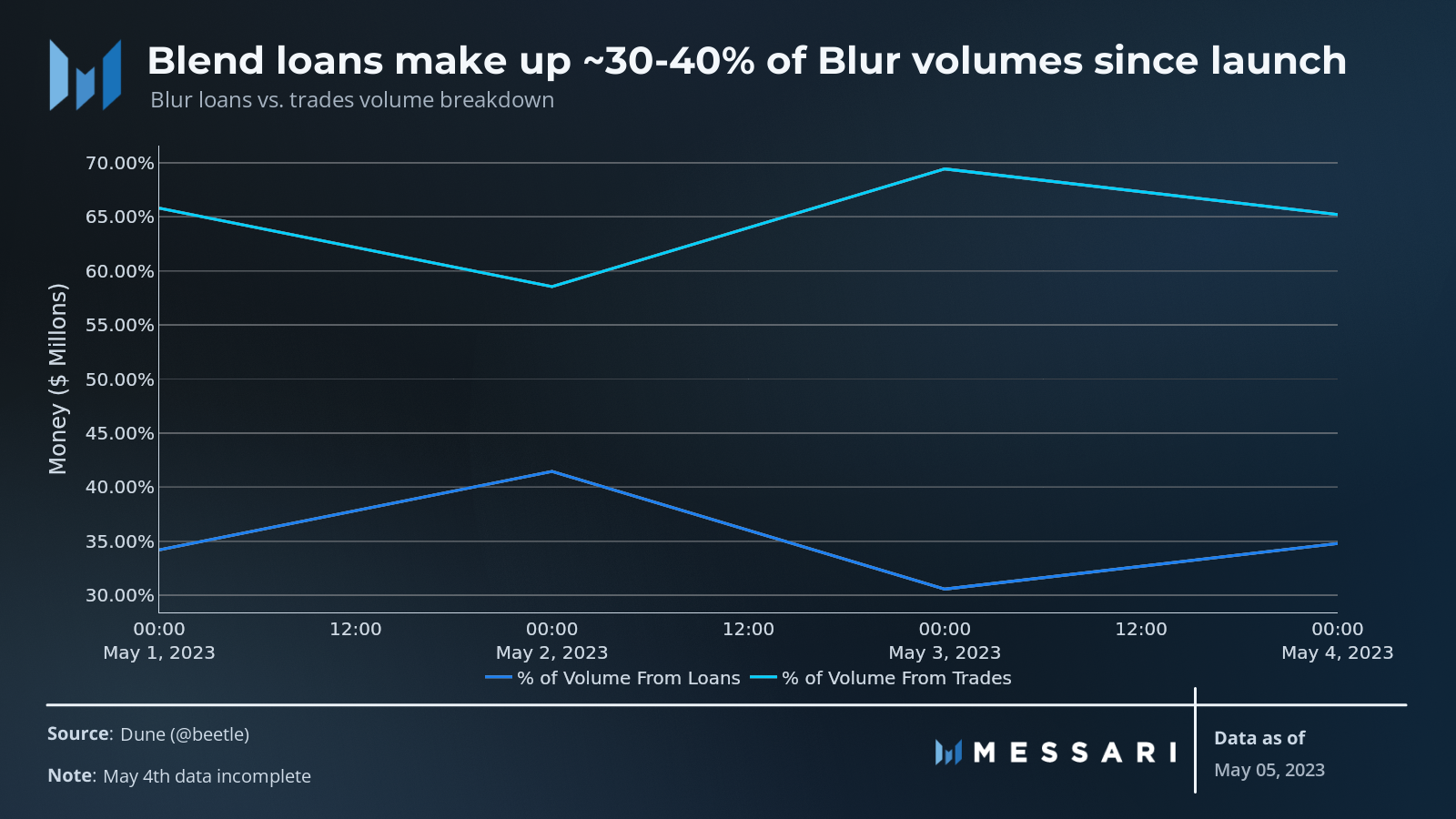
Due to its peer-to-peer model, Blend allows for highly aggressive loan-to-value (LTV) ratios not seen anywhere throughout DeFi. Combine that capability with lenders being incentivized to provide aggressive loans (h/t kycrypto.eth) and we see that a significant portion of loans are clustered around the riskiest LTVs.
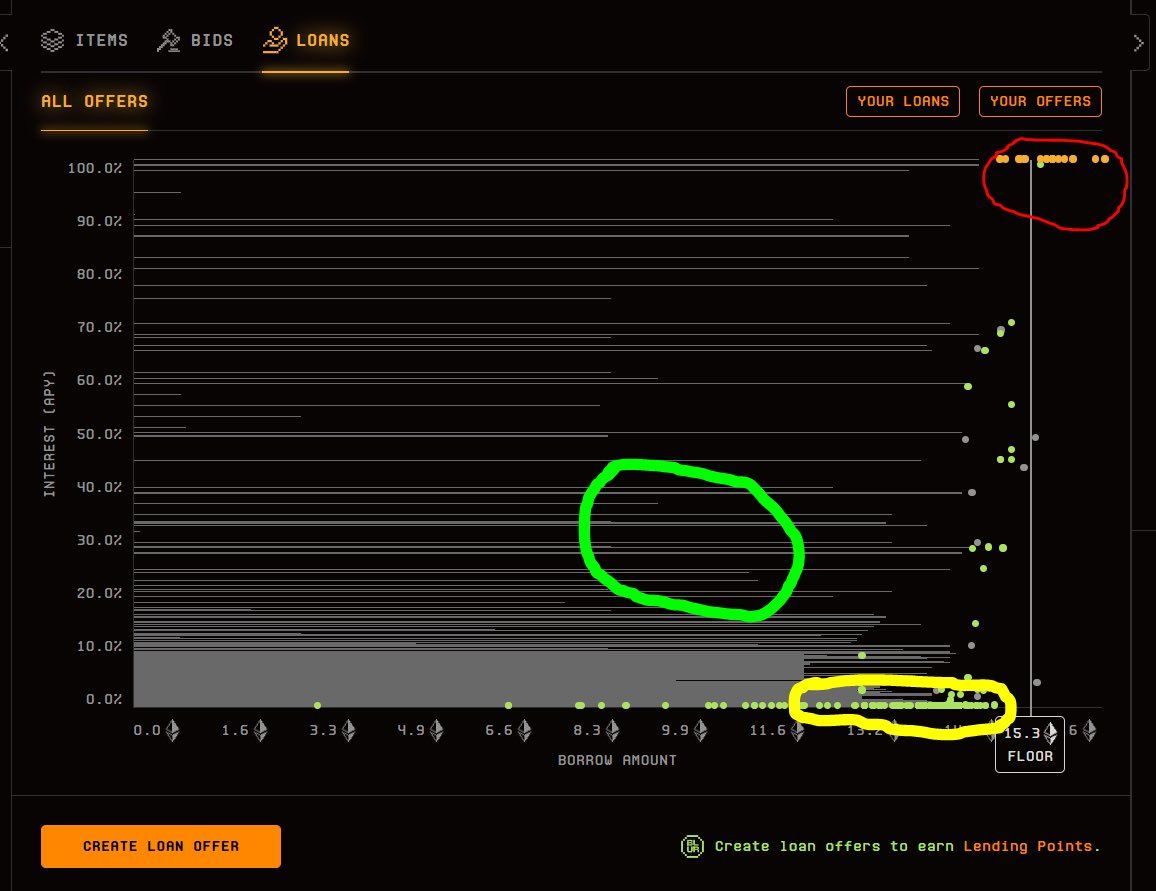
Red indicates 95%+ LTVs. Yellow indicates zero-interest loans, which don’t make economic sense but are possible due to Blur’s incentives. Green indicates where moderately safe (50-60% LTV) loans would be – in the Azuki market as of May 3, there were none. (Source: kycrypto.eth)
Growth in NFT financialization has two major implications for the market:
First, increased financialization runs counter to the original NFT narrative centered on community. Combined with exchange-like trading interfaces, NFTs are increasingly trending towards the “altcoins with pictures” moniker — especially as high LTV ratios introduce more price volatility to the market. However, the community aspect isn’t completely dead – people touting their NFTs on places like Twitter is still central to project success – but it does, and seemingly will, matter less and less over time.
Second, lending offers marketplaces a new route towards profitability. Historically, NFT marketplaces have relied solely on trading fees to generate revenue. That model was jeopardized once Blur, Sudoswap, and many other exchanges began offering easy-to-use interfaces that circumvented royalty enforcement.
Blend likely accelerates this trend toward zero trading fees. As the first major mover in the marketplace space to incorporate lending, Blur will have every incentive to drive trading fees to zero, cornering the market against the laundry list of competitors totally reliant on those very fees.
That's bad news for those competitors.
OpenSea is already feeling the pressure after Tiger Global marked down its valuation by 76%, implying a total valuation of around $4 billion. Though tokens are far from being equity in any sense, speculators may still be drawn to BLUR’s 1.8 billion FDV in comparison. Even if Blur’s equity value is added to the token value, it would only come out to 2.8 billion – 33% short of OpenSea’s current valuation.
Curve launches crvUSD
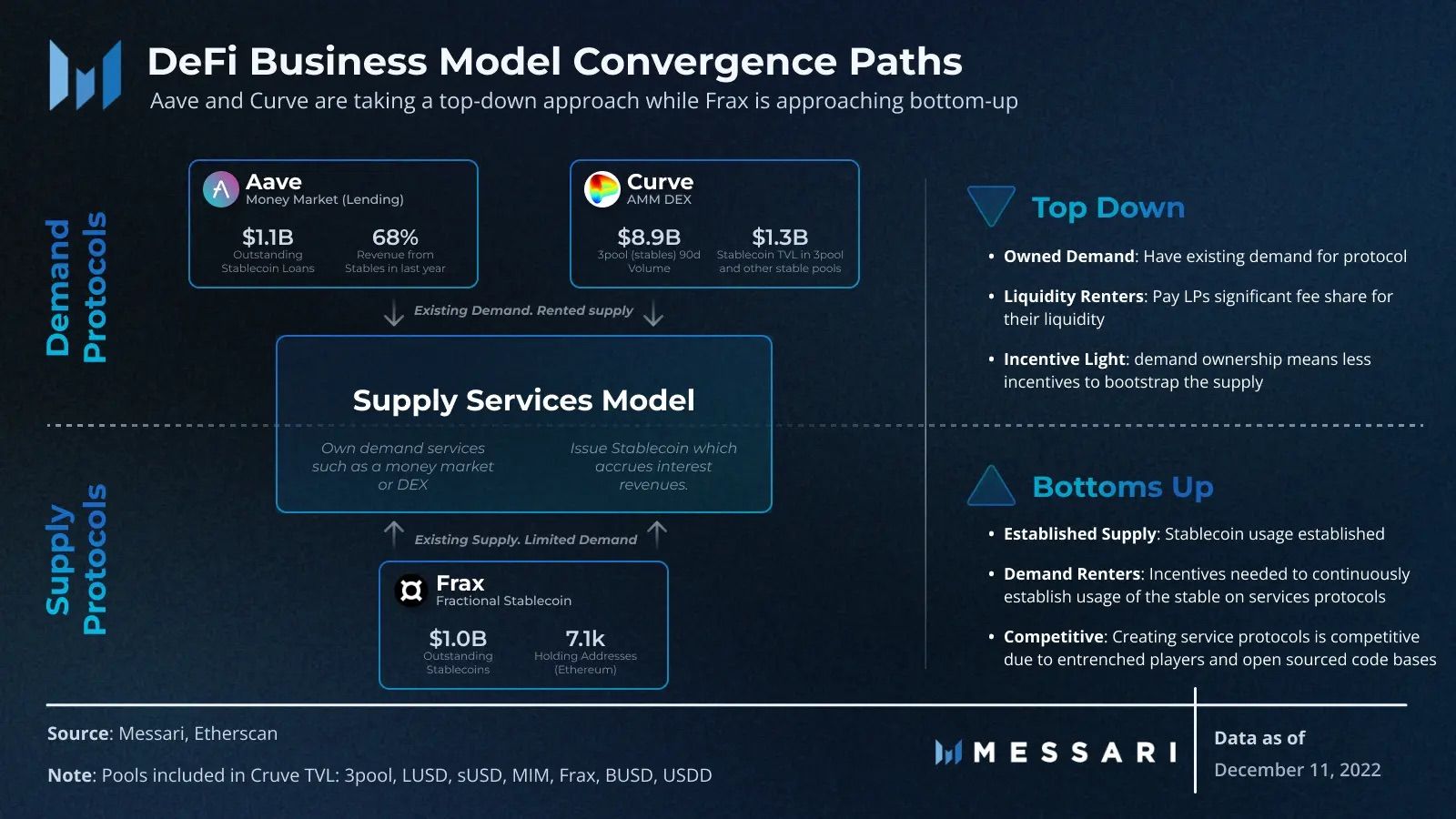
On Wednesday, Curve launched its stablecoin, crvUSD. It is an overcollateralized debt position similar to DAI and Aave’s GHO. The key difference is in how the collateral is managed. Rather than staying in vaults in DAI’s case or earning lending interest in GHO’s case, collateral for Curve’s stable is placed in a dynamic AMM across different price bands (similar to UniV3 ticks).
As the price of the collateral asset decreases, collateral is partially liquidated into crvUSD over a continuous price spectrum versus the abrupt liquidations in the traditional CDP models (Maker and Aave). Similarly, as the price of the collateral increases, the collateral asset is bought to rebalance.
In effect, the borrower of crvUSD also functions as a market maker in the AMM pool and is exposed to the associated risks.
Overall, Curve’s approach is unique design, but it does come with some tradeoffs:
- Permanent Loss: Selling collateral on the way down and buying on the way up opens up the likely scenario of permanent loss since the AMM can never guarantee it will buy back collateral at the same price it sold. Over time, this model will lock in collateral loss for borrowers.
- Greater Capital Efficiency: Borrowers passively provide liquidity to the AMM, allowing it to simultaneously serve both the AMM’s needs and the loan’s collateral needs.
- Lower AMM Fees: Potential to undercut the competition on swap fees given that liquidity is provided passively from borrower collateral and the protocol can instead earn revenue from interest payments.
Sui mainnet goes live
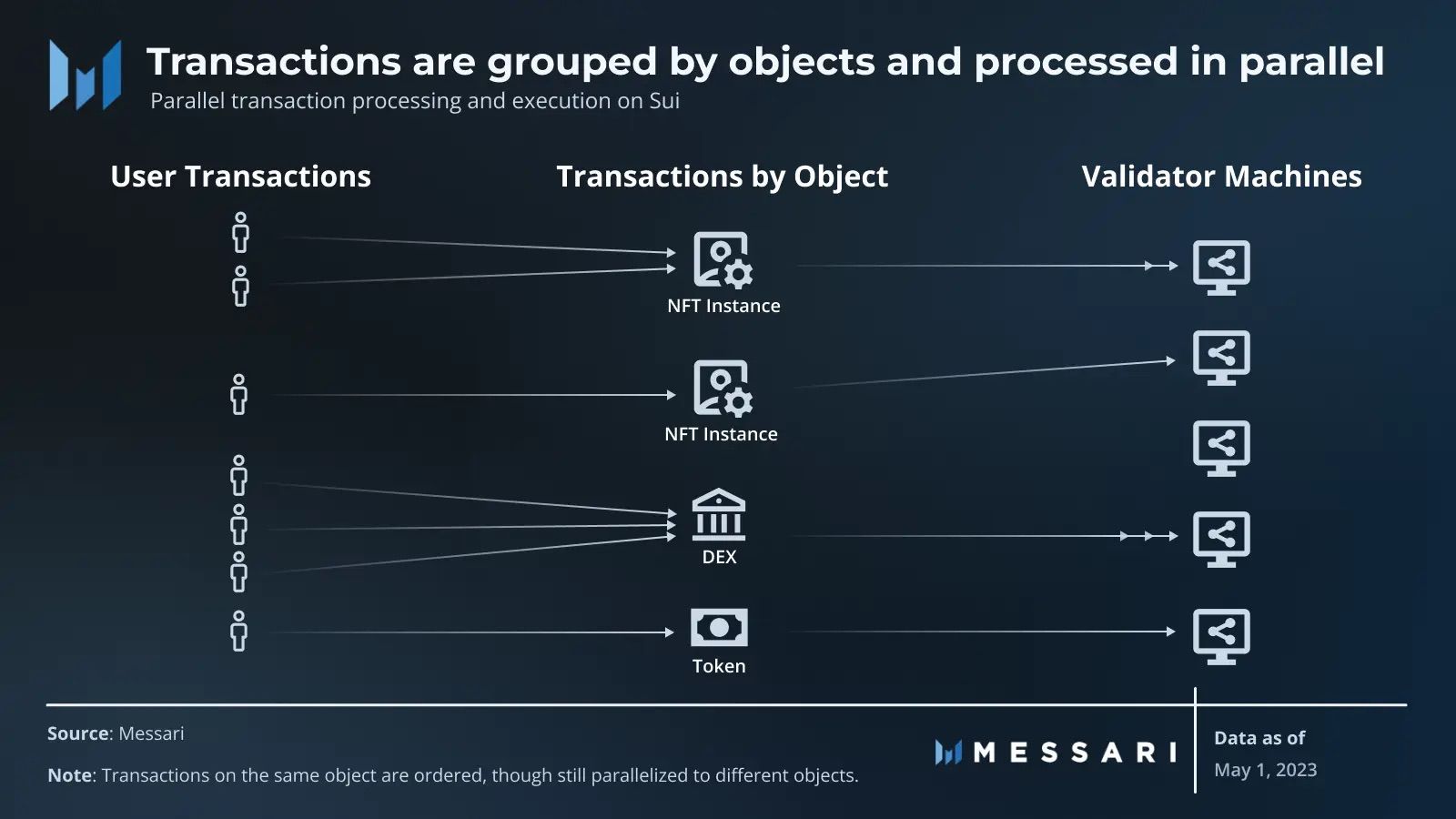
Sui is a highly anticipated Layer-1 blockchain and one of two teams to emerge out of the Facebook Diem blockchain project (the other being Aptos). Sui employs a modified version of the Move programming language that utilizes an object-centric data model. This model allows Sui to group transactions by object and execute on them in parallel, theoretically allowing for greater throughput.
The launch statistics gave a different impression. Whether due to capability or demand constraints, the max TPS recorded on Sui was around 137 transactions per second, and on average, TPS has ranged between 9-16 transactions per second.
However, whether Sui sustains 100 TPS or 100,000 TPS won’t be what dictates success. What ultimately will drive success will be the demand for unique applications built on top of the network. In order for those applications to be built in the first place, Sui must acquire the scarce resources of developers and liquidity – no small feat in a highly competitive space.
Wormhole Launches Connect
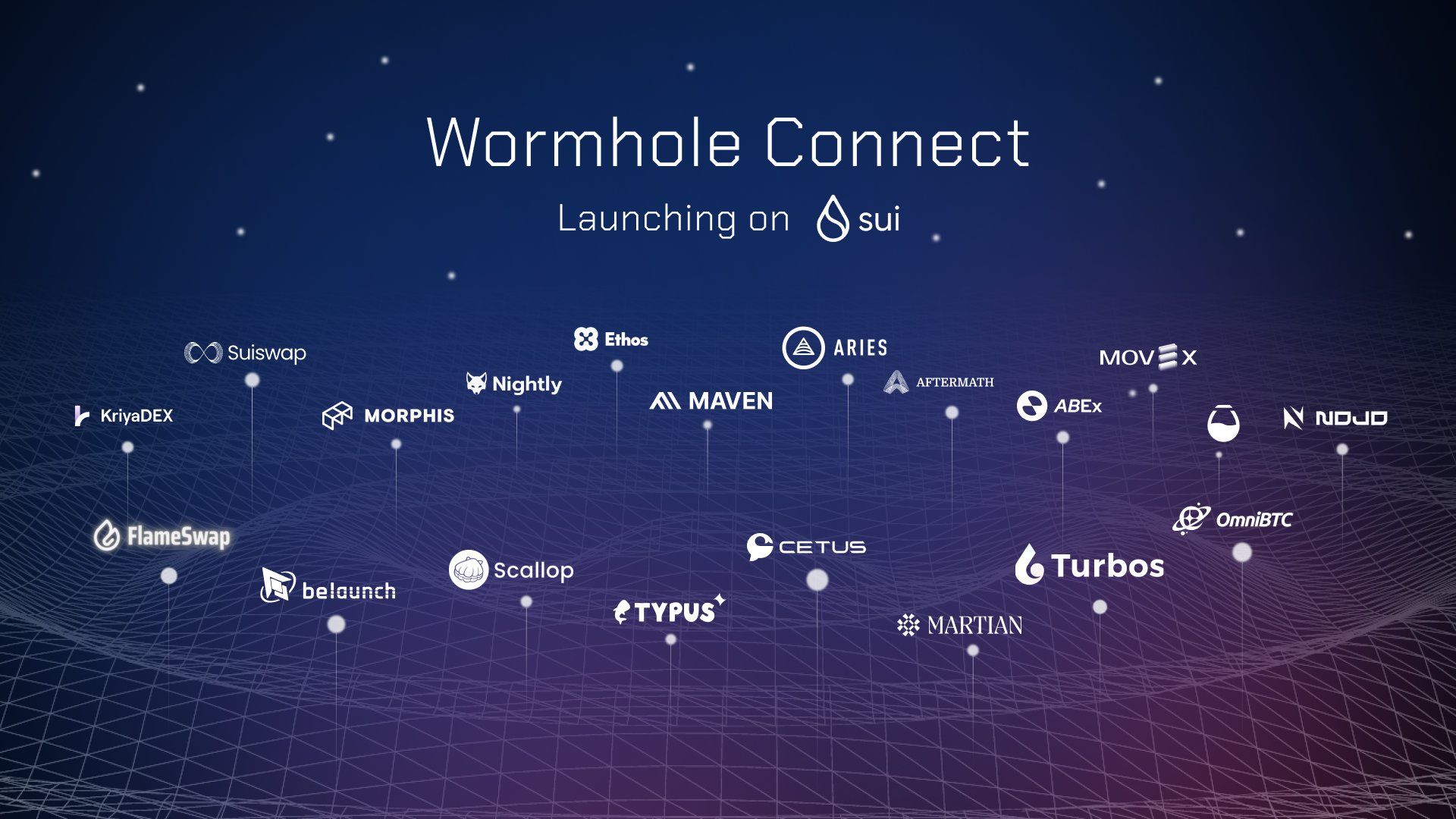
Wormhole launched a widget that allows developers to integrate cross-chain bridging to their dApps in three lines of code. That affords every dApp the ability to integrate bridging natively, instead of forcing users to utilize separate bridging applications. The widget leverages Wormhole’s existing tech in a compartmentalized, easy-to-use form.
Already, projects like Drift and Bonk in the Solana ecosystem, as well as several projects in the Sui ecosystem, have integrated Connect.
Source: Wormhole
Wormhole Connect may solve one of the biggest issues facing non-EVM L1s – which is, unsurprisingly, their lack of connectivity. Historically, bridging to Solana or Aptos has been far from frictionless. Compared to EVM <> EVM transfers, the UX has been terrible. Solutions like Allbridge and the old Wormhole required transactions from multiple wallets across chains in a sluggish fashion as well as posed security risk. Wormhole Connect emulates traditional bridges by allowing users to bridge cross-chain while only paying fees from the source chain. Destination chain accounts can then be topped off with enough money for gas.
-----
Messari Pro Offer
Don’t miss our weekly recap and other essential research with a Messari Pro subscription. Users that sign up today through June 5th, with code ‘UNLOCKPRO’, get a 10% discount! Not ready to commit? We also offer a free one-week trial.
Let us know what you loved about the report, what may be missing, or share any other feedback by filling out this short form. All responses are subject to our Privacy Policy and Terms of Service.