Web 3 Trends for 2020

From our Crypto Theses for 2020 - download the full report here.
If you want to “re-decentralize” the internet, there are some critical pieces of infrastructure you need to ensure are in place first. Decentralized hardware, computation, domain registry, identity and governance systems are just a few. Let’s dive into the infrastructure that’s been built so far, and peak around the corner at what’s next in the non-financial Web 3 stack.
1 Decentralized Hardware. It’s unclear whether there’s real demand for many non-financial “uncensorable” applications today given their sky-high costs relative to centralized alternatives. Most new hardware projects and marketplaces will face significant challenges in bootstrapping their networks to the point that economies of scale kick in. That said, two projects we’re excited about are Helium, which has created a protocol to incentivize the buildout of a wireless IoT device network, and Orchid, a decentralized VPN protocol. Orchid is especially interesting as part of the crypto commerce stack, as its protocol helps node operators earn tokens by providing bandwidth to users in a tor-like routing network and decentralized marketplace.
2 Compute/Storage Along with the “utility token” narrative, demand for decentralized storage, computing, etc. seemed dead this year. We still believe in the thesis, though I think we properly set expectations last year: “this is a five year vs. 2019 trend; these tokens will be critical to fueling Web 3.0’s future growth.” I’ve gotten more bullish on digital resource tokens recently. As government surveillance ramp up, the “Airbnb” model for excess file storage / compute / data gets compelling much sooner than I thought it would. Filecoin released its public testnet last week with an anticipated mainnet launch sometime around the start of Q2. (At this point, I’ll be liquid on my FIL tokens by 2023 or 2024.) Storj is in a final beta phase leading up to its production launch, scheduled for early 2020. Sia is expanding into video streaming storage thanks to a mid-summer $3.5 million raise, and has some valuable regulatory clarity in the form of its settlement with the SEC for the 2014 Sianote offering.
So these projects are real now, but it’s unclear to what degree Filecoin’s mainnet launch and token distribution will ultimately be hindered by its initial reliance on the controversial SAFT fundraising instrument, and how that will impact their eventual token distributions. If the team can resolve outstanding issues with the SEC (I think they will), then the Web 3 storage market is Filecoin’s to lose. Its remaining ICO warchest gives it plenty of runway to outmarket and outlast competitors. Areweave may be the other platform to watch, as they launched late last year and recently raked in $5 million in funding from a good group of investors.
3 Replacing ICANN. It’s clear the current DNS/Certificate Authority needs an upgrade. Nothing spoke to that recently quite like a private equity firm buying the entire .org domain name space for $1 billion. Token Daily’s Imran Khan published a terrific post last year on how exactly the current system is centralized and inefficient. Handshake remains the favorite to solve the issue, especially among the developer crowd. (At least in this market cycle...we remember Namecoin!) Handshake still hasn’t emerged from development, but community sentiment indicates it could be barrelling toward a mainnet launch (and massive token airdrop) within the next few months. If true (I think it is), it will be interesting to see which sites seek a Handshake-powered solution. Disgruntled .orgs working in tech / libertarian markets would be a good starting point.
Handshake isn’t alone in the race to replace the old registry infrastructure. Draper-backed Unstoppable Domains expanded its domain markets to include Ethereum addresses (using .cypto) in October after launching auction markets for Zilliqa domains earlier in the year. Its top rival, the Ethereum Name Service (ENS), completed a major upgrade back in May, which allowed it to start issuing Ethereum-based domains as NFTs. Most Unstoppable Domains and ENS customers are purchasing domains as a replacement for convoluted public key addresses or as possible investments. But neither startup offers a more complete solution than what Handshake is promising.
4 Blockstack. We’re going to see fairly quickly whether its tenable for a crypto token to survive the SEC registration process, and promote a fully functioning network and community.By going the Reg A route Blockstack allowed non-accredited U.S. investors to purchase STX tokens while simultaneously making it all but impossible for those investors to sell the tokens on any exchange based in the country. So what's the plan? Down the road Blockstack believes the project could be “sufficiently decentralized”, which would allow them to deregister the tokens.
Outside of the novel token issuance, Blockstack is tackling something that actually matters (a rarity in crypto these days) and building a new tech stack that aims to give users total control over their application data. Blockstack was more than just the inspiration for the new Silicon Valley plotline. Their marketing is pretty good too.
5 Oracles I’m baffled by Chainlink. Is it the solution to the evasive Oracle Problem? Or is it an overhyped project that seems to have inherited the #XRPArmy as followers? Tech giants Oracle and Google recently announced plans to use Chainlink’s network for data sharing purposes, and multiple large Ethereum-based projects, such as Synthetix and Streamr, have turned to Chainlink for reliable data feeds. But I still don’t understand the economics of the token itself? And I definitely don’t understand them at $1.3 billion in network value.
Outside of Chainlink, various DeFi protocols - MakerDAO, Compound, and UMA among them - also introduced new oracle designs in 2019 to remove the layer of trust associated with their price feeds. Financial protocols and applications like derivatives need ultra-reliable data (obviously), but there’s diminishing returns with all these new oracle releases. I anticipate the rate of new releases will decline, and the variety of solutions will ultimately contract as projects merge their designs and converge on a unified oracle contract standard. There’s no reason why MakerDAO wouldn’t adopt some of UMA’s Data Verification Mechanism elements, for instance.
6 The Web 3 Browser Brave has been the quintessential example of how an app’s adoption mustn’t necessarily correspond with value accrual to token holders. The Brave browser and ecosystem are growing fast, with Brave now claiming over 10 million monthly active users. So far, that’s had little impact on the BAT price, though Brave will be an interesting project to watch as the company has already done the hardest part in creating a quality product that people actually want to use at scale. With their rate of adoption, BAT is a prime candidate for experimentation with new token economic models that could bring unique value to Brave’s users (rewards, tipping overlay, etc.)
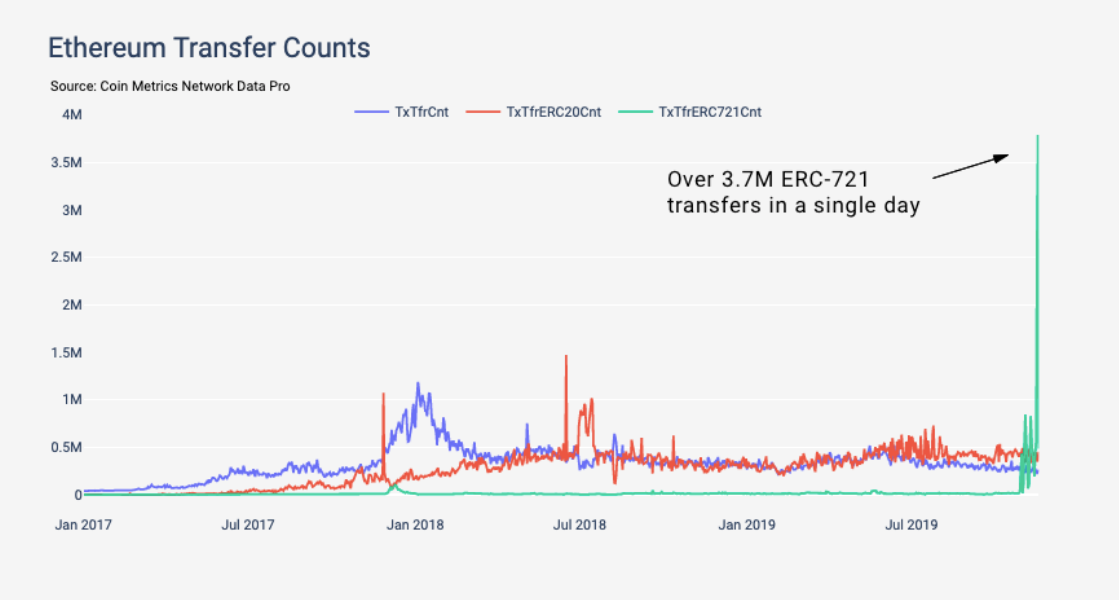
7 Gaming as in NFTs Demand for crypto-collectibles dried up almost as quickly as it caught on with CryptoKitties. The free-fall in user interest was not surprising as “card” games that leveraged non-fungible tokens seemed like a niche market that offered little value compared to larger franchises with in-game virtual goods. Then “Gods Unchained” happened. Demand for the (at-the-time) mildly popular NFT trading game exploded after gaming giant Blizzard opted to blackball a professional gamer on its platform for publicly backing the Hong Kong protestors. The Gods Unchained team called out Blizzard for the move, and this happened:
Source: CoinMetrics
I’m not sure I’d call this show of moral support an NFT resurgence per se, but the rise of NFT marketplaces and Microsoft’s interest in offering crypto collectible rewards to Azure customers are two additional promising data points. In the meantime, the de-platforming trend is getting more real and economically dangerous, which makes me more bullish we’ll see some willingness for gaming companies to allow goods to trade freely across ecosystems. The good news is the NFT space has time to identify more suitable, high-throughput environments to build on. Most of those platforms are still in the early stages of development and likely won’t be ready to support such games for 1-2 more years anyway.
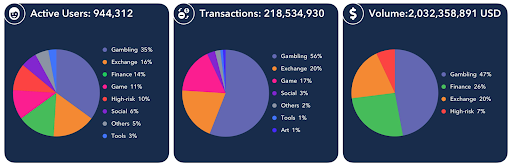
8 Gaming as in Gambling. It’s understandable users have gravitated towards blockchain gambling apps. Online gambling operations remain banned in the US and most of Asia, two of the largest crypto user bases, and permissionless platforms offer a refuge for the risk-seekers in these countries. Dapp.com’s latest Dapp Market Report shows that gambling applications represent more than twice the market share as any other gaming sector in terms of active users, transactions, and volume.
Source. Dapp.com
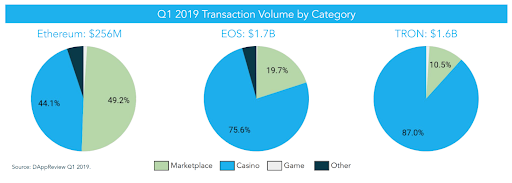
It’s also interesting which chain(s) these apps call home. Most online casinos have opted to build on low-to-zero fee, high-throughput platforms like EOS and Tron (for now), as they were happy to trade off censorship resistance for increased performance and higher profit margins (should apps look to subsidize users by eating transaction fees for the sake of adoption).
Source: Wave Financial
Or so they thought. A report from Coinbase and a 30-day notice posted by EOS-based dapp EarnBet suggest things are not all fun and games on EOS at the moment. An early November spike in on-chain user actions threw the network into “congestion mode,” making it excessively expensive to execute any transaction. Could this EOS implosion actually spell good news for (dare I say) Tron? Maybe, but we’d actually see layer two solutions like Loom Network being the ultimate beneficiaries of EOS’s congestion. In the long run, expect to see the online casinos build on their own Polkadot parachain or Cosmos zones.
9 New social platforms Decentralized social media projects are early; but the potential is there. I don’t really buy the near term potential that users will go for the explicit financialization of their previously intangible social capital. (Remember the rags-to-riches reddit gold stories? Me neither.) The real challenge with “decentralizing” social media is not the incentive models, but in the user acquisition away from the large incumbents, who are so entrenched that you might argue the real decentralizing innovations may have to come from them (or regulatory actions). In the face of continued challenges to free speech across the media landscape, expect to see more calls for protocols, not platforms.
The longer we go without seeing Telegram’s TON, Kakao’s Klay token, or Signal’s Mobilecoin, though, the more skeptical I get about their potential, and the more they begin to look like overt 2017-2018 cash grabs. I do believe in Jack and Twitter, though. As I noted in the “people to watch” section, Jack recently revealed a plan to decentralize Twitter’s back-end with a small independent initiative called Bluesky that will be led by Twitter’s CTO. It makes sense, too. Even if Twitter ultimately became a client of that open standard, some would argue the value of the platform would come from the parent client’s curation vs. the raw firehouse of unfiltered data.
If Facebook’s Libra announcement was a seminal moment in the history of cryptocurrencies, the Bluesky announcement may be of similar magnitude for the Web 3 thesis. A protocol-dominated social media world would permit competing implementations of each protocol, allowing new non-exploitive business models to be tested, switching costs to be slashed, and free speech and privacy to flourish. But you have to believe in the messenger.
In that case, I don’t trust Zuck. I do trust Jack. (If I had to choose one.)
10 Everything else. The layers to the Web 3 stack itself are still evolving, and we haven’t even had time to touch on two of the more interesting applications in Web 3, video transcoding (Livepeer) and geospatial mapping (FOAM). Livepeer built the first video transcoding product on top of its network (via Livepeer, Inc.) and also launched a public testnet for a new, scalable protocol called Streamflow, after raising $8 million in June. FOAM launched a beta version of its token-curated registry (TCR) to verify user geolocation submissions, which as of April boasted ~140 monthly participants, and began testing a purpose-built scaling solution themselves for accelerating location updates. As projects powered by “work” tokens, FOAM and LPT depend on adoption, but their addressable markets seem small and maybe too early. Who will be the most likely early adopters?
They highlight the thrust of the Web 3 question in general. Are we still five years too early?

Prior to founding Messari, Ryan was an entrepreneur-in-residence at ConsenSys, and on the founding teams of Digital Currency Group, where he managed the firm’s seed investing activity, and CoinDesk, where he led the company’s restructuring & annual Consensus conferences. He has been an investor & prolific writer in the crypto industry since 2013.