War of The Virtual Worlds: A Look Into The Metaverse Economies

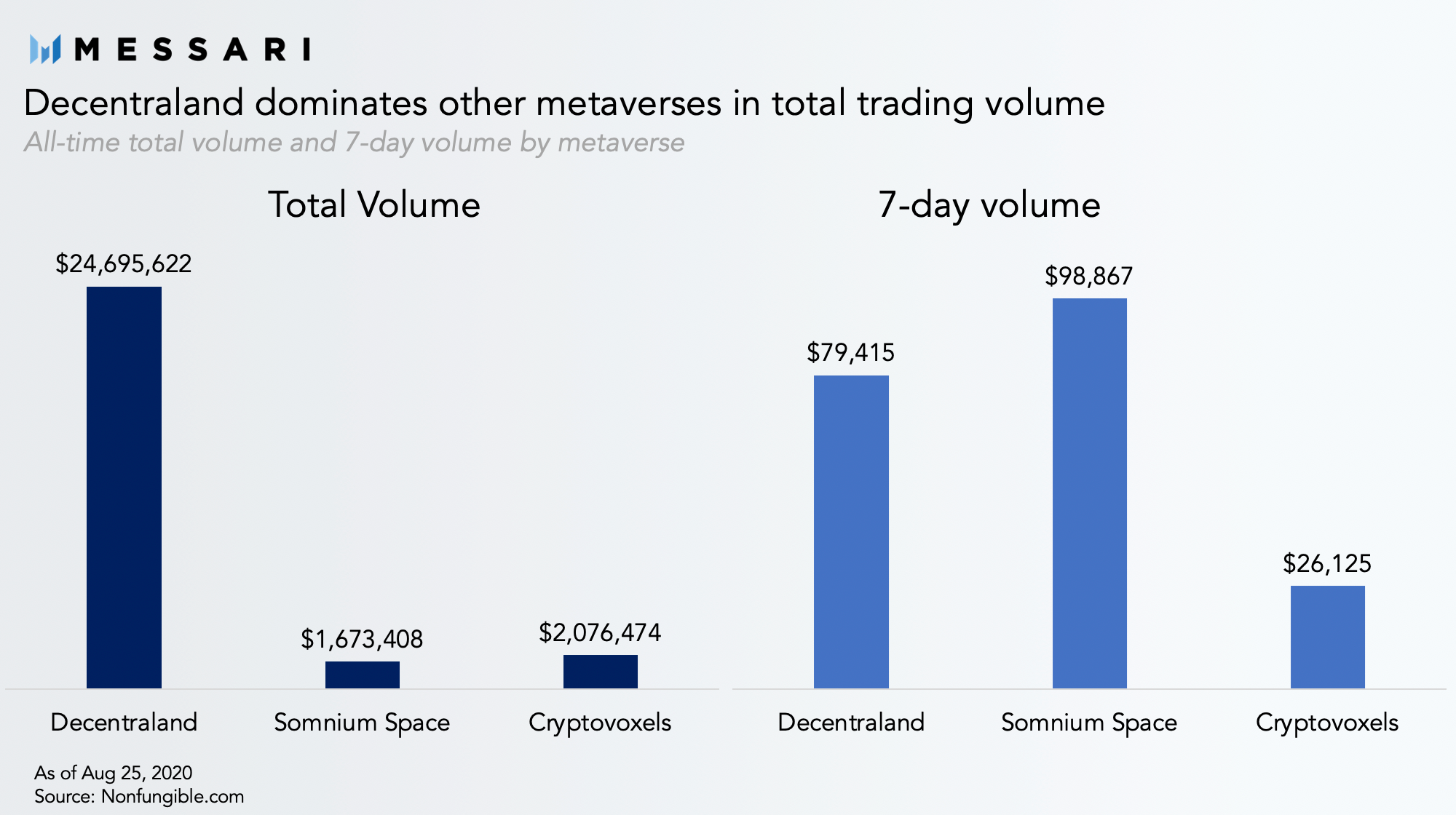
Metaverses – virtual worlds – are perhaps one of the most ambitious categories within the crypto ecosystem since they combine two emerging technologies – virtual reality and crypto. The three top Metaverse games by all-time trading volume – and most other metrics – are Decentraland, Somnium Space, and Cryptovoxels. While not the most important metric, trading volume speaks to the speculative nature of these games which are all still in the early stages of building their virtual communities and economies. If virtual worlds follow the winner-take-most value accrual, then the leading platform’s digital land could be valuable in the future. So is there enough space (virtual) for multiple to coexist?
A brief introduction to the Decentraland Metaverse
Projects like Decentraland, Cryptovoxels, and Somnium Space are combining virtual reality (VR) and several crypto primitives such as smart contracts and non-fungible tokens (NFTs) in order to create virtual worlds with digital scarcity. All the land in Decentraland’s virtual reality is tokenized and has a corresponding non-fungible token called LAND that acts as a claim to ownership. Multiple pieces – or parcels – of LAND can be merged to create an estate (EST) thereby increasing the size of one’s digital property. Any user is allowed to develop and monetize their digital property however they see fit whether that means creating a casino or a digital art gallery.
Decentraland also utilizes a native asset called MANA which is burned to acquire LAND. MANA tokens are also used for the purchase of in-game goods and services. For more information about how Decentraland operates, see the Decentraland Messari profile.
The Rising Decentraland Economy

Mason was a Senior Research Analyst at Messari focused on Web3 protocols and cryptoassets. Before Messari, Mason worked at ConsenSys as a Content Marketer focused on marketing strategy. Mason obtained his Master’s in Business Management at Hong Kong Baptist University.