Vertex Protocol: A Vertically Integrated DEX

Vertex, a clever play on words for ‘vertically integrated DEX’, is a protocol with a novel design built atop of Arbitrum. It is a hybrid orderbook-AMM DEX that supports cross-margined accounts across perps, spot, and money markets with extremely low latency execution enabled by its offchain sequencer that hosts a central limit orderbook (CLOB). Vertex offers the lowest fees of any CEX or DEX available today and has partnerships with professional market makers to establish deep liquidity. There will be no token until October, but there is an ongoing incentives program whereby 9% of the total token supply will be distributed to market makers and takers. Vertex’s primary weaknesses are the lack of decentralization in the protocol’s current implementation, general challenges associated with bringing cross-margined accounts onchain, and extremely low fees that could make it difficult to return substantial value back to token holders.
Vertex Overview
The team behind Vertex, formerly referred to as Vertex Protocol, was initially planning to launch an FX-focused dapp on Terra prior to its implosion and the subsequent failures of Celsius, 3AC, and others. The collapse of Terra combined with the failures of CeFi motivated the team to build a product that delivers a CEX-like trading experience with the added benefits of onchain transparency and self-custody. AMMs like Uniswap, money markets for borrowing and lending like Aave, and perpetual trading dapps such as dYdX and GMX drive a vast majority of Ethereum’s and its L2’s TVL. Vertex is attempting to build a product that combines all three of these popular DeFi primitives into one user interface so that users are no longer required to hop around various dapps to service their needs. This makes the TAM of Vertex look highly attractive, although it is worth noting that the peer-to-pool model of Vertex’s money market and XY=K product formula DEX have largely been ousted in DeFi by the peer-to-protocol and concentrated liquidity models respectively.
Hybrid Orderbook-AMM
The Vertex core development team operates an offchain sequencer that acts as the liaison between traders and Vertex’s smart contracts on Arbitrum. This design provides users with sub-30 millisecond latency, low gas fees, and guaranteed MEV mitigation as long as the Vertex team doesn’t abuse their privilege of ordering transactions. The sequencer is solely responsible for ordering transaction requests on a FIFO basis and matching trades across the orderbook. More sophisticated players, such as professional market makers like Wintermute, can plug into Vertex’s API or SDK to interact directly with the sequencer and provide bids/asks to the CLOB. On the other hand, users who aren’t as technical can LP on Vertex, with that liquidity acting as the backbone of the protocol’s XY=K AMM that is fully onchain. The sequencer therefore has 2 pools of liquidity to execute trades against, which should enhance efficiency across the dapp’s verticals. The integration of a Uni V2 style AMM also enables Vertex to support long-tail assets, which could drive volume in the future if projects elect to seed native token liquidity on Vertex.
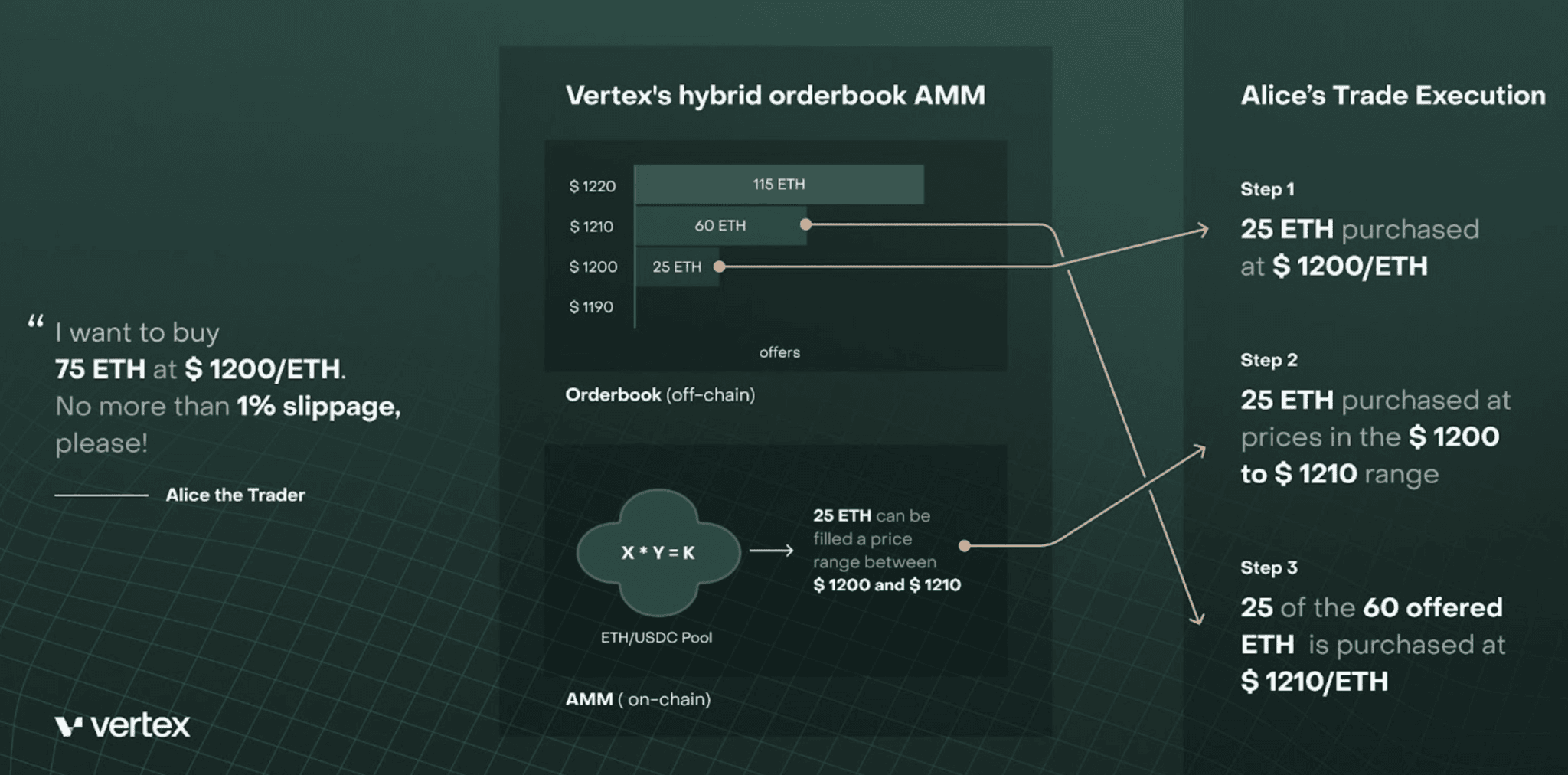
If the sequencer were ever to go offline, user’s trades would automatically resort to being routed through the AMM i.e. enter ‘Slo-Mo Mode’. Unlike dYdX which halted operations at the end of 2021 due to an AWS outage, Vertex would have defaulted to Slo-Mo Mode leaving traders with the ability to close high leverage positions that had been opened prior to the outage. However, the amount of available liquidity, execution speed, gas efficiency, etc. would all experience degraded performance and largely defeat the purpose of using Vertex for perps trading. For example, the AMM only has $430k of liquidity across its 3 supported pairs; wBTC/USDC, wETH/USDC, and ARB/USDC. The team has ambitions to decentralize the sequencer at a later date, but even the leading Ethereum L2s that rely on centralized sequencers have not solved this problem and any aggressive push towards decentralization could have a negative impact on Vertex’s performance.

Sam leads coverage on Ethereum, L2s, Aave, Compound, as well as NFTs and gaming. Previously worked on a hedge desk at UGC.