Velodrome V2: The Liquidity Hub for Optimism

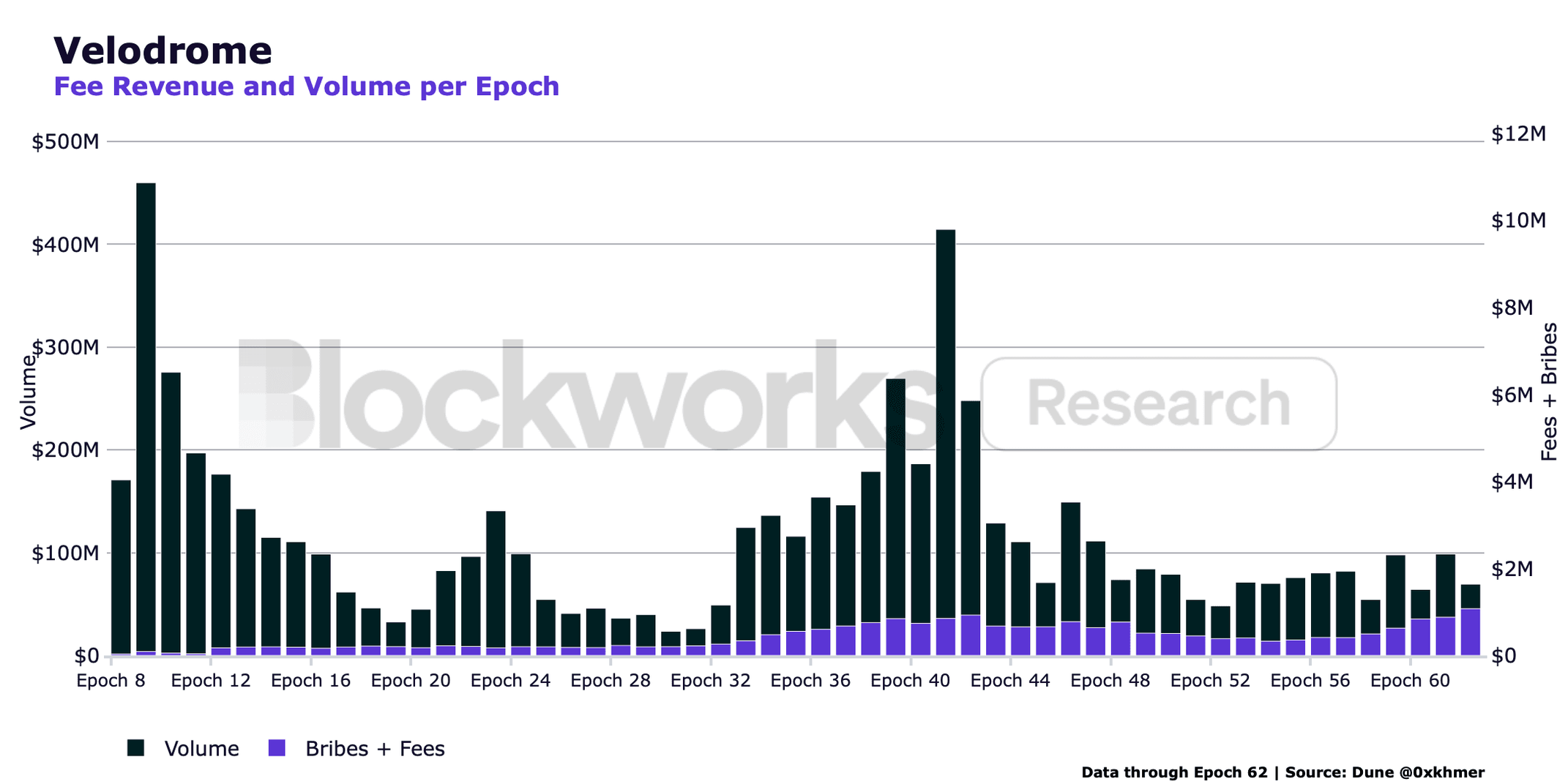
Velodrome launched in June 2022 and remains one of the leading DeFi primitives on Optimism after more than a year of live operations. The Solidly fork recently launched its V2 upgrade, which included a revamped UI, a liquidity pool factory registry that enables greater customization over liquidity pool types, implemented the infrastructure to support automated voting management for veVELO voters, and more. The V2 upgrade has already had a large impact on protocol revenue, which breached all time highs during epoch 62 (August 6th through August 13th) despite static trading volume. Velodrome is aiming to serve as the liquidity hub for Optimism’s ecosystem of rollups within the ‘Superchains’, with projects such as Aerodrome forking Velodrome’s tech stack and deploying on Base. If the OP narrative continues to show strength and Base proves successful, VELO could represent an interesting way to gain high beta exposure.
Overview
Velodrome took inspiration from the designs of Solidly, Curve, Convex, and Uniswap in its pursuit to create the liquidity hub of the OP Stack/Superchain ecosystem. The protocol attempts to establish deep liquidity to attract swappers by rewarding LPs with VELO tokens that are directed to pools based upon the number of veVELO votes they receive each epoch, or each week in the case of Velodrome. The motivation to build Velodrome stemmed from the lack of sufficient methods to incentivize liquidity. Every protocol needs ample liquidity for a variety of reasons, whether it be for native tokens, stablecoins, pegged derivative tokens, or other asset types. The most traditional way to incentivize liquidity is handing out native token rewards to LPs who stake (or lock) their LP tokens for a predefined amount of time. While this is highly effective in the immediate term, it’s common for staked LPs to dump the token rewards and push the native token price down. Additionally, LPs often leave once the value of the liquidity incentives decrease or run out, thus leaving the protocol in the same spot in which it started.
An effective way to drive sustainable liquidity was pioneered by Curve and Convex, which introduced a market whereby alternative protocols can bribe veCRV holders to direct CRV and other token incentives to their pool of choice. However, the concentrated ownership of veCRV makes it difficult for newer protocols to compete with incumbents. For instance, the top 10 veCRV holder addresses control ~84.48% of the supply and therefore determine which pools a vast majority of newly minted CRV is directed to. The Velodrome team elected to airdrop 18% of the genesis supply, or 72M tokens, as veVELO to ~15 protocols deemed most likely to battle for liquidity incentives via bribes and contribute to the broader Velodrome ecosystem. Another 6% of the supply, or 24M VELO, is reserved for future protocol partnerships in the form of veVELO. Lastly, both the Optimism and Velodrome teams were allocated a total of 15% of the supply, or 60M tokens, with a vast majority locked as veVELO to support a healthy bribe market. Needless to say, the supply of veVELO is more evenly distributed than that of veCRV. Velodrome also iterated on Solidly’s initial design by addressing a few key issues, such as more effectively tying rewards to emissions, implementing processes that make taking advantage of the bribes market unfeasible, and prolonging VELO emissions so that late entrants into the war over veVELO voting power still stand a chance.
V2 Upgrade
As mentioned in our previous report on Velodrome, users can earn rewards through fees, emissions, bribes, and rebases. The fees come from traders swapping, the emissions are controlled by veVELO voters, external bribes are paid by any individual or group that wants to incentivize a pool, and rebases are paid to veVELO holders in the form of veVELO so that voting power dilution is less drastic. 100% of fees and bribes accrue to veVELO holders, whereas LPs are incentivized exclusively via VELO emissions that are entirely controlled by veVELO voters. Under V1 of Velodrome, swap fees were capped at 0.05%. The V2 upgrade removed this cap and now sets swap fees at 0.05% and 0.30% by default on stable and volatile pools respectively. However, these fees can be changed at the request of protocols, and soon, at the discretion of veVELO voters. The increase in swap fees has made a substantial impact on protocol revenue despite stagnant trading volume.

Sam leads coverage on Ethereum, L2s, Aave, Compound, as well as NFTs and gaming. Previously worked on a hedge desk at UGC.