Valuing Uniswap - The World's Largest Decentralized Exchange


Decentralized Exchange (DEX) volumes have been soaring to start 2021. At their current pace, monthly DEX volumes could blow past their previous record set in September 2020, reaching more than $55 billion. With clear product-market fit, accelerating volumes, and significant earnings potential, DEXs – and in particular automated market makers – have quickly become the most successful DeFi protocols to date.
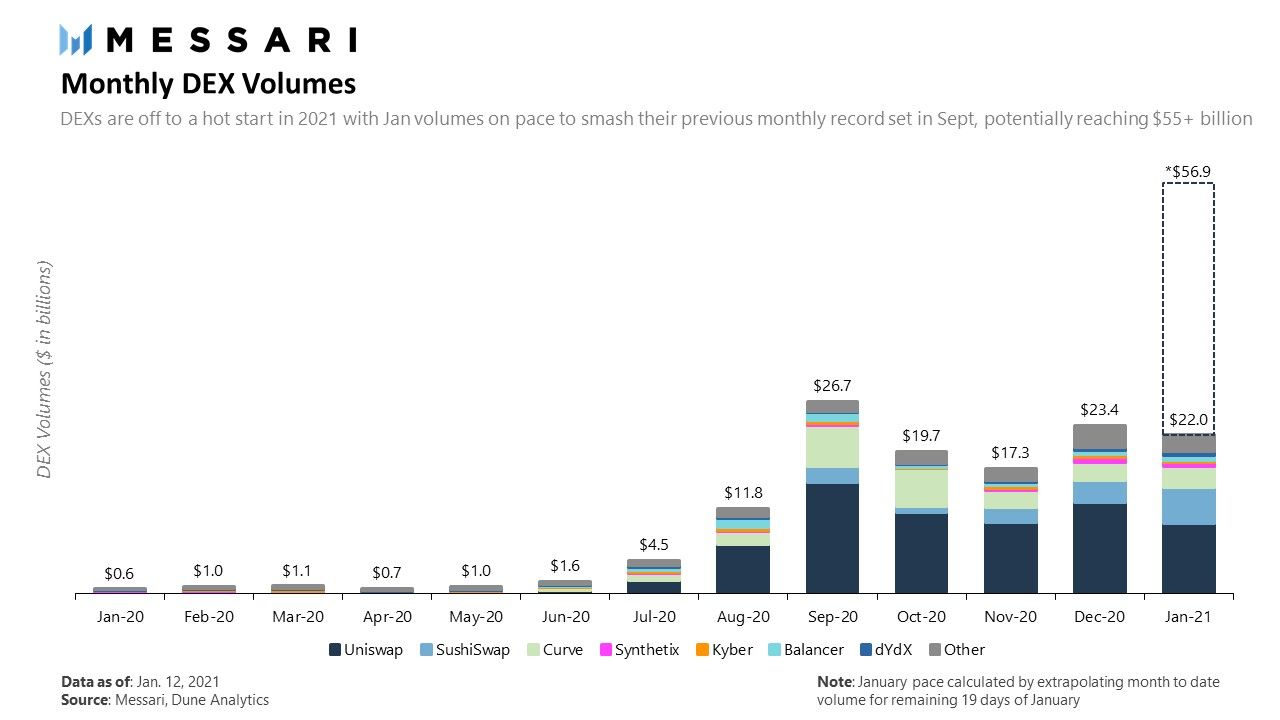
But how valuable are DEXs actually?
In our first piece in a series on DEX valuations, we look at Uniswap - the industry leader to provide readers with a framework for how to think about valuation.
Uniswap: Overview
Uniswap is a decentralized exchange built on Ethereum that utilizes an automated market making (AMM) system rather than a traditional order-book. Instead of matching individual buy and sell orders, users can pool together two assets that are then traded against. The price is determined based on the ratio between the two assets. On the platform, users can permissionlessly swap tokens, and create (and add tokens to) liquidity pools to earn swap fees.
In a nutshell, Uniswap coordinates a decentralized exchange by providing the rules and incentives to get users to supply their capital in order to make markets for any asset on Ethereum. The product of this is a globally accessible, always available, decentralized exchange with programmatic liquidity.

Mira was a Senior Research Analyst at Messari. Prior to joining Messari, Mira was a Senior Portfolio Manager for a US$6 billion Asia Pacific equities fund at APG Asset Management. Mira received a BA in Economics and Mathematical Methods in the Social Sciences from Northwestern University.
Ryan Watkins was a Senior Research Analyst at Messari. Previously, he worked at Moelis & Company as an Investment Banking Analyst where he worked on deals in the technology, telecom, and fintech sectors. Ryan graduated Magna Cum Laude from the Gabelli School of Business at Fordham University.