USDD’s first year post-2.0 launch is defined by yield as a core product strategy. Through USDD Earn and sUSDD, the protocol emphasizes savings yield as a primary value proposition, offering rates above typical stablecoin market yields.
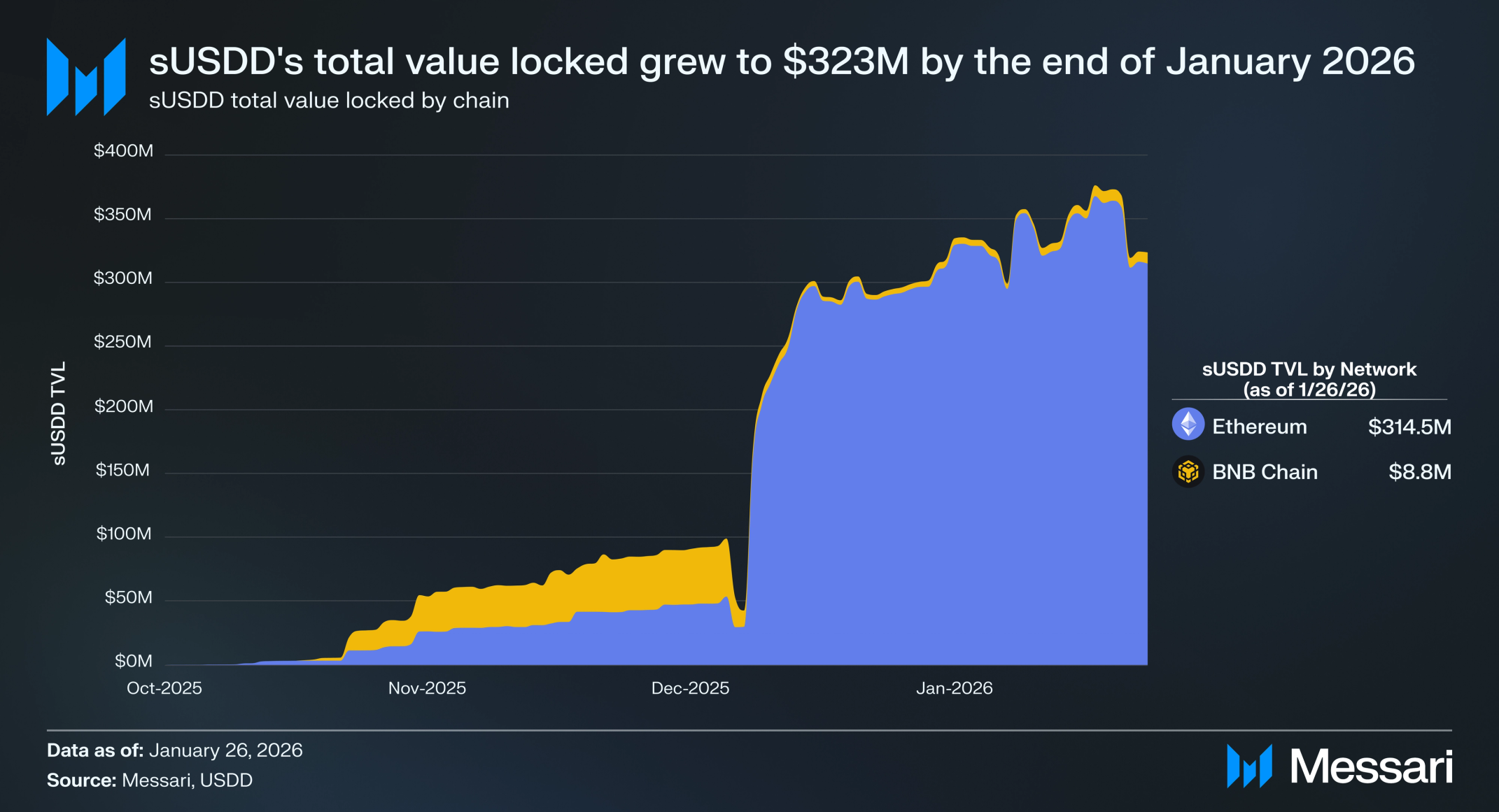
sUSDD serves as the primary savings vehicle for USDD. The token accrues yield through a rising redemption rate and consolidates incentives into a single, composable product, with over $310 million in TVL on Ethereum as of January 2026.
Issuance design balances yield-driven demand with risk controls. Vault-based minting on TRON introduces rate-sensitive supply backed by over-collateralization, while fixed-rate swapping via the PSM on Ethereum and BNB Chain prioritizes direct par redemption.
USDD relies more on protocol-native mechanisms for peg enforcement than most stablecoins. Minting, redemption, and liquidation rules played a larger role than secondary-market liquidity in anchoring price behavior.
USDD reflects a deliberate tradeoff. The protocol pursued above-market savings yields to drive adoption while using explicit collateral buffers, rate controls, and transparency to manage associated risks.
Introduction
USDD is a U.S. dollar–denominated stablecoin designed for onchain settlement and savings use across DeFi. The protocol's current iteration, USDD 2.0, was launched on TRON on Jan. 25, 2025. USDD 1.0 relied on a hybrid algorithmic model that was heavily dependent on external subsidies from the TRON DAO Reserve to fund user yields and support its peg.
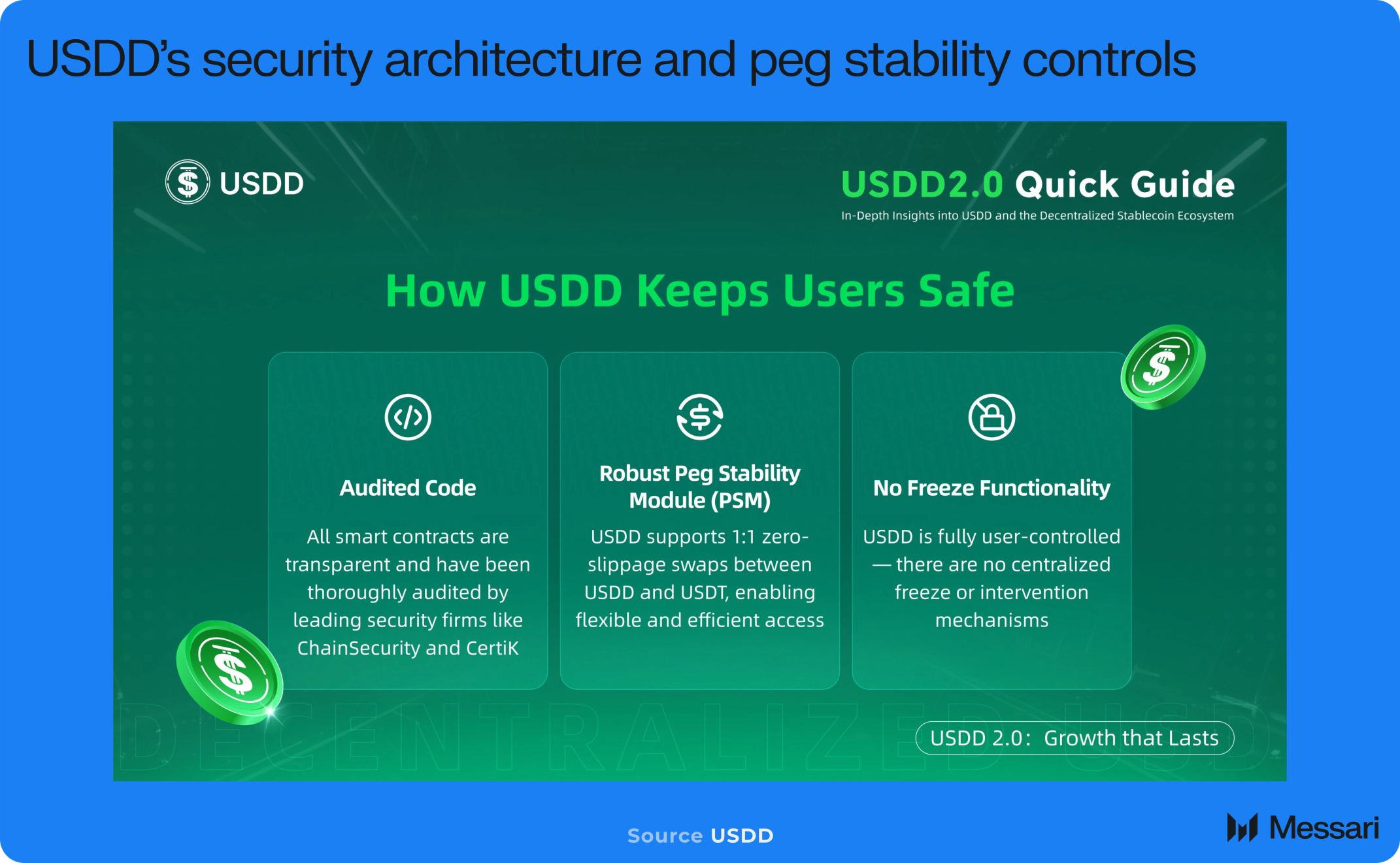
USDD 2.0 relies on overcollateralization, permissionless liquidations, and protocol-native minting as its core stability mechanisms. USDD supports fixed-rate minting and redemption via a Peg Stability Module (PSM), allowing users to swap USDT or USDC and USDD at a 1:1 ratio. USDD is minted against onchain collateral held in publicly verifiable vaults, including USDT, TRX, and sTRX, with dynamic minimum collateralization ratios enforced to maintain system solvency. When vaults fall below required thresholds, collateral is liquidated through open auctions, allowing solvency to be restored without discretionary intervention. Complementing this framework, Smart Allocator functions as the protocol’s onchain treasury manager, deploying a portion of reserves to generate recurring protocol revenue that supports incentives and savings products.
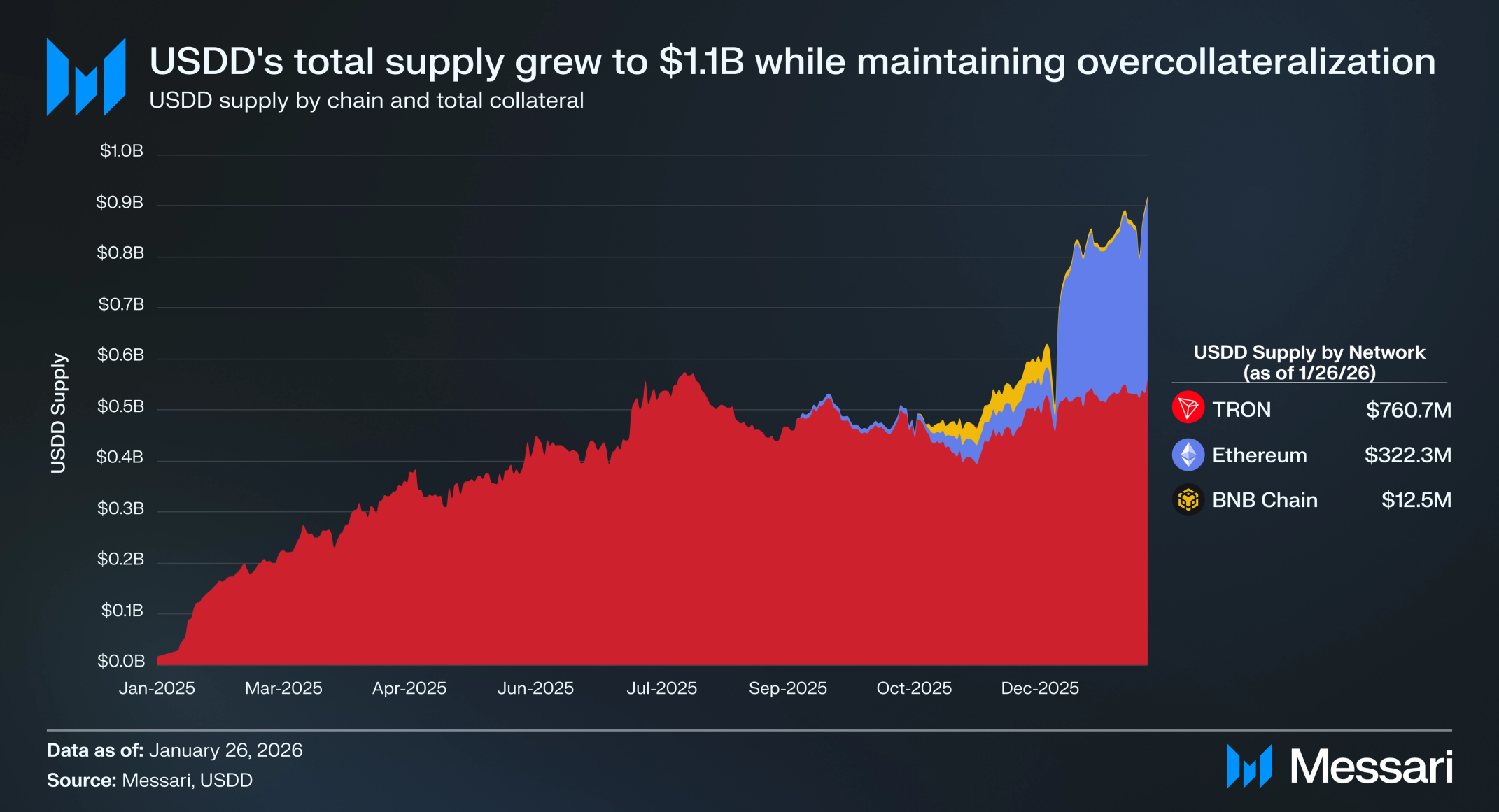
Over the past year, USDD expanded from TRON-native operations to a multichain footprint spanning TRON, Ethereum, and BNB Chain, emphasizing native issuance and fixed-rate minting and redemption.
Across its first year, USDD 2.0 evolved from a TRON-first launch into a multichain stablecoin system with expanded collateral options and clearer, protocol-defined paths for issuance and redemption.
Protocol and Collateral Expansion
USDD 2.0 launched in January 2025 with a 20% annual percentage yield (APY) incentive program, which helped drive total value locked (TVL) past $200 million within one month. As the system matured, competitive incentives remained central to USDD’s product strategy, but their role became more narrowly defined. Incentives primarily influence demand for USDD, while issuance volume is ultimately constrained by protocol-defined rules around collateralization and liquidation.
sTRX vault rollout
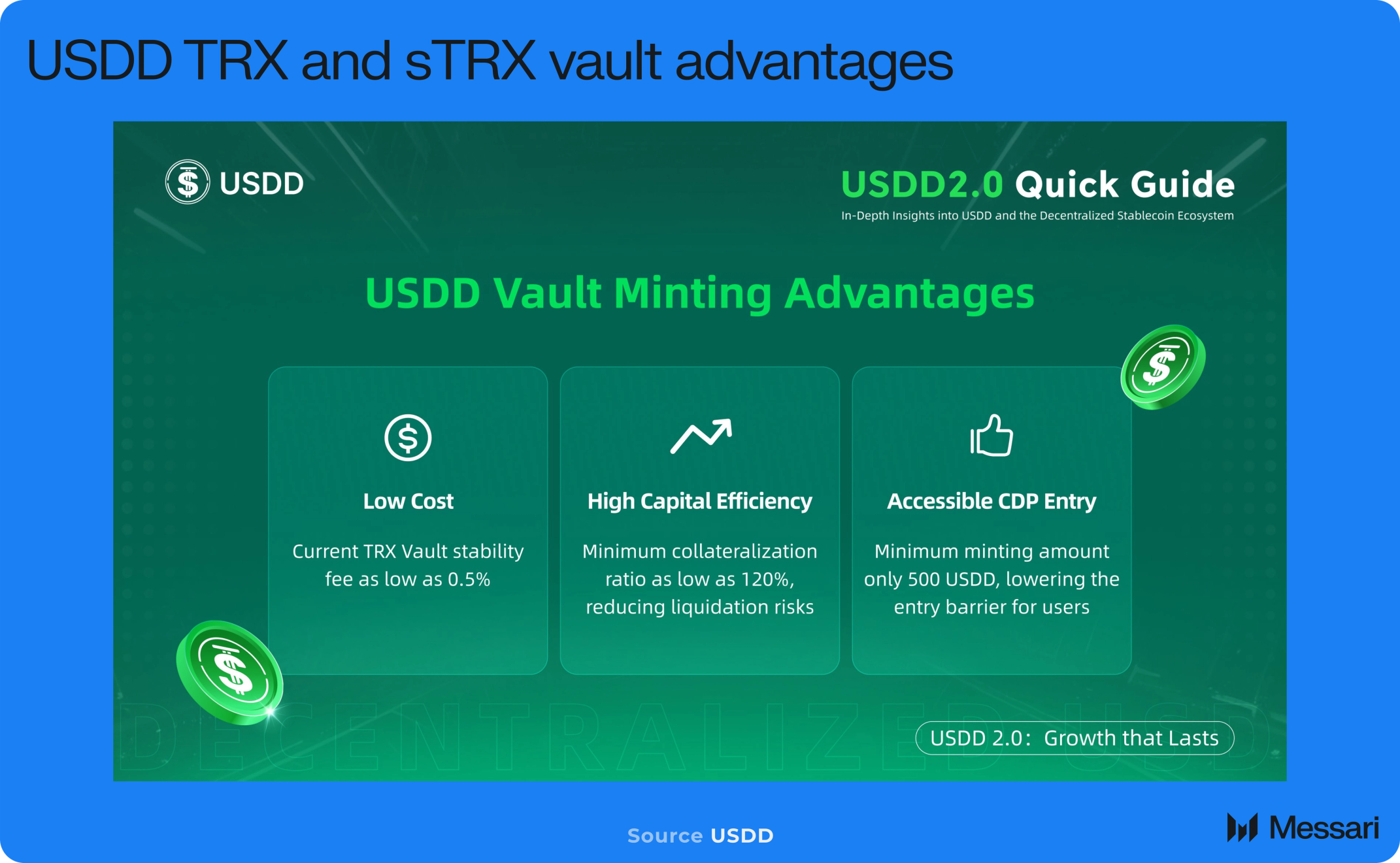
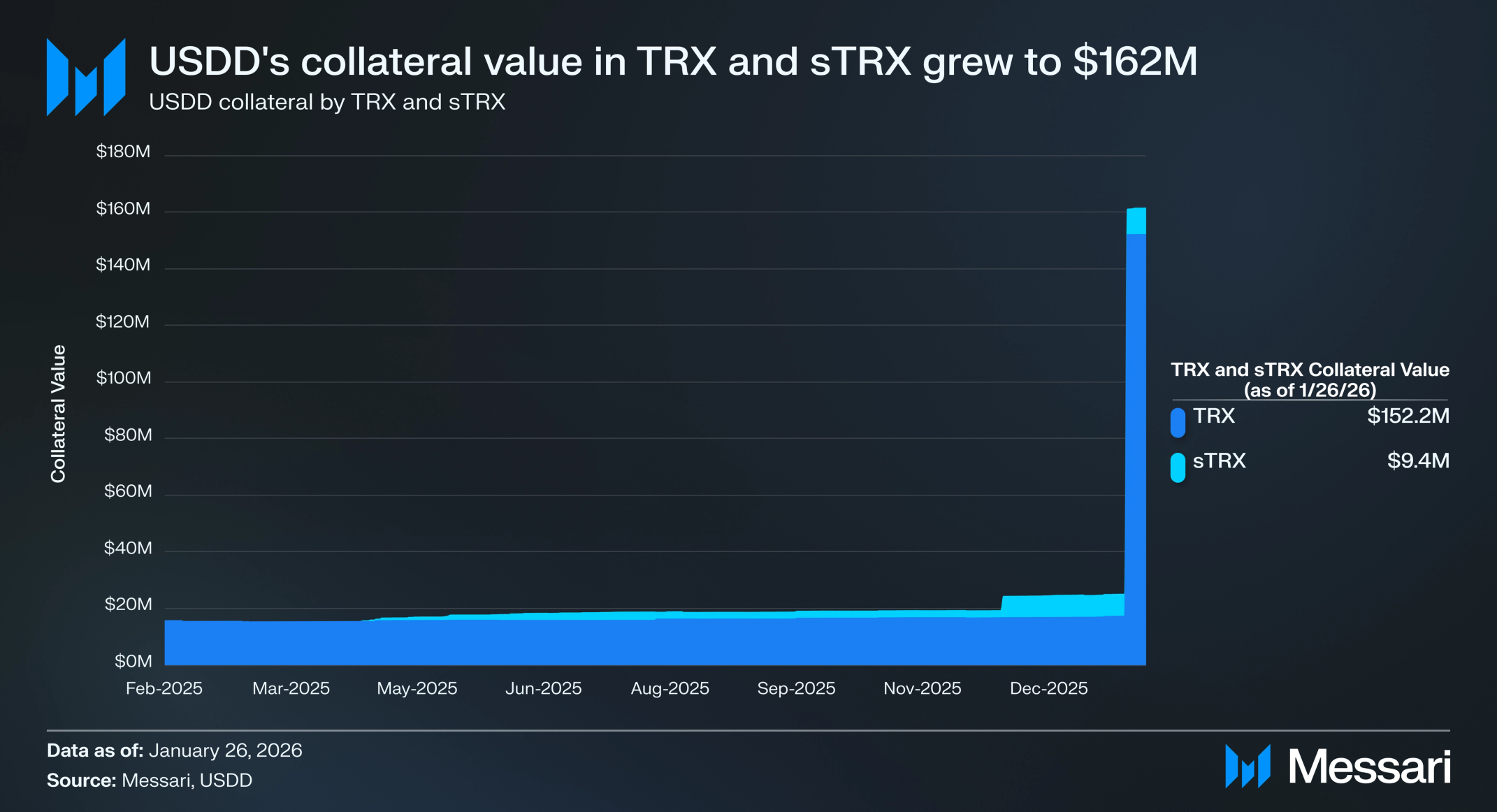
In April 2025, USDD introduced vault support for sTRX (staked TRX), extending issuance beyond stablecoin-only collateral and anchoring supply formation more directly to TRON-native assets. This expanded who could mint USDD and made issuance more sensitive to protocol rates and incentives.
sTRX vaults allow users to stack staking rewards with yield from minting USDD. This yield structure encourages users to mint USDD and deploy it into yield-bearing products, thereby maximizing their returns. From a risk perspective, the rollout made risk treatment explicit at the vault level by assigning each collateral type its own parameters for collateralization, fees, and liquidation. These parameters allow the protocol to express differentiated risk tolerance across assets without relying on discretionary intervention.
As of Jan. 26, 2026, asset-specific vault parameters resulted in conservative collateralization for volatile assets. TRX vault tranches (TRX-A, TRX-B, and TRX-C) carried 0.5% stability fees and were collateralized at between 238.45% and 293.43%. By comparison, USDT-A operated at a 1% stability fee with a 120.34% collateral ratio, while sTRX-A had a 205.69% collateralization ratio at a 1% stability fee.
These parameters reflect a deliberate tradeoff. For volatile collateral, USDD requires high collateral buffers to reduce undercollateralization risk during drawdowns, even if that limits minting capacity. Compared with stablecoin systems where supply is dominated by stablecoin-backed issuance, this design introduces greater rate sensitivity into USDD supply, in turn leading to greater assurance in its ability to maintain overcollateralization.
Stability fee adjustments and incentive programs
Throughout 2025, USDD actively adjusted stability fees and incentive capacity to allow users to mint USDD at attractive rates, which resulted in consistently high demand across vaults and savings products. Stability fees functioned as the primary cost of supply for USDD minted through vaults, while savings incentives shaped demand for holding and deploying USDD.
Beginning in February 2025, the protocol operated a recurring USDD Earn savings program offering up to 20% subsidized APY on deposited USDD, with capacity limits periodically adjusted across venues. In parallel, multiple TRX and sTRX vault campaigns regularly reduced stability fees to 0.5% for TRX and 1% for sTRX. Together, these measures lowered the cost of minting while increasing the attractiveness of holding USDD, reinforcing issuance behavior driven by the spread between borrowing costs and savings yields.
In October 2025, USDD expanded its yield architecture with the introduction of sUSDD, an interest-bearing representation of USDD. Rather than distributing explicit rewards, sUSDD accrues yield through an increasing sUSDD-to-USDD redemption rate, aligning returns with vault-style accounting and improving composability across DeFi.
Relative to most stablecoin savings products, which offer mid-single-digit yields at scale, sUSDD’s savings rate has remained meaningfully higher, positioning yield as USDD’s primary adoption lever rather than a marginal enhancement. Data from DefiLlama show that yields on large, high-TVL stablecoin lending and liquidity pools have generally ranged from near-zero to the mid-single digits, with most pools clustering between roughly 3% and 5% APY throughout 2025.
Multi-Chain Expansion
Native Ethereum issuance and Peg Stability Module
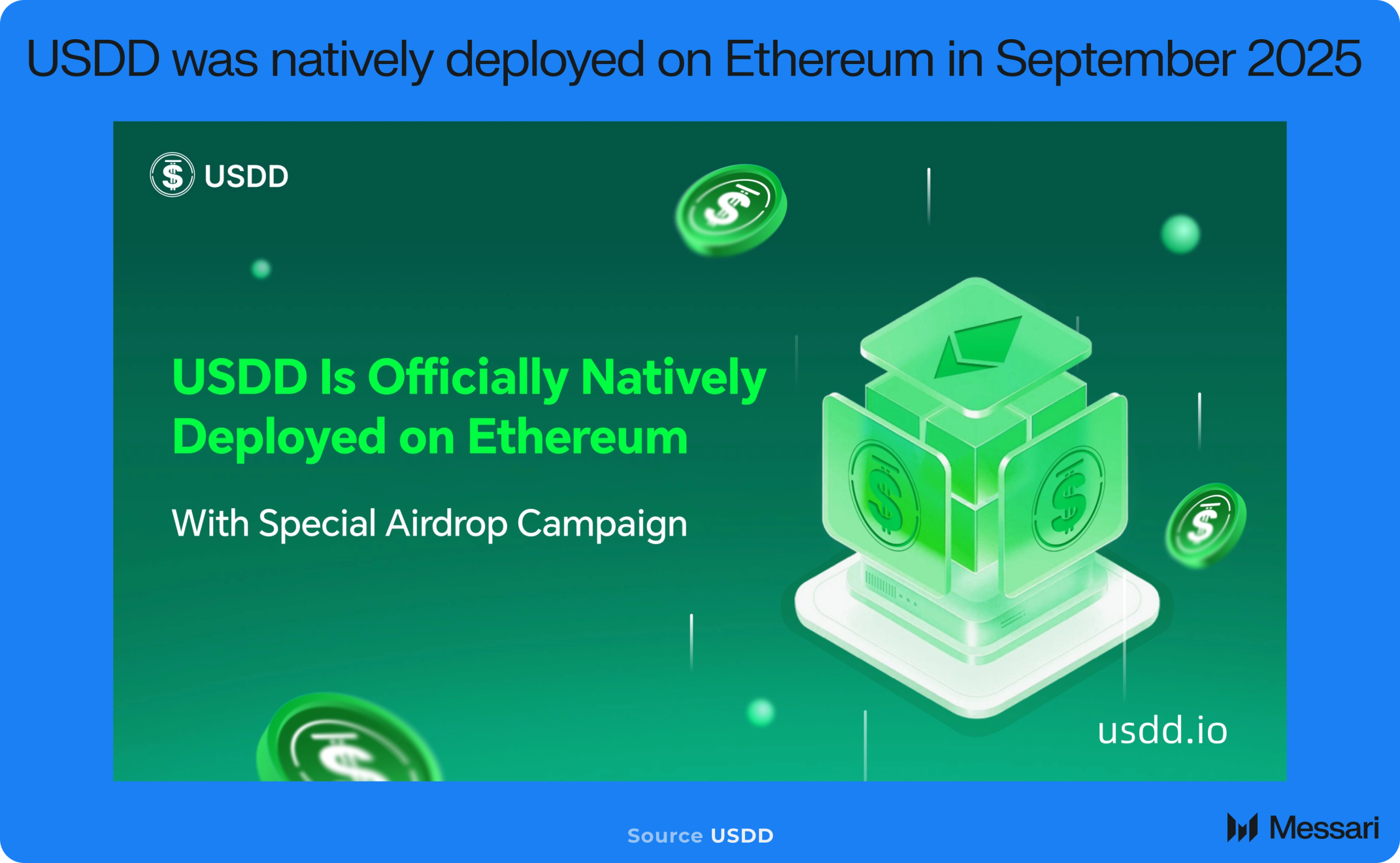
USDD expanded to Ethereum in September 2025 with native ERC-20 issuance, extending the Peg Stability Module (PSM) framework already in use on TRON to a new execution environment. While the PSM itself was not new, Ethereum marked the first deployment where fixed-rate stablecoin conversion became the primary issuance pathway rather than a complement to vault-based borrowing.
The PSM enables users to mint or redeem USDD directly with the protocol at a fixed 1:1 rate against supported stablecoins, including USDT and USDC. This par convertibility reduces reliance on secondary-market liquidity for peg maintenance and shifts price stabilization toward protocol-controlled minting and redemption.
As of Jan. 26, 2026, USDD supply on Ethereum totaled $322.3 million with $322.3 million in collateral, primarily held in PSM-USDT-A ($87.3 million) and protocol-managed reserves (SA001-A at $235 million). This composition indicates that Ethereum-native USDD issuance was driven largely by stablecoin swaps and reserve-backed minting rather than borrowing against volatile collateral.
Relative to TRON, this design prioritizes predictable convertibility and tight peg behavior on Ethereum, while increasing reliance on stablecoin collateral and protocol-managed reserves.
Over the past year, USDD’s approach to peg stability increasingly relied on rule-based mechanisms embedded at the protocol level. On TRON, peg support was primarily enforced through overcollateralized vault issuance and automated liquidations. On Ethereum and BNB Chain, fixed-rate minting and redemption via the PSM anchored convertibility directly at par.
Throughout 2025, USDD’s aggregate collateral value consistently exceeded circulating supply, with system-level collateralization ranging from 103% to 199% and averaging approximately 112%. This buffer reflects a system designed to absorb issuance and redemption flows.
At the chain level, collateralization profiles reflected different issuance paths. On TRON, where USDD is minted through borrowing against volatile collateral, median collateralization was approximately 110%, reflecting the combined effect of protocol parameters and user positioning. On Ethereum, USDD operated near parity, with issuance primarily backed by fixed-rate stablecoin swaps through the PSM and protocol-managed reserves. BNB Chain followed the same PSM-backed issuance model, though at a smaller absolute scale.
Taken together, these patterns indicate that USDD successfully adopts different dominant issuance mechanisms across environments to maintain peg stability. Vault-based issuance introduces rate-sensitive supply dynamics and higher collateral buffers, while PSM-based issuance emphasizes predictable convertibility and tight price anchoring. Compared with stablecoin systems that rely predominantly on secondary-market liquidity to enforce pegs, USDD places greater emphasis on protocol-native minting and redemption mechanisms to anchor price behavior.
Security and Risk Management
As USDD expanded across additional contracts and execution environments in 2025, operational complexity increased. In response, the protocol emphasized standardized safeguards, including external audits, conservative parameterization, and improved financial transparency.
USDD introduced a public treasury dashboard in October 2025 to improve visibility into reserves, protocol finances, and system composition. Updated on a quarterly basis, the dashboard discloses protocol-level financials, including $3.8 million in revenue, $631,000 in expenditure, and $3.2 million in profit for Q4 2025.
From a risk perspective, public financial reporting serves as a monitoring mechanism, allowing external observers to evaluate the scale of incentives, reserve deployment, and protocol income relative to outstanding supply.
Closing Summary
One year after the USDD 2.0 migration began, the protocol’s most material evolution has been operational rather than conceptual. Throughout 2025, USDD moved away from a subsidy-dependent, hybrid design toward a stablecoin framework defined by explicit collateral backing, rule-based solvency management, and fixed-rate minting and redemption.
USDD expanded its collateral surface through the introduction of sTRX vaults, extended native issuance to Ethereum and BNB Chain, and paired these deployments with broader audit coverage and additional transparency tooling, including a public treasury dashboard. These changes reflect an emphasis on standardized execution across chains, with issuance and stability mechanisms tailored to each environment rather than relying on discretionary support.
Relative to the broader stablecoin market, USDD has prioritized adoption through above-market savings yields while constraining risk through conservative collateralization and protocol-native minting and redemption. Compared with stablecoin designs that emphasize either capital efficiency or passive peg enforcement via secondary markets, USDD’s approach reflects a deliberate balance of growth, solvency, and operational control.
Taken together, the first year of USDD 2.0 reflects the protocol's maturation, driven by execution. Stability over the period was achieved not through aggressive incentives, but through higher collateralization, constrained issuance paths, and clearly defined conversion mechanisms.
All content was produced independently by the author(s) and does not necessarily reflect the opinions of Messari, Inc. Author(s) may hold cryptocurrencies named in this report. This report is meant for informational purposes only. It is not meant to serve as investment advice. You should conduct your own research and consult an independent financial, tax, or legal advisor before making any investment decisions. Nothing contained in this report is a recommendation or suggestion, directly or indirectly, to buy, sell, make, or hold any investment, loan, commodity, or security, or to undertake any investment or trading strategy with respect to any investment, loan, commodity, security, or any issuer. This report should not be construed as an offer to sell or the solicitation of an offer to buy any security or commodity. Messari does not guarantee the sequence, accuracy, completeness, or timeliness of any information provided in this report. Please see our Terms of Service for more information.
No part of this report may be (a) copied, photocopied, duplicated in any form by any means or (b) redistributed without the prior written consent of Messari®.
Jake is a Research Analyst on the Protocol Research team. He previously worked as an Investment Analyst at an AI-driven crypto research platform and as a Venture Analyst at a digital assets venture fund. He advised multiple RWA tokenization projects on tokenomics. Jake graduated from the University of Southern California, where he studied Philosophy and Finance.
Jake is a Research Analyst on the Protocol Research team. He previously worked as an Investment Analyst at an AI-driven crypto research platform and as a Venture Analyst at a digital assets venture fund. He advised multiple RWA tokenization projects on tokenomics. Jake graduated from the University of Southern California, where he studied Philosophy and Finance.