On Sept. 8, 2025, the USDD protocol deployed its stablecoin on Ethereum, continuing the transition from USDD 1.0 to 2.0, and establishing USDD’s presence within DeFi's largest and most liquid Layer 1 ecosystem.
USDD’s Peg Stability Module (PSM) enables users to mint and swap USDD on a 1:1 basis against other stablecoins such as USDT and USDC, ensuring deep liquidity, tight peg stabilization, and user confidence.
In April 2025, the protocol launched the sTRX Vault on the TRON network after its successful launch of TRX Vault, allowing users to mint USDD against sTRX (Staked TRX) liquid staking tokens. This enhances capital efficiency by enabling users to earn staking rewards while using their assets as collateral.
Smart Allocator as a Sustainable Yield Engine: The Smart Allocator uses PSM-derived reserves to generate sustainable onchain yield, and is positioned to power future interest-bearing products like sUSDD on Ethereum.
Proactive Security Assurance Through Audits: A comprehensive security audit of all new Ethereum-based smart contracts was successfully completed by CertiK in Sep. 2025, a reputable firm in the blockchain security sector.
Primer
USDD is a stablecoin designed to maintain a 1:1 peg with the U.S. dollar. The protocol's current iteration, USDD 2.0, was initially launched on TRON on Jan. 25, 2025. USDD 1.0 relied on a hybrid algorithmic model that, while effective for initial market entry, was heavily dependent on external subsidies from the TRON DAO Reserve to fund user yields and support its peg.
The core stability mechanisms of USDD 2.0 are overcollateralization and community-driven liquidation and auctions. Every USDD token is backed by a surplus of diversified crypto assets (USDT, USDC, TRX, and sTRX) which are held in publicly verifiable onchain vaults. Users can permissionlessly mint USDD by depositing TRX, USDT, sTRX, and USDC into these vaults. The protocol enforces a dynamic minimum collateralization ratio to ensure the protocol remains solvent at all times. This model provides a transparent defense for the stablecoin's peg, grounding its value in onchain assets. USDD 2.0 also features a community-driven liquidation and auction process. When a user’s Vault drops below the required collateral ratio, the system automatically triggers a public auction of the collateral, allowing the community to participate in maintaining peg stability without requiring manual intervention from the protocol.
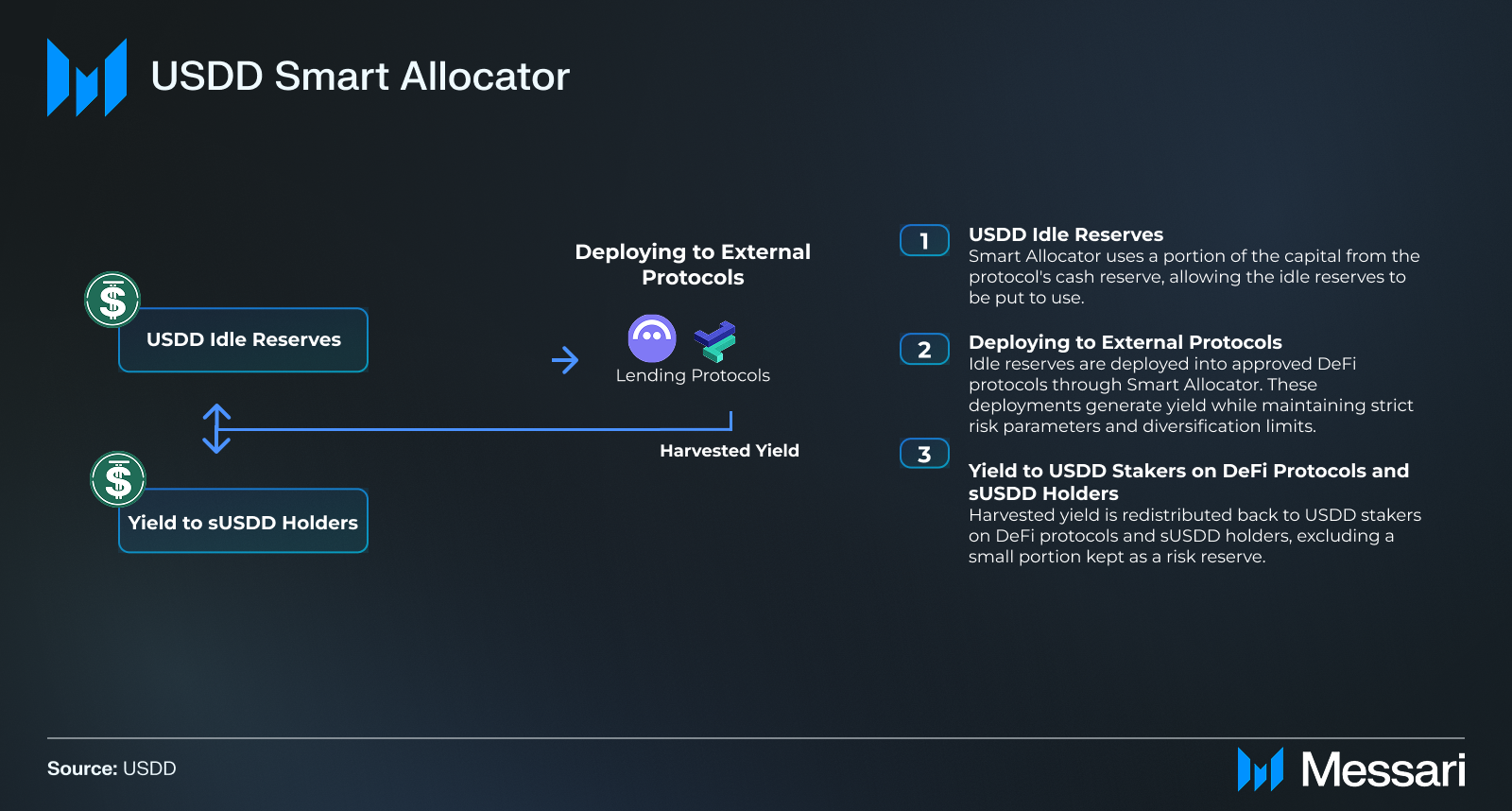
A key innovation within the USDD 2.0 ecosystem is Smart Allocator, which functions as the protocol's onchain treasury manager. It is designed to generate a sustainable, real yield by deploying a portion of idle cash reserves, which are deployed into investment opportunities to earn returns. The returns from these investments provide a continuous revenue stream, allowing the protocol to fund user incentives via its “Earn” product.
On Sept. 8, 2025, the USDD protocol officially announced the native deployment of its USDD stablecoin on the Ethereum network, establishing USDD as a sovereign ERC-20 token on Ethereum and its native TRON version.
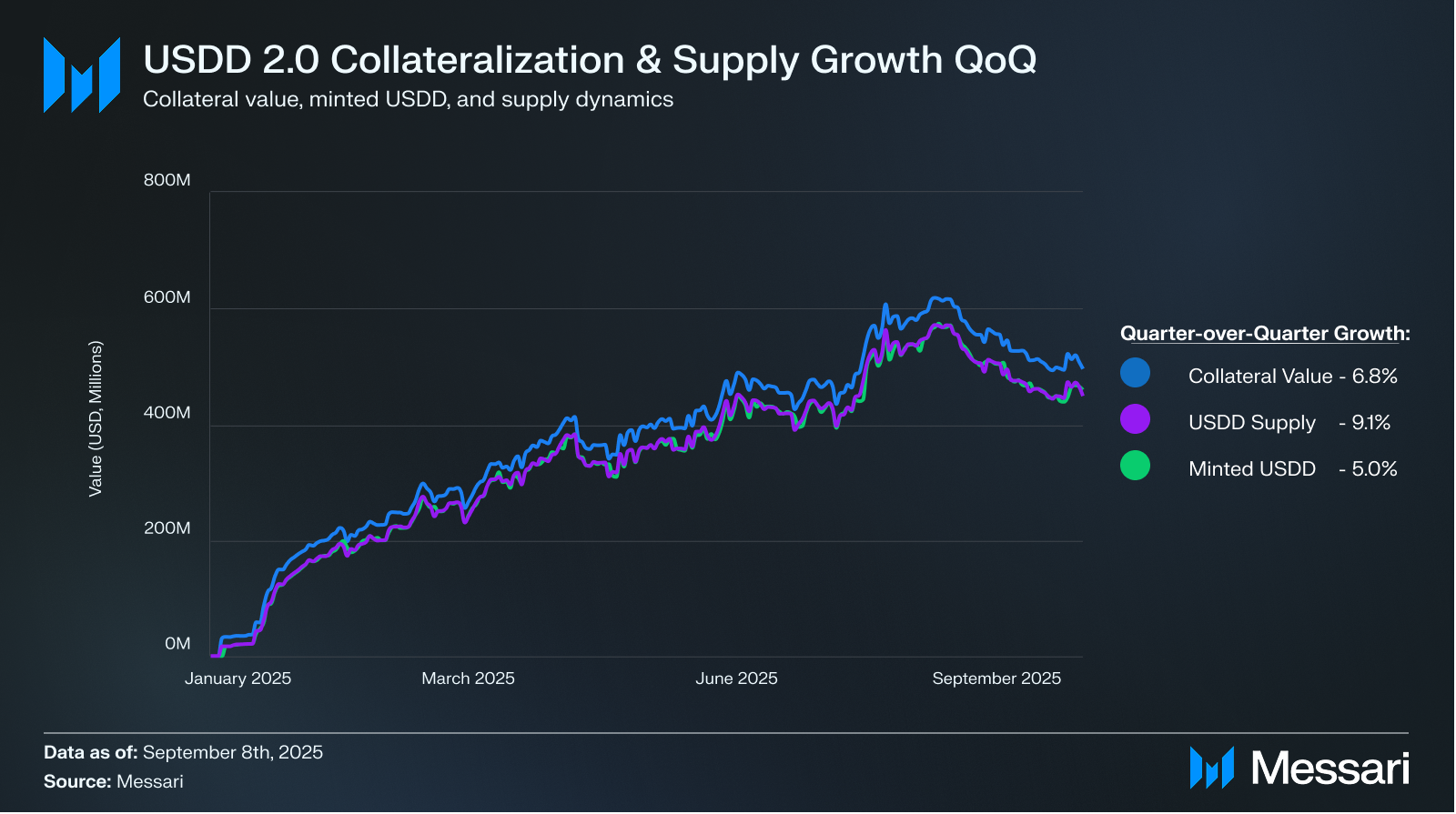
Since its relaunch in January 2025, the USDD 2.0 protocol has demonstrated consistent and healthy growth, laying a stable foundation for its recent ecosystem expansions. Over the first three quarters of the year, both the total supply of USDD and its backing collateral expanded significantly, with total collateral value peaking at over $620 million in early August. Crucially, the protocol has maintained its overcollateralized stance throughout this period, with the total value of its reserve assets consistently exceeding the total circulating supply of USDD. This trend of increasing security is further evidenced by the most recent quarter-over-quarter data, which shows collateral value growing by 5% while the stablecoin's supply grew by 3%, indicating a strengthening collateralization ratio leading into its multi-chain deployment.
The Peg Stability Module (PSM)
A core component of the launch was the simultaneous activation of a Peg Stability Module (PSM) for the new Ethereum-native USDD. This module allows users to mint and redeem USDD directly on Ethereum at a 1:1 ratio with other major stablecoins, starting with USDT and USDC. The deployment of the PSM provides a strong price anchor and a deep source of liquidity, addressing two of the main challenges for any protocol within the maturing stablecoin market.
Elastic and Deep Liquidity: the Foundation for Integration
The PSM effectively functions as a central bank for USDD on Ethereum, providing what is known as "elastic" liquidity. This means the supply of USDD on Ethereum is not fixed; it can expand or contract based on user activity, as the PSM facilitates. When demand for USDD is high, users mint more at the PSM, and the supply grows. When demand decreases, users redeem USDD, and the supply shrinks. This contrasts with the often-static liquidity in typical Automated Market Maker (AMM) pools, which require large amounts of locked capital on both sides of a trading pair. The PSM, by contrast, can facilitate the minting of billions of dollars worth of USDD with minimal price impact, ensuring that the protocol can absorb large inflows and outflows without the peg breaking.
Incentivizing Arbitrage: The Enforcement of the Price Peg
This fixed 1:1 conversion rate within the PSM results in persistent arbitrage opportunities that enable the regulation of the price of USDD across the entire Ethereum ecosystem, including all decentralized exchanges (DEXs). The PSM effectively establishes a hard price floor and ceiling at $1.00. For example, if the price of USDD on a secondary market like Uniswap or Curve were to dip to $0.998 due to transient selling pressure, a rational economic actor (the arbitrageur) would be incentivized to execute a profitable trade. They would buy large quantities of USDD from the DEX at the discounted price of $0.998 and immediately take that USDD to the PSM to redeem it for the same amount of USDC or USDT, instantly capturing a risk-free profit. This act of large-scale buying on the open market creates significant buying pressure, rapidly driving the market price of USDD back up toward its $1.00 peg until the arbitrage opportunity is eliminated.
Conversely, if high demand on a DEX pushed the price of USDD up to $1.002, arbitrageurs would perform the opposite trade. They would go to the PSM, mint a large amount of USDD for exactly $1.00 each, and then sell that newly minted USDD on the DEX for $1.002, again capturing a risk-free profit. This large-scale selling pressure on the open market immediately drives the price back toward the $1.00 peg.
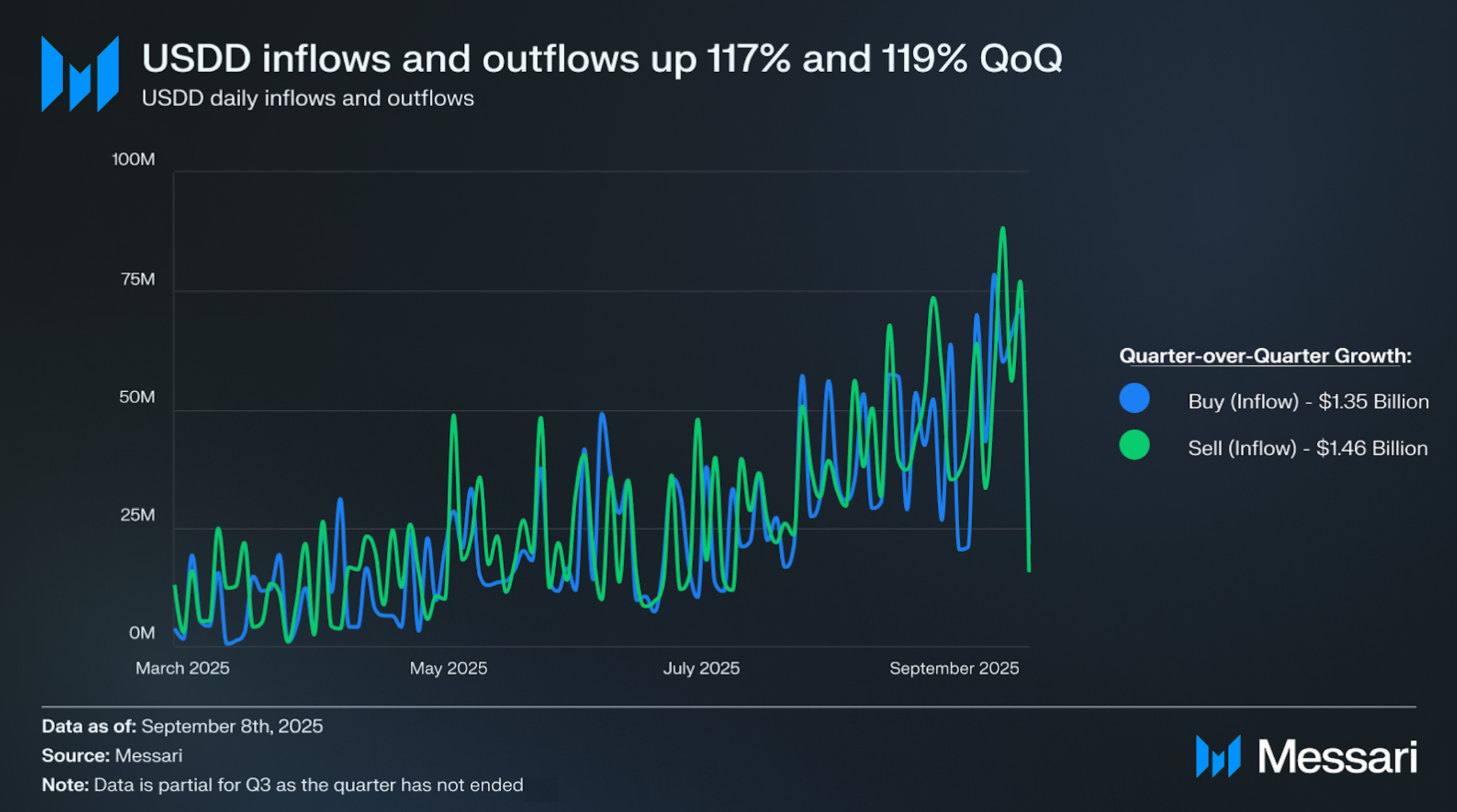
PSM flows over the past two quarters underscore its central role in USDD’s stability. Though Q3 has not yet ended, total inflows (users minting USDD against USDT/USDC) have already increased by 117% QoQ from $1.15 billion to $2.5 billion, as of Sept. 8, 2025. Outflows (redemptions) are up 119% QoQ from $1.24 billion to $2.7 billion over the same period. This activity suggests that the PSM is now capable of absorbing large swings in demand, as it facilitates arbitrageurs bringing USDD to peg.
CertiK Security Audit
Alongside the launch, the protocol announced that CertiK completed a comprehensive security audit on the new Ethereum smart contracts. This public verification provides assurance to users and developers that the contracts have been vetted for potential vulnerabilities. In conjunction with the technical launch, the protocol also initiated an aggressive go-to-market strategy via a special airdrop campaign to incentivize the broader Ethereum community to engage with USDD. To celebrate the native Ethereum deployment, the campaign offers a tiered APY structure based on daily TVL snapshots of the total USDD held on Ethereum, “ranging from 12% at low TVL to 6% as TVL increases, ensuring fair and transparent distribution.”
Smart Allocator
Smart Allocator enables sustainable yield generation, and its mechanics are designed for security, transparency, and conservative capital management. Smart Allocator exclusively deploys funds from cash reserves held by the protocol into investment opportunities to earn returns. Investment risks are kept to a minimum with the protocol’s adoption of a conservative strategy. Smart Allocator effectively functions as a conservative, onchain treasury manager. Its strategy is governed by smart contracts that adhere to a strict set of rules:
Reallocation: These protocols allocate funds to lending pools for top-tier crypto assets (e.g., USDT and USDC) but will eventually seek to reallocate into defi-protocols to earn interest for redistribution
Risk Parameters: The system operates under strict, transparent parameters, including caps on the total percentage of reserves that can be deployed and limits on allocating to any single protocol. These parameters are designed to prevent over-concentration and mitigate systemic risks.
Capital Deployment Cap: This is a hard limit on the total percentage of the protocol's idle reserves that Smart Allocator can use at any time.
Concentration Limit per Platform: This rule limits how much capital can be allocated to any DeFi platform.
Active, Dynamic Monitoring: Every investment decision is made under the active, dynamic monitoring of the USDD and JUST DAO teams. Real-time adjustments are made as market conditions evolve.
Smart contracts periodically harvest the yield earned from the target DeFi platforms. This harvested yield, which represents real profit from lending activities, is then programmatically swept back into the USDD protocol for pro-rata distribution to USDD stakers on DeFi protocols and sUSDD holders.
The Mechanics of sUSDD
The long-term vision for yield within the USDD ecosystem is centered on the USDD Earn product and its interest-bearing token, sUSDD, which provides a durable and transparent on-chain savings mechanism. Through a simple smart contract interface, users deposit USDD to mint a proportional amount of liquid sUSDD tokens. The yield is not paid out directly but is accrued through a constantly appreciating exchange rate, calculated as the total USDD in the contract divided by the circulating sUSDD supply. This exchange rate rises continuously, pushed upwards as real profits from the protocol's Smart Allocator are programmatically swept into the contract, fairly distributing value to all holders by increasing the underlying backing of each token.
A crucial feature of this design is that the quantity of sUSDD in a user's wallet remains constant, making it a highly composable and predictable asset that can be used as collateral in other DeFi protocols. This enables users to earn the baseline yield while leveraging their position for more advanced capital efficiency strategies. This entire model represents the final step in transitioning the protocol away from temporary, subsidy-based incentives to a perpetual, self-sustaining economic engine powered by its own activities.
Conclusion
The recent native deployment on Ethereum represents the culmination of USDD's strategic pivot to a more resilient and sophisticated protocol. This multi-front expansion is built upon the robust, overcollateralized foundation of USDD 2.0, a necessary evolution from the protocol's subsidized origins to a model grounded in verifiable, on-chain assets. The protocol's design, which combines the liquidity of the Peg Stability Module with the long-term, sustainable yield of the Smart Allocator, provides a comprehensive framework for both stability and growth. By simultaneously expanding its multi-chain presence and enhancing capital efficiency for its core users, USDD is positioning itself not just as a stablecoin but as a foundational, self-sufficient financial primitive for a more interconnected DeFi ecosystem.
This report was commissioned by USDD Tech Limited. All content was produced independently by the author(s) and does not necessarily reflect the opinions of Messari, Inc. or the organization that requested the report. The commissioning organization may have input on the content of the report, but Messari maintains editorial control over the final report to retain data accuracy and objectivity. Author(s) may hold cryptocurrencies named in this report. This report is meant for informational purposes only. It is not meant to serve as investment advice. You should conduct your own research and consult an independent financial, tax, or legal advisor before making any investment decisions. Past performance of any asset is not indicative of future results. Please see our Terms of Service for more information.
No part of this report may be (a) copied, photocopied, duplicated in any form by any means or (b) redistributed without the prior written consent of Messari®.
FaustianCreek is a Research Analyst for Messari. His main interests are in AI Infra, DePIN, and DeFi. FaustianCreek was a former consultant at a number of asset management firms in addition to prior experience at a DePIN protocol.
FaustianCreek is a Research Analyst for Messari. His main interests are in AI Infra, DePIN, and DeFi. FaustianCreek was a former consultant at a number of asset management firms in addition to prior experience at a DePIN protocol.