USD.AI: The Loan Book Catches Up

Below we frame 12-month scenarios for USD.AI and CHIP. The model calibrates to current fundamentals: yield-bearing capital at ~84% of TVL, reserve yield at 4.5%, and net APY at 85% of gross, matching today's 8.20%/6.98% print. Origination fees are assumed at 1% of new originations. FDV is held at ~$408M across scenarios to isolate the fundamental question.
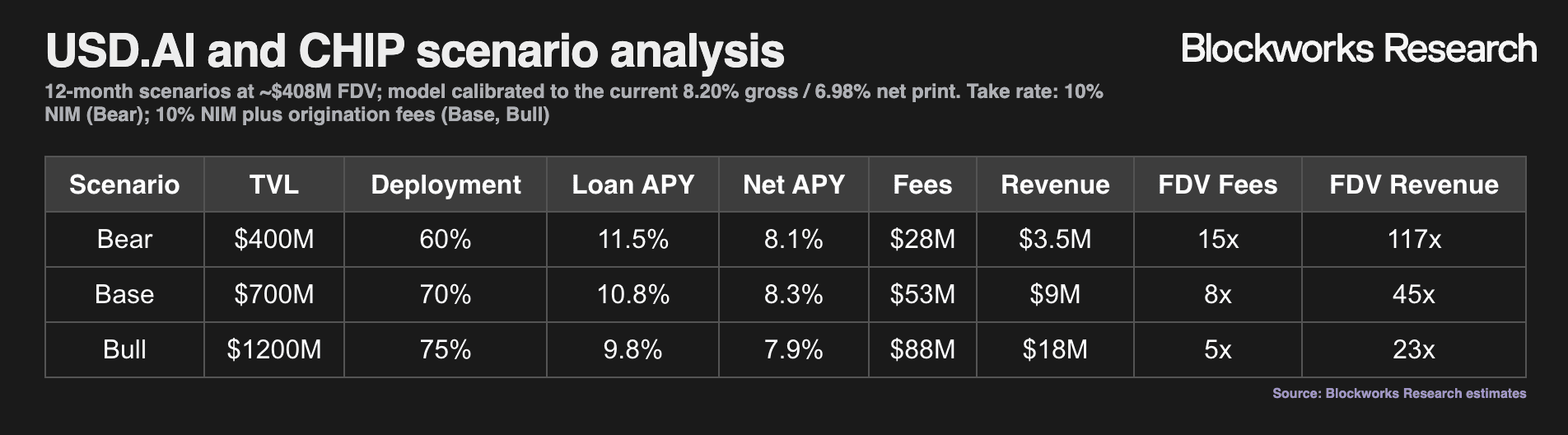
Bear assumes Season 2 ends in October without an Aave listing, points capital exits, and pipeline conversion stalls; deployment rises mechanically as TVL shrinks against termed-out loans. Base assumes the signed term sheets convert with modest organic growth on top. Bull assumes the $1B origination target lands, funded by deposit growth, loops through a live Aave integration, and external facilities in the Bullish mold.
For depositors, net APY lands between 7.9% and 8.3% in every row, because falling TVL raises the deployment ratio against a termed-out book while rising TVL brings rate compression and dilution from capital that outpaces origination. Double-digit yield in these scenarios is a gross figure: the protocol's 11.7% projection is gross, assumes full pipeline conversion on today's TVL, and would imply ~10% net at the current 85% pass-through. We treat that as an upside case rather than a base case, since it requires all $312.1M of signed paper to fund without matching deposit growth. The realistic net range of 7.0% to 8.3% still ranks among the stronger hardware-backed yields onchain, and sits well above sUSDe's ~5% current carry, with credit and liquidity risk in place of funding-rate risk.
For CHIP, the same cenarios the fee multiple from ~15x to ~5x. Base-case ~8x lands at rough parity with ENA's ~7.5x, but the claims behind the two multiples have diverged: ENA's fee switch has passed and awaits only a supply milestone, while CHIP has no proposal scheduled. Paying a peer multiple for a token without a peer claim is the premium, even where the headline ratios match; CHIP screens cheap only in the bull column, and reaching it requires flawless execution.
On tracked protocol revenue, even the bull case is ~23x with no committed claim on any of those dollars. A token whose multiple ranges that widely on execution outcomes, with no claim on the revenue behind it, is a venture position in a liquid wrapper, and that is the correct frame for sizing it. Three developments would change our stances:
- Fee routing to sCHIP: A governance-committed share of protocol revenue to stakers converts CHIP from a claimless governance token into a yield instrument and would move us from Neutral toward Overweight, cliff calendar permitting. Continued absence into Q1 2027, as the April cliffs approach, would move us back to Underweight.

Nick leads coverage on the DePIN and Proof of Work sectors. Previously led research and engineering at a DePIN-focused accelerator.