Updating AAVEnomics

The Umbrella proposal’s redesign of the SM should offer improved mechanisms to cover bad debt. Eliminating stkAAVE as the slashing asset reduces the tail risk of large selling pressure, price impact, and slippage on the token. Burning aTokens is a more deterministic and capital efficient mechanism for covering these obligations. Additionally, it provides a venue for Aave lenders to earn additional yield on their supplied tokens, in compensation for the additional risk. While Aave has historically only incurred $2-$3M in bad debt, the Umbrella mechanism reduces tail risks on the AAVE token, offers lenders a venue for additional yield, and should be substantially more capital efficient, overall.
Aave is currently firing on all cylinders and putting up banner numbers on its financials and key metrics. Aave closed last quarter with both revenue and earnings at record highs. Additionally, the protocol’s net treasury balance sits at an all time high of over $60M, and the GHO supply continues to grow, eclipsing $100M. These key metrics have grown every quarter since Q1 2023. AAVE currently trades at a historically low valuation on a Price to Earnings basis.
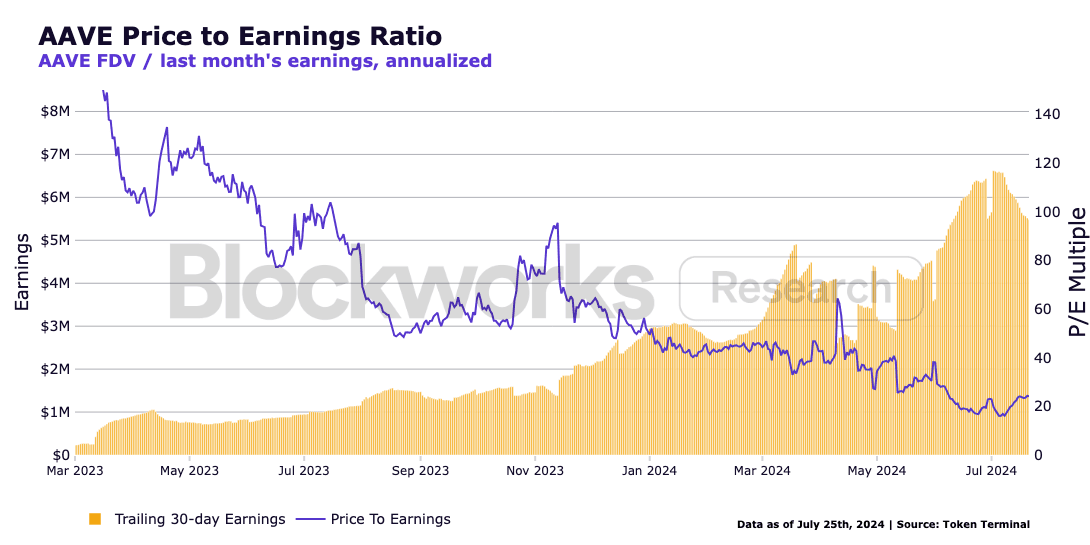
In recent months, Aave’s TVL and total borrows have shown a bullish divergence to the overall market. TVL and borrows, in both dollar-terms and ETH-terms, have continued to make 52-week highs, while the TOTAL index and DeFi TVL remain beneath their March and June highs. Aave is in its best position ever to return profits to its token holders.

Luke leads coverage on money markets, stablecoins, real world assets, interoperability, and intents-based infrastructure. Previously worked in market research and product at a startup incubator.