Unpacking BTCFi and New Yield Opportunities


Primer
BTC's market cap is ~$1.8 trillion, yet 99% of BTC is idle, meaning it is not used onchain in DeFi to generate yield. BTC holders and Bitcoin developers have faced challenges building an onchain economy on Bitcoin, primarily due to a lack of programmability, custody options, and unsustainable yield.
Since the rise in smart contract platforms like Ethereum, which can handle more complex protocols and transactions, many attempts have been made to integrate DeFi into the Bitcoin network. Upgrades like Lightning Network (2018) boosted transaction speed, Taproot (2021) improved privacy and script flexibility for metaprotocols like Ordinals (2023), and BitVM (not launched yet) enabled Turing-complete smart contracts via offchain computation and onchain settlement.
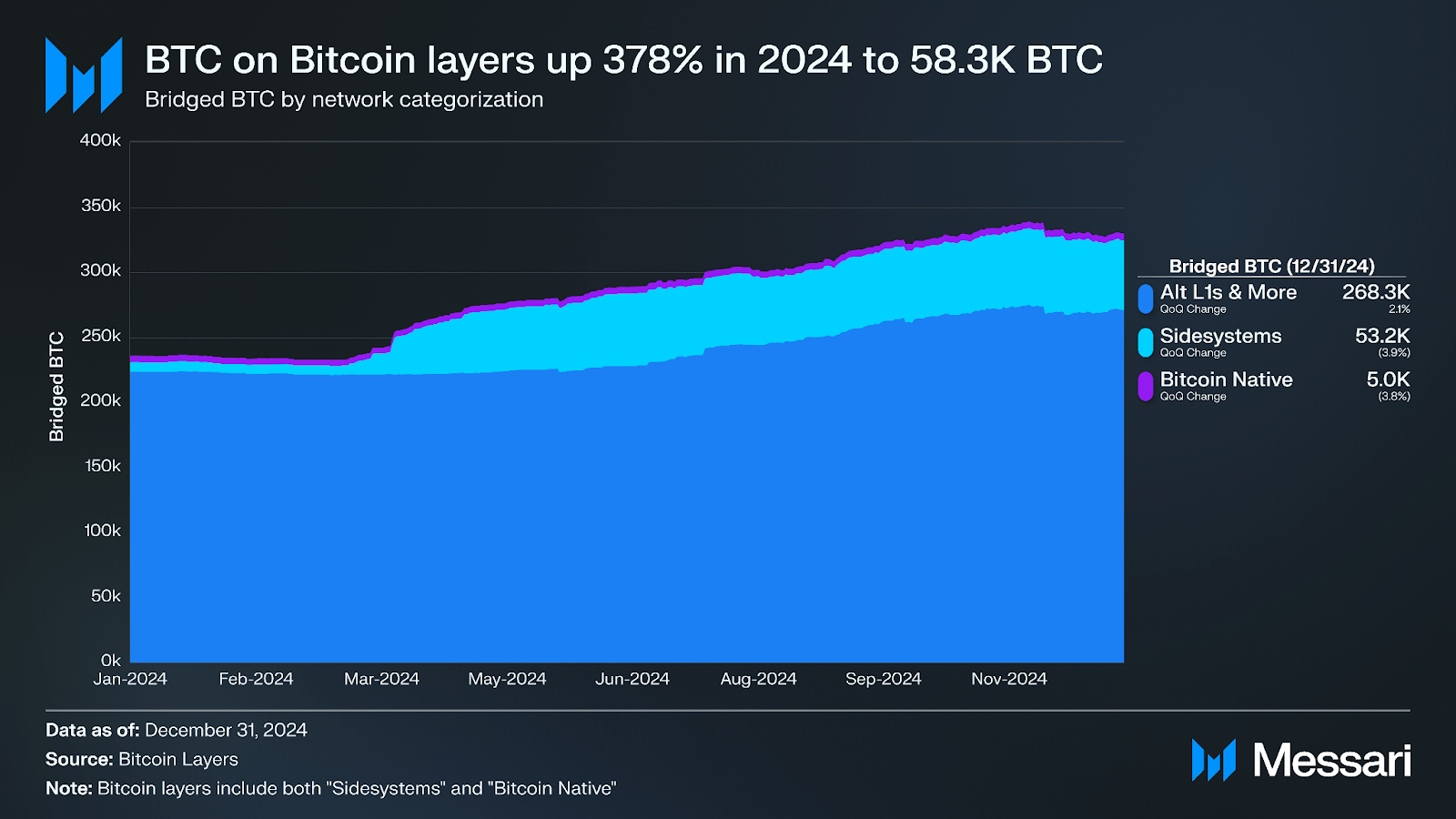
In Q4’24, 268,300 BTC was bridged to L1s and L2s (i.e., Ethereum, Solana, Arbitrum, etc.), and 53,200 BTC was bridged to sidesystems (i.e., Stacks, Merlin, Core, etc.). While BTC bridged to L1s and L2s was more dominant this past quarter, BTC bridged to side systems rose 378% in 2024 to 53,200 BTC, showcasing consistent growth. Users bridging BTC to sidesystems or swapping into wrapped alternatives may be doing so to use their BTC more productively. This implies that while BTC DeFi is still more popular on alt L1s, there is accelerating interest in using BTC in more native settings.
Despite Bitcoin’s TVL-to-market cap ratio being significantly lower than Ethereum's, even modest adoption of BTCFi (DeFi on the Bitcoin Network) could unlock substantial capital. Looking forward, a few catalysts could spur increased BTCFi activity, including rising Bitcoin dominance, OP_CAT, and institutional and government adoption, among other bullish events. The key question is: What will provoke users to be more capital-efficient with their BTC, and where will they seek yield opportunities?
Sam Ruskin - @CryptoSam01

Sam was previously a product manager at ether.fi, as well as LifeMed AI. He graduated from Ohio State University, where he founded the Ohio State Blockchain Club. He is now an Enterprise Research Analyst at Messari focused on finding the next best applications and protocols in internet finance.

Hayden is a Research Analyst specializing in the intersection of crypto-economic incentive mechanisms and their role in DeFi, DePIN, and AI ecosystems. Prior to joining Messari, Hayden worked as a Research Analyst at The Block and as a Venture Associate at a crypto-native venture capital fund.

Jeremy is a research analyst at Messari with interests in Infra, DeFi, and Enterprise adoption. Prior to joining Messari, Jeremy worked as an analyst at Fidelity Digital Assets.