Uniswap Interface Fee Switch


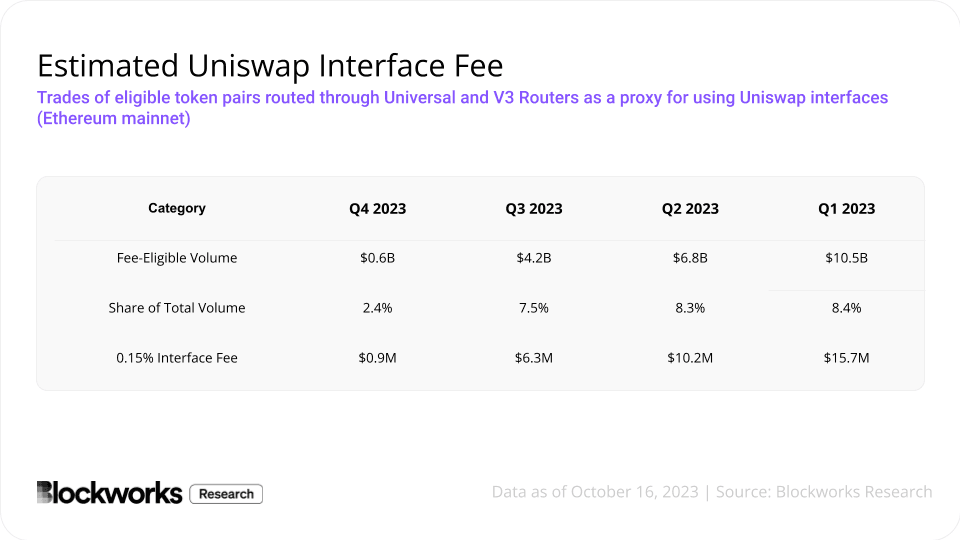
Despite the high interface fee, it is important to note that only a small portion of Uniswap’s volume is routed through its frontends. According to our research, which uses trades routed through the Universal Router and V3 routers as a proxy for using Uniswap interfaces, only 7.5% to 8.4% of fee-eligible volume originates through Uniswap’s interfaces, with that figure being even lower at 2.4% for the ongoing quarter. Router contracts attempt to find the most efficient route to execute trades, and the Uniswap interfaces facilitate trades by routing through these contracts. However, it is important to note that this methodology does not perfectly track Uniswap interface activity: by our estimate, had a 0.15% interface fee been implemented for the previous three quarters, Uniswap would have generated ~$33M in revenue YTD.
Binance’s lowest fee tier for regular users on spot trades is 0.10%, both on the maker and taker sides. Implementing this 0.15% fee would make a spot trade more expensive on Uniswap compared to all of Binance’s fee tiers, not even accounting for liquidity provider swap fees. We do not believe that as a result of this interface fee switch, Uniswap loses market share to other DEXs, simply that swappers will use aggregators and other alternative frontends with trade volume ultimately still being routed through Uniswap.
UNI token holders control a “fee switch,” a parameter in Uniswap V2, V3, and V4 that allows a portion of swap fees to accrue to a DAO-specified address at the expense of LPs. The Uniswap delegate community has repeatedly attempted to turn on the switch but has constantly failed in their attempts to do so. UNI token holders are likely not pleased with Uniswap Labs turning on a fee switch before they were able to do so. However, if a protocol fee switch is enabled, it will come from the existing swap fee given to LPs rather than being in addition to existing swap fees.
One wonders why Uniswap Labs is choosing to turn on this interface fee switch now, considering they’ve likely been paying out expenses from previous raises and token allocations, including a $165M raise in October 2022. Is this a symptom of an equity + token dual structure, where in theory, Uniswap Labs’ has a larger duty to drive value to equity holders rather than token holders? In addition, many large UNI token investors are likely equity holders too, and thus, in theory, are indifferent between revenue accruing to the equity or token. However, if you are an equity holder that is now accruing value through the interface fee switch, you are likely much less concerned about accruing value through the token, and this may be expressed in future governance votes to turn on the fee switch.
To date, no spot DEX has successfully managed to solve the LVR (loss-versus-rebalancing) problem. Turning on an interface fee switch and not returning any of those excess fees to liquidity providers seems unjust, especially considering how important liquidity providers are to the protocol and how a sustainable path to profitability for them has not been found yet. In addition, this interface fee switch means that retail swappers will incur the added cost, but MEV bots who are extracting value from swappers and liquidity providers will not.
Perhaps Uniswap is fearful of vastly decreased DEX volumes if this interface fee was applied to all swaps, as MEV volume currently comprises the bulk of the DEX’s volume. Interestingly, this interface fee switch will also apply to UniswapX trades routed through Uniswap’s frontends, with UniswapX fillers most likely being sophisticated market makers or searchers. Like existing LPs, these market makers are also unlikely to be happy with Uniswap’s fee switch, likely seeing it as an additional fee that they could have charged themselves.

Ren leads coverage on Options, Structured Products, Money Markets, and AMMs. Previously worked at a crypto hedge fund managing DeFi strategies.

Matt leads coverage on DEXs, derivatives, governance, and the Avalanche ecosystem. Previously he worked as an Analyst at Ikigai Asset Management and Teller Finance.