The Render Network is a distributed GPU rendering and compute protocol that distributes AI and 3D rendering jobs across idle consumer-grade GPUs, reducing dependence on centralized cloud providers.
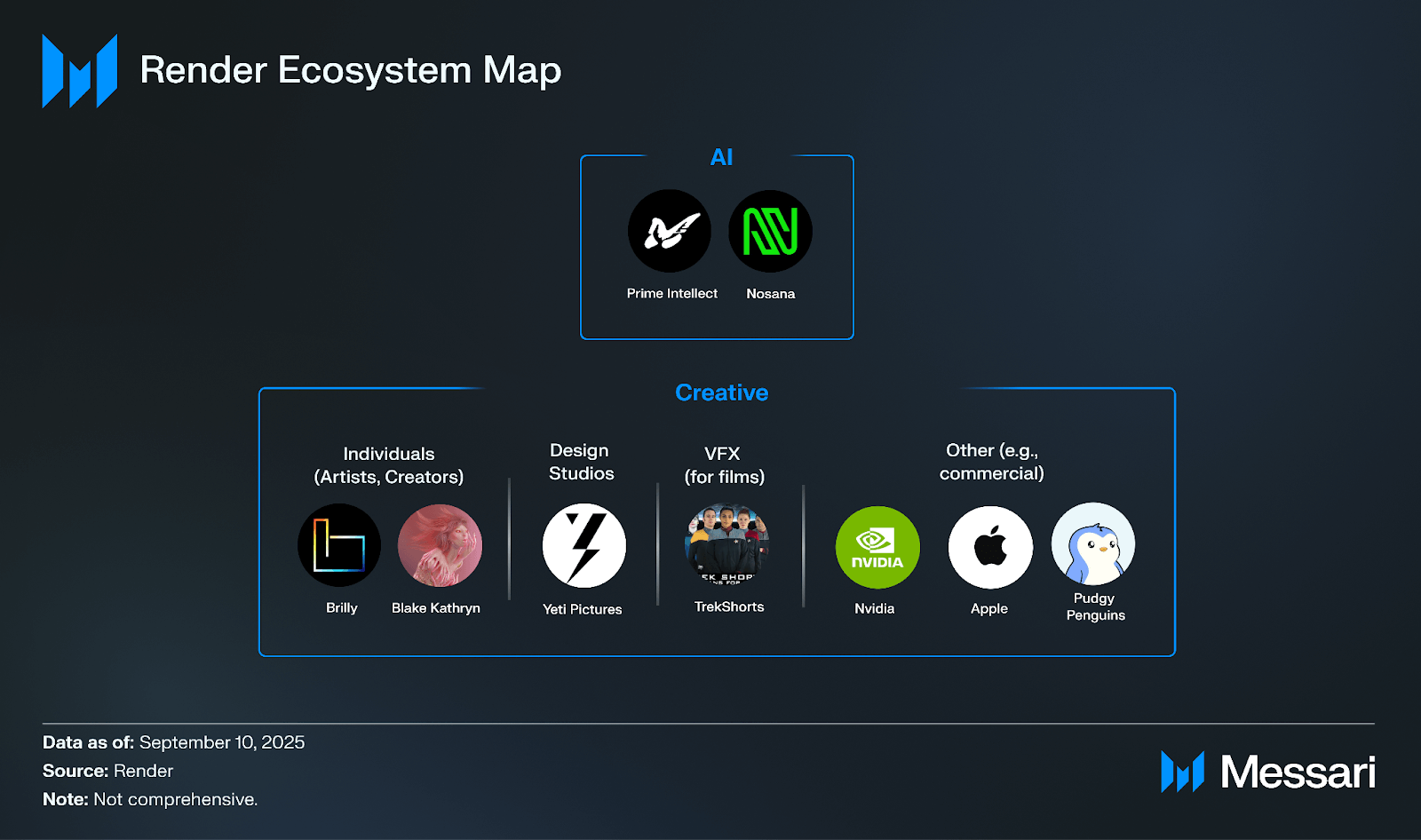
The Render Network is used by a range of creative studios, indie games, digital artists, and animation projects, including Trek Shorts, Pudgy Penguins, and Yeti Pictures.
The Render Network has been used to render over 60 million image frames and has powered real, large-scale displays like the Las Vegas Sphere, concerts including the Super Bowl, various games, and is even used by NASA.
On the rendering side, the Render Network combines GPU node operators, centralized cloud storage, and native support for Blender and Cinema 4D via the C4D Wizard plugin to help users validate, package, and submit rendering jobs efficiently.
The product suite is expanding beyond rendering into AI-specific computing, with the rollout of the Render Network Compute Subnet supporting inference, AI training, and general computing workloads via integrations with clients like Jember, Scrypted, and Intelligent Internet.
Introduction
The rapid expansion of AI, expected to grow from $184 billion in 2024 to $826 billion by 2030, is driving unprecedented demand for GPU compute. GPU infrastructure, critical for powering AI, 3D rendering, and gaming, is itself projected to increase from $83 billion in 2025 to $353 billion by 2030. Within this, rendering represents a key application layer, increasingly shaped by AI-enhanced workflows in media, design, and immersive content. The global 3D rendering market alone is projected to grow from $4 billion in 2023 to $32 billion by 2032. While high-end enterprise GPUs dominate headlines for powering AI training, a massive pool of consumer-grade GPUs, which are often idle or underutilized, remains untapped. Recent estimates suggest that over 40% of global GPU capacity is currently unused, including gaming rigs, creative desktops, and crypto-era hardware.
The Render Network addresses this gap by orchestrating a decentralized network of consumer-grade GPUs to support artists, designers, and creative studios in rendering high-fidelity content. The protocol distributes workloads across idle GPU nodes worldwide, enabling scalable, secure, and cost-efficient rendering without relying on centralized cloud providers.
Render’s ecosystem includes: (i) the new Render Network Compute Subnet, designed to support AI and general compute workloads such as training and inference; (ii) The Render Network Rendering Subnet, the original core product that distributes 3D rendering tasks, submitted via the Render Portal and supported through integrations with OctaneRender, Blender and Cycles, Cinema4D and Redshift; and (iii) the Render API, which allows developers and platforms to programmatically submit and manage rendering and compute jobs, retrieve outputs, and monitor system activity.
OTOY, founded in 2008 by Jules Urbach (Co-Founder, CEO, and Chairman), is led by a team that also includes Trevor Harries-Jones (COO). The Render Network was then founded in 2017 by Jules Urbach, with the Render Network Foundation established in 2023 as an independent nonprofit overseeing governance, grants, and ecosystem development. Designed as a decentralized physical infrastructure network (DePIN), Render connects creators and developers with underutilized GPU compute for rendering and 3D graphics at scale, while the Render Compute Subnet extends these capabilities to AI workloads. Key foundation leadership includes Tristan Relly (Head of Operations), Ryan Shea (Head of Product), and Silvia Lacayo (Head of Marketing and Communications), while Trevor Harries-Jones serves on the Foundation board. Render is also backed by an advisory board that includes Ariel Emanuel (CEO of Endeavor), Brendan Eich (Founder and CEO of Brave Software), Mike Winkelmann (Beeple), and Emad Mostaque (Founder of StabilityAI). Specifically, the network’s largest ecosystem partner is OTOY, a for-profit company that provides rendering services and develops the core infrastructure and user-facing tools for the Render Network. Users of OTOY products (e.g., OctaneRender) can choose to route their rendering and compute tasks through the Render Network.
To further catalyze innovation on the network, the Foundation helped establish RenderLabs in 2025 as a for-profit spinout focused on commercial opportunities tied to AI and distributed computing. RenderLabs serves as a resource for builders seeking to integrate AI tools and agentic workflows into their applications, evaluating tools based on quality, performance, and ease of integration.
The Render Network allows decentralized, GPU-accelerated rendering and computation by connecting creators with node operators through a trust-minimized, blockchain-coordinated system. This infrastructure rests on a few core pillars: distributed GPU node operators and centralized cloud storage options. These components interlock to facilitate task distribution, execution, and compensation across the network.
Node Operators
Node operators provide the backend GPU compute power for the Render Network. In exchange for contributing their resources, they earn RENDER tokens. Operators should ideally meet the following hardware guidelines:
A CUDA-enabled NVIDIA® GPU with a minimum of CUDA® 10.1 drivers and compute capability 3.0 or higher (minimum recommended driver version 566.36)
6GB+ VRAM (8GB+ preferred)
32GB+ system RAM
100GB+ free disk space (SSDs or non-mechanical drives preferred)
To ensure reliable performance, operators are also benchmarked via OctaneBench and are assigned a reputation score that increases with successful job completions. The OB score is the primary factor used to assign rendering jobs, with higher-scoring nodes prioritized for faster delivery. Reputation acts as a secondary modifier: if two nodes have similar OB scores, the node with the higher reputation is preferred. The reputation system applies to both operators and creators (i.e., the demand side of the network), helping prevent malicious Sybil attacks and reducing failed renders. Over time, the reputation logic is updated to adapt to the network’s growing complexity. Specifically, there are two main node types: (i) Render nodes, which handle traditional 3D rendering, whose performance is evaluated on consistency and throughput; and (ii) Compute nodes, which are optimized for general and AI compute workloads (e.g., inference, training), who follow a separate emissions system and reward logic based on uptime and utilization. Notably, node onboarding is currently curated based on the compute needs of artists and developers, requiring operators to fill out an interest form.
Multi-Format File Support and Data Distribution
The Render Network supports a range of industry-standard scene formats, including ORBX, Blender, Redshift, and Cinema 4D, which are used to package all the necessary geometry, textures, materials, lighting, and animation data required to perform a rendering job. While ORBX provides an extensible, open container format compatible with distributed rendering workflows, the network is designed to accommodate multiple file types depending on the creator’s preferred toolchain.
Render supports a wide range of compute-heavy workloads (e.g., 3D motion graphics, generative rendering, and immersive experiences rendered at 8K–25K resolution). Each scene is divided into discrete assets and frame-level tasks, which are hashed, encrypted, and uploaded to the cloud infrastructure. Assets remain encrypted in storage (whether in memory or on disk), and rendered outputs are encrypted before transmission. Each frame is watermarked prior to download, ensuring that outputs are only accessible post-payment. While user-uploaded files remain available for future use and are not stored ephemerally, any assets downloaded by a node are temporary and automatically deleted once the render job is complete, minimizing long-term exposure and reducing the attack surface for sensitive content. As such, node operators never have access to raw files or job content; everything is executed inside a sandboxed environment using proprietary software.
The security of the Render Network does not rely solely on splitting scenes into smaller parts. Rather, it stems from the fact that the files themselves remain inaccessible to the operators. Even if a single node receives an entire scene file, encryption and sandboxing prevent the operator from extracting or viewing any content. For long-form projects, an additional layer of protection is achieved through job distribution, where outputs are spread across multiple nodes, so no single machine ever holds the complete rendered work, even in the unlikely event of compromise.
The ORBX format also supports advanced use cases through embedded animation, volumetric capture, and light field data, positioning the network to serve both traditional content pipelines and emerging real-time or AI-native media applications.
Cloud Storage
Render’s infrastructure also uses centralized cloud storage systems to manage job assets. When a creator uploads a scene, the container file (whether ORBX, a zip of .ocs, .blend, or .c4d files, or single file uploads) and associated assets (textures, references, outputs) are encrypted and stored in a hybrid storage setup. This includes major providers like AWS, Dropbox, and Amazon S3. Specifically, nodes securely download job assets for processing and upload rendered results back to cloud storage.
Bringing It All Together
Now that there is a base understanding of the underlying components of the network, let’s go over an example workflow:
Creators submit their scenes using supported tools (i.e., OctaneRender, Cinema4D, or Blender Cycles), uploading them as ORBX files, zipped project folders, or individual asset files, depending on their preferred workflow.
The ORBX file is submitted through the Render Portal or via the API with customized parameters (e.g., resolution, sample count, frame range).
Creators choose the tier selection:
Tier 2 (Priority): Offers priority queue access and faster, more powerful node allocation. Priced at 100 OBh per RENDER token.
Tier 3 (Economy): More affordable but slower, with no guaranteed queue priority. Priced at 200 OBh per RENDER token.
Tier 1 (Trusted): Not yet live. Will enable access to verified, high-performance nodes for demanding scenes.
A fiat-denominated quote is generated based on estimated time per frame and GPU benchmarks.
A 5% protocol fee is applied per job to fund ongoing network operations via the network’s primary service provider, OTOY, which maintains the core infrastructure and user-facing tools for AI and 3D rendering.
Upon approval, payments made in fiat are converted to RENDER tokens and burned as part of the Burn-Mint Equilibrium (BME) model.
Jobs are assigned to nodes based on OctaneBench, availability, scene complexity, and creator reputation. Higher-reputation creators can run more concurrent jobs and are prioritized in allocation queues.
GPU nodes decrypt the job, render the assigned frames, and upload outputs to cloud storage.
Creators manually approve the results. If left unreviewed for 72 hours, outputs are automatically approved. Node operators are rewarded based on the OctaneBench Hours (OBh) that are delivered.
For advanced workflows, the Render Network also offers an API and SDK, allowing studios to automate rendering pipelines, submit jobs programmatically, and manage large-scale compute operations across creative and production teams.
RENDER Token
Token Allocations
The Render Network has a maximum supply of 644.2 million RENDER. As of September 2025, ~85 million remain to be emitted, with emissions decreasing over time and governed annually via RNP votes. A total of 842,757.1 RENDER have been burned through job payments, bringing the existing circulating supply to ~559 million. Approximately 2.7 million RENDER have been issued as node operator rewards to date, excluding other initiatives like artist grants or migration incentives. Future rewards depend on community-approved emission allocations and network usage.
Notably, monthly emissions do not immediately enter the circulating supply. As highlighted in the June and July 2025 Foundation reports, only a portion of each month’s emissions is actively distributed to node operators, grants, bounties, migration incentives, and operational needs. Unused tokens remain locked by the Foundation for future use and do not contribute to the circulating supply of tokens. This dynamic issuance is counterbalanced by the Burn-Mint Equilibrium (BME) mechanism: tokens spent on rendering and compute jobs are burned, creating a direct feedback loop between token supply and network activity. As a result, emissions are not purely inflationary; they adapt to true demand. For a breakdown of the pre-Solana token allocations and legacy vesting schedules, please refer to the earlier token model here.
Token Functions
The Render Network’s token was first introduced in 2017 as an ERC‑20 token under the RNDR ticker, preceding the mainnet’s full launch in 2019, and was later bridged to Polygon as an MRC-20 token. In November 2023, the network migrated its smart contracts to Solana, deploying a new SPL token under the RENDER ticker. As of Nov. 2, 2023, tokenholders can swapRNDR (ERC-20 and MRC-20) for RENDER (SPL) at a 1:1 ratio. Based on a commercially reasonable review, ERC-20 and MRC-20 RNDR tokens now lack functionality, while SPL RENDER serves the following purposes:
Payment for rendering jobs.
Distributed as rewards to node operators.
Voting in governance via RNPs.
Notably, the network’s tokenomics are governed by the Burn-Mint-Equilibrium (BME) model, which regulates supply through three core components: (i) Predictable Fiat Pricing, where rendering jobs are quoted in fiat, converted to RENDER at time of payment, and burned after completion; (ii) Emissions Schedule, which introduces capped, declining issuance over time (e.g., 9.1 million RENDER in Year 1 per RNP-006), distributed weekly based on onchain activity; and (iii) Sustainability, achieved by aligning emissions with actual demand for GPU compute while preserving long-term scarcity through predictable burning.
Governance
The protocol’s governance operates through the Render Network Proposal (RNP) system, a structured framework for proposing, debating, and implementing upgrades and funding initiatives. Tokenholders participate via onchain voting, now conducted through Nation.io using Solana-compatible wallets, following the migration from Ethereum-based Snapshot. Specifically, proposals follow a six-stage process:
Initial Proposal or Grant: Community members submit improvement ideas to Render moderators. If viable, a Discord channel is opened and labeled with the proposal’s title.
Draft Submission: The proposal is iteratively refined via community feedback. Authors may refine, withdraw, or escalate to voting.
Render Network Foundation Review: Core contributors and developers evaluate technical feasibility, economic impact, and risks over a reasonable window and provide feedback to the proposer. Public commentary is shared in Discord.
Initial Proposal Vote: The draft RNP shall be put forth for a simple majority vote to gauge community interest and support. This vote shall remain open for a period of 72 hours and shall not be subject to any quorum requirement. Should the proposal garner majority support, it shall proceed to the Final RNP Vote phase.
RNP Vote: The refined RNP shall be presented to the community for a decisive vote conducted through the voting platform. The voting period shall span 6 days. For an RNP to be considered approved, it must satisfy the following criteria: Attain a majority approval of at least 50% of the total votes cast. Achieve a quorum of at least 15% of the total RENDER token supply participating in the vote.
Implementation: Approved RNPs enter the development queue and are tracked publicly on GitHub with status tags: In Development → Implemented.
In urgent situations (e.g., protocol outages), the foundation can invoke the Emergency Proposal Protocol, bypassing early proposal stages. Emergency RNPs must meet a higher approval threshold (i.e., 20% of the total supply) to pass and be implemented immediately. While the Render Network Foundation provides technical and operational support for the RNP process, all proposals, whether community-initiated or otherwise, are ultimately subject to community approval via tokenholder vote. The Foundation may review proposals for feasibility, provide recommendations, and facilitate implementation logistics, but it does not have veto authority over RNPs.
Render Network Ecosystem
Users and Projects
Recent projects that highlight the variety of benefits that Render Network provides include:
Yeti Pictures: The acclaimed Athens-based motion design studio behind award-winning title sequences and commercials now uses Render for its Octane-powered rendering capabilities.
PlayPudgyParty (Pudgy Penguins): Game animations for the Pudgy Penguins franchise were rendered in 4K at 8000 samples using thousands of GPUs on Render.
ARTECHOUSE: An immersive art space that featured artists leveraging Render to power real-time visual experiences at ultra-high resolutions.
W1 Curates: A London-based public art gallery that used Render to deliver large-scale digital exhibitions with complex motion graphics and volumetric effects.
Coachella / UNVRS: For live performances and stage visuals at Coachella and UNVRS using Render to offload heavy rendering jobs.
Las Vegas Sphere: Digital artist Brilly used Render to meet strict production deadlines for Coca-Cola’s AI-powered flavor campaign featured on the Las Vegas Sphere, a venue known for its demanding spherical display format and extreme resolution requirements.
Nasa via V! Studios: Animation studio V! Studios rendered over 100 jobs on the Render Network for NASA’s Benefits for Humanity 2022, creating a series of 4K trailer-style videos as part of a digital-first storytelling initiative for the International Space Station.
Super Bowl Trailer: For the Super Bowl LIX countdown trailer, digital artist Andy Torres used OctaneRender and the Render Network to handle the compute load required for stadium-scale visuals.
Network Metrics
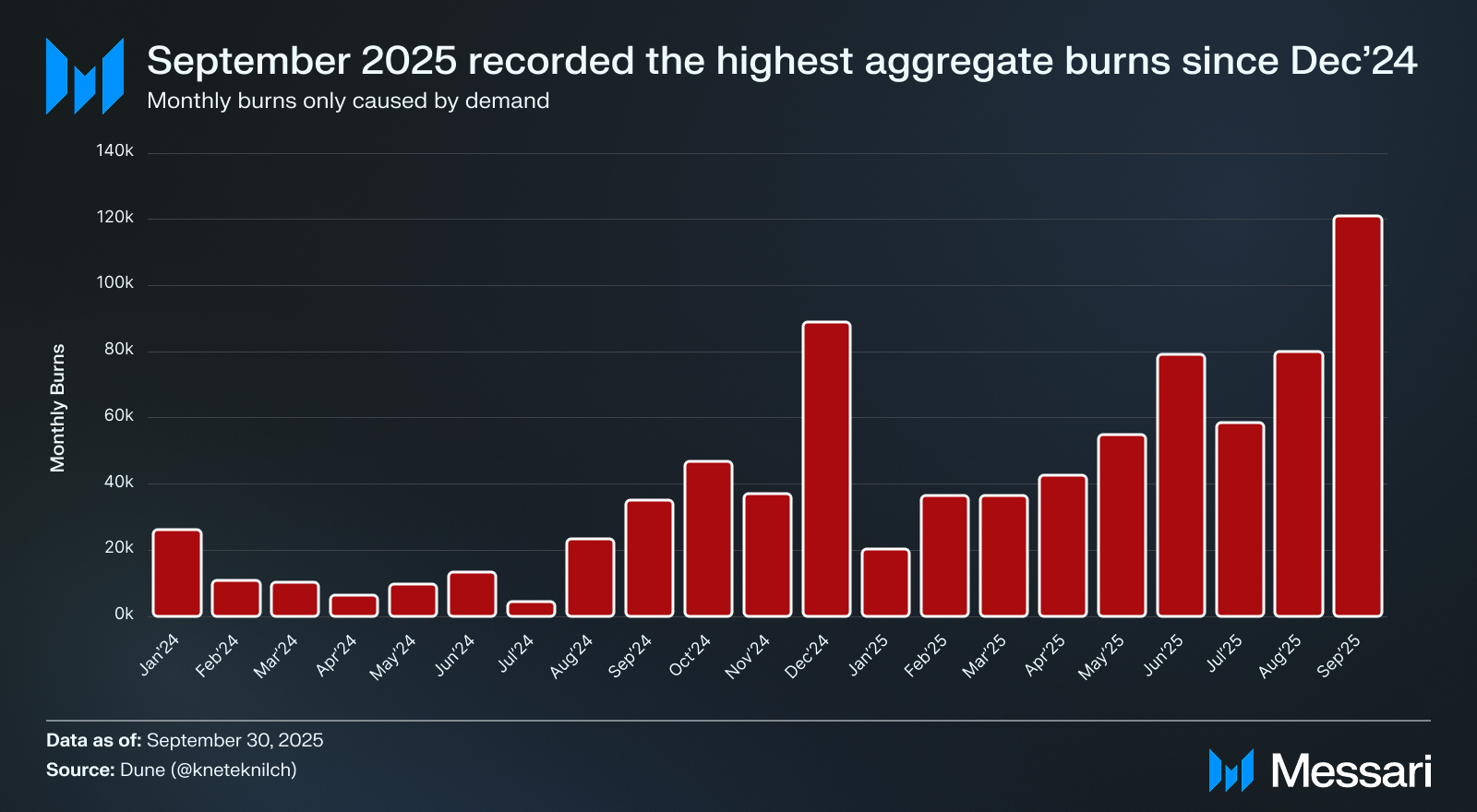
On the burn side, monthly RENDER token burns have continued to increase throughout 2025, building on 2024’s growth.
From January to September, 2025 saw 530,171.1 RENDER burned, up from 139,924.0 RENDER during the same period in 2024, representing a ~278.9% increase over the prior year’s equivalent timeframe. This comparison excludes Q4 figures, so full-year growth may differ.
While January 2025 accounted for ~20,452.3 RENDER burns, this has since increased to ~120,928.5 RENDER as of September 2025. The average MoM growth so far in 2025 stands at ~28.8%.
These burn figures correspond to rendering job submissions processed through the Render Portal, representing pure demand for GPU compute on the network. September 2025 recorded the highest aggregate burns since December 2024, indicating a continued increase in job throughput.
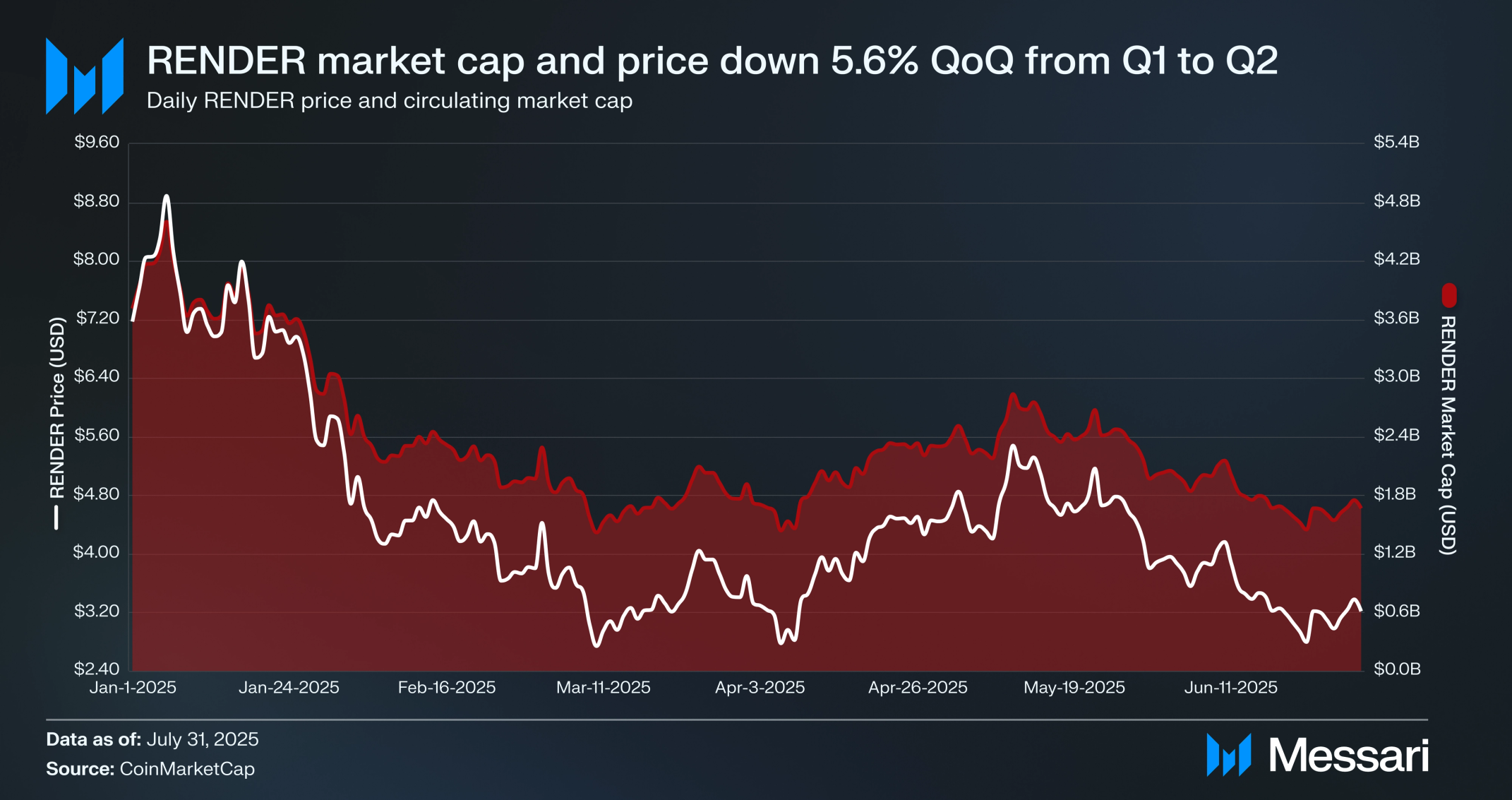
On the price side, RENDER ended Q2 2025 at $3.21, a 5.6% decrease from its Q1 closing price of $3.41, with the market cap following a similar trajectory. This contraction in market valuation occurred despite a notable increase in network usage and token burns during the same period.
Bounty Program
On July 24, 2025, the Render Network launched its Bounty Platform to support community-led contributions to the network’s development. The platform allows contributors to earn RENDER tokens by completing open tasks across various categories (e.g., technical tooling, documentation, research, community engagement, and product feedback). The bounty system is part of a broader effort to decentralize protocol development and create more pathways for ecosystem participation.
Roadmap
The Render Network does not currently maintain a formal, centralized roadmap. Instead, progress and priorities are communicated through Render Network Proposals (RNPs). These proposals outline upcoming initiatives, infrastructure expansions, economic upgrades, and governance enhancements.
Expanding Compute Capabilities and Building the Render Compute Network
Between 2023 and 2024, a series of proposals: RNP-005, RNP-007, RNP-008, and RNP-009, focused on partnering with decentralized compute platforms such as Beam, FedML, Nosana, and Prime Intellect. These integrations aimed to extend the Render Network’s infrastructure to support non-rendering workloads (e.g., AI training and DevOps tasks). However, limited demand and early market conditions meant these efforts did not result in sustained usage. By 2025, the Render Network advanced from exploratory partnerships to launching its own general compute subnet under RNP-019. The subnet aims to capture emerging demand for inference, training, and complex compute jobs that exceed the scope of traditional rendering.
Broadening Software and Tooling Integrations Beyond Octane
Other proposals (i.e., RNP-014 and RNP-016) focused on expanding support beyond OctaneRender by integrating additional rendering engines such as Blender Cycles and Autodesk Arnold. These changes aimed to improve compatibility across a broader range of creative tools and workflows. The proposals established the basis for ongoing efforts to make the network accessible across different production environments, including support for software like Cinema 4D.
Other one-off RNPs include:
RNP-017: Integration of OctaneRender for Blender into the Render Network: Connects OctaneRender directly with Blender workflows and implements vault-based monetization tools. Vaults support upfront and streaming payments, programmable revenue splits, and enforceable royalty mechanics for creators.
RNP-018: Year 2 of BME Emissions Allocations: This is a process-oriented proposal specifically allocating emissions for year 2 of the BME model. It maintains node rewards at par with Year 1, increases artist grants allocations, and maintains year-on-year allocations for foundation operations.
Closing Summary
The Render Network sits at the intersection of decentralized infrastructure and rendering compute, offering a blockchain-coordinated alternative to legacy cloud rendering services. Originally focused on Octane-based rendering workloads, the network has evolved to support additional rendering engines as well as AI-native GPU jobs through its newly launched Compute Subnet. With a technically robust architecture that supports multiple file formats, hybrid cloud storage, and a trust-minimized node system, Render positions itself as a foundational layer for scalable, distributed compute. Its tokenomics, governed by the Burn-Mint Equilibrium, aim for long-term sustainability by aligning emissions with real usage. The project has progressed steadily through community-approved RNPs and creator studios (e.g., Yeti Pictures and Pudgy Penguins), showcasing Render’s cross-domain adoption across AI, 3D production, and compute infrastructure.
This report was commissioned by The Render Network Foundation. All content was produced independently by the author(s) and does not necessarily reflect the opinions of Messari, Inc. or the organization that requested the report. The commissioning organization may have input on the content of the report, but Messari maintains editorial control over the final report to retain data accuracy and objectivity. Author(s) may hold cryptocurrencies named in this report. This report is meant for informational purposes only. It is not meant to serve as investment advice. You should conduct your own research and consult an independent financial, tax, or legal advisor before making any investment decisions. Past performance of any asset is not indicative of future results. Please see our Terms of Service for more information.
No part of this report may be (a) copied, photocopied, duplicated in any form by any means or (b) redistributed without the prior written consent of Messari®.