Talus is creating the infrastructure for a sustainable, digital economy centered around decentralized, agent-based automation.
Talus’ core Nexus framework standardizes how AI services operate onchain, enabling transparent and verifiable agent operations.
Talus raised more than $10 million in funding led by Polychain Capital with strategic investments from the Sui Foundation and Mysten Labs’ Walrus Protocol.
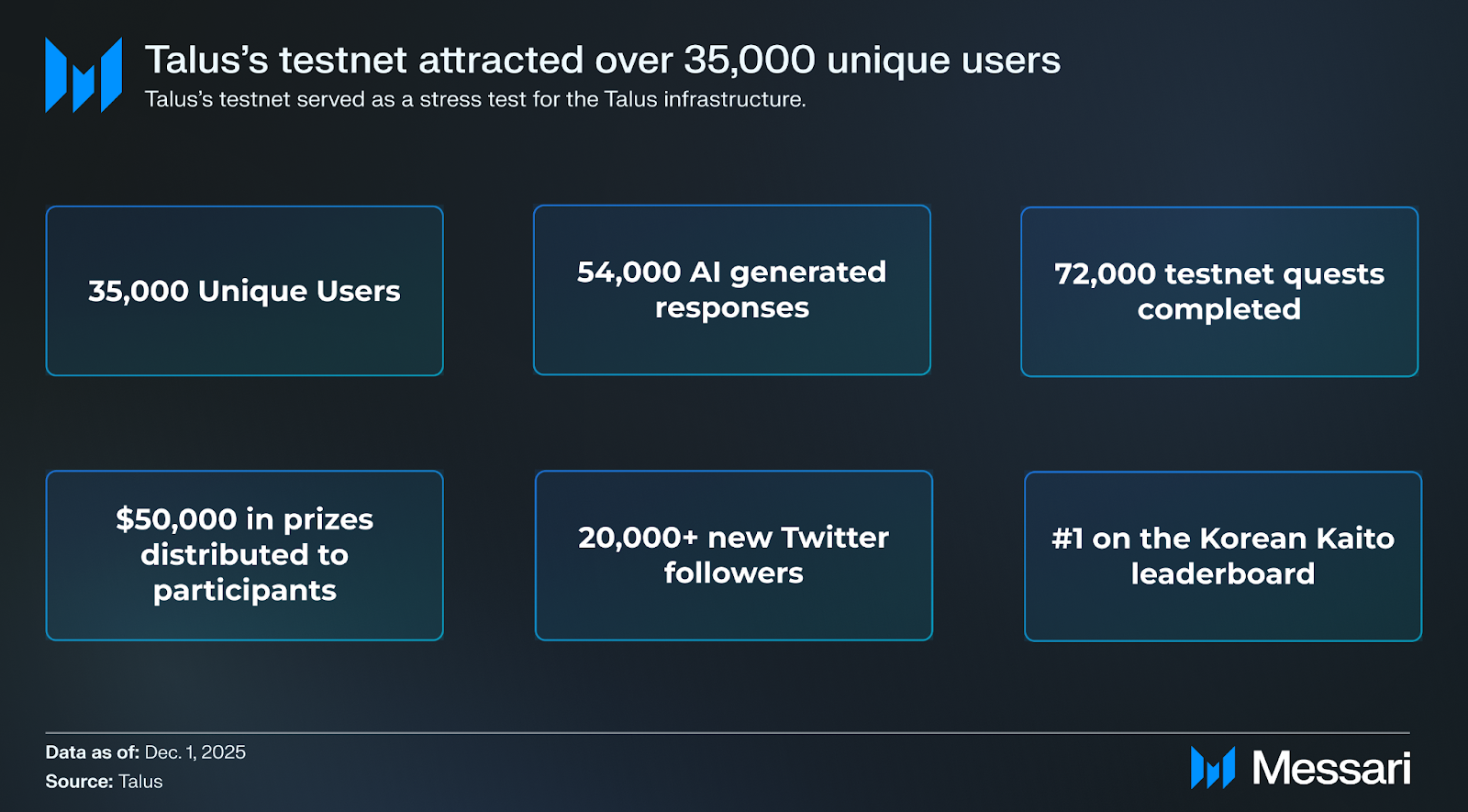
Talus launched their testnet in September 2025, with its feature product Idol.fun, which attracted over 35,000 unique verified users.
Introduction
The AI agent market is expected to grow 705.7% by 2030, from an estimated $5.3 billion to $42.7 billion. Around 80% of global companies that have adopted any form of digital automation utilize AI agents in some capacity, according to PWC, with two-thirds of those companies reporting “measurable” cost savings. Enterprises are adopting AI agents, but accountability remains a pitfall, and an estimated 45% of agent queries produce erroneous answers. Agent accountability is a requirement, and an auditable ledger is the ideal tool for enforcement.
The convergence of AI and blockchain technology has given rise to new paradigms in 2024–2025, as crypto projects seek to capitalize on the explosive growth of autonomous AI agents. The first iterations of this convergence lacked elegant monetization methods. Value accrual was not built into the associated token, resulting in price action more akin to a creator coin.
Past agent designs have also lacked security. While AI models continue to improve at minimizing hallucinations, the risk remains present. AI agents need tightly controlled permissions for managing digital assets. When an AI agent operates onchain, the only interface with the chain is through a wallet. The entire agentic workflow, along with the private keys for that wallet, is stored in a centralized database somewhere. Users have little to no transparency with these existing agents, sacrificing trust.
Talus Labs is a Decentralized AI (DeAI) infrastructure startup with a mission to “build a more democratic and efficient digital economy.” It aims to provide the missing infrastructure required to bring trust, transparency, and economic incentives to autonomous AI agents onchain, serving as the foundation for a digital economy. Talus Labs addresses a timely need. As AI “digital workers” become capable of real economic tasks, users and developers require a trust mechanism to verify agent actions and outcomes. By leveraging onchain and offchain resources when appropriate, Talus Labs posits that AI agents can evolve from black-box tools into independent economic entities with onchain accountability, and Talus is providing the infrastructure.
“Blockchain technology and artificial intelligence are the two most powerful technologies in the world today,” says Talus CSO and co-founder Ben Frigon. “Like much of web2, AI is in danger of being controlled by just a few powerful actors. Talus' mission is to ensure AI is accessible and controlled by the many, not just a select few.”
According to Talus Labs, one pain point is that existing versions of AI agents cannot monetize themselves; they often incur API or compute costs with no native revenue model. Talus proposes the Talus Network and Nexus to combat these limitations. Nexus provides the missing execution, coordination, and trust layer for autonomous AI agents, enabling the onboarding of AI services with optimized cost and performance tailored to user requests. This enables use cases such as creating environments where agents compete and earn rewards on behalf of their creators or token holders. By ensuring guaranteed, transparent execution and creating a unified coordination layer for autonomous systems, Talus Network provides the infrastructure required to facilitate an agentic economy with a thoughtful incentive structure that rewards infrastructure providers and users. As CEO and co-founder Mike Hanono explains, turning AI agents “from cost centers into revenue drivers” could redefine AI’s economic role, with Talus’ token, US, becoming the foundational asset capturing that value flow.
Sept. 2024: Talus was accepted into Google’s Cloud Program. This granted Talus access to Google’s state-of-the-art AI and machine learning tools, Google Cloud’s infrastructure, and direct support from Google’s AI experts.
Sept. 2024: Talus Network launched a demo of Nexus on Sui’s MoveVM, the world's first fully onchain agentic framework for autonomous AI agents.
Feb. 2025: Talus integrates the Sui Network for auditability, Walrus for offchain storage, and announces Idol.fun.
Apr. 2025: Talus launches the Devnet and releases the Nexus whitepaper detailing the developer toolkit for building fully onchain agents.
Talus Network emerged in 2023 as a blockchain platform dedicated to decentralizing access to artificial intelligence. Since then, it has adopted Sui Move as its primary stack for onchain tasks. Sui was chosen for its high throughput and parallel transaction processing, which are essential when multiple autonomous agents are interacting simultaneously.
Verifiable Agent Actions
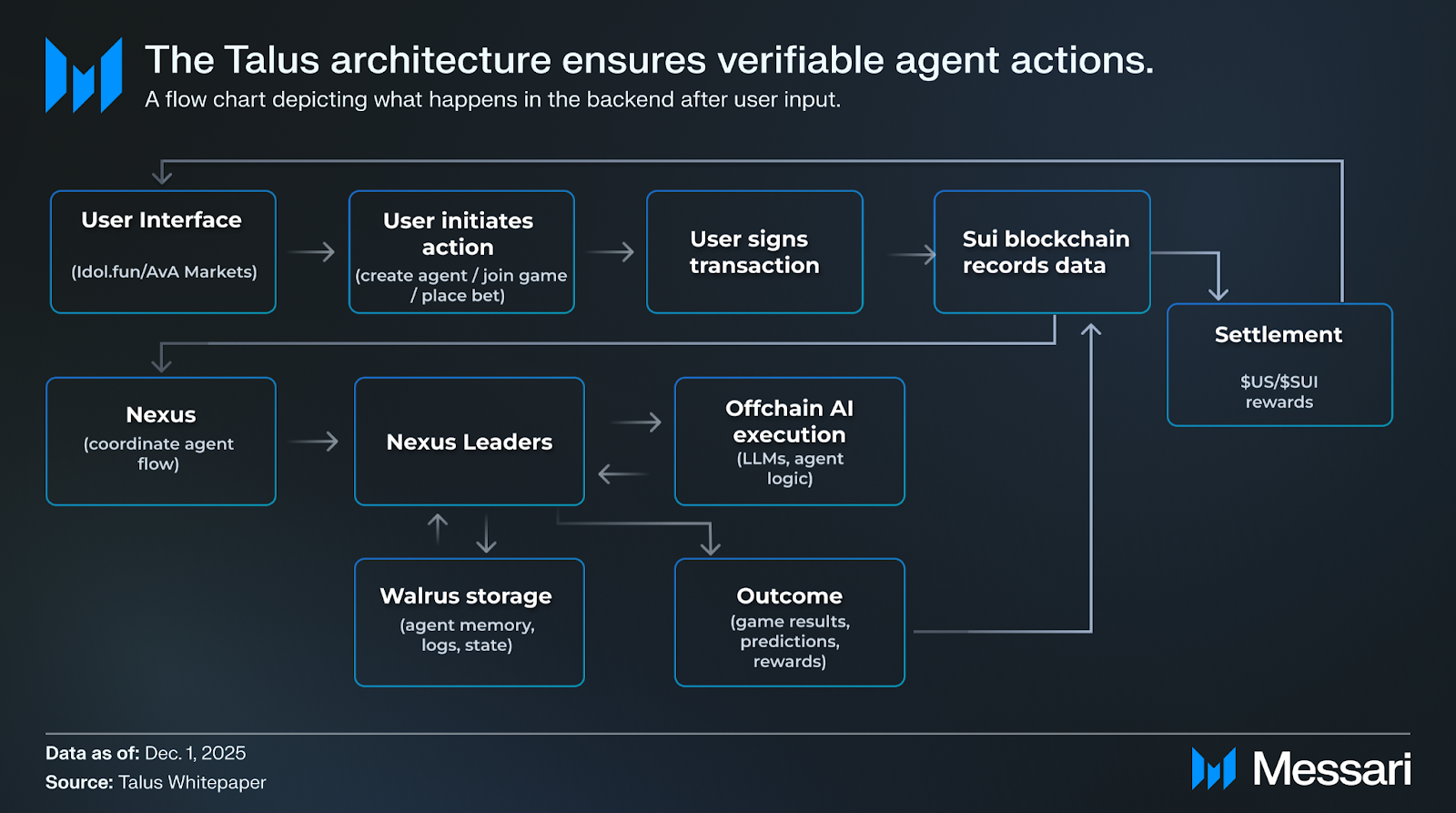
To address the shortcomings of existing centralized agents, Talus developed Nexus as the first framework for fully onchain agents. Nexus is a standardized onchain protocol that allows secure interoperability between AI services and onchain services. Nexus takes a tools-based approach to crafting agents, meaning developers have flexibility in how they craft AI tools and onchain services modularly through the protocol. Each component of an agent designed with Nexus can have independent verifiability and cost considerations. Nexus utilizes smart contracts to establish permissions for each module of the service, enabling transparent asset management in a trust-minimized manner.
Web2 and Web3 siloed agents have their respective advantages, but Talus takes the best of both worlds to deliver a cost-effective, decentralized, and composable agent infrastructure. Talus defines inputs and outputs for offchain services, including result verifiability, data transmission interfaces, and payment flows. This creates infrastructure that enables AI agents to share computing power, models, and intelligence without compromising on composability, asset management, and service quality.
Talus standardizes offchain computation and how it is triggered, coordinated, verified, and paid for by abstracting general data services as Talus Tools and structuring execution as Talus Workflows. This enables developers to utilize onchain and offchain processes with transparent coordination, while the Nexus Leader network autonomously executes these workflows around the clock. These leaders are held accountable by staking US tokens, which are slashed in the event of providing bad data or explicit failure to perform.
Talus Agents and The Talus Network
Beyond on and offchain synchronization is the need for a decentralized infrastructure that supports the autonomous handling of data, resources, and authority to call offchain resources when necessary. Talus achieves this through Talus Agents and The Talus Network. Talus Agents are shared entities that manage resources and delegation, while the network executes workflows in a trustless and permissionless manner as the coordination layer underpinning all agent activity. Talus uses the Sui Network to verify agent operations, manage their identities and state, and record outcomes of agent interactions. By having agent actions occur as onchain transactions, Talus ensures that AI behaviors are transparent and auditable in real time. Talus optimizes for high throughput and concurrency by leveraging Sui’s parallel execution engine, allowing multiple agents to run simultaneously without conflicts.
The infrastructure layer handles data ownership, workflow status, and the outcomes of competitions, as well as settlement, effectively serving as the brain and ledger for the autonomous AI economy. The synthesis of Nexus, Talus Agents, and the Talus Network enables democratized access to advanced technology without compromising security. All actions are verifiable onchain; there is no opaque point of trust or black box, and everything is cost-effective.
Nexus: Execution Layer
Nexus is Talus’ developer framework, enabling developers to build, coordinate, and monetize AI agents on the Talus Network. It is a decentralized agentic automation protocol akin to n8n or Zapier, but onchain. Nexus is the automation engine that orchestrates agent decisions and actions under the hood.
Nexus standardizes how AI functionalities transform into onchain services by providing modules and smart contracts for defining agent workflows, handling multi-agent coordination, and interfacing with offchain resources via the Nexus Leader system, which acts as an oracle bridging on and offchain tasks. For example, if two agents are to compete, the protocol will escrow any stakes, call out to offchain executors to run the agents’ logic, wait for their moves, verify any proof from the offchain compute, and then record the result onchain.
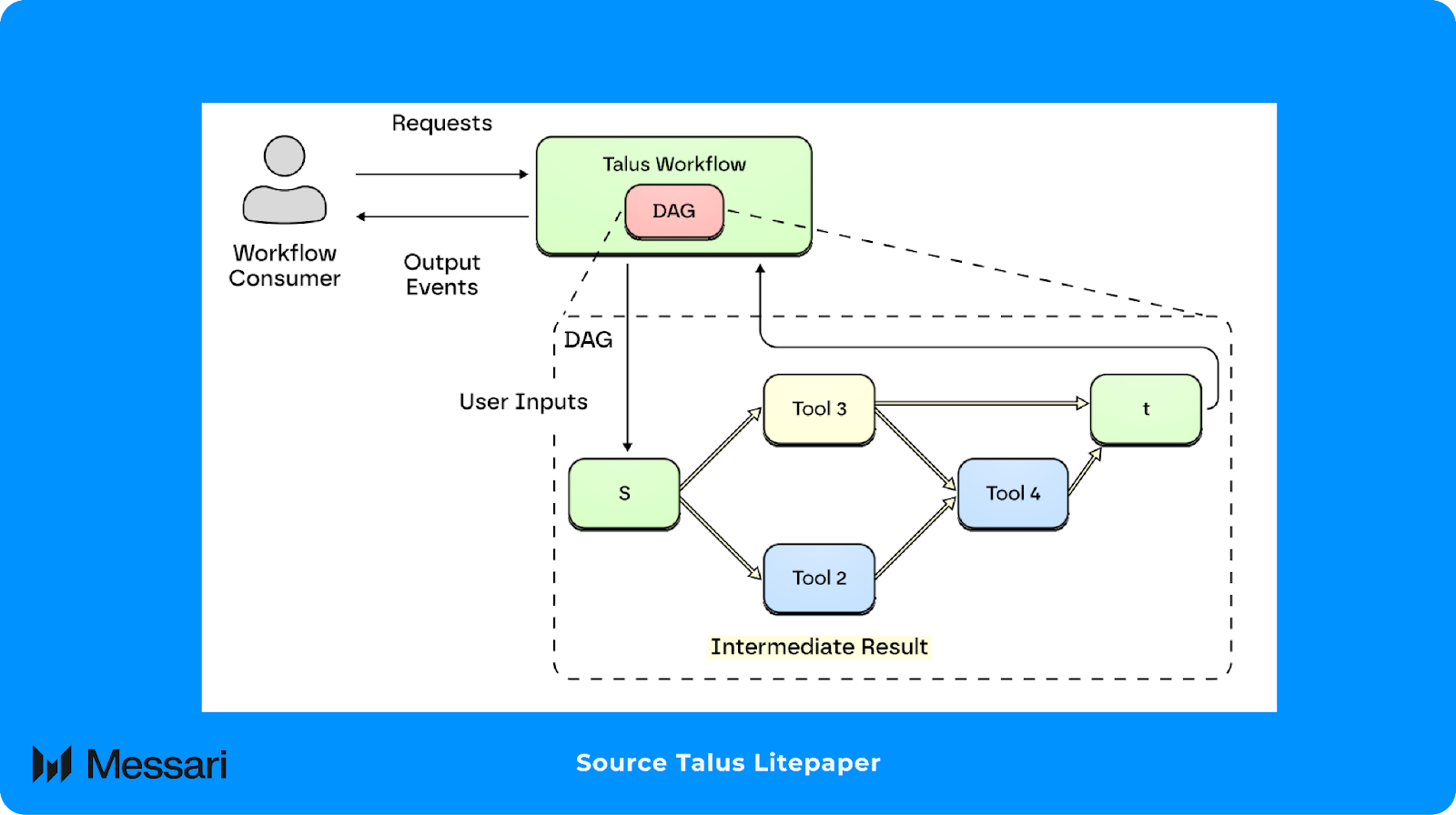
Talus Workflows can be thought of as blueprints and are technically Directed Acyclic Graphs (DAGs). DAGs optimize for efficiency due to their absence of loops and rigid paths, and should be thought of as step-by-step recipes. Talus Tools serve as the building blocks that initiate on and offchain tasks, such as token swaps (onchain) or calling an AI model (offchain). To create a workflow, developers define task sequences that are then stored onchain as smart contracts on the Sui Network. As these are completely onchain, workflows provide composability and allow developers to pick and choose workflows as building blocks for their custom agents.
When a workflow is deployed, the Nexus Leader nodes handle offchain activities and report the results onchain. Onchain fees are paid in SUI or US, and a portion of the fees is streamed to the tool creator, the Talus Foundation, and US stakers. This permissionless approach binds all the different parts of Talus into one digital economy: the nexus.
Developer Economy
Nexus defines standard interfaces for these workflows, streamlining the process for developers to contribute to Nexus modules. Talus structures its agentic ecosystem around three interdependent economic layers: the Tool Marketplace, Agent Marketplace, and Agent-as-a-Service (AaaS) framework, each building on the last. Together, these layers form the economy that allows Talus to scale decentralized automation, create durable network effects, and support a new class of autonomous economic actors.
Tool Marketplace
Nexus has its own dedicated tool registry, the Tool Marketplace. This serves as the protocol’s base-layer economy, enabling developers to publish and monetize modular tools built on Nexus. These tools range from general-purpose functions, such as cost-efficient LLM access, to specialized Web3 modules. They are the atomic units of capability that agents depend on to execute tasks. Each new tool increases the functional breadth of the agent ecosystem, compounding network effects as more workflows rely on a growing library of modules.
Tool execution is monetized on a per-workflow basis, establishing a recurring revenue stream for developers and encouraging continuous improvement. The delivery-versus-payment mechanism ensures secure, decentralized settlement between tool providers and agents, reducing coordination overhead and enabling a permissionless supply side of innovation.
Agent Marketplace
The Agent Marketplace is where developers package tools into fully autonomous agents that users interact with directly. These agents function as decentralized services capable of executing personalized, intent-driven workflows, such as algorithmic trading, account automation, or DeFi strategy execution.
Developers can identify market needs and build niche, high-performance agents tailored to specific use cases. This mirrors the specialization curve seen in Web3 protocols but applied to autonomous workflows.
Agents-as-a-Service
The tools and agent marketplaces enable developers to deploy Agents-as-a-Service, where an AI agent or workflow is offered as a service to enhance existing decentralized applications (dApps).
This modular design enables the addition of new AI capabilities (e.g., an image recognition module or a trading strategy module) to the Talus ecosystem as onchain services that agents can call at any time. The framework supports agentic workflows, which are multi-agent, multi-step protocols (where one agent’s output becomes another’s input, etc.), that enable complex scenarios. By standardizing how these interactions occur and how offchain components are invoked, Talus has positioned Nexus as the auction house for decentralized AI automation.
Testnet
Talus launched its public testnet in Sept. 2025 with $125k in incentives for participants. The testnet was the first public exhibition of AI agents built with Nexus. Over 35,000 unique users participated in the Nexus testnet, with over 72,000 tasks completed in the testnet task center, showcasing Nexus’ ability to perform under load. The Talus team also introduced a Community Hub and loyalty program during testnet, where participants earned points and Tallys NFTs.
Ecosystem Applications
While Nexus offers broad, horizontal infrastructure value, infrastructure alone does not bootstrap an ecosystem. Talus needs flagship applications that demonstrate real, engaging use cases and attract developers, users, and attention. Talus Vision and Agent vs. Agent (AvA) Games, starting with Idol.fun, are designed to do just that by immediately providing usable experiences that utilize all aspects of Talus’ suite, while acting as stress tests for the infrastructure.
Talus Vision
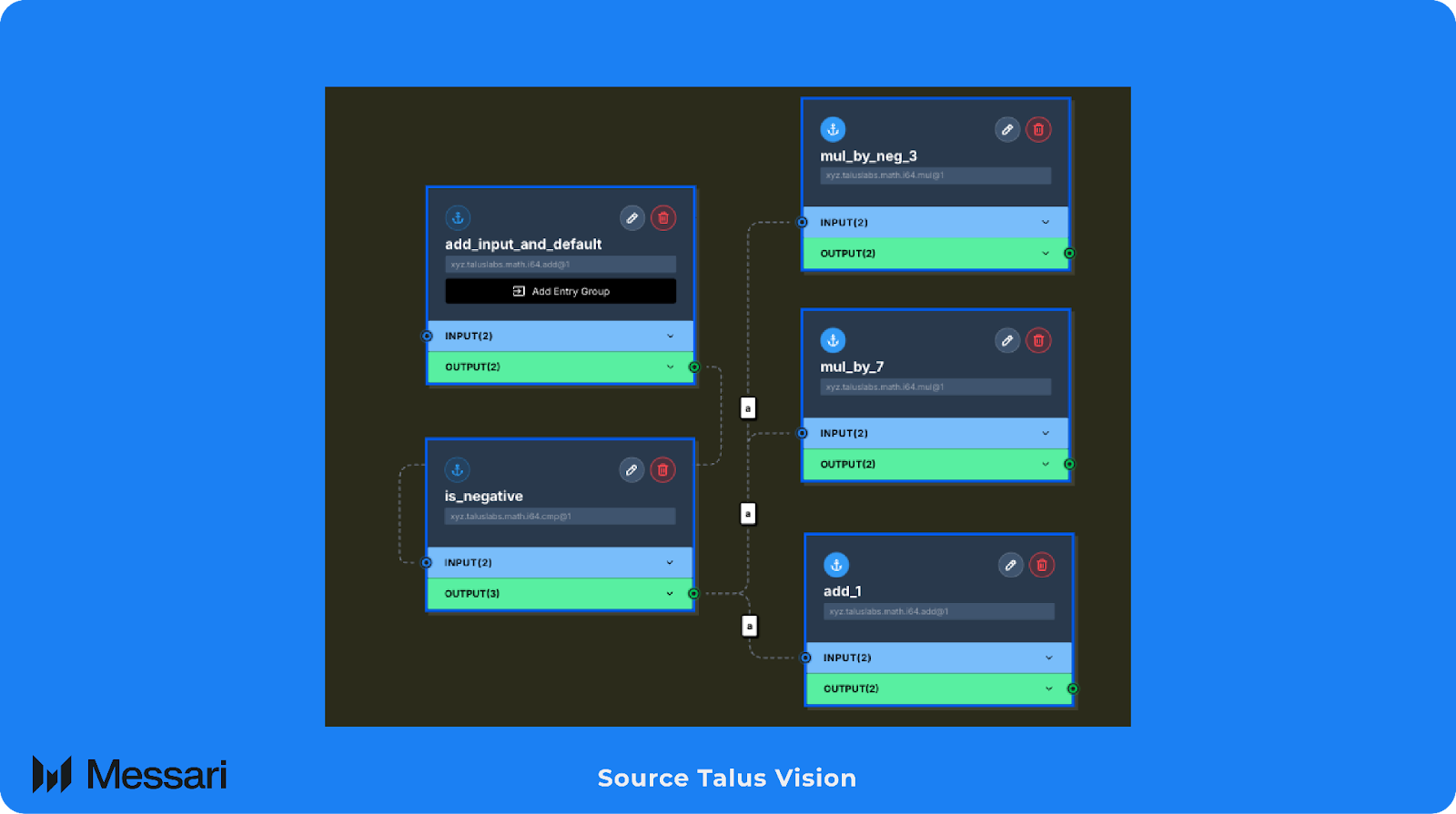
Talus launched Talus Vision in Nov. 2025, a graphical low-code workflow builder for the ecosystem. Talus Vision offers a user-friendly drag-and-drop interface for visually creating agent workflows and deploying them onchain. This can lower the barrier to entry for building with Talus, attracting not just blockchain engineers but AI enthusiasts who prefer a low-code environment. In the long run, Talus Vision could even allow end-users to craft custom agent behaviors or mash-ups of existing agents without writing code. With Vision, users can choose a blank workflow, quickstart template, or browse previous templates created by users to start their first workflow.
Idol.fun
Talus introduces Idol.fun as an incubation serving as a distribution platform to support AvA games and markets. This is a new category of Web3 speculation where AI agents compete in transparent, verifiable onchain battles. Users wager on these outcomes through speculation markets, rather than speculating on liquid tokens, which offer immutability, auditability, and freedom from insider manipulation. Speculators maintain the ability to engage in high-stakes games without the risk of rug pulls. With peak memecoin mania in the past, speculators are likely looking for a new game, and Talus’ AvA approach could capture some of that volume.
To build an AvA Game, developers need four essential components: decentralized automation (Nexus), a distribution platform to host and surface their games (Idol.fun), engaging AI agents (Idol Agents), and a built-in monetization mechanism. Talus has made all of this possible.
Idol.fun rolled out alongside the testnet as the first consumer-facing app built on Talus. Idol.fun complements the Talus ecosystem by creating consumer demand for the protocol and by showcasing what unique use cases can be built on top of it, enabling users to launch their own AI agents to compete in AvA games. Talus kicked this off with the Idol Agents competition. Three personality agent idols were launched using Nexus, and participants directed these agents to interact with viral posts on X, winning prizes when the original poster responded to the agents.
This served as both an engaging user-facing game and a stress test for Talus’ infrastructure. Outside of user engagement, Talus leveraged the traffic from the competition to verify that its protocol could handle rapid agent interactions and that outcomes remained verifiable. The team allocated $50k to incentivize participation in the Idol Agents competition. The competition had over 10,000 participants, generating more than 54,000 AI responses.
Partnerships
Mysten Labs: Beyond their investments in Talus, Mysten is also providing technical collaboration. The use of Sui and Walrus keeps Talus closely aligned with Mysten’s ecosystem, and the Sui team has publicly highlighted Talus as a flagship product for the next wave of onchain AI use cases. Talus Labs CEO Michael Hanonobelieves these partnerships “accelerate the next phase of onchain AI,” as they allow for the complete integration of Sui’s infrastructure with Talus’ Nexus protocol.
Allora: Talus partnered with Allora on Nov. 19, 2025. Allora offers self-improving synthesis for Talus’ Network, presenting new facilities for autonomous agents. Its network connects independent machine learning models to form a self-improving system of connected models. By leveraging Allora, Talus plans to integrate it with Nexus, providing developers with another tool for developing agents.
Lagrange (DeepProve zkML): Added to Talus’ offchain execution layer in Oct. 2025, Talus tackles AI trust issues through zero-knowledge proofs. Lagrange’s DeepProve library will be used to generate zk-proofs for verifying AI agent behavior, aiming to maintain a speculative game with no manipulation or hallucination. If an agent claims it accomplished something, the zk-proof is there to confirm. The partnership is still in a proof-of-concept stage, with the teams focusing on integrating DeepProve’s functionality, with the intention of releasing verifiable workflows in AvA markets.
Sentient: In Oct. 2025, Talus partnered with Sentient to increase distribution to Sentient’s three million+ users. Sentient is a decentralized protocol building an open and community-built AGI network. The goal of the partnership is to integrate Talus’ onchain agents into Sentient’s AgentHub and chat applications, and increase Talus’ exposure to mainstream AI communities outside of Web3.
US Tokenomics
Talus’ native token, US, lies at the heart of its incentive structure and decentralization strategy. Designed as the currency of the ecosystem, US aligns the interests of users, developers, and node operators in the Talus Network.
US has a fixed total supply of 10.0 billion tokens with 0% inflation. The token follows a deflationary model through a novel dual-track protocol income system. When revenue falls below a threshold set by the protocol, income from priority fees is burned to reduce the circulating supply of the token. When revenue exceeds that threshold, fees are distributed to Nexus Leaders, who are responsible for scheduling and verifying workflows.
Utility
US is the “coordination asset”, designed to function as the primary fee and payment token. Users who wish to deploy AI agents or execute workflows through Nexus pay in US to prioritize execution or to access higher tiers of trusted computing services. Within the Talus ecosystem, all activity ultimately settles through US.
Because Talus is built on Sui, base layer transaction fees are still paid in SUI; however, Talus’ design routes external value into US by automatically converting a portion of the gas fees into US on the open market. In addition to gas and priority fees, Talus has baked in demand for US with the following utility:
Developers earn US when their Talus Tools on the Tool Marketplace are called, or agents on the Agent Marketplace are invoked.
Nexus Leaders post US as collateral to secure the network. Additionally, Leaders receive US for good behavior or have their stake slashed for bad behavior.
Locking US within the LRP prior to staking going live.
Governance privileges
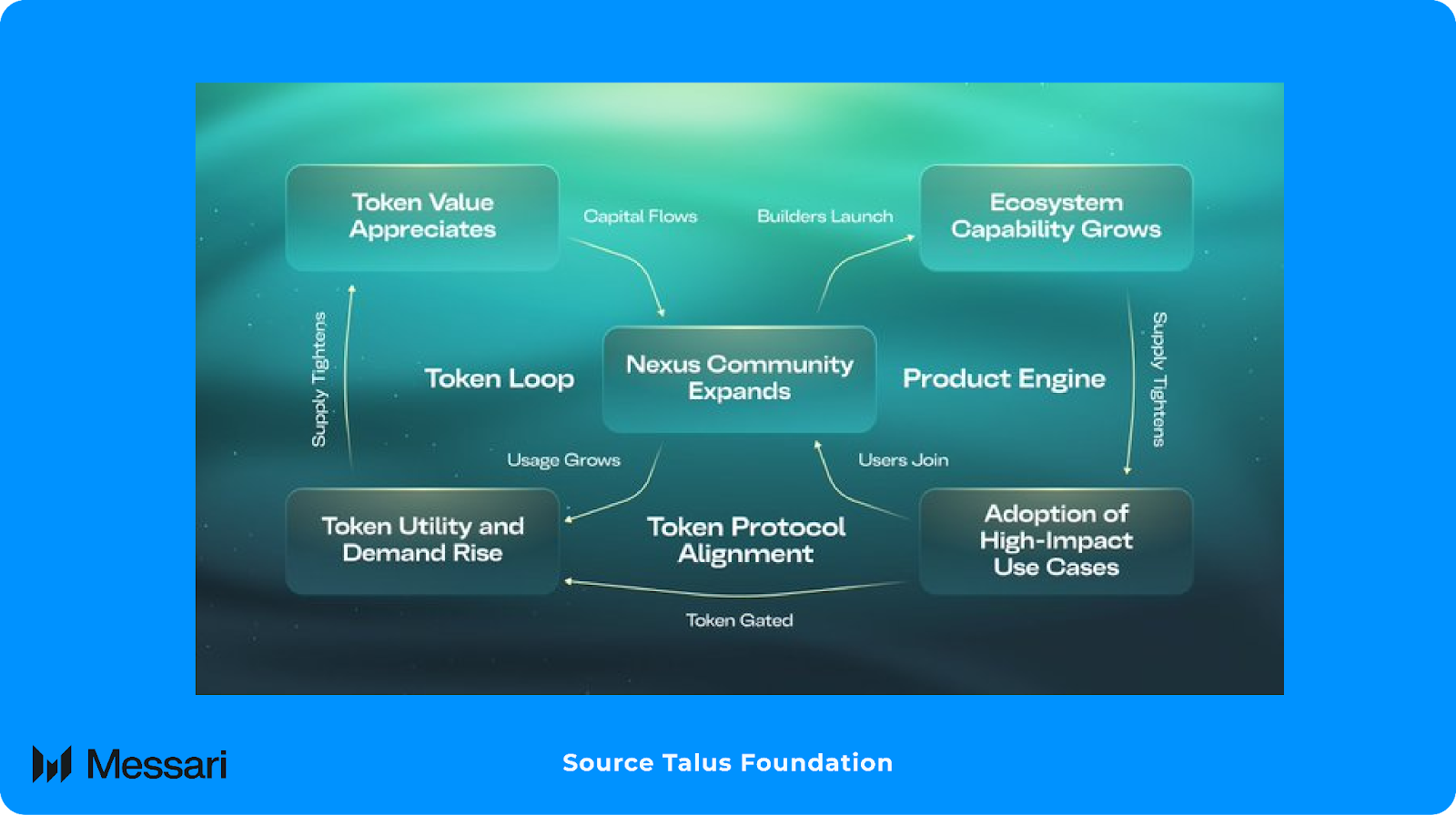
Talus implemented a thoughtful flywheel for the US token, avoiding inflationary mechanics. US is required at every corner of the ecosystem, which facilitates organic demand. Every application, workflow, agent, transaction, and integration increases the demand for US. The more the ecosystem is adopted, the greater the demand for the token, and the more value US accrues.
Finally, Talus’ token design incorporates explicit mechanisms to bootstrap early usage and then gradually tighten effective supply. One key feature is the Nexus Subsidy program. In the early stages of the network, users who spend gas on Talus workflows can receive a portion of those fees back in US, turning initial usage into a subsidized experience and incentivizing experimentation. This subsidy is funded from a reserve pool and is designed to taper as organic demand grows, a common bootstrapping strategy in crypto networks, complemented by the LRP. Users who lock US to help secure the network before it is fully decentralized can earn additional rewards from a temporary pool, encouraging early security provision when the protocol may still be more reliant on a smaller set of actors. Both programs distribute tokens to active users and contributors, helping seed broad token ownership.
Supply and Distribution
Community and Ecosystem
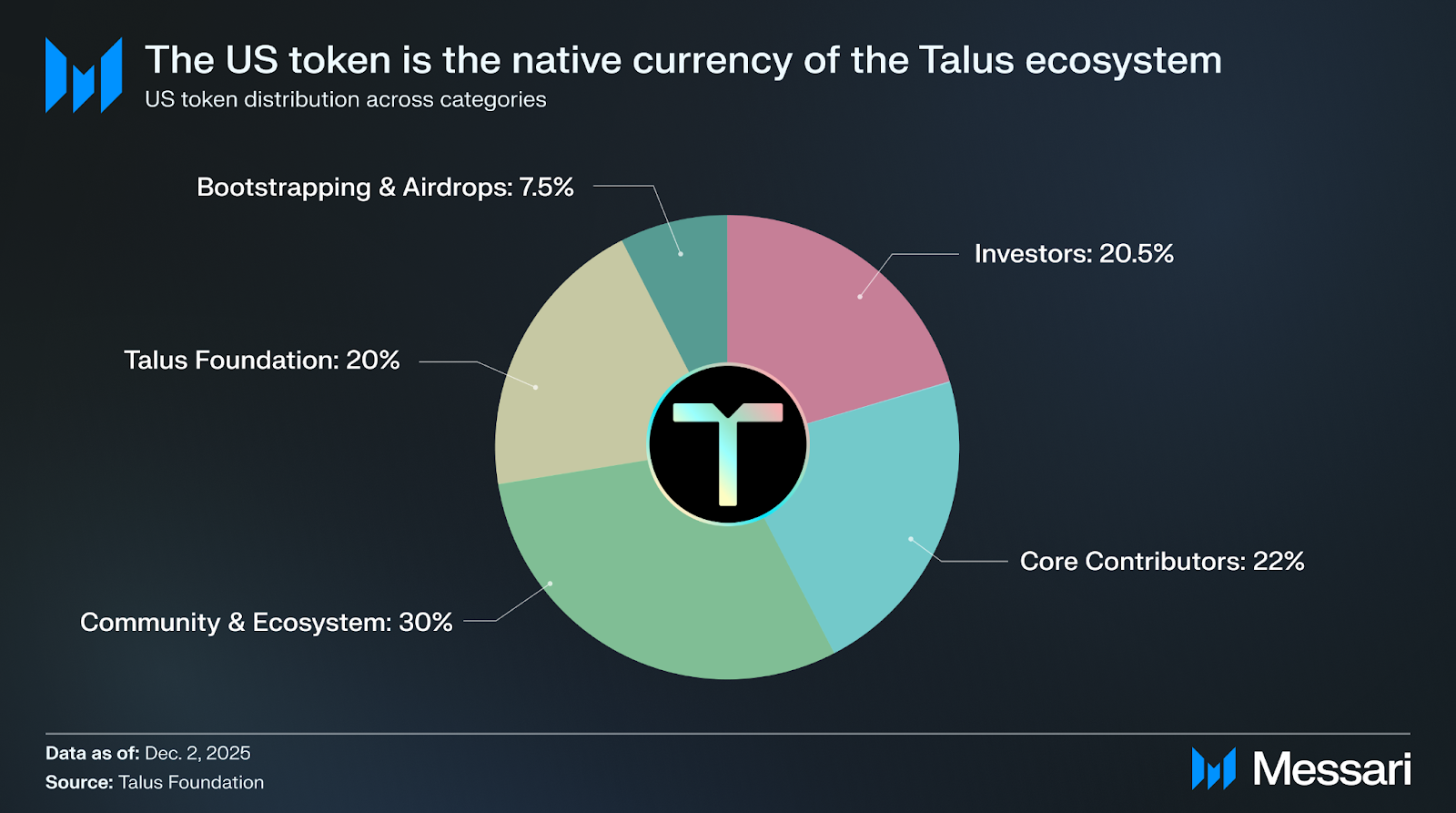
30% of the token is allocated to the Community and Ecosystem for the following:
Nexus Subsidy Program
Developer Grants
Tool onboarding incentives
Community and DAO initiatives
Public-goods infrastructure
Security audits and open-source contributions
DEX and CEX liquidity
Talus Foundation
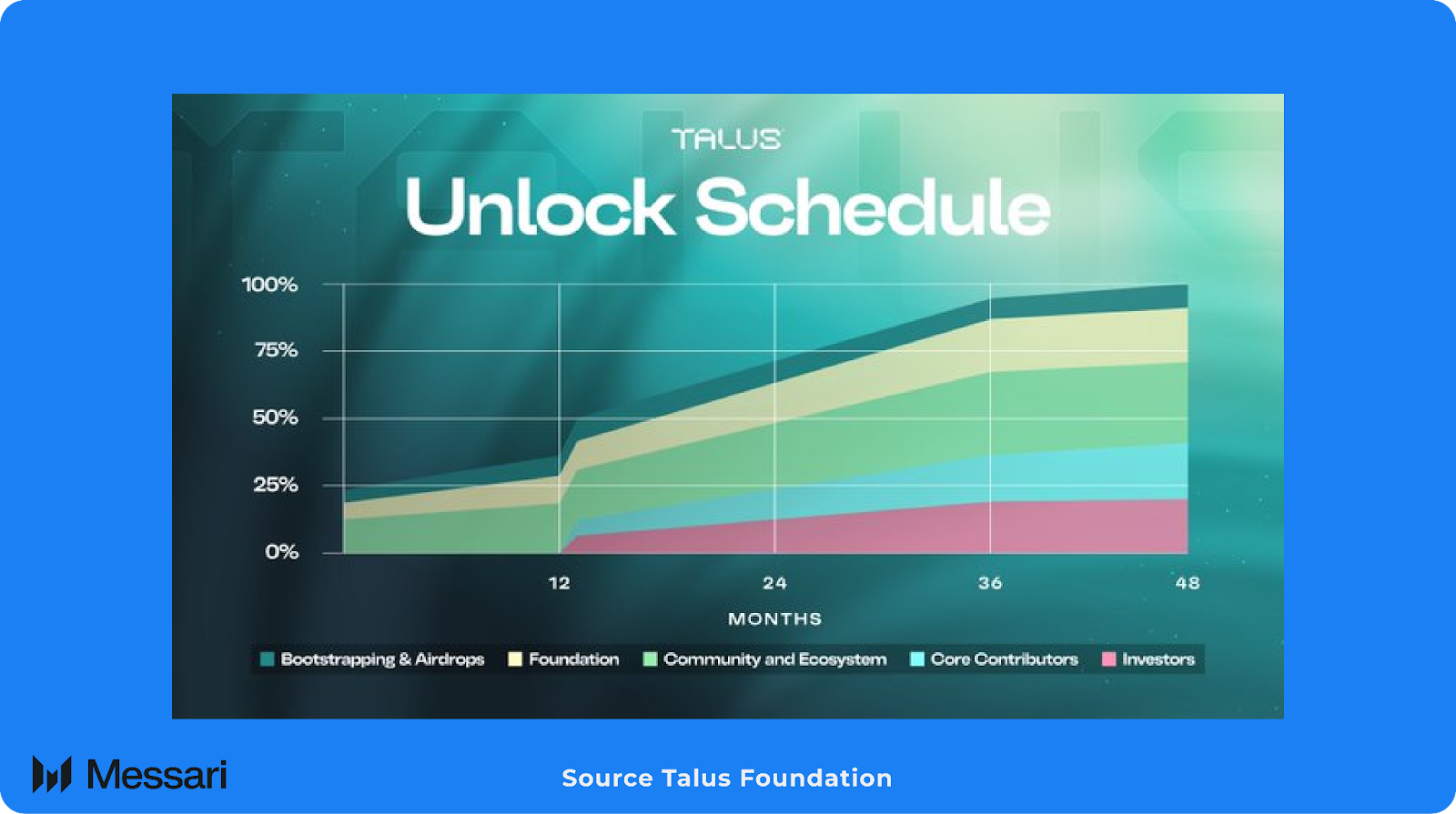
20% of the token is allocated to the Talus Foundation for efforts involving global expansion, protocol readiness, and Leader network decentralization incentives. A small portion will be unlocked on day 1, with the rest unlocking linearly over a 36-month period.
Investors
20.5% of the token is allocated to investors with 0% immediately available, a 12-month cliff, and 24-month linear vesting.
Core Contributors
22% of the token is allocated to core contributors of the infrastructure, with 0% circulating after the Token Generation Event (TGE), a 12-month cliff, and a 36-month linear vesting period.
Bootstrapping and Airdrop Programs
7.5% of the token is allocated to the TGE airdrop, Loyalty Reward Program (LRP), and future campaigns tied to the Nexus Mainnet launch. Any unclaimed tokens remain dedicated to community initiatives.
Closing Summary
Talus provides a generalized execution and coordination layer, along with its infrastructure, to serve as the foundation for an entire digital economy. Nexus does not prescribe specific use cases; instead, it enables any automated workflow. These can range from LLM-powered data processing to DeFi strategy execution to consumer gaming logic. It exposes tools, agents, and agent services as composable primitives that are usable, flexible, and capable. As these tools can be reused by multiple agents and services, each new component increases optionality and thus the network matures. What’s being built here can have similar network effects to those seen in Amazon’s Web Services in cloud computing, Hugging Face with model hubs, and Stripe in payments, except that Talus is doing this in a decentralized, agentic environment. This makes it an infrastructural substrate for the next generation of internet-native automation.
At the core of this architecture is a commitment to verifiable and trust-minimized automation. Talus replaces opaque, centralized AI execution with a deterministic, cryptographically secured environment where agent behavior can be audited, validated, and depended upon. This ensures integrity across workflows, enabling coordination between autonomous systems without relying on trust in any individual actor or intermediary. In doing so, Talus introduces a level of reliability and transparency that is essential for scaling autonomous agent activity across high-stakes, multi-party environments.
As more developers deploy agents, integrate tools, and build automation pipelines on Talus, the protocol becomes the foundation for a new class of decentralized software ecosystems. Its open, programmable, and composable design encourages innovation at the edges, allowing teams to create specialized agents, shared services, and complex workflows that interoperate natively. The result is a network where autonomy compounds, and each addition strengthens the broader system, expanding what can be built upon it.
This report was commissioned by Talus Labs. All content was produced independently by the author(s) and does not necessarily reflect the opinions of Messari, Inc. or the organization that requested the report. The commissioning organization may have input on the content of the report, but Messari maintains editorial control over the final report to retain data accuracy and objectivity. Author(s) may hold cryptocurrencies named in this report. This report is meant for informational purposes only. It is not meant to serve as investment advice. You should conduct your own research and consult an independent financial, tax, or legal advisor before making any investment decisions. Past performance of any asset is not indicative of future results. Please see our Terms of Service for more information.
No part of this report may be (a) copied, photocopied, duplicated in any form by any means or (b) redistributed without the prior written consent of Messari®.
Dillon is a Research Analyst on the Protocol Research team. He previously worked as an Automation/Mechatronics Engineer at Flex, Nike, and Target after graduating with a BSE in Mechanical Engineering from the University of Michigan - Ann Arbor. While he has maintained an interest in robotics, his interests lie in DeAI, privacy, prediction markets, and, more recently, quantum computing.
Dillon is a Research Analyst on the Protocol Research team. He previously worked as an Automation/Mechatronics Engineer at Flex, Nike, and Target after graduating with a BSE in Mechanical Engineering from the University of Michigan - Ann Arbor. While he has maintained an interest in robotics, his interests lie in DeAI, privacy, prediction markets, and, more recently, quantum computing.