Starpower raised $4.5 million across two rounds, led by Alliance DAO, Framework, and Solana Ventures.
Starpower has shown early signs of traction, with over 1 million connected devices and 1 million application users across approximately 792 cities worldwide.
In March 2025, Nature Nanotechnology accepted a paper co-authored by the Starpower team, highlighting its DeSci-driven battery research and work on next-generation storage for AI and compute.
The Genesis Airdrop distributed 30 million STAR tokens to early users, paving the way for Starpower’s mainnet, which transitions the network to live energy coordination and full token utility.
Introduction
Global energy systems are evolving to meet rising electricity demand, driven by growing urbanization, increased electrification, and the computational needs of AI and digital infrastructure. In response, the adoption of renewable energy sources like solar and wind has accelerated, and distributed energy resources (DERs), such as home batteries, electric vehicles, and smart appliances, are becoming more common in households and businesses.
However, renewables introduce a key challenge: intermittency. Their variable output makes it difficult to maintain a stable energy supply, placing stress on existing grid infrastructure. Meanwhile, DERs remain largely underutilized due to the lack of real-time coordination systems and meaningful incentives for participation in grid services.
Starpower addresses this gap by creating a decentralized energy network that enables connected devices to operate as part of a Virtual Power Plant (VPP). By combining smart hardware, AI-driven energy management, and blockchain-based incentives on Solana, Starpower allows users to monitor, optimize, and contribute energy resources in response to grid needs. This approach helps stabilize renewable-heavy energy systems while giving users tangible rewards for their participation, offering a scalable and incentive-aligned solution to a growing global energy challenge.
Research Contents
Background
Starpower was founded in 2023 by Laser Ding and Dr. Darcy Jia, who combine deep expertise in energy systems, blockchain, and IoT. Ding, formerly Chairman Assistant at HashKey Group and an early Ethereum investor, has a background in DePIN-focused startups. Dr. Jia holds a dual PhD in Photovoltaics and Computer Science and brings experience in renewable energy research and systems design. The company is headquartered in Singapore.
Starpower was created to address growing challenges in the global energy transition, particularly grid instability and the inefficiencies in managing distributed energy resources (DERs). The team envisioned a decentralized energy network where everyday devices, like EVs, batteries, and home appliances, could help balance the grid and earn crypto incentives in return.
The company’s first product, the Starplug, enabled users to connect household appliances to its decentralized energy network. In 2024, Starpower was selected to join the Alliance DAO accelerator, a leading Web3 startup program. After graduating from the cohort, the team launched its Genesis Airdrop Campaign, distributing 30 million STAR tokens to early users, testnet participants, and Pioneer Pass NFT holders.
Technologically, Starpower is rooted in DeSci-driven battery innovation and is building a DePIN-based global energy network with deployments across Australia and Europe. Its integration with Solana mainnet enables real-time energy tracking and onchain coordination, forming a crypto-native Virtual Power Plant (VPP) foundation.
Technology
Rising Energy Demand and the Limitations of Renewable Sources
Global electricity demand is surging. As of 2024, electricity consumption has grown by approximately 4%YoY, fueled by industrial expansion, urbanization, and the increasing digitalization of modern life. A key driver of this trend is artificial intelligence (AI), which requires massive computational power. According to McKinsey, electricity demand from AI is expected to grow by 18% by 2050 in a slow-evolution scenario—placing significant pressure on already stressed energy systems.
Meanwhile, the global energy mix is undergoing a rapid transition. Efforts to reduce carbon emissions have accelerated the adoption of renewable energy sources such as solar, wind, and hydro. These are expected to grow by 90% between 2023 and 2030. However, renewables bring a fundamental challenge: intermittency. Unlike fossil fuel plants that provide consistent power output, renewable generation depends on environmental conditions—solar energy, for instance, is only available during the day, and wind varies with weather. This variability contributes to grid instability, energy supply gaps, and even power outages.
Starpower’s approach: stabilizing renewable energy through decentralization
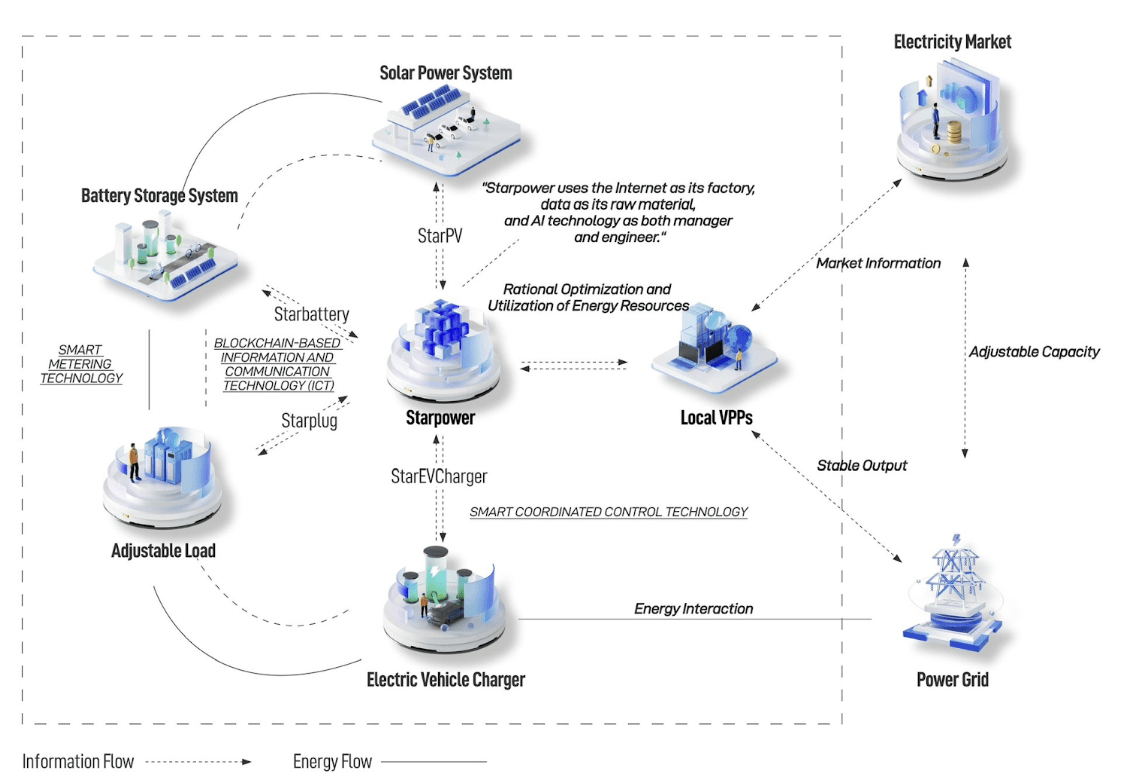
To address the volatility of renewable energy and the growing electricity demand, Starpower introduces a decentralized energy coordination model. It connects distributed energy resources (DERs)—home batteries, electric vehicles (EVs), and smart appliances—into a single, software-managed ecosystem. Rather than building centralized infrastructure, Starpower enables these decentralized assets to function collectively as a Virtual Power Plant (VPP), responding in real-time to fluctuations in energy supply and demand.
Starpower operates as a multistack protocol, combining smart hardware and AI-driven software to build a decentralized, data-driven energy network on the Solana blockchain. Starpower addresses residential and commercial energy needs by intelligently coordinating the use of DERs. The system comprises the following core components:
Hardware layer: Devices such as smart plugs, EV chargers, and home storage batteries are connected to the network. These devices become active participants in the system, capable of storing, consuming, or discharging electricity as needed.
Software layer: Starpower’s software functions as the coordination engine. It aggregates device-level data, applies AI algorithms to optimize energy usage patterns, and manages system-wide scheduling and demand response. It also facilitates data monetization and device-level incentives through STAR tokens.
Energy Aggregation Starpower connects and aggregates various smart energy devices, such as home batteries, EV chargers, and smart plugs, into a distributed energy network. These devices can store excess energy during periods of high renewable energy production (e.g., midday for solar) and release it when demand increases, helping to stabilize the grid.
Grid Balancing & Demand Response Starpower coordinates the operation of energy-consuming devices—such as air conditioners and water heaters—to help reduce peak demand. This prevents grid overloads and supports grid stability. During periods of grid stress, participating users can temporarily adjust the usage of their devices in exchange for rewards (paid in STAR tokens).
Decentralized Energy Storage & Distribution Rather than relying on large-scale, costly battery farms, Starpower leverages decentralized storage resources (such as home batteries and electric vehicles). These devices store cheaper electricity during off-peak hours or excess solar energy and distribute it back to the grid when demand is high, contributing to grid stability.
Blockchain for Transparency & Incentives All transactions and energy contributions are recorded on the blockchain, ensuring transparency and trust. Participants who contribute to grid stability earn STAR tokens, which can be used within the ecosystem for other services or traded on exchanges.
Residential Use Case
Starpower offers hardware kits—such as Starplug, Starbattery, and Starcharger—that connect common household devices to the network. Through its dApp, users can monitor energy consumption, schedule device operations, and receive AI-powered suggestions to improve efficiency and reduce electricity costs. In addition, users can choose to share anonymized device data with grid partners to contribute to broader energy coordination and infrastructure planning.
In future releases, Starpower will expand support to energy-storing devices, including EV batteries and solar panels, enabling bidirectional coordination—managing both energy consumption and energy supply. This will allow users to not only optimize energy usage but also contribute stored energy back to the grid during peak periods.
Commercial Integration
Beyond residential use, Starpower integrates directly with energy manufacturers and infrastructure providers through API-level software connections. It acts as a communication and optimization layer between DERs and regional power systems, enabling commercial-scale deployment of decentralized energy management solutions.
The long-term goal of Starpower is to operate as a global Virtual Power Plant. By integrating millions of distributed energy devices into a coordinated system, Starpower aims to enhance grid resilience, reduce system-wide costs, and support the shift toward a zero-carbon energy economy.
The Dual Benefit of Starpower: Energy Efficiency & Crypto Integration
Starpower’s integration of DePIN brings a two-fold advantage. First, it enhances energy efficiency by optimizing when and how renewable energy is stored, consumed, and redistributed across the network. Second, it introduces a crypto-native incentive layer—users who help stabilize the grid by contributing their energy resources are rewarded with STAR tokens. Unlike ecosystems that rely on token ownership for participation, Starpower uses its token as an incentive mechanism rather than an access gate. This design lowers the barrier to entry, broadens involvement, and ties rewards to accurate energy contributions.
Whether motivated by reducing energy costs, improving grid efficiency, or simply earning crypto, participants in Starpower become active contributors to a decentralized, energy-efficient future.
Starpower: Products and Services Overview
Starpower delivers a full-stack solution for decentralized energy coordination by offering a combination of hardware devices, software integrations, and energy services. These components work together in a network that can intelligently manage energy consumption, optimize storage, and support grid stability while rewarding users through an incentive layer.
1. Hardware Devices
Starpower manufactures and supports a suite of smart energy devices that integrate directly with its decentralized platform. These devices help users monitor, control, and optimize energy use in real-time while contributing to the broader energy network.
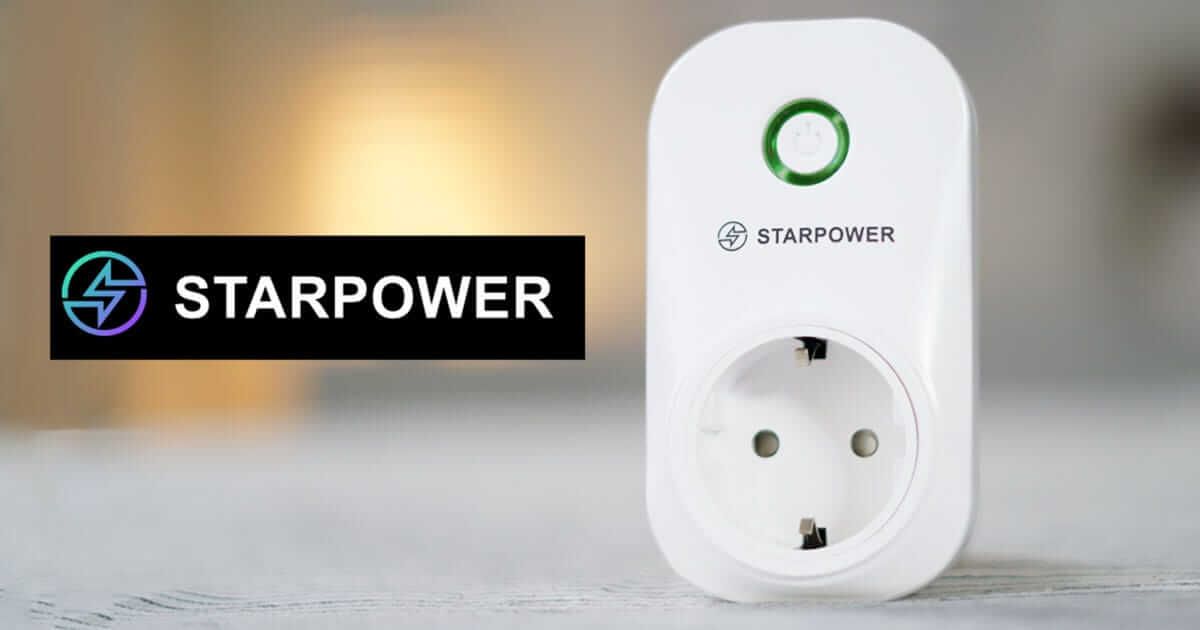
The StarPlug is a plug-and-play smart outlet connecting directly to household appliances, enabling real-time energy monitoring, remote control, and optimization of usage. The Starpower app allows users to track electricity consumption, schedule appliance operations during off-peak hours, and reduce energy costs. Designed for everyday devices and higher-load equipment like crypto mining rigs, the StarPlug supports up to 1400W. Its seamless integration into the Starpower network allows users to participate in grid balancing and earn rewards in the form of tStar tokens based on their efficiency and device performance.
StarBattery is currently in development. It is a home energy storage unit designed to capture surplus electricity from solar panels or low-cost grid energy and store it for later use. Enabling load shifting and energy dispatch during peak hours helps users lower bills, increase energy independence, and return stored power to the grid through Starpower’s virtual power plant coordination. It also acts as a backup power source in case of outages and will be fully integrated into the Starpower ecosystem for automated management and token rewards.
The StarCharger, also in testing, is a smart EV charging unit built to manage charging cycles based on grid demand and electricity pricing. It automatically schedules charging during off-peak hours to reduce energy costs. It will allow bi-directional energy flow in future iterations, effectively turning EV batteries into mobile energy storage nodes. Like other devices, the Starcharger connects to the Starpower app for real-time control and monitoring, and its integration into the broader DePIN network allows EV owners to contribute to grid stability and earn rewards in the process.
2. Software Integration
Beyond its proprietary hardware, Starpower is building software integrations with major energy manufacturers, including Tesla and BYD, using open APIs to connect third-party batteries, EVs, and other energy devices. These integrations allow users to manage supported external hardware through the Starpower app without buying new devices. This approach expands compatibility across a wide range of home and commercial systems while maintaining a consistent user interface and reward mechanism across the platform.
At the platform level, the Starpower app and dApp serve as the unified hub for onboarding devices, analyzing energy usage, managing schedules, and tracking rewards. Users can access dashboards that provide insights into consumption patterns, control all connected hardware remotely, and participate in demand response or energy-saving programs. The app also tracks earnings from the incentive layer—tStar and Nova tokens during the testnet phase and STAR tokens after mainnet launch—allowing users to monitor and optimize their returns in real-time.
Besides consumer tools, Starpower offers energy services to grid operators and utilities through a SaaS layer. These services include real-time demand response coordination, decentralized virtual power plant (VPP) aggregation, and predictive analytics for energy efficiency. To operate effectively, a mature VPP typically requires aggregating a critical mass of Distributed Energy Resources (DERs). However, traditional VPP operators may encounter difficulties achieving this scale due to limited or suboptimal incentive structures for participant engagement. In response, there has been increased interest in third-party aggregators incorporating token-based incentive models to encourage DER participation. One such example is Starpower, which functions as a middleware layer connecting DERs with centralized grids. This approach supports enhanced load flexibility, grid resilience, and potential reductions in environmental impact. By analyzing distributed energy data and generating actionable insights, such platforms can assist in optimizing grid operations while compensating contributors. In doing so, they help reduce barriers to aggregation and may offer operational benefits to VPP providers aiming to expand.
5. Tokenized Incentive Layer
Lastly, Starpower’s tokenized incentive system underpins its decentralized coordination model. Users earn tStar tokens during the current testnet phase based on how efficiently their devices operate. In contrast, Nova tokens—accrued via Pioneer Pass NFTs—offer additional benefits and will convert into tStar. Upon mainnet launch, the STAR token will become the network’s core reward and utility asset, enabling users to exchange value, access services, and participate in governance. This layered incentive model encourages participation without requiring users to hold tokens upfront, lowering the barrier to entry while aligning long-term network growth with user rewards.
Tokenomics
The STAR token has a fixed total supply of 1 billion and plays multiple roles within the Starpower ecosystem.
Incentives: Users earn STAR for staying connected, contributing energy capacity, and participating in demand response events. The more responsive and integrated their devices, the higher the reward potential.
Payments & Access: In future integrations with utilities and power providers, users can use STAR to pay energy bills or access premium services like priority charging or lower-rate electricity.
Governance: STAR will also serve a governance function, giving token holders the ability to vote on network policies, reward mechanisms, and protocol upgrades.
Network Participants (55%): Allocated to users who connect and contribute devices to the Starpower network, driving ecosystem growth and decentralization.
Core Team (15%): Reserved for founding members and key contributors who support the development and long-term maintenance of the platform.
Investors (15%): Designated for early-stage backers who provide essential network development and scaling funding.
Foundation (7%): The Starpower Foundation manages governance, incentive frameworks, and strategic initiatives.
Climate Initiatives (5%): Committed to supporting environmental efforts aligned with Starpower’s mission to enable a zero-carbon energy future.
Community Airdrops (3%): Distributed to early adopters and engaged users to foster participation and grow the network’s user base.
Phased Incentive Mechanism:
Starpower’s reward model is structured across three proof phases that reflect the network’s maturity and user contributions:
Phase 1: Proof of Connectivity (PoCn) Users are rewarded simply for maintaining an active connection to the network. This phase focuses on building a strong foundation of devices and users, encouraging rapid early adoption with low technical barriers.
Phase 2: Proof of Capacity (PoC) As the network scales, rewards shift toward users who contribute measurable energy capacity—whether through power consumption, generation (e.g., solar), or storage (e.g., batteries). Devices must stay online and submit valid capacity data to qualify.
Phase 3: Proof of Response (PoR) Once the network is large enough, it enters the responsive coordination phase. Users are rewarded for participating in real-time demand response—modifying device behavior in reaction to VPP signals to help balance energy supply and demand across the grid.
Rewards are distributed weekly to account for fluctuations in electricity use between day/night cycles and weekdays/weekends. This weekly baseline ensures fair and accurate accounting, smooths out short-term anomalies like outages, and incentivizes stable, consistent device operation.
Burn Mechanism & Value Capture
To maintain long-term sustainability and token scarcity, Starpower employs a multi-channel buyback and burn mechanism:
Device & License Revenue: A portion of revenue from device sales and network licenses is used to repurchase and burn STAR.
SaaS Services: Revenue from software services and energy optimization tools is also partially allocated to token repurchase and burning.
Fixed Supply: No additional STAR tokens will be minted, and with regular burn events, the circulating supply will decrease over time—potentially increasing the value of each token as network usage grows.
According to project analytics, Starpower Explorer reports over 1 million connected devices and 1 million application users across approximately 792 cities worldwide. This activity level reflects early engagement with decentralized energy systems and suggests an emerging geographic distribution pattern. Although the network remains in its early stages, its presence across multiple regions indicates initial interest in energy tracking and participation tools.
Starpower is supported by a network of strategic partners and investors who bring deep expertise across decentralized infrastructure, real-world data, and early-stage growth. These collaborators help accelerate Starpower’s mission to build a global, device-driven energy network.
Strategic Hardware & Infrastructure Partners
WEIHENG Intelligent Technology: A Tier-1 battery manufacturer partnered with Starpower to co-develop advanced home energy storage systems. The collaboration enables the direct integration of WEIHENG batteries into the decentralized network for real-time energy balancing and tokenized rewards.
AlphaESS: A global leader in battery energy storage systems, working with Starpower to develop “Starbattery.” This integration allows AlphaESS devices to function as nodes in Starpower’s Virtual Power Plant (VPP), supporting carbon credit issuance and new monetization channels for users.
AdvanSol: AdvanSol's technology is compatible with over 90% of global photovoltaic (PV) module brands. The company plans to integrate 50 MW of its PV modules into the Starpower network as an initial step.
OEM Manufacturers: Partnering with energy device manufacturers to ensure hardware compatibility and supply scalability.
Venture & Accelerator Partners
Alliance DAO: A leading Web3 accelerator. Starpower joined and graduated from Alliance’s 13th cohort in 2024, gaining strategic support in product, fundraising, and scaling.
Framework Ventures: A top-tier crypto VC that led Starpower’s $2.5M seed round in 2025, focusing on Web3 infrastructure, data systems, and token network design.
Solana Ventures: The investment arm of the Solana blockchain, backing high-throughput DePIN applications like Starpower for scalable real-world infrastructure.
IoTeX: A platform connecting real-world devices to blockchain for trusted data and automation, aligned with Starpower’s mission to build a decentralized IoT energy layer.
Arweave: A decentralized storage protocol enabling permanent, tamper-proof data archiving—supporting long-term data integrity in energy and device management.
Escape Velocity: A DePIN-focused accelerator supporting early DePIN projects from idea to launch, offering resources and network access to fast-track growth.
HashKey Group: A regulated digital asset firm based in Asia, providing Starpower with institutional exposure and strategic positioning in the region.
Fenbushi Capital: One of the first blockchain-focused VC firms, backing foundational Web3 infrastructure with an emphasis on real-world applications.
Basis Ventures: An early-stage fund supporting Web3 infrastructure and protocol innovation, aligning with Starpower’s long-term development goals.
Bitscale Capital: A venture firm focused on decentralized networks, helping Starpower connect with the broader DePIN ecosystem through capital and expertise.
Roadmap
Starpower is building a decentralized energy network at the intersection of blockchain, IoT, and advanced battery technologies. The roadmap spans hardware deployment, software integration, and long-term ecosystem scaling, intending to enable a global, crypto-native Virtual Power Plant (VPP) that enhances grid stability, efficiency, and user participation.
Technical Development
Starpower’s infrastructure is grounded in decentralized scientific collaboration (DeSci), with battery R&D led in partnership with Tier-1 manufacturers such as WEIHENG (ECACTUS). The team is developing millisecond-response battery systems for high-performance use cases, including AI and data center workloads. Advancements include solid-state battery chemistries, lithium-silicon anodes, and custom battery management systems (BMS) optimized for speed, safety, and scalability.
Device deployment has already begun across Australia and Europe. By 2025, the protocol aims to integrate 80% of global battery brands. This will be supported through hardware-level partnerships embedding trusted chips directly into devices. Each device will be assigned a unique Solana ID, enabling real-time, secure, and verifiable onchain interactions and energy coordination.
As part of its research-driven approach, a study co-authored by Starpower co-founder Darcy Jia on nanostructure-driven battery performance was accepted for publication in Nature Nanotechnology in March 2025, reflecting the project’s contribution to the scientific foundations of next-generation energy systems.
2023–2025: Hardware Deployment Development and rollout of smart plugs, home storage batteries, and EV chargers to support household-level energy optimization and grid interaction.
2024–2026: Software Integration Direct API integration with major energy device manufacturers to provide cross-brand control and data visibility within a unified Starpower interface.
2025–2030: Ecosystem Expansion Planned initiatives include launching a consumer-facing energy management SaaS platform, grid-level services for energy balancing, and expanding the energy device network to support real-time decentralized coordination.
Ecosystem Growth Strategy
Starpower is supporting network adoption and developer activity through incentive programs, strategic integrations, and platform tooling:
A Trusted Hardware Program, launching in 2025, facilitates direct integration with OEMs to embed blockchain-ready chips for seamless onboarding into the Starpower network.
Developer outreach is a core focus, with planned hackathons, technical showcases, and integration grants to support ecosystem growth.
A dedicated ecosystem fund will grant open-source tooling, application development, and hardware contributions aligned with Starpower’s infrastructure goals.
Closing Summary
Starpower is building a decentralized energy coordination network that combines smart hardware, AI-driven software, and blockchain infrastructure. The platform enables real-time energy optimization and grid balancing through a Virtual Power Plant (VPP) model by integrating distributed energy resources such as home batteries, electric vehicles, and smart appliances.
Since its founding in 2023, the company has made notable progress across product development, network deployment, and ecosystem growth. Its infrastructure is anchored on the Solana blockchain and features a layered incentive model powered by the STAR token. Starpower’s hardware and software stack supports residential and commercial use cases to improve energy efficiency while providing users with new participation and reward mechanisms.
With support from a range of partners across the energy and Web3 sectors, Starpower has begun to establish a presence in key markets, reporting early traction with over 1 million users across hundreds of cities. Its roadmap outlines continued hardware integration, developer engagement, and ecosystem expansion, positioning the platform to contribute to broader efforts around renewable energy adoption and decentralized infrastructure.
This report was commissioned by Starpower Foundation. All content was produced independently by the author(s) and does not necessarily reflect the opinions of Messari, Inc. or the organization that requested the report. The commissioning organization may have input on the content of the report, but Messari maintains editorial control over the final report to retain data accuracy and objectivity. Author(s) may hold cryptocurrencies named in this report. This report is meant for informational purposes only. It is not meant to serve as investment advice. You should conduct your own research and consult an independent financial, tax, or legal advisor before making any investment decisions. Past performance of any asset is not indicative of future results. Please see our Terms of Service for more information.
No part of this report may be (a) copied, photocopied, duplicated in any form by any means or (b) redistributed without the prior written consent of Messari®.
Armita is a protocol researcher with a robust background in technology and blockchain. Before her role at Messari, she distinguished herself as a tech entrepreneur, executive, and advisor for various blockchain startups. Armita holds two master's degrees, one in Computer Engineering and another in Business Management, as well as a double major undergraduate degree in Physics and Pure Mathematics.
Armita is a protocol researcher with a robust background in technology and blockchain. Before her role at Messari, she distinguished herself as a tech entrepreneur, executive, and advisor for various blockchain startups. Armita holds two master's degrees, one in Computer Engineering and another in Business Management, as well as a double major undergraduate degree in Physics and Pure Mathematics.