Sending Network redefines internet communication by leveraging decentralization to eliminate reliance on centralized DNS, certificate authorities, and IP allocation, ensuring a censorship-resistant and secure digital environment.
Following a multi-layered architecture—Access Layer, Relay Layer, and Consensus Layer—the Sending Network optimizes for privacy, scalability, and decentralization, utilizing blockchain, peer-to-peer networking, and edge computing for efficient real-time communication.
SendingMe, a decentralized messaging application built on Sending Network, demonstrates the network’s capabilities by offering end-to-end encrypted communication, wallet-based identity, and financial integrations without intermediaries.
Sending Network raised $21.2 million through a node sale, with participation from 6,469 unique wallets.
Sending Network’s AI Agent Communication Framework is designed to connect AI agents with each other and support autonomous, modular, and ethically governed AI agents that operate transparently under DAO governance while integrating with Sending Network's communication infrastructure.
Introduction
The modern internet is built upon the TCP/IP stack, a foundational communication protocol that enables global connectivity. However, its reliance on centralized components, such as Domain Name System (DNS) servers, SSL/TLS certificates, and fixed IP addresses, introduces limitations. Centralized DNS servers are prone to censorship and single points of failure, SSL/TLS trust models depend on certificate authorities that can be compromised, and the allocation of IP addresses is controlled by a few governing bodies, limiting flexibility and increasing privacy risks. These structural issues expose users to security threats, surveillance, and restricted access, challenging the open and permissionless nature of the internet.
What if there was an alternative? A way to rebuild the TCP/IP stack in a decentralized, Web3-native manner while maintaining compatibility with existing networks? Sending Network, a Decentralized Physical Infrastructure Network (DePIN) developed by Sending Labs, proposes exactly this. It introduces a secure, scalable, and wallet-based communication protocol powered by blockchain, edge computing, and end-to-end encryption. Instead of relying on centralized intermediaries, Sending Network redefines internet communication by leveraging decentralization at its core.
There are five key pillars that reshape the traditional internet stack:
Unlimited IP Address Supply – Solving IPv4 and IPv6 limitations through decentralized addressing.
Decentralized Trust at the Transport Layer – Eliminating reliance on certificate authorities and centralized intermediaries.
Decentralized DNS Protocols – Ensuring censorship resistance and increased security.
Decentralized Physical Infrastructure – Enabling peer-to-peer networking and reducing dependency on corporate-owned data centers.
Financially Enabled Communication Endpoints – Integrating payments and identity management directly into communication protocols.
While these innovations operate behind the scenes, most users will experience the network seamlessly, much like they do with the traditional TCP/IP stack today. Sending Network launched SendingMe, a decentralized application (dApp) built on this new stack to showcase its capabilities. This dApp enables users to send end-to-end encrypted messages, participate in both public and private chats, and make voice and video calls—all using their wallet addresses as secure communication identifiers.
By reimagining the internet’s communication layer, Sending Network offers a vision for a decentralized, trust-minimized future in which users regain control over their data, privacy, and digital interactions.
Background
Sending Network, developed by Sending Labs, is a multi-layered communication DePIN network led by a seasoned team with deep expertise in Internet technologies, operating systems, and Web3. Mason (Founder of Sending Labs) created Dolphin Browser and scaled it to 200+ million users across the United States, Europe, and Japan before its acquisition by NASDAQ-listed Sohu. Lareina (COO of Sending Labs) led marketing and growth at Double Protocol, following her time in marketing at Nervos Network.
Sending Network raised $12.5 million in a round co-led by Insignia Venture Partners, MindWorks Capital, and Signum Capital, with participation from K3 Ventures, Lingfeng Innovation Fund, UpHonest Capital, and Apollo Investment. They also raised $21.2 million via a node sale, with 6,469 unique wallets participating.
Sending Network had two testnet alphas in 2024, focusing on initial protocol testing and refining node performance. A third alpha-testnet went live on April 21 and ended on May 20, 2025. Sending Network’s history reflects a rapid push to establish itself as a DePIN leader, leveraging both software and hardware (Edge Router A1) innovations.
Sending Network is a multi-layered communication DePIN network designed to deliver secure, scalable, real-time messaging in a decentralized framework. It integrates blockchain, edge computing, and peer-to-peer (P2P) networking to address Web2’s privacy risks and Web3’s scalability bottlenecks. The network is used to create consumer-facing applications and AI frameworks. As of March 2025, over 2 million accounts have been created on Sending Network.
Architecture Overview
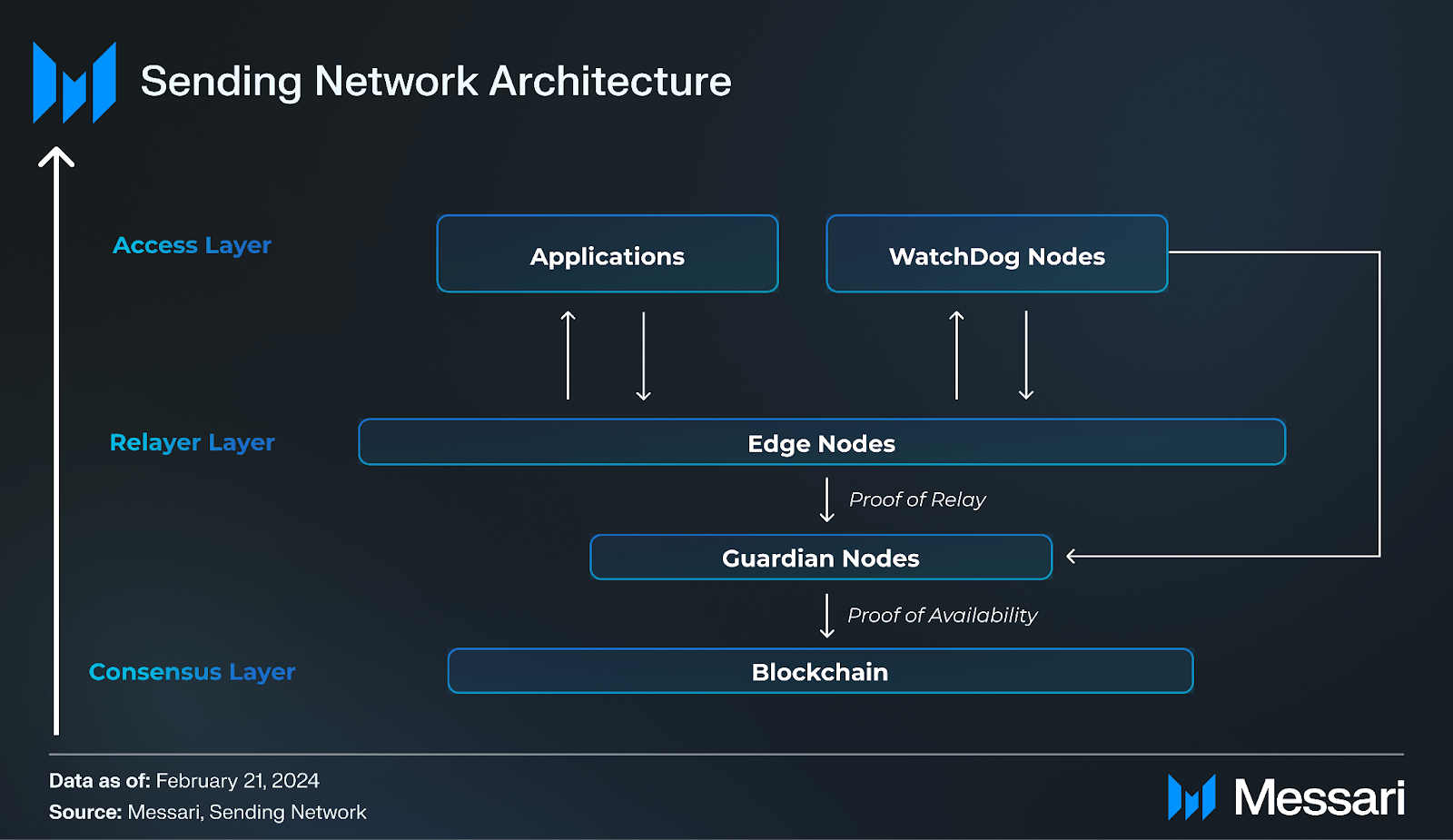
Sending Network has a three-tier structure designed to optimize for privacy, scalability, and decentralization. The (i) Access Layer, (ii) Relay Layer, and (iii) Consensus Layer work together to handle everything from user interaction to message delivery and network governance. The system integrates blockchain, P2P networking via libp2p, and edge computing, with messages processed offchain for speed and economics managed onchain for trust.
Access Layer
This is the “front door,” or entry point, for users, where they connect to the network. It’s also where clients (user applications like SendingMe) interface with the system via client nodes. These end-applications are connected to the broader ecosystem in three different ways: (i) local (on-device), (ii) delegation (public, remote), or (iii) private (customized). The Access Layer ensures users can join the network flexibly while maintaining secure, encrypted communication.
Relay Layer
This is the "highway" of the network, where messages travel between users. It’s powered by Edge Nodes, which relay messages and cache them temporarily for offline recipients. Edge Nodes do the heavy lifting, acting as decentralized relays. They use bandwidth and caching resources to relay encrypted messages between client nodes, cache messages for offline clients (deleted once retrieved), and support text, voice, video, and even smart contract commands.
The Relay Layer and subsequent nodes within the layer use the libp2p library for P2P communication, enabling efficient routing via a Pub/Sub multicast strategy (no flooding the network with broadcasts). The Relay Layer is the delivery system as it moves messages fast and securely without storing them long-term, leveraging edge computing to keep latency low and scalability high.
Consensus Layer
This is the "control room," ensuring the network stays honest, stable, and incentivized. It uses blockchain (a Layer-2 solution) to manage economics and proofs. Validators enforce network rules using two novel mechanisms: Proof of Relay (PoR), validating message workloads via KZG commitments, and Proof of Availability (PoA), ensuring node uptime via Verkle trees. Economic incentives and proofs are processed on the Layer-2 solution. The Consensus Layer keeps the system decentralized and self-sustaining, anchoring trust and economics while keeping message handling offchain.
Types of Nodes
Edge Nodes
Edge Nodes operate within the Relay Layer of the Sending Network, forwarding messages while utilizing bandwidth and storage resources. They ensure offline message caching and verify message forwarding through the Proof of Relay mechanism, using Zero-Knowledge (ZK) proofs to compress and submit data to Guardian Nodes for verification. To maintain network efficiency, a node selection algorithm prioritizes high-uptime nodes, while built-in redundancy ensures message delivery even in cases of downtime. There are currently 1,112 active Edge Nodes.
Watchdog Nodes
WatchDog Nodes act as sentinels in the network, monitoring Edge Nodes by sending challenge messages and reporting results to Guardian Nodes for performance evaluation. These challenge messages, indistinguishable from normal traffic, ensure that Edge Nodes remain responsive, with failures potentially leading to penalties. WatchDog Nodes are rewarded based on the number of effective checks performed, with diminishing returns for repeated checks, making them accessible for ordinary users to host with minimal hardware requirements. There are currently 517 active Watchdog Nodes.
Guardian Nodes
Guardian Nodes serve as ZK verifiers, transaction sequencers, and node performance reviewers. They validate proofs from Edge and WatchDog Nodes while determining rewards or penalties based on Relay Node performance. They submit transactions to a Layer-2 blockchain, where offchain execution occurs, generating state transitions and ZK proofs. The finalized data is then sent to the Layer-1, ensuring data availability and network integrity.
AI Agent Framework
While Sending Network has built foundational decentralized infrastructure for consumer-facing applications, they have also created an Agent-to-Agent modular communication framework.
This architecture is agent-friendly, modular, and ethically designed, allowing AI agents to operate autonomously with minimal oversight while enabling integration. Governed by DAOs, the system ensures transparency, security, and community-driven decision-making, fostering a decentralized and adaptable intelligence ecosystem.
Token Utility
Sending Network’s token, SDN, powers the decentralized communication network by ensuring security, rewarding participation, and enabling user benefits.
For Nodes:
Edge Nodes must stake SDN. In return, they will earn relay fees (paid in SDN) and risk being slashed for poor performance.
Watchdog Nodes do not need to stake SDN tokens but will earn rewards for monitoring network health through their checks on Edge Nodes.
Guardian Nodes must stake SDN and validate workloads to receive validation rewards (paid in SDN).
For Users:
Pay relay fees in SDN for messaging.
Stake SDN to receive airdrops from partner projects.
Hold SDN to unlock premium features (e.g., HD calls, custom themes).
Hold SDN to participate in governance as the network transitions to a DAO.
For Developers:
Prepay relay fees in SDN to lower user costs.
Purchase high-throughput APIs using SDN tokens.
Earn rewards (paid in SDN) for contributions to protocol improvements.
Ecosystem
The Sending Network tech stack has started to grow beyond SendingMe with 9 live integrations and 35+ in progress for a total of over 44 partnerships.
Based on various public sources and internal direction from the team, the roadmap is split into the two phases below:
Closing Summary
Sending Network’s vision for a decentralized, blockchain-powered communication infrastructure challenges the limitations of traditional internet protocols. By leveraging decentralization at every layer, from addressing and trust to messaging and AI integrations, the protocol offers enhanced security, censorship resistance, and user control. Its multi-tier architecture, combining edge computing, peer-to-peer (P2P) networking, and blockchain consensus, ensures scalability and efficiency while maintaining privacy. With the successful development of applications like SendingMe and significant funding to support further innovation, Sending Network is positioning itself as a leader in the DePIN space.
This report was commissioned by Sending Labs. All content was produced independently by the author(s) and does not necessarily reflect the opinions of Messari, Inc. or the organization that requested the report. The commissioning organization may have input on the content of the report, but Messari maintains editorial control over the final report to retain data accuracy and objectivity. Author(s) may hold cryptocurrencies named in this report. This report is meant for informational purposes only. It is not meant to serve as investment advice. You should conduct your own research and consult an independent financial, tax, or legal advisor before making any investment decisions. Past performance of any asset is not indicative of future results. Please see our Terms of Service for more information.
No part of this report may be (a) copied, photocopied, duplicated in any form by any means or (b) redistributed without the prior written consent of Messari®.
Jeremy is a research analyst at Messari with interests in Infra, DeFi, and Enterprise adoption. Prior to joining Messari, Jeremy worked as an analyst at Fidelity Digital Assets.
Jeremy is a research analyst at Messari with interests in Infra, DeFi, and Enterprise adoption. Prior to joining Messari, Jeremy worked as an analyst at Fidelity Digital Assets.