Mantle upgraded to an OP–Succinct ZK validium in September 2025, reducing withdrawals to ~12 hours, improving finality to ~1 hour, and shifting to ZK validity proofs with EigenDA for data availability.
Mantle’s staking and restaking stack remains one of its largest capital bases, with mETH holding $791.7 million in ETH and cmETH holding $277 million, for a combined ~$1.07 billion in underlying assets as of late 2025.
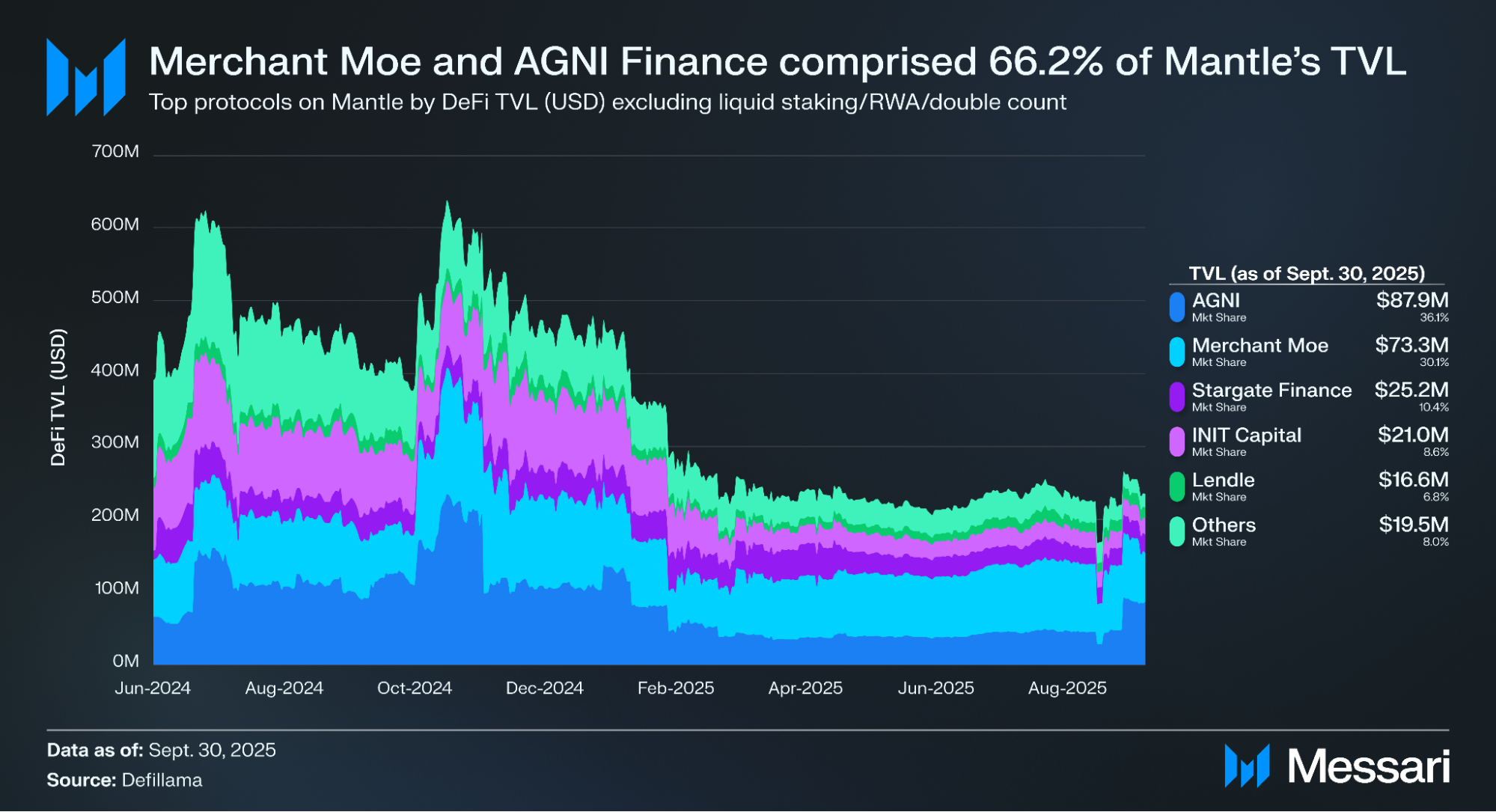
DeFi activity on Mantle remains concentrated across two primary venues, with Merchant Moe and Agni collectively representing 66% of the network’s $242.3 million DeFi TVL as of September 30, 2025, highlighting early liquidity hubs within the ecosystem.
Institutional tokenization activity expanded, driven by Mantle’s TaaS platform and issuances such as Ondo’s USDY, which reached ~$29M tokenized on Mantle.
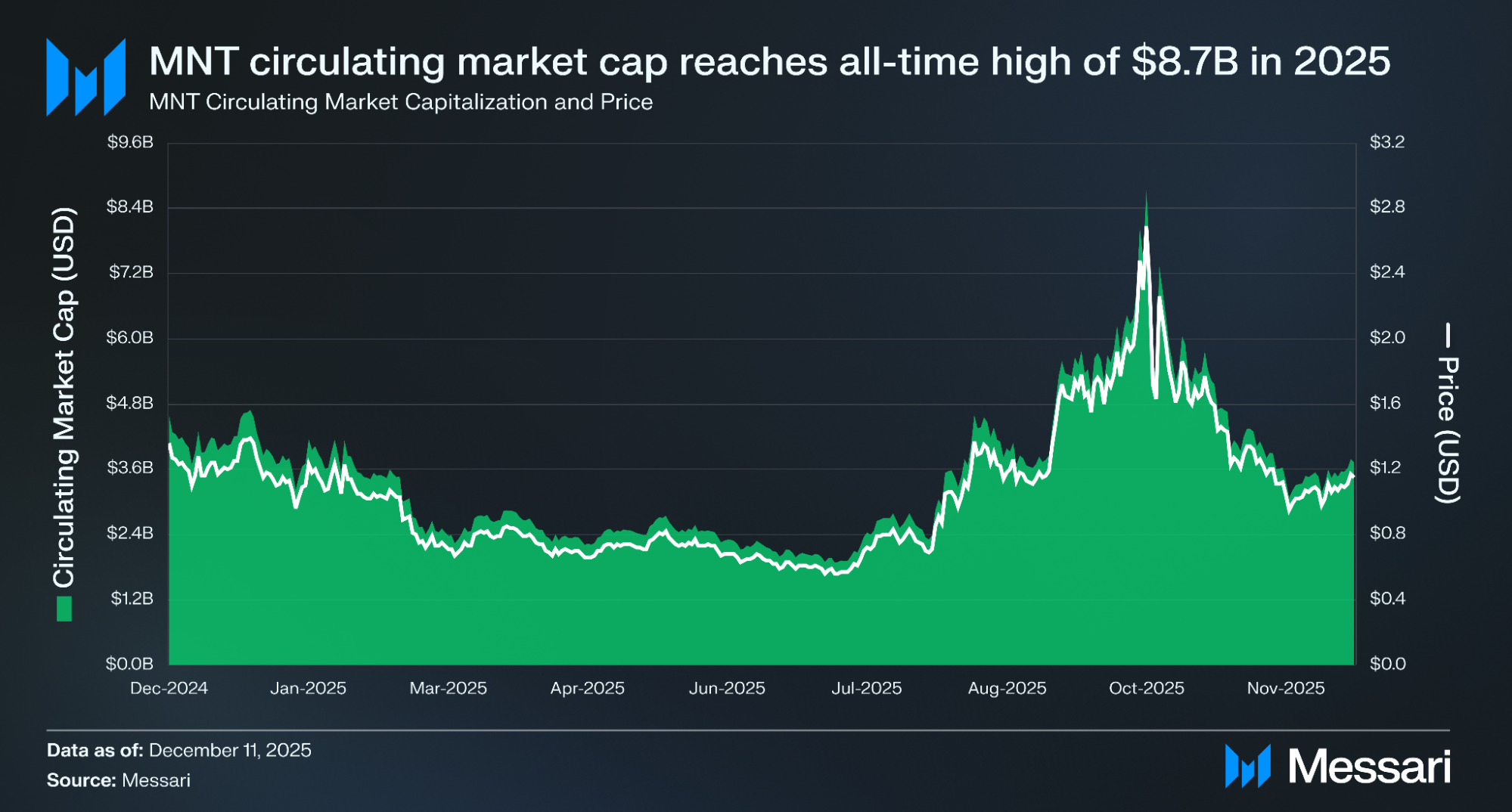
Deepening exchange integration strengthened MNT’s utility and distribution, as Bybit introduced expanded MNT-quoted pairs, discounted fee payments, and collateral programs. During this period, MNT’s circulating market cap reached approximately $8.7 billion on October 8, 2025.
Introduction
Existing Layer-2 networks continue to compete for users, liquidity, and institutional attention as activity on Ethereum grows. Despite improvements in execution and cost efficiency, participants still face fragmentation across networks and limited alignment between financial applications, yield mechanisms, and collateral systems. These gaps create friction for institutions and DeFi users seeking a more coordinated onchain environment.
Mantle approaches this market from a different angle. Rather than operating solely as a general-purpose coordination layer, Mantle is building a modular onchain finance ecosystem that brings liquidity, staking, Bitcoin-denominated assets, and enhanced account-level functionality into a unified environment. This direction, outlined in the protocol’s 2025 strategy update, signals Mantle’s shift toward infrastructure built for institutional onchain finance and emerging capital-markets use cases.
Over the past year, following its shift in narrative, Mantle has taken steps toward this vision through updates to its network architecture and the introduction of products that expand its new identity. These efforts support a system where capital can move across staking, collateral, liquidity provision, and user applications in a more coordinated way. Together, these developments better position Mantle as an ecosystem built for onchain finance rather than its dated roots as a general-purpose Layer-2 network.
Background
Previously positioned as an Optimistic Layer-2 network, Mantle’s Q1 2025 note to token holders outlined a distinct shift in its narrative. The update repositioned Mantle from a general-purpose L2 toward a modular ecosystem, including a six-pillared framework dedicated to building scalable infrastructure for onchain finance. Over the following year, the protocol started to execute its vision, strengthening its identity while attracting institutional participants and DeFi/TradFi natives through multiple product-oriented initiatives:
Launched on April 24, 2025, The Mantle Index Four (MI4) has successfully established Mantle’s onchain, institutional-grade index fund.
Built on Mantle Network and launched on June 18, 2025, UR introduced the financial banking use case into Mantle Network’s ecosystem.
On July 3, 2025, Mantle launched MantleX, the organization’s research and incubation arm, which aims to explore the use of AI agents to deploy the Mantle treasury more effectively, for community engagement, and for onchain research functionalities.
Familiar products, such as the mETH Protocol, Function (FBTC), and Mantle Network, have also progressed in meaningful ways year-over-year, further supporting the protocol’s growth:
The mETH Protocol has focused on institutional adoption and transparency, securing integrations with enterprise custody platforms, including Fireblocks Off Exchange and Copper.
Function (FBTC) continues to enhance Bitcoin's utility and yield opportunities within DeFi to its institutional user base.
Mantle Network has experienced infrastructural improvements to support the protocol’s new identity as a "Liquidity Chain." This includes an upgrade to the protocol’s architecture, transitioning from an optimistic L2 to a ZK validium powered by Succinct’s SP1 zkVM.
Together, these developments illustrate Mantle’s progression toward an integrated onchain finance platform, serving as the foundation for the protocol’s onchain banking-oriented vision.
Technology
Mantle Network’s technology stack has evolved from a simple Optimium design (Ethereum settlement and offchain DA) into a modular system that combines the OP Stack, zero knowledge (ZK) validity proofs, and EigenDA as its primary data availability layer. Since its launch, Mantle has undergone two major public iterations and a third transition toward an OP-Succinctvalidium architecture.
Mantle V1 Alpha
Mantle V1 Alpha launched on mainnet in July 2023, using the OVM codebase from Optimism to introduce a modular L2 structure. V1 established fundamental EVM equivalence and Ethereum settlement, but had several constraints. Without EIP-1559, users bid for block space through a first-price auction, leading to volatile fees. The network followed a first-come, first-served sequencing rule, where a new block was produced once a transaction was received. As a result, block times were not fixed and varied according to the transaction flow.
Mantle V2 Tectonic
To address these issues, Mantle V2 Tectonic went live in March 2024, migrating the network to Optimism’s OP Stack Bedrock. V2 integrated EIP-1559 on Mantle, introducing a dynamically adjusted base fee and an optional tip for faster inclusion. Block production became transaction independent and fixed at 2 seconds, allowing multiple transactions per block and stabilizing latency and throughput. The upgrade also removed the Data Transport Layer and Threshold Signature Scheme from the architecture, thereby enhancing the efficiency of the Mantle Network.
OP-Succinct ZK Validium Transition
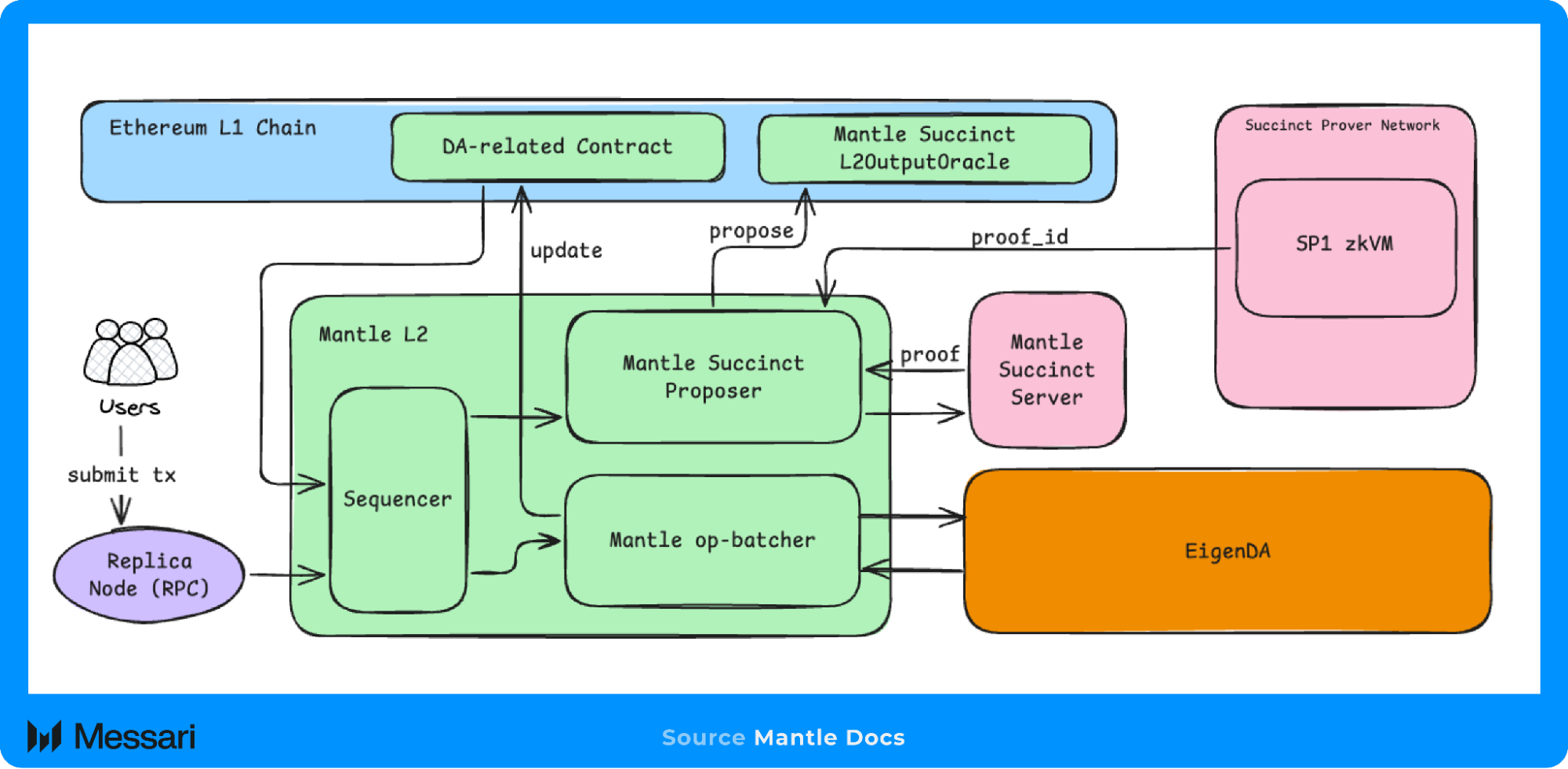
In September 2025, Mantle deployedOP-Succinct on mainnet, transitioning from an optimistic L2 to a ZK validium powered by Succinct’s SP1 zkVM. The execution environment remains OP Stack-based and EVM equivalent, but batches are now paired with succinct ZK proofs generated by Succinct’s proving system. These proofs attest to the correctness of state transitions for each batch.
Fast finality & exits: Target one-hour finality and twelve-hour withdrawals, a significant improvement over seven-day exit periods common in major optimistic L2s.
ZK-verified security: State transitions are verified by validity proofs, reducing the necessity to trust the sequencer.
Cost-efficient proofs:Succinct’s SP1 prover network and an optimized zkVM can lower proving costs to as low as $0.002 per transaction. Using aggregation and curve-based optimizations, the design can remain scalable under high load.
Data availability is handled offchain by EigenDA, rather than by posting complete transaction data on the Layer-1 blockchain. This design aims to preserve Ethereum-grade security for execution, improve finality properties through validity proofs, and reduce data costs by externalizing data storage to a specialized EigenDA operator set.
Mantle also has ongoing research and development efforts that target:
Custom execution clients (RETH and REVM) that are expected to bring up to 2x speed improvements over the current Geth client.
Current Architecture
Mantle's current architecture consists of three primary components: execution, proofs, and data availability.
Execution and Rollup Logic
Mantle Network continues to utilize an OP Stack-based execution layer that is fully EVM-equivalent. Applications and tooling built for Ethereum can be deployed with minimal changes and via ZK validity proofs. Only mathematically correct state roots are committed back to Ethereum for settlement.
Transactions are sequenced and executed by Mantle’s single, trusted sequencer. Batches of transactions are then grouped and form the basis for both settlement to Ethereum and proof generation in the OP-Succinct system.
This centralized sequencer model is how most production rollups operate today; however, it also introduces censorship and transaction ordering risks. There have been multiple proposed solutions, including decentralized sequencers and TEEs, but each has its own trade-offs. In March 2024, Mantle’s research team published a fair sequencing architecture: a transaction-ordering scheme that uses verifiable randomness and modular roles (mempool manager, sequencer, executor) to ensure transactions are included and ordered in a way that reduces censorship and MEV manipulation. The design is not yet live on Mantle mainnet.
With the V2 Tectonic upgrade in March 2024, Mantle adopted fixed 2-second block times and EIP-1559-style fee mechanics, using MNT as the gas asset. This gives developers a predictable block schedule and a fee market that responds smoothly to demand. From a user perspective, transactions typically confirm in a few seconds on Mantle. Finality is reached once the corresponding batch is proven and finalized on Ethereum. Under OP Succinct, this currently targets a roughly one-hour finality, with withdrawals completing in approximately twelve hours.
Proofs to the L1
While Mantle initially explored a standard optimistic fraud-proof system using Cannon and MIPS, development progress led the team to pivot toward integration with SP1 and adopt a ZK-validity model instead.
Under the OP-Succinct ZK Validium design, Mantle augments the OP Stack execution environment with ZK validity proofs instead of fraud proofs. Succinct’s prover generates ZK proofs that each batch of transactions was executed correctly according to the EVM rules. Unlike fraud proofs, which only prove incorrectness when challenged, validity proofs attest to the validity of a batch. These ZK proofs are verified by smart contracts on Ethereum L1, allowing external verifiers to trust that posted state roots correspond to valid state transitions without having to replay all transactions.
Data Availability Layer
To ensure transaction data remains accessible for verification, Mantle publishes data to a data availability (DA) layer. In the earlier Mantle DA design, Mantle implemented its own DA module on top of EigenLayer, with additional logic such as unicast-style data propagation and explicit staking of MNT by DA nodes.
As the network matured, Mantle shifted toward using EigenDA, by EigenLayer, as the primary DA layer, with Mantle-specific configuration and governance at the protocol level rather than maintaining a separate DA brand.
EigenDA uses a distributed set of operators that stake or restake capital to provide data storage and serving guarantees. Data is encoded and split into fragments using erasure coding, then distributed across operators. As long as a sufficient subset of operators remains honest and online, clients can reconstruct the complete batch data. This structure raises the cost of data withholding or censorship and allows Mantle to scale data throughput beyond what is economically viable directly on Ethereum.
Tokenomics
Mantle’s ecosystem includes six primary tokens that support governance, staking, restaking, Bitcoin liquidity, and institutional index products across Mantle’s modular onchain finance stack. These tokens underpin the network’s economic coordination, yield mechanisms, and collateral flows.
MNT
MNT is Mantle’s native token, serving as both a governance and utility token. It is the underlying asset on the Mantle network. It is used to pay for gas on the Mantle Network, participate in Mantle DAO governance, support ecosystem incentives, and provide collateral within the Mantle treasury. MNT can also be used as collateral within Mantle’s DeFi ecosystem. MNT trades on 24 exchanges, with Bybit being the most traded centralized exchange. Bybit records approximately $70 million in daily volume, which accounts for approximately 80% of the market share across all exchanges.
The total and maximum supply of MNT is fixed at 6.2 billion tokens. Approximately 3.3 billion tokens are in circulation (~53.4%). Of the supply locked, it is held by the Mantle treasury, which holds 2.9 billion tokens (~46.6% of the maximum supply). Since MNT originated from the BIT migration, the token has no team or investor vesting and no recurring emissions. Any future MNT allocation is determined solely through governance-directed treasury actions. Treasury deployments are approved through Mantle’s proposal process and are used to support ecosystem growth, liquidity, RWA initiatives, and balance sheet operations.
Recently, Mantle’s relationship with Bybit has evolved from a standard token listing to a deep integration where MNT now serves as a core platform asset across trading, VIP, and institutional products. In an Aug. 29, 2025 joint roadmap, Bybit and Mantle established three priorities:
Expanding MNT trading pairs
Enabling discounted MNT-denominated fee payments
Introducing MNT-based benefits for VIP and institutional users
On September 9, Bybit listed 21 new MNT-quoted spot pairs and made MNT a base asset in its Main Trading Zone to improve price discovery and native MNT usage, while MNT lockers in Bybit Earn gained access to airdrop rewards via Megadrop events. Bybit also rolled out MNT-based fee discounts (25% on spot, 10% on futures), which applies a 1.3-1.5x multiplier to MNT balances for VIP tier calculations. For institutions, the MNT x Bybit Institutional program includes options where pledged MNT can unlock higher leverage (up to 8x spot margin) and longer fixed-rate loan terms of up to four months.
These integrations materially enhanced MNT’s liquidity profile and broadened its utility across Bybit’s platform. Around this period, MNT’s price reached an all-time high of approximately $2.70, and its circulating market cap reached roughly $8.7 billion on October 8, 2025, coinciding with the expanded exchange support and deeper market participation.
mETH
mETH is the core asset of mETH Protocol, Mantle’s ETH liquid staking and restaking protocol deployed on Ethereum and governed by Mantle. Each mETH token represents a claim on staked ETH plus accumulated rewards, with the mETH-to-ETH exchange rate gradually increasing over time as staking rewards compound (i.e., it is not a rebasing token like stETH). As of December 10, 2025, the exchange rate of 1 mETH is equivalent to 1.08 ETH.
mETH Protocol scaled quickly after launch, establishing itself as a core liquidity component within the Mantle ecosystem. However, TVL has moderated over the past year: as of December 10, 2025, mETH holds $791.7 million in ETH, down 53.9% YoY from $1.72 billion a year earlier.
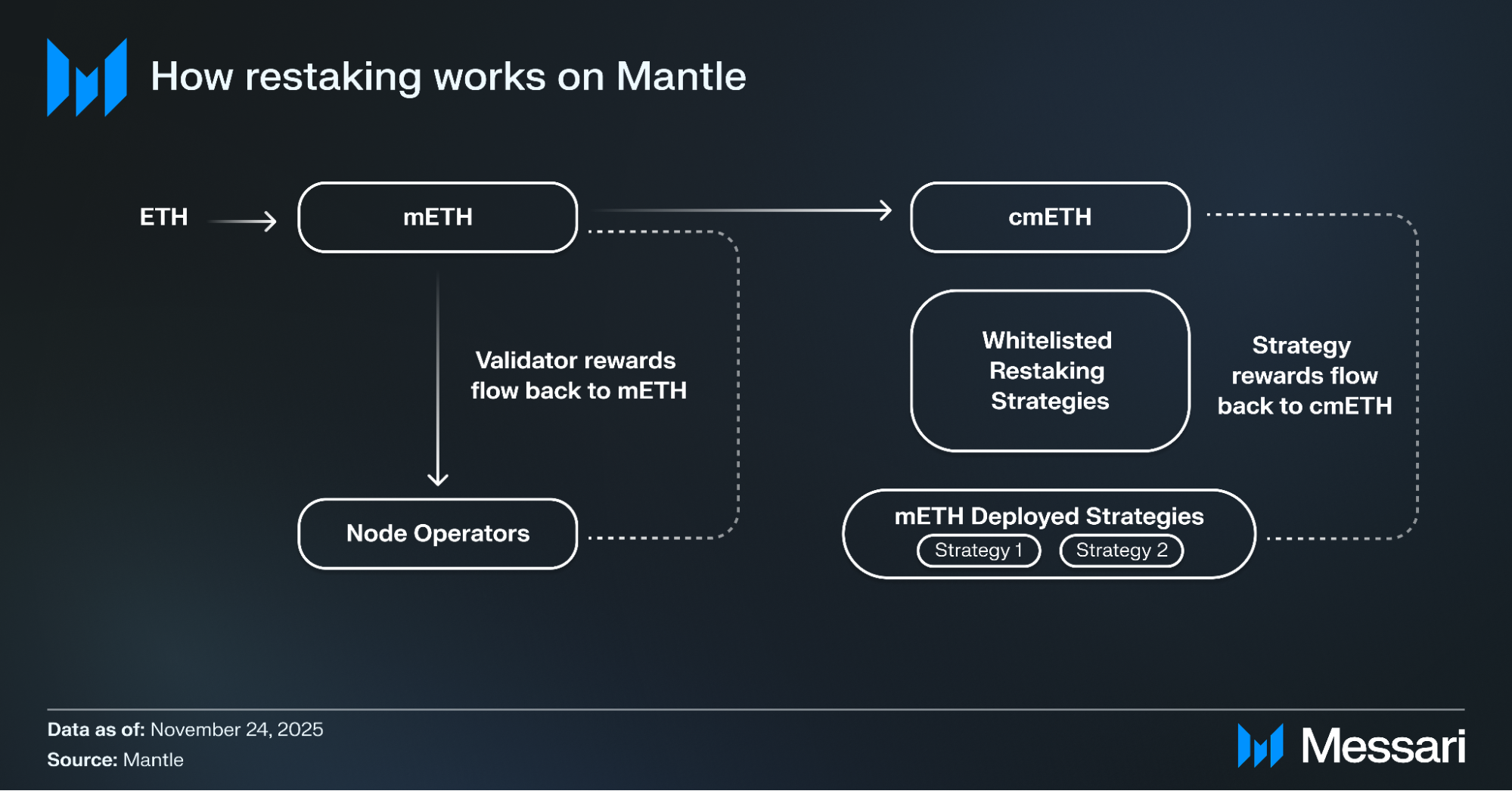
mETH Protocol charges a 10% fee on staking rewards, a portion of which is paid to a curated set of professional node operators such as P2P, Blockdaemon, Stakefish, and Kraken. These node operators serve as the underlying validators responsible for running the Ethereum consensus infrastructure on behalf of mETH stakers.
The risk profile of mETH is broadly aligned with standard Ethereum staking risk, where validator rewards depend on consistent uptime and correct attestations. Penalties, including slashing, apply for extended downtime or consensus faults.
As of November 22, 2025, mETH staking yield was also around 2.8%, which is comparable to other major ETH staking protocols.
Mantle’s mETH has gained traction across public company treasuries, onchain treasuries, and DeFi protocols:
In May 2025, Republic Technologies, an Ethereum technology services provider and treasury, allocated a significant portion of its ETH to mETH.
Various DeFi protocols on Mantle, such as Merchant Moe, Range Protocol, INIT Capital, and many others, host mETH pairs or offer mETH-based yield vaults.
cmETH
cmETH is the liquid restaking token of mETH Protocol. In May 2024, Mantle Network integrated cmETH and COOK through the passage of MIP-30. mETH holders can deposit their mETH and receive cmETH at a 1:1 rate. The underlying mETH will continue to earn standard Ethereum staking rewards, but cmETH will also accrue rewards from various restaking networks. cmETH provides diversified exposure across EigenLayer, Symbiotic, and Karak.
As of November 22, 2025, cmETH manages roughly $277 million worth of ETH.
cmETH distribution has expanded across centralized venues and DeFi integrations:
In June 2025, Bybit, Mantle, and EigenLayer launched a joint campaign that rewarded cmETH minters with an extra 100,000 EIGEN prize pool, layering this bonus on top of cmETH’s existing restaking yield.
Methamorphosis Season 3 launched in March 2025 and ran until September 22, 2025, routing additional COOK incentives to cmETH users via Powder points. Points accrue when cmETH is deployed in DeFi protocols across Mantle Network or HyperEVM than when it is held in a wallet.
Various DeFi protocols have implemented cmETH: Pendle enabled trading and locking in fixed cmETH yield, Morphobeat allowed users to borrow against cmETH on HyperEVM while accruing “Hearts” points on pairs, and HyperSwap offered a cmETH/uETH liquidity pool with native points incentives.
COOK
COOK is the native governance token of mETH Protocol, launched in October 2024 to govern the protocol’s key parameters, including fees, validator onboarding, staking and restaking allocations, and incentive design across both mETH and cmETH. While initial phases were characterized by the Methamorphosis incentive campaigns, the protocol has transitioned toward a long-term treasury vision, positioning COOK as the economic backbone for mETH’s expansion into institutional markets.
Formal onchain governance using COOK is not yet active; protocol decisions are currently coordinated through the Mantle Forum. As the protocol transitions away from its original incentive-driven model (e.g., Metamorphosis seasons), the emphasis has shifted toward making COOK the value-capture mechanism for mETH Protocol’s evolving treasury.A major protocol upgrade on Dec. 15, 2025, introduced a Buffer Pool mechanism to support on-demand redemptions from mETH to ETH. Enabled through a dual-liquidity pathway that allocates a portion of validator-side ETH into Aave, this upgrade addresses the liquidity bottlenecks common in Ethereum staking. Key outcomes of the Buffer Pool upgrade include:
Targeting a <24-hour redemption window under normal buffer conditions.
Allocating approximately 20% of the protocol's TVL to Aave’s ETH market, routing smaller requests to an instant buffer and larger requests to the Aave reserve.
Maintaining a ~2.56% net protocol APY despite the ~20% allocation toward the liquidity buffer.
Continued strategic alignment with Bybit to enable mETH as trading and margin collateral, further supported by OTC support for large institutional flows.
This upgrade is foundational to COOK’s evolving role, positioning it as the capture mechanism for staking revenue, liquidity provisioning, and future treasury utility as mETH Protocol scales toward advancing its ETH treasury asset solution.
Function
Function (FBTC) is an omnichain Bitcoin asset pegged 1:1 to BTC, originally incubated by Ignition (now operating under the Function brand) with Antalpha Prime and Mantle as initial core contributors. It uses a Threshold Signature Scheme (TSS) network to custody BTC and mint or redeem FBTC on supported chains such as Ethereum and Mantle. On Mantle, FBTC functions as Bitcoin-denominated collateral for lending, borrowing, and liquidity provision.
MI4
MI4 is the tokenized share class of Mantle Index Four Fund, an institutional crypto index product launched on April 24, 2025 by Mantle in partnership with Securitize. The fund is structured as a British Virgin Islands limited partnership and is dedicated to offering market-cap-weighted exposure to leading crypto assets, such as BTC, ETH, and SOL, enhanced by staked token yields. Overall, it provides simplified access to diversified crypto beta with traditional administration, quarterly rebalancing, and a 1% management fee. As of December 10, MI4 manages approximately $173 million in assets, with a YTD return of 28.17%.
Network Ecosystem
Mantle’s ecosystem has expanded across multiple verticals spanning tokenization, DeFi liquidity, consumer-facing applications, and onboarding infrastructure. This breadth supports Mantle’s broader vision of becoming a modular onchain finance platform powered by unified liquidity, institutional integrations, and AI-enabled user experiences.
Real-World Assets (RWA) & Tokenization
Tokenization-as-a-Service (TaaS) platform
On October 2, 2025, Mantle announced a Tokenization-as-a-Service (TaaS) platform aimed at institutional issuers of RWAs. The service offers an end-to-end stack for compliant tokenization, including licensing and KYC, legal structuring, smart contract deployment, security monitoring, and a regulated user interface, and is designed to connect directly into Mantle’s DeFi and exchange integrations for price discovery and secondary liquidity.
RWA Issuers and Assets
Mantle’s RWA footprint expanded through major issuer partnerships:
Ondo Finance (USDY):USDY, Ondo’s tokenized note backed by short-term U.S. Treasuries and bank deposits, continues scaling on Mantle. As of December 11, 2025, approximately $29 million in USDY is tokenized on Mantle.
Ecosystem Development & Programs
On October 2, 2025, Mantle announced a global RWA hackathon series and a scholarship program to support this initiative. The hackathon is an online, ecosystem-wide competition offering $150,000 in prizes across six tracks, including a dedicated RWA track, DeFi, AI, ZK & Privacy, infrastructure, and GameFi.
DeFi Ecosystem
Merchant Moe, part of the Trader Joe ecosystem, is the largest DEX on Mantle, with roughly $59 million in TVL and around $308 million in 30-day volume as of November 22, 2025. The DEX utilizes a Liquidity Book design and MOE governance token, which can be staked for sMOE yield and veMOE voting power over future emissions and MNT-funded incentives.
Agni Financeis an AMM-based DEX focused on spot trading and concentrated liquidity. As of November 22, 2025, it held around $36.3 million in TVL and approximately $169 million in 30-day volume, with USDe/USDT as its most active pool.
INIT Capitalis a DeFi lending and borrowing (money market) protocol that enables users to create Liquidity Hooks: custom strategies, such as looping, leveraged yield farming, or margin trading, that route through INIT’s lending pools. As of November 22, 2025, it held around $12.6 million in TVL and $4.3 million in outstanding borrows.
Lendle is a money market protocol. It offers overcollateralized lending and borrowing, and redistributes a share of protocol revenue back to depositors in assets such as BTC, ETH, stablecoins, and MNT. As of Nov. 22, 2025, it held approximately $10.2 million in TVL and $1.5 million in outstanding borrowings.
Across the network, Mantle’s DeFi TVL reached $242.3 million as of September 30, 2025. Merchant Moe and Agni together represent approximately 66% of total TVL, underscoring their position as the core liquidity hubs within Mantle’s financial stack.
Consumer, AI, and Onboarding
Gaming & User Acquisition: Mantle has also invested in gaming-based growth programs. Mantle Games Fest, run in partnership with HyperPlay, distributed 300,000 MNT across six games between April 24 and May 21, 2025 to drive onchain user growth and retention.
Mantle Passport: On the onboarding side, Mantle introduced Mantle Passport in August 2025, a wallet solution utilizing Para’s distributed MPC to enable social login accounts, recoverability, and per-app permissions while keeping keys non-custodial.
Roadmap
Mantle’s roadmap focuses on three priority domains: core infrastructure, RWA and DeFi expansion, and distribution channels.
Infrastructure Roadmap
Production deployment of custom execution clients (RETH and REVM) to deliver an estimated 2x speed improvement over the current Geth client.
Chain abstraction by implementing things like optimal path selection across bridges/DEXs, asset fusion (treating multiple tokens more seamlessly), and one-click dApp integration to make it easier for apps to plug in.
RWA & DeFi Roadmap
Mantle’s Tokenization-as-a-Service platform, offers issuers an end-to-end framework, including licensing and KYC, legal structuring, contract deployment, audits, and security, to help onboard additional RWA issuers and standardize token and disclosure templates.
Global RWA hackathons and scholarships aim to cultivate a pipeline of builders focused on compliant tokenization initiatives.
mETH Protocol and cmETH are expected to grow via deeper integration in DeFi protocols from COOK incentives from Methamorphosis Season 3.
Distribution & User Access Roadmap
On the distribution side, Mantle has recently deepened its integration with Bybit, and this is expected to continue.
UR, the smart money app and stablecoin banking infrastructure built on Mantle Network, delivers an all-in-one crypto and fiat management platform. The application is compliant, licensed, and spans over 50 countries with 7 multicurrency fiat access points for users and businesses under the supervision of SR Sapherstein AG.
Closing Summary
Across its product suite, Mantle expanded capital pathways through mETH and cmETH (a combined ~$1.07 billion across staking and restaking as of late 2025), Function’s FBTC for Bitcoin-denominated collateral, and MI4, the protocol’s institutional index product, managing approximately $173 million in assets. DeFi activity on Mantle grew to $242.3 million in TVL as of September 30, 2025, led by Merchant Moe and Agni, which together accounted for roughly two-thirds of onchain liquidity.
Institutional adoption also progressed through Mantle’s Tokenization-as-a-Service platform, which onboarded issuers such as Ondo Finance (with ~$29 million in USDY tokenized) and World Liberty Financial (USD1 announcement). On the distribution side, Mantle deepened its integration with Bybit, including expanded MNT trading pairs, fee discounts, and new collateral programs, contributing to MNT reaching a circulating market cap of approximately $8.7 billion in October 2025.
Looking forward, Mantle’s roadmap prioritizes throughput improvements via custom execution clients, further decentralization with EigenDA v2, expanded RWA issuance, and broader DeFi integrations for mETH and cmETH. These developments collectively position Mantle as a liquidity-aligned platform focused on institutional onchain finance rather than a traditional execution-focused Layer-2 network.
This report was commissioned by Mantle. All content was produced independently by the author(s) and does not necessarily reflect the opinions of Messari, Inc. or the organization that requested the report. The commissioning organization may have input on the content of the report, but Messari maintains editorial control over the final report to retain data accuracy and objectivity. Author(s) may hold cryptocurrencies named in this report. This report is meant for informational purposes only. It is not meant to serve as investment advice. You should conduct your own research and consult an independent financial, tax, or legal advisor before making any investment decisions. Past performance of any asset is not indicative of future results. Please see our Terms of Service for more information.
No part of this report may be (a) copied, photocopied, duplicated in any form by any means or (b) redistributed without the prior written consent of Messari®.
Armita is a protocol researcher with a robust background in technology and blockchain. Before her role at Messari, she distinguished herself as a tech entrepreneur, executive, and advisor for various blockchain startups. Armita holds two master's degrees, one in Computer Engineering and another in Business Management, as well as a double major undergraduate degree in Physics and Pure Mathematics.
Kaleb was previously a research and governance analyst at 404 DAO. His primary interests are high performance L1 and L2 chains and innovative DeFi protocols.
Armita is a protocol researcher with a robust background in technology and blockchain. Before her role at Messari, she distinguished herself as a tech entrepreneur, executive, and advisor for various blockchain startups. Armita holds two master's degrees, one in Computer Engineering and another in Business Management, as well as a double major undergraduate degree in Physics and Pure Mathematics.
Kaleb was previously a research and governance analyst at 404 DAO. His primary interests are high performance L1 and L2 chains and innovative DeFi protocols.