Hemi embeds a Bitcoin full node within an EVM. This allows Solidity contracts to query Bitcoin’s UTXO state, enabling Bitcoin-native programmable applications.
Hemi’s Proof-of-Proof (PoP) consensus mechanism anchors Hemi to Bitcoin. PoP miners submit Hemi state commitments to Bitcoin.
DeFi is driving Hemi’s early ecosystem growth. Liquid staking and staking protocols like Lorenzo, BitFi, and Swell issue BTC-based derivatives that serve as the foundation for yield strategies on Hemi.
Hemi’s tunneling system is rolling out in phases. It currently uses optimistic settlement for Ethereum and multisig vaults for Bitcoin, with future upgrades planned for ZK-based settlement and BitVM2 verification to support assets like BRC-20s and Ordinals.
The HEMI token will be used to pay for transaction fees, incentivizing Bitcoin security inheritance, staking, incentives, and governance. Hemi will employ a veHEMI staking mechanism to access governance, sequencing, liquidity provisioning for Hemi tunnels, and more.
Introduction
Bitcoin is the largest crypto asset by market capitalization, yet its utility remains constrained by the limited programmability of its base layer. Without support for complex smart contracts, Bitcoin is primarily used as a store of value or collateral in external systems. Efforts to extend Bitcoin’s capabilities through wrapped assets or merged-mined sidechains have introduced tradeoffs in custody, decentralization, and developer flexibility.
Hemi is a modular Layer-2 (L2) protocol designed to address these limitations. Its architecture embeds a full Bitcoin node within an Ethereum Virtual Machine (EVM), enabling Solidity contracts to observe and respond directly to Bitcoin’s UTXO state. This approach reframes Bitcoin and Ethereum not as siloed systems but as components of a broader “supernetwork,” combining Bitcoin’s security with Ethereum’s composability.
The network employs a hybrid Proof-of-Stake (PoS) consensus mechanism known as Proof-of-Proof (PoP) to enhance security. Sequencers stake HEMI tokens to order transactions, while PoP miners anchor Hemi’s state commitments to Bitcoin. Once confirmed on Bitcoin, Hemi blocks achieve Bitcoin finality, mitigating weak subjectivity and censorship risks that are inherent to PoS-only systems.
Interoperability is another core feature of Hemi’s design. Through its tunneling framework, the protocol enables trust-minimized transfers between Bitcoin, Ethereum, and Hemi without relying on external validators. These tunnels are intended to support a range of assets, including Bitcoin-native tokens such as BRC-20s and Ordinals, while using Bitcoin’s Proof-of-Work consensus as the final settlement layer.
Hemi launched its mainnet on March 12, 2025, following a public testnet debut at Bitcoin Nashville in 2024. The project has secured $30 million in funding from investors, including YZi Labs (Binance Labs), Big Brain Holdings, and Republic Digital. With more than 70 integrations across liquid staking, restaking, and decentralized finance, Hemi is positioning itself as a platform for transforming Bitcoin from a passive store of value into a productive asset within DeFi.
Background
Hemi was founded in 2024 as a standalone L1 before transitioning into a modular L2 designed to extend Bitcoin’s functionality without altering its base layer. Hemi is led by co-founder and former Bitcoin Core developer Jeff Garzik alongside lead architect Max Sanchez. Its development emphasizes modularity, cross-chain interoperability, and fault tolerance, with specialized node roles such as Bitcoin-Secure Sequencers, Bitcoin Finality Governors, Proof-of-Proof miners, and modified Geth nodes. Together, these components distribute responsibilities across the network to strengthen resilience and reduce the attack surface compared to conventional Proof-of-Stake systems.
Technology
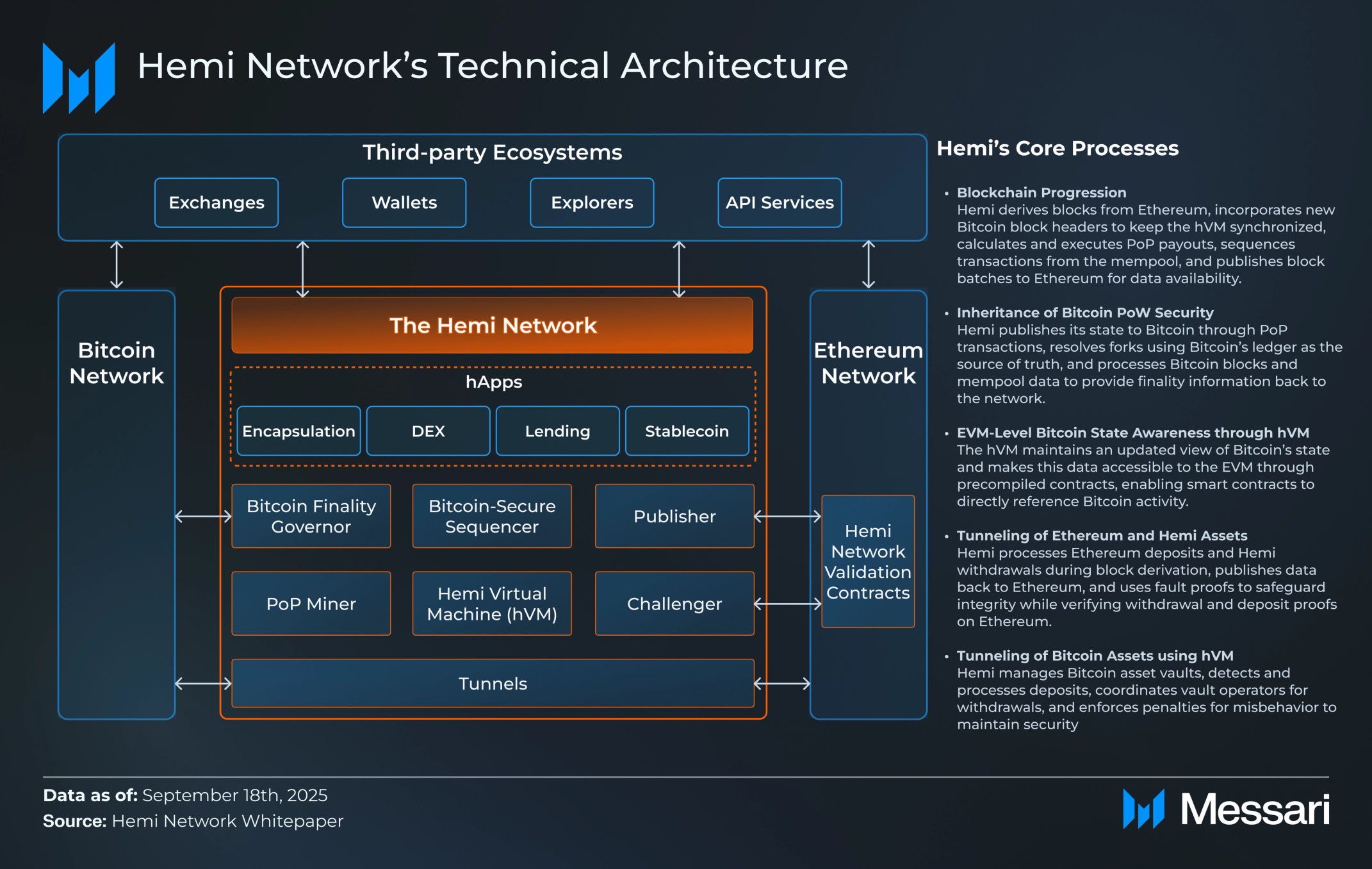
Hemi combines Bitcoin’s security with Ethereum’s programmability through the Hemi Virtual Machine (hVM), an EVM-compatible runtime environment that integrates a fully indexed Bitcoin node. This design allows Solidity contracts to query Bitcoin’s UTXO state directly, enabling applications that extend Bitcoin beyond its native scripting limitations. A Proof-of-Proof consensus mechanism anchors Hemi’s state to Bitcoin, while specialized nodes distribute responsibilities for sequencing, anchoring, and interoperability. Together, these elements create an execution environment designed to support trust-minimized asset transfers and Bitcoin-denominated financial applications.
Proof-of-Proof Consensus
Hemi secures its network through a hybrid model that combines Proof-of-Stake (PoS) with a mechanism called Proof-of-Proof (PoP). Bitcoin-Secure Sequencers (BSS nodes) manage transaction ordering and consensus operations, supported by Bitcoin Finality Governors (BFG nodes) that monitor the Bitcoin blockchain for PoP commitments and relay finality data back to the network. PoP miners then embed cryptographic commitments of Hemi’s state into Bitcoin blocks, creating externally verifiable checkpoints that anchor Hemi’s history to Bitcoin’s PoW.This design addresses weaknesses common to PoS-only systems. In pure PoS networks, attackers with access to old validator keys can attempt long-range reorganizations, while current majority stakers can censor transactions. By requiring valid PoP commitments on Bitcoin, Hemi prevents such reorganizations unless an attacker could also compromise Bitcoin itself. Similarly, if sequencers attempt censorship, users can bypass them by submitting transactions directly to Bitcoin, where they must be included in subsequent Hemi blocks.
Hemi blocks typically achieve Bitcoin finality after nine Bitcoin blocks, or about 90 minutes. At that point, a reorganization would require both a 51% attack on Hemi and a simultaneous 51% attack on Bitcoin. Hemi reaches a state of “superfinality,” where the combined PoS/PoW model provides security guarantees that are stronger than those of either system alone. This anchoring framework could also be extended beyond Hemi itself, offering a potential foundation for other applications or networks seeking to inherit Bitcoin’s security.
Hemi Virtual Machine (hVM)
The Hemi Virtual Machine (hVM) is a customized EVM runtime that integrates a fully indexed Bitcoin node within its environment. By exposing Bitcoin data directly to the EVM, smart contracts written in Solidity can observe and respond to the UTXO state without relying on external relays or custodial wrappers. This enables developers to design contracts that validate Bitcoin transactions, monitor balances, or trigger logic based on Bitcoin block data.
By combining Ethereum’s development environment with direct Bitcoin awareness, the hVM lowers barriers for building Bitcoin-native applications. Developers familiar with EVM tooling can easily deploy decentralized finance protocols, asset management platforms, or cross-chain coordination layers while maintaining a trust-minimized link to Bitcoin. This approach expands Bitcoin’s role beyond passive collateral, enabling programmable use cases secured by its consensus.
The hVM also serves as the execution environment for Hemi’s tunneling system, which requires protocol-level awareness of both Bitcoin and Ethereum states. This dual awareness is a distinguishing feature among L2 designs, supporting Hemi’s broader goal of treating Bitcoin and Ethereum as components of a connected supernetwork rather than isolated chains.
Hemi Bitcoin Kit (hBK)
The Hemi Bitcoin Kit (hBK) is a developer toolkit that extends the functionality of the hVM by providing APIs and SDKs for working directly with Bitcoin data. It allows applications to query Bitcoin’s UTXO set, parse transactions, and synchronize cross-chain events. These capabilities allow smart contracts to respond to Bitcoin activity in real time without requiring developers to run their own infrastructure.
By simplifying access to Bitcoin’s state, the hBK enables use cases that were previously difficult to implement. Lending markets can reference Bitcoin transactions as collateral events, derivatives protocols can build logic around onchain price feeds, and DeFi applications can design products that react natively to Bitcoin movements. In each case, the hBK reduces technical friction and makes Bitcoin-aware applications more accessible to EVM developers.
The kit is a key component of Hemi’s effort to bring programmability to Bitcoin without altering its base layer. Together with the hVM, it gives developers the ability to combine Ethereum’s composability with Bitcoin’s security, broadening the design space for decentralized applications anchored to Bitcoin.
Tunnels
Hemi introduces a tunneling framework to enable asset transfers across Bitcoin, Ethereum, and Hemi in a trust-minimized way. Unlike conventional bridges, which rely on external validators or custodians, Tunnels operate with protocol-level awareness of both Bitcoin and Ethereum states. This architecture allows the system to natively verify cross-chain events and incorporate them into Hemi’s execution environment.
The tunneling framework is being rolled out in phases. In the current stage, Ethereum Tunnels operate through an optimistic dispute model, and Bitcoin Tunnels use Multisig custodianship, an approach that is common in cross-chain bridges. However, Hemi’s roadmap prioritizes progressive decentralization: upcoming phases plan to introduce ZK-proof-based settlement for Ethereum and BitVM2-powered verification for Bitcoin. These upgrades are designed to reduce reliance on trusted parties and extend support to Bitcoin-native assets such as BRC-20s and ordinals.
Tunnels also incorporate decentralized dispute resolution. Any participant can act as a challenger, monitoring transactions and raising disputes if irregularities occur. This reduces reliance on a single trusted party and strengthens security guarantees compared to centralized bridging models. By combining tunneling with its PoP consensus, Hemi seeks to offer a more resilient framework for cross-chain interoperability.
Node Architecture
Hemi distributes responsibilities across several specialized node types to strengthen security and fault tolerance:
Bitcoin-Secure Sequencers (BSS): Manage block production and staking operations while integrating checkpoints from the governors.
Proof-of-Proof (PoP) Miners: Embed Hemi state proofs into Bitcoin blocks, anchoring the network to Bitcoin’s security.
Modified Geth Nodes: Provide compatibility with Ethereum’s execution environment, enabling interoperability.
Challengers (future role): Will allow independent participants to contest invalid transactions or state proofs once implemented.
Together, these roles distribute responsibilities across the network, reducing the risk that a failure in any one node type could compromise the entire system. By separating consensus, finality, execution, and monitoring across specialized participants, Hemi minimizes single points of failure and strengthens fault tolerance. This modular design reflects the protocol’s broader goal of combining programmability with Bitcoin’s security guarantees.
Tokenomics
Utility
The HEMI token is central to the operation of the Hemi network. It pays transaction fees, incentivizes Proof-of-Proof miners to publish state commitments to Bitcoin, and rewards sequencers who maintain ordering in the Proof-of-Stake layer. In doing so, the token links its value directly to the protocol’s throughput and security. HEMI also supports ecosystem growth by funding developer grants, liquidity incentives, and adoption programs, while playing a role in coordinating liquidity across Hemi’s tunnels to enable secure asset movement between Bitcoin, Ethereum, and Hemi. Together, these functions position HEMI as more than a transactional currency, embedding it into the infrastructure, security, and economic development of a programmable Bitcoin ecosystem.
Governance and Staking
Hemi governance is structured around veHEMI, a non-transferable governance token created by staking HEMI. Holders of veHEMI can participate in protocol decision-making, influence sequencing rights, and provide liquidity for the network’s tunneling system. This design ties governance authority to long-term commitment, as stakers lock tokens to secure influence over the network. Beyond core governance, veHEMI is expected to integrate into application-layer incentives, extending its role from infrastructure coordination to broader ecosystem participation. In this way, the staking model embeds governance, security, and liquidity provisioning into a single mechanism that aligns users, developers, and network operators.
Distribution
HEMI has an initial total supply of 10.0 billion tokens, distributed across four major stakeholder categories:
25.0%(2.50 billion HEMI) - Team & Core Contributors
15.0% (1.50 billion HEMI) - Hemispheres Foundation
Vesting Schedule & Emissions
Hemi’s token generation event (TGE) on Aug. 29, 2025, introduced approximately 9.8% of the 10 billion HEMI supply into circulation. The initial liquid supply consisted of the first unlocked tranche from the Community and Ecosystem allocation, along with tokens distributed through the Hemispheres Foundation. Following the launch, additional supply has been scheduled for release through structured vesting, while ongoing protocol emissions target an annual inflation rate of 3–7% to sustain incentives for participants securing and operating the network.
Hemi’s vesting schedule for each major allocation category is as follows:
Community & Ecosystem: Vesting terms vary by sub-allocation, ranging from immediate unlocks to 36 months.
Team and Core Contributors: 36-month vesting (12-month cliff, 24-month unlock)
Hemispheres Foundation: Governed transparently by the foundation
Protocol Emissions: Targeted annual inflation rate of 3-7%
Fundraising
Hemi has secured $30 million across two funding rounds. The first raise, a $15 million seed round in September 2024, was led by YZi Labs (Binance Labs) with participation from Big Brain Holdings, SNZ Holding, Crypto.com Capital, Cypher Capital, and Breyer Capital. Proceeds from this round supported Hemi’s transition from a standalone Layer-1 chain to its modular Layer-2 framework, financing the technical development of the hVM, hBK, and Proof-of-Proof consensus while laying the groundwork for early ecosystem partnerships.
A second $15 million round in August 2025 extended the protocol’s runway as Hemi moved into production. The round was again led by YZi Labs, joined by Republic Digital and HyperChain Capital. The second raise was announced shortly after Hemi’s TGE on Aug. 29, 2025.
Network Activity and Protocol Usage
Usage
Since its mainnet launch in March 2025, Hemi has demonstrated rapid growth in both user participation and transaction throughput. Active address counts surged to 18,694 in Q3 2025, marking the network’s highest level of user engagement to date. This growth was driven by both new and returning participants, showing that Hemi is not only attracting fresh adoption but also retaining existing users.
Transaction activity has accelerated alongside this user expansion. In the week of August 18, 2025, Hemi processed 768,897 transactions, a sharp increase compared to prior months. Revenue during that same week reached 1.54 ETH. The combination of growing address activity and surging transaction counts marks an inflection in usage as participants increasingly deploy assets into yield-bearing applications on Hemi, designed to help users generate yield on their Bitcoin.
Staking
Hemi supports multiple forms of staking that serve distinct purposes within its ecosystem. The first is a vote-escrow (ve) mechanism for HEMI tokens, which allows holders to lock tokens for a minimum of 12 days and up to four years, in six-day increments. Longer commitments increase a participant’s governance weight and align them more closely with the protocol’s long-term development. This system mirrors designs seen in other ve-token models, balancing liquidity with incentives for deeper engagement.
Alongside ve-locking, Hemi offers a boost staking program where users can deposit assets such as hemiBTC, enzoBTC, USDT, USDC.e, DAI, brBTC, and egETH into reward contracts. Unlike traditional Proof-of-Stake systems, these deposits are not used for network validation and therefore carry no slashing risk. Instead, they enable participants to earn ecosystem rewards through points-based campaigns coordinated with partners. Programs currently distribute Hemi Points, Eigenpie Points, Lorenzo Points, and Bedrock Diamonds, with bonuses for early adopters and large deposits.
This dual model expands staking beyond security to encompass yield opportunities across Bitcoin, Ethereum, and stablecoin assets. It positions Hemi as both a programmable Bitcoin layer and a reward hub for multi-asset participants. As the network matures, data on ve-lock durations, reward participation, and liquid staking token issuance will provide insight into how capital is being allocated between governance, security, and yield generation.
Governance
Governance activity on Hemi will be facilitated through the veHEMI staking system, which allows token holders to lock HEMI for governance rights. Given the recency of the token generation event, governance tools have yet to be released. When activated, Hemi’s governance framework is intended to align validators, PoP miners, and ecosystem developers under a unified coordination mechanism. Future governance decisions will likely address validator parameters, tunnel upgrades, and incentive distribution, with direct implications for protocol operations and security.
Technical Development
The launch of Hemi’s mainnet in March 2025 introduced a modular architecture that integrates a Bitcoin full node into an EVM execution environment. Since then, technical progress has focused on establishing core infrastructure, including the tunneling system for cross-chain transfers between Ethereum, Bitcoin, and Hemi, and the integration of Proof-of-Proof consensus. The development of the tunnel system follows a phased approach: in the current phase, Ethereum tunnels use an optimistic dispute model to support ETH-based assets, while Bitcoin tunnels rely on multisig vaults to secure BTC transfers. Later phases are planned to introduce zero-knowledge proof settlement for Ethereum tunnels and BitVM2+hVM for Bitcoin tunnels, progressively enhancing security.
State of the Hemi Ecosystem
Hemi’s ecosystem is curated around its core objective of making Bitcoin usable as programmable capital. Since the March 2025 mainnet launch, more than 70 projects have begun developing on Hemi, with early development concentrated in liquid staking and DeFi. Protocols such as Lorenzo, BitFi, and Swell issue liquid staking tokens (LSTs) that allow Bitcoin holders to earn yield while retaining liquidity, while DeFi platforms like Spectra and Yield Nest extend these assets into structured vaults and composable strategies. Hemi has also introduced in-house applications, including Vesper, a yield automation protocol, and Odyssey, a user-facing DeFi hub, to streamline participation. These projects collectively position Bitcoin as an actively deployed asset within programmable finance rather than a static store of value.
DeFi
DeFi is the focal point of Hemi’s early ecosystem development, with most projects centered on unlocking yield opportunities for Bitcoin. Unlike traditional custodial services, Hemi enables users to deploy Bitcoin-based assets into programmable financial applications. This shift positions BTC as productive collateral for lending, trading, and structured yield strategies, rather than a static store of value.
Hemi’s DeFi TVL reached a peak of $450.0 million by mid-July 2025 before retracing to around $265.0 million by early September 2025. Much of this growth has been driven by liquid staking protocols, which issue derivative tokens that preserve the liquidity of underlying BTC while enabling composability within DeFi. By anchoring early adoption around LSTs, Hemi has laid the groundwork for higher-order financial products built directly on Bitcoin, expanding both capital efficiency and user choice.
Bitcoin Liquid Staking Tokens
Liquid staking protocols form the foundation of Hemi’s DeFi ecosystem, enabling Bitcoin holders to earn yield while retaining liquidity. Instead of locking BTC in a static contract, users can stake Bitcoin and receive derivative tokens that remain transferable and composable across protocols. This approach preserves exposure to Bitcoin while allowing the asset to circulate through multiple layers of financial applications.
Several teams are developing LST infrastructure within the Hemi ecosystem. Lorenzo offers enzoBTC, a composable wrapped Bitcoin product designed for deployment across DeFi and restaking strategies. BitFi issues bfBTC, a real-yield Bitcoin derivative backed by quantitative strategies and custodial safeguards. Stakestone specializes in institutional-grade Bitcoin staking products with an emphasis on risk management and regulatory alignment. Together, these protocols expand the range of options for BTC holders to earn yield while maintaining liquidity and exposure to Bitcoin.
Restaking extends this functionality by enabling LSTs to secure shared infrastructure beyond standard yield generation. Swell’sswBTC can be restaked across platforms such as EigenLayer, Symbiotic, and Karak, allowing BTC derivatives to contribute to broader cryptoeconomic security while generating additional returns. Bedrock provides a complementary restaking protocol that integrates Bitcoin with EigenLayer, enabling BTC holders to access additional layers of yield while reinforcing security for network services. Pell similarly enables LST holders to secure decentralized validated services like oracles, bridges, and data availability layers. By combining liquidity, composability, and restaking utility, LSTs position Bitcoin as a versatile building block for decentralized finance.
Liquidity and Yield Infrastructure
On top of the liquid staking infrastructure, Hemi’s ecosystem is developing applications that put LSTs to work across structured yield strategies, lending, and trading. These applications abstract away technical complexity and give users streamlined access to returns, helping to transform Bitcoin from static collateral into an actively productive asset. By integrating LSTs directly into these platforms, Hemi ensures that liquidity remains composable and capital efficiency is maximized.
Spectra, for instance, offers modular vaults that can deploy LSTs across multiple chains, allowing users to access diversified strategies through a single interface. Yield Nest provides a simplified entry point for BTC yield aggregation, curating opportunities for depositors who prefer managed exposure. Ichi expands functionality further by introducing stabilized value tokens and LP vaults tied to Bitcoin-denominated assets, which enable additional trading and hedging strategies. These projects broaden the range of yield options while deepening liquidity across the Hemi ecosystem.
In-House DeFi Infrastructure
Beyond external integrations, the Hemi ecosystem includes in-house and affiliated protocols that extend onchain utility for Bitcoin-denominated assets. Vesper, a yield automation platform, packages BTC LSTs into structured vaults, giving users simplified access to yield strategies. The protocol streamlines yield generation by directing deposits into predefined strategies, creating steady demand for LST liquidity within Hemi’s DeFi stack.
Odyssey serves as an affiliated DeFi hub that consolidates core user functions. The application combines trading, swapping, and looping features with direct support for LSTs and other Hemi-native assets. By reducing the friction of cross-protocol activity, Odyssey provides a unified venue for deploying BTC-based assets and acts as a central gateway into the broader ecosystem.
Wallets and User Access
Access to the Hemi ecosystem is designed to be familiar to both Bitcoin and Ethereum users. On the Ethereum side, Hemi supports standard EVM wallets such as MetaMask, while on the Bitcoin side, it integrates with address formats like SegWit and Taproot, ensuring broad compatibility. Assets can be bridged into Hemi via tunnels and managed through the same wallet interfaces already used on other networks, with hardware wallet support extending security for participants who prefer offline key management. This dual approach lowers onboarding barriers, enabling Bitcoin liquidity and Ethereum programmability to converge in a seamless user experience.
Identity
Hemi incorporates identity infrastructure to enable secure, verifiable interactions across its Bitcoin- and Ethereum-aware environment. By introducing decentralized identifiers tied to wallets and applications, developers can build services that require authentication, reputation, or access control without relying on centralized intermediaries. This identity layer complements Hemi’s cross-chain design, allowing participants to coordinate activity while maintaining pseudonymity and self-sovereignty.
Several projects are building identity solutions on Hemi. Demos focuses on verifiable credentials for user reputation, offering identity primitives that can be integrated across decentralized applications. ZNS provides human-readable names and domains, simplifying asset transfers and protocol interactions across Bitcoin and EVM contexts. Humanode develops biometric-based proof-of-personhood, adding a layer of Sybil resistance to networks built on Hemi. Nomis applies onchain reputation scoring, enabling credit, lending, and access-control use cases. Together, these projects broaden the trust layer for Bitcoin-native DeFi by embedding identity as a core feature of application development.
Infrastructure
Hemi’s infrastructure layer is supported by data providers such as Pyth, RedStone, Stork, and The Graph, which deliver reliable price feeds and indexing services for DeFi protocols, and by security-focused integrations like Quantstamp for audits and Safe for multisig wallet infrastructure. Interoperability is strengthened through Portal to Bitcoin, LayerZero, and Hyperlane, which expand Hemi’s tunneling and cross-chain capabilities. Additional contributors, including OOOO.money, Sumer, Cycle, Spicenet, and BTCD provide liquidity infrastructure and developer tooling, collectively ensuring that Hemi applications can operate securely, reliably, and across multiple networks.
Roadmap
Hemi outlines its development across three stages: Today, Tomorrow, and the Future. Each phase highlights the network’s priorities as it moves from strengthening its core infrastructure toward scaling adoption and enabling a fully interoperable multichain ecosystem.
Today
Hemi is currently focused on establishing its foundational infrastructure. The network’s Proof-of-Proof (PoP) consensus anchors its state to Bitcoin, providing finality and security guarantees beyond what a standalone Proof-of-Stake system could offer. Alongside PoP, the Hemi Virtual Machine (hVM) integrates a full Bitcoin node into an EVM environment, and the Hemi Bitcoin Kit (hBK) equips developers with the tools to build Bitcoin-aware smart contracts. Early tunneling infrastructure between Bitcoin and Ethereum is also live, enabling secure and trust-minimized cross-chain asset transfers.
Tomorrow
In the near term, Hemi plans to enhance interoperability and decentralization across its ecosystem. Upcoming upgrades include bidirectional tunnels between Bitcoin and Ethereum, as well as a Bitcoin tunnel leveraging BitVM to further reduce trust assumptions in cross-chain transfers. The roadmap also includes the deployment of a decentralized sequencer network, designed to lower censorship risks and expand validator participation. Additionally, Hemi will launch Chainbuilder, a development framework for app-specific L3s that inherit Hemi’s security and cross-chain connectivity.
Future
Looking further ahead, Hemi envisions a multichain ecosystem that unifies Bitcoin and Ethereum while supporting new application categories. Chainbuilder will expand to host specialized L3s for use cases such as AI and advanced financial applications. The hVM and hBK toolkits will evolve to support Bitcoin metaprotocols like BRC-20s, Runes, and Ordinals, allowing these assets to interact directly with EVM-based applications. Over the long term, Hemi aims to build shared sequencing and data availability layers that improve interoperability, capital efficiency, and scalability across its entire ecosystem.
Closing Summary
Hemi is redefining Bitcoin’s role in decentralized finance by enabling it to function as programmable capital. By embedding a full Bitcoin node within an EVM environment and anchoring network state to Bitcoin through Proof-of-Proof consensus, Hemi creates a trust-minimized execution layer that combines Bitcoin’s settlement assurances with Ethereum’s composability. Its live tunneling infrastructure extends interoperability between Bitcoin, Ethereum, and Hemi, with current optimistic and multisig models evolving into ZK settlement and BitVM-based verification through ongoing development. This foundation provides the technical framework for Bitcoin-denominated applications to operate securely and at scale.
The Hemi ecosystem is centered on DeFi and consists of liquid staking, restaking, and yield infrastructure, to enable Bitcoiners to generate yield on their assets while maintaining exposure to Bitcoin. The HEMI token utility powers Hemi as a means of payment for transaction fees, through governance via veHEMI, and as an incentive to participate in the Hemi ecosystem through staking and other means. Looking forward, Hemi’s trajectory will depend on expanding tunnel functionality, deepening PoP participation, and activating governance. If these components mature as planned, Hemi could establish itself as a central platform for deploying Bitcoin as productive collateral across lending, trading, and structured financial strategies.
This report was commissioned by Hemi. All content was produced independently by the author(s) and does not necessarily reflect the opinions of Messari, Inc. or the organization that requested the report. The commissioning organization may have input on the content of the report, but Messari maintains editorial control over the final report to retain data accuracy and objectivity. Author(s) may hold cryptocurrencies named in this report. This report is meant for informational purposes only. It is not meant to serve as investment advice. You should conduct your own research and consult an independent financial, tax, or legal advisor before making any investment decisions. Past performance of any asset is not indicative of future results. Please see our Terms of Service for more information.
No part of this report may be (a) copied, photocopied, duplicated in any form by any means or (b) redistributed without the prior written consent of Messari®.
Hayden is a Research Analyst specializing in the intersection of crypto-economic incentive mechanisms and their role in DeFi, DePIN, and AI ecosystems. Prior to joining Messari, Hayden worked as a Research Analyst at The Block and as a Venture Associate at a crypto-native venture capital fund.
Hayden is a Research Analyst specializing in the intersection of crypto-economic incentive mechanisms and their role in DeFi, DePIN, and AI ecosystems. Prior to joining Messari, Hayden worked as a Research Analyst at The Block and as a Venture Associate at a crypto-native venture capital fund.