Falcon Finance's dual-token system features USDf as an overcollateralized synthetic dollar and sUSDf as its yield-bearing version. USDf anchors dollar value, while sUSDf appreciates as institutional-grade strategies feed rewards into the vault.
USDf supports both Classic and Innovative minting flows, applying a 1:1 mint for stablecoins and dynamic OCRs for volatile collateral based on liquidity and volatility risk. Peg integrity is upheld through delta-neutral hedging and multi-venue arbitrage, ensuring USDf remains fully backed despite underlying price fluctuations.
Risk management and transparency are engineered into every layer of the system. From MPC-secured custody and off-exchange settlement to real-time dashboards and quarterly audits, Falcon Finance aims to uphold institutional-grade protections.
The Falcon Miles program bridges user activity with long-term token alignment. Miles accumulate from minting, staking, and ecosystem participation, determining eligibility for FF token incentives and airdrops.
Introduction
Falcon Finance introduces a new approach to synthetic dollars by combining multi-collateral management, diversified yield generation, and transparent risk controls. Think of global crypto markets as a busy sky full of unpredictable weather, volatility storms, liquidity turbulence, and sudden directional swings, and that stablecoin protocols are the planes trying to fly through it. Falcon Finance steps in as the air-traffic control tower, managing collaterals, supervising risk across markets, and ensuring every synthetic dollar (USDf) reaches its destination safely. Rather than relying on a single “weather pattern” such as funding-rate arbitrage, Falcon employs a broad suite of institutional-grade navigation tools that uphold stability while consistently generating yield. The result is a flight system built for clarity, resilience, and trust.
Falcon Finance was founded by Andrei Grachev, who serves as its founding partner and Managing Partner, as well as co-founder of DWF Labs. This shared leadership highlights a symbiotic relationship in which Falcon Finance operates as a project incubated and supported by DWF Labs' team. As a seed investor and incubator of Falcon Finance, DWF Labs provides strategic support, including funding, ecosystem growth, business and operational support for Falcon Finance to build a synthetic stablecoin infrastructure (e.g., USDf). It is not framed as a traditional "partnership" but more as an integrated initiative, with DWF Labs publicly positioning Falcon as part of its portfolio of supported protocols.
Falcon Finance completed multiple rounds of fundraising, totaling $45 million. DWF Labs seeded Falcon Finance with $10 million, and subsequently, Fetch contributed an additional $5 million. Additionally, M2, Monarq, and a few high-net-worth individuals contributed a total of $16 million. In 2025, World Liberty Financial raised a $10 million strategic round. The buildpad pre-sale before TGE for FF, raised $4 million and was 28 times oversubscribed. Meaning that $108.8 million was returned to contributors.
Technology
Falcon Finance is a universal collateralization infrastructure powering onchain liquidity and yield. It utilizes a dual-token system, advanced minting and redemption mechanics, and a risk management framework to deliver a stable, scalable, and yield-bearing dollar alternative.
Dual Token System
Falcon Finance’s dual-token system is built around two core assets: USDf and sUSDf, which work together to deliver stability, capital efficiency, and institutional-grade yield.
USDf
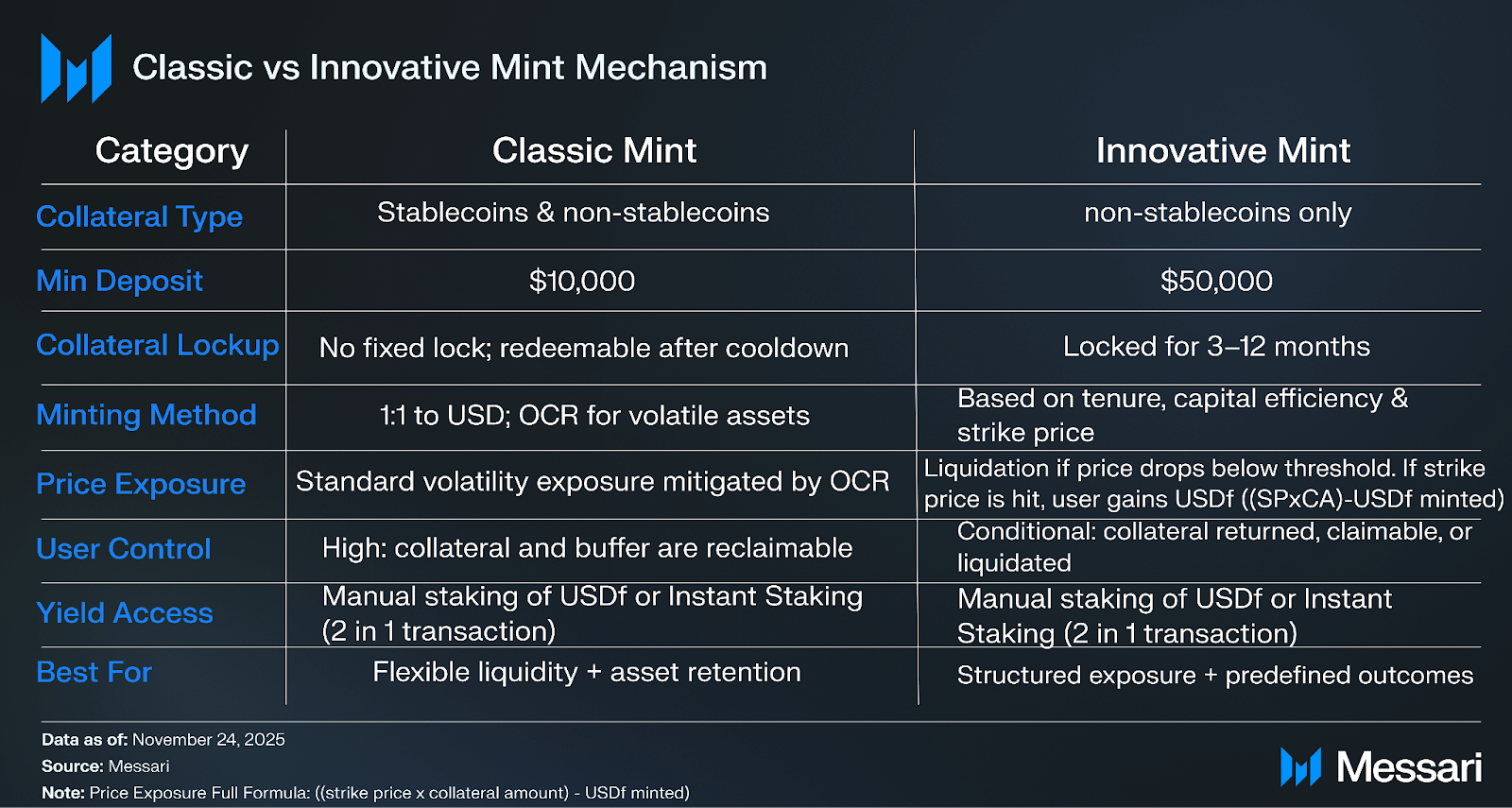
USDf serves as the protocol’s overcollateralized synthetic dollar, acting as a store of value, medium of exchange, and unit of account within the ecosystem. Users can choose to mint in two ways: Classic or Innovative. Classic Mint emphasizes flexibility and collateral retrieval, whereas Innovative Mint focuses on structured outcomes, fixed terms, and predefined exposure to price movements, while allowing users to still benefit if their collateral goes up in value.
USDf is minted by depositing eligible collateral, which includes stablecoins such as USDT and USDC, non-stablecoin assets like BTC, ETH, and select altcoins, and RWA assets such as Tokenized Gold and Tokenized Stocks. Stablecoin deposits mint USDf at a 1:1 ratio, while non-stablecoin and RWA deposits utilize a dynamic Overcollateralization Ratio (OCR) calibrated to the asset’s volatility, liquidity, and historical behavior. This ensures that the total collateral value always exceeds the value of USDf issued. A portion of the collateral is retained as an overcollateralization buffer, which absorbs price fluctuations and can later be reclaimed based on market conditions.
To maintain stability, Falcon pairs this design with delta-neutral hedging strategies that neutralize directional exposure in spot and perpetual markets, ensuring that collateral volatility does not compromise USDf’s backing. Peg stability is further supported through cross-market arbitrage opportunities: when USDf trades above $1.00, users can mint at peg and sell for profit, and when it trades below $1.00, users can buy discounted USDf on external markets and redeem it through Falcon for full collateral value.
sUSDf
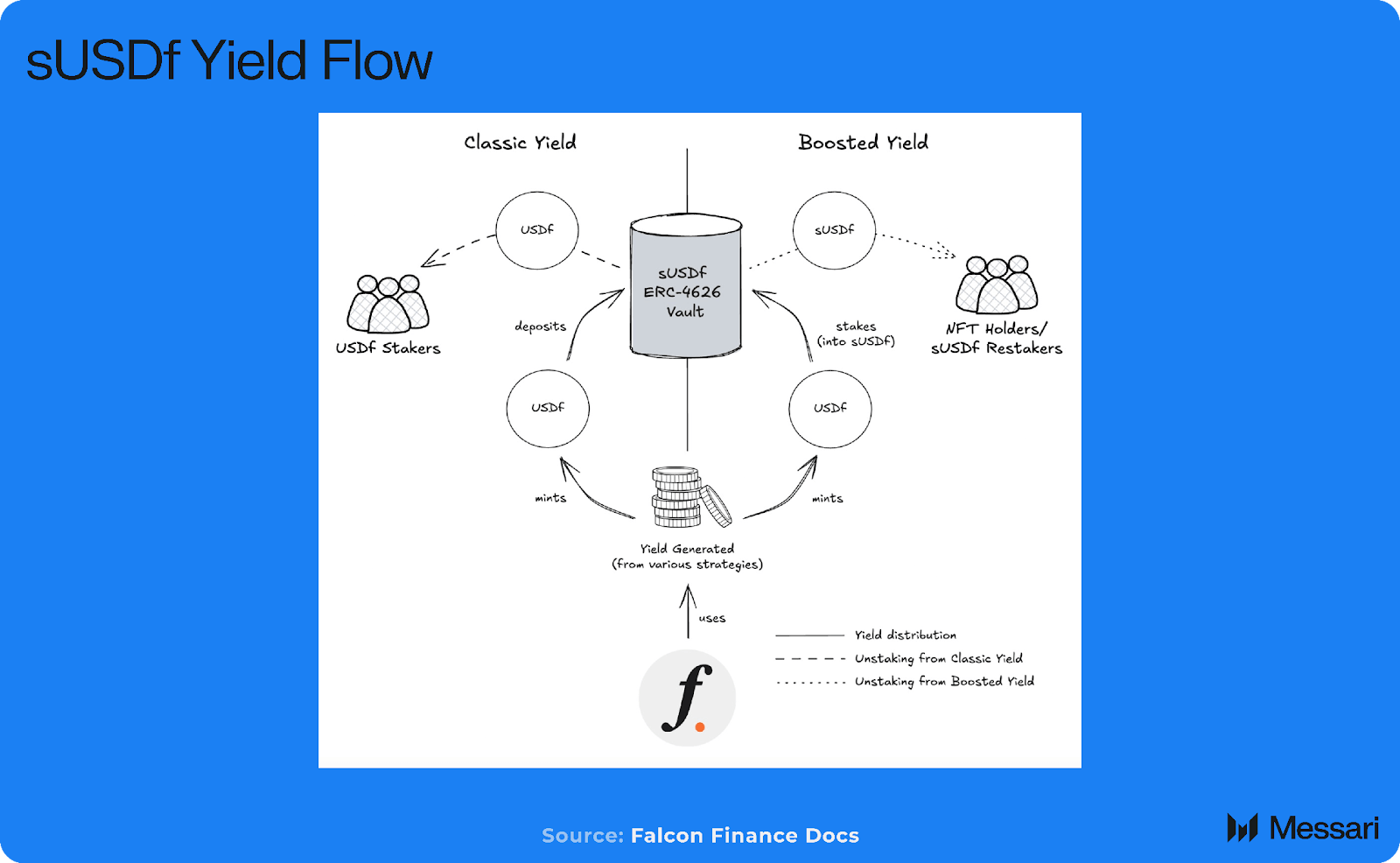
sUSDf is the yield-bearing version of USDf. Users mint sUSDf by staking their USDf into Falcon’s ERC-4626 vaults, where the token automatically accrues yield. This yield stems from Falcon’s diversified suite of institutional strategies, including positive and negative funding rate arbitrage, cross-exchange price arbitrage, native altcoin staking, options-based strategies, and statistical arbitrage, all of which collectively increase the value of sUSDf relative to USDf over time. The protocol determines the sUSDf-to-USDf value by dividing the total USDf staked, plus accumulated rewards, by the total sUSDf supply. Therefore, every unit of sUSDf continually appreciates as yield accrues. For users seeking even higher returns, Falcon offers fixed-term restaking, allowing sUSDf holders to lock their tokens for periods such as three or six months in exchange for boosted yields. Upon restaking, users receive an ERC-721 NFT representing their unique locked position. At maturity, this NFT can be redeemed for the user’s original sUSDf plus the additional boosted yield earned.
Staking Vaults
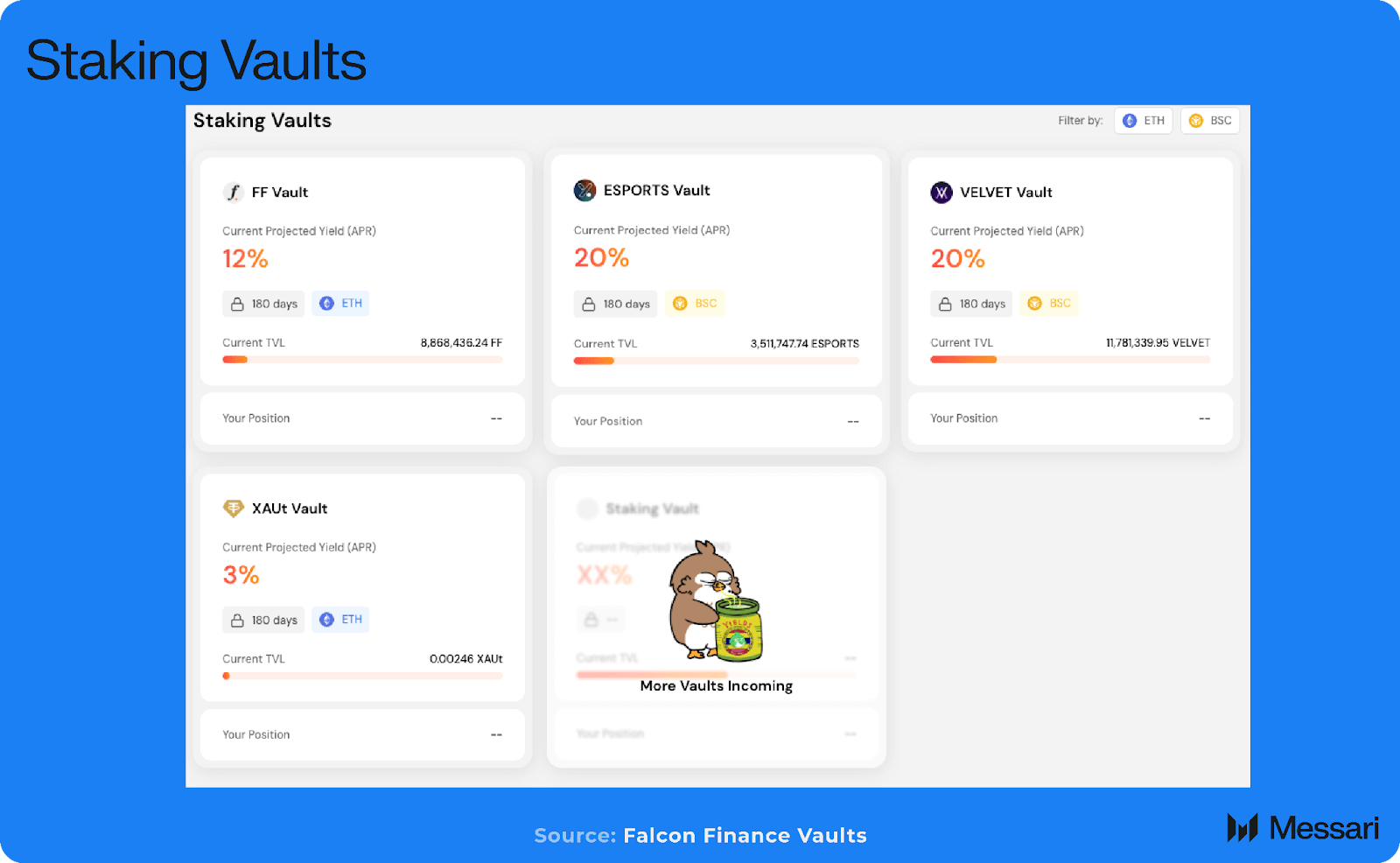
Falcon Finance’s Staking Vaults are designed to help holders monetize idle crypto without having to exit their positions. Users deposit supported tokens for a predefined term, and Falcon pools utilize this capital to run internal, risk-managed trading strategies and generate returns. Instead of paying rewards in the deposited asset, the vault pays a predictable USDf-denominated yield rate, while preserving principal so participants can withdraw the same amount of tokens they have staked once the term is over. After the lockup period is up, withdrawals are not instant, as there is a short cooldown window to allow positions to unwind before the original assets are released. As of December 10, 2025, there are currently four vaults available, with a total of $4.8+ million in assets staked.
Insurance Fund
The Insurance Fund is a central pillar of Falcon Finance’s risk management architecture, operating as an onchain, verifiable reserve designed to shield the protocol, its users, and the stability of USDf during episodes of extreme market stress. Structured as a pool of stablecoin reserves secured within a multi-signature address, requiring approvals from both internal Falcon members and external contributors. The fund is designed to scale in tandem with Falcon’s growth, and a portion of the protocol’s monthly profits is regularly allocated to expand its size. This ensures the Insurance Fund strengthens in proportion to Falcon’s adoption and rising TVL, reinforcing its ability to safeguard users under increasingly complex market environments.
Functionally, the Insurance Fund plays two essential roles. First, it serves as a financial buffer capable of absorbing rare periods of negative yield performance. Second, the fund acts as a market backstop to support USDf’s peg during liquidity stress.
The Insurance Fund’s importance becomes particularly clear in real-time stress scenarios. Consider a sudden, market-wide crash in which a major collateral asset decreases in value rapidly. Such volatility might temporarily destabilize Falcon’s delta-neutral strategies, producing an unusual negative daily yield. At the same time, panic selling could push USDf’s market price down to $0.985, for example, on a decentralized exchange, signaling a breakdown in liquidity. In this situation, the Insurance Fund intervenes on both fronts. It first absorbs the negative yield by deploying the capital required to offset the loss, preserving the sUSDf-to-USDf exchange rate and protecting user returns for that period. Simultaneously, it assumes its role as a peg-defender by purchasing USDf at the discounted market price, thereby reducing excess supply and restoring its value back toward $1.00. These purchases complement arbitrage opportunities already available to KYC-ed users, collectively restoring USDf’s peg and ensuring that the synthetic dollar remains stable even under deep market stress.
Risk Management & Transparency
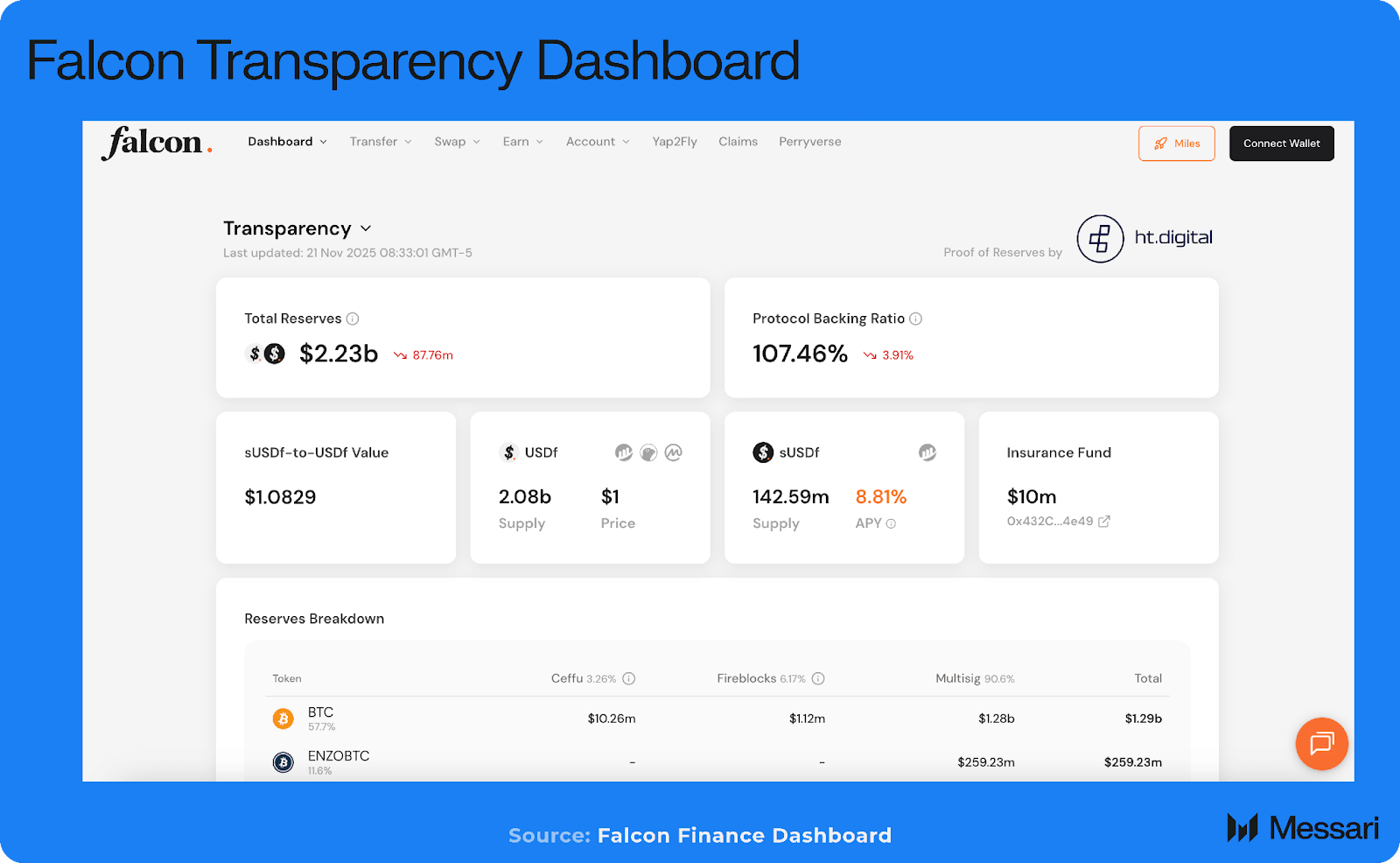
Falcon Finance manages risk through a disciplined, multi-layered framework designed to protect USDf’s stability and safeguard user assets across all market conditions. It begins with strict collateral screening, where only assets that pass rigorous liquidity, volatility, and market-depth tests are accepted, and non-stablecoins receive dynamically calibrated overcollateralization ratios with built-in buffers to absorb price swings. All collateral is secured through institutional custodians using multi-sig and MPC controls, alongside off-exchange settlement that minimizes counterparty risk. Falcon’s trading strategies then reinforce stability through delta-neutral hedging, diversified arbitrage, and continuous monitoring systems that enforce near-zero net exposure and trigger automated unwinds during extreme volatility, supported by machine-learning models that detect emerging risks early. A seven-day cooldown on redemptions ensures safe unwinding from active strategies. Falcon Finance’s reserves and overcollateralization backing are audited by HT Digital, which publishes weekly Reserve Attestations and quarterly ISAE3000 Assurance Reports.
As of November 2025, over 2.2 billion USDf and 142.5 million sUSDf are in circulation.
Tokenomics
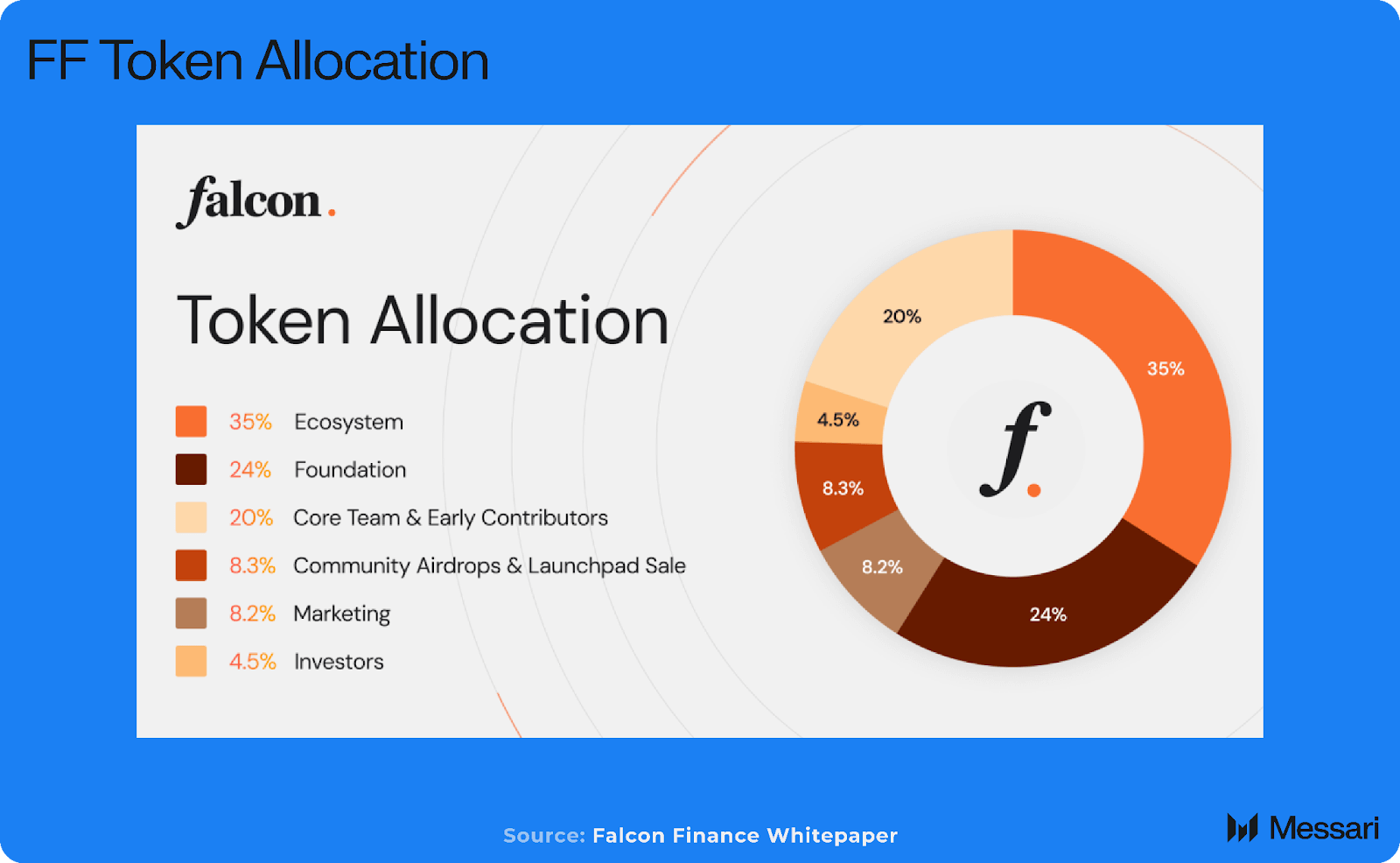
Falcon’s governance token, FF, powers ecosystem coordination and incentives. FF has a total supply of 10 billion, and, at TGE, the circulating supply was 23.4%. FF is primarily used for governance voting, staking yields, reducing OCR requirements, discounting fees, and priority access to new products.
FF Allocation Breakdown
Ecosystem Growth (35%): To be used for airdrops, integrations, RWA initiatives
Foundation (24%): To be used for foundation growth like risk management and audits
Core Team (20%): one-year cliff, three-year vesting
Airdrops & Launchpad (8.3%): To be used for community programs like Falcon Miles, Buidlpad, Yap2Fly
Marketing (8.2%): To be used for long-term brand and user acquisition
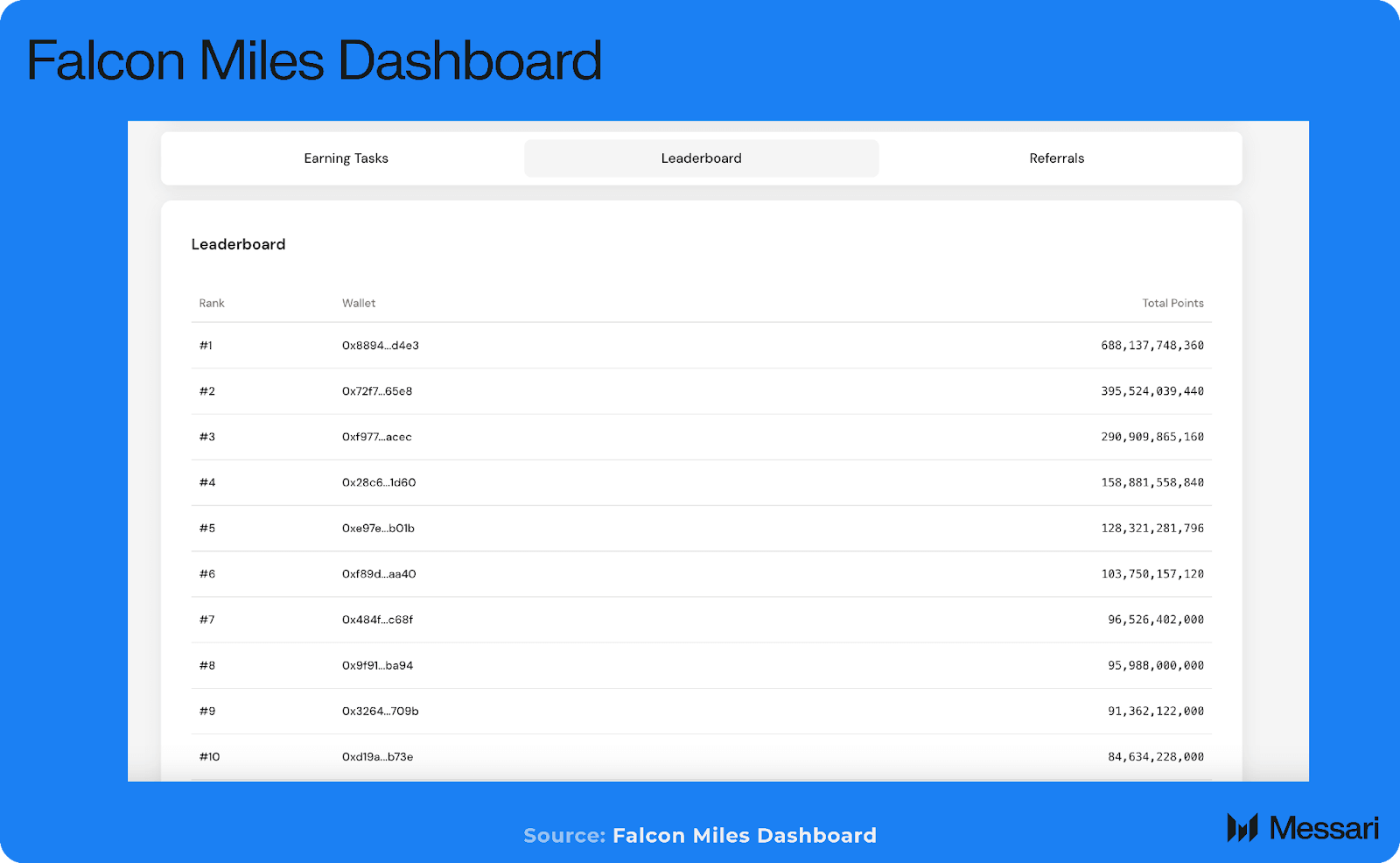
The Falcon Miles program is an incentive system within Falcon Finance designed to reward meaningful participation and ensure fair, structured distribution of the FF. Falcon Miles functions as a multiplier-based rewards engine that applies specific factors to the USD value of eligible actions, such as minting USDf through Classic or Innovative Mint, staking USDf into sUSDf, holding USDf over time, or restaking sUSDf into Boosted Yield vaults. The longer users commit or the more they engage, the more Miles they can earn. Beyond minting, holding, and staking, users receive Miles by contributing liquidity to supported DEXs and by generating trading volume in eligible USDf pools on Ethereum or BNB Chain.
Integrated DeFi participation also qualifies, with Miles awarded for supplying balances to money markets like Morpho and Euler, or engaging in yield tokenization protocols such as Pendle, Spectra, and Napier. A referral system provides up to 10% of a referee’s Miles, and additional Miles come from completing social and community-oriented tasks. All Miles earned from the previous day’s activity are shown as “Daily Earned Miles” on the user dashboard, with current multipliers and eligible actions published on the Miles page.
Roadmap
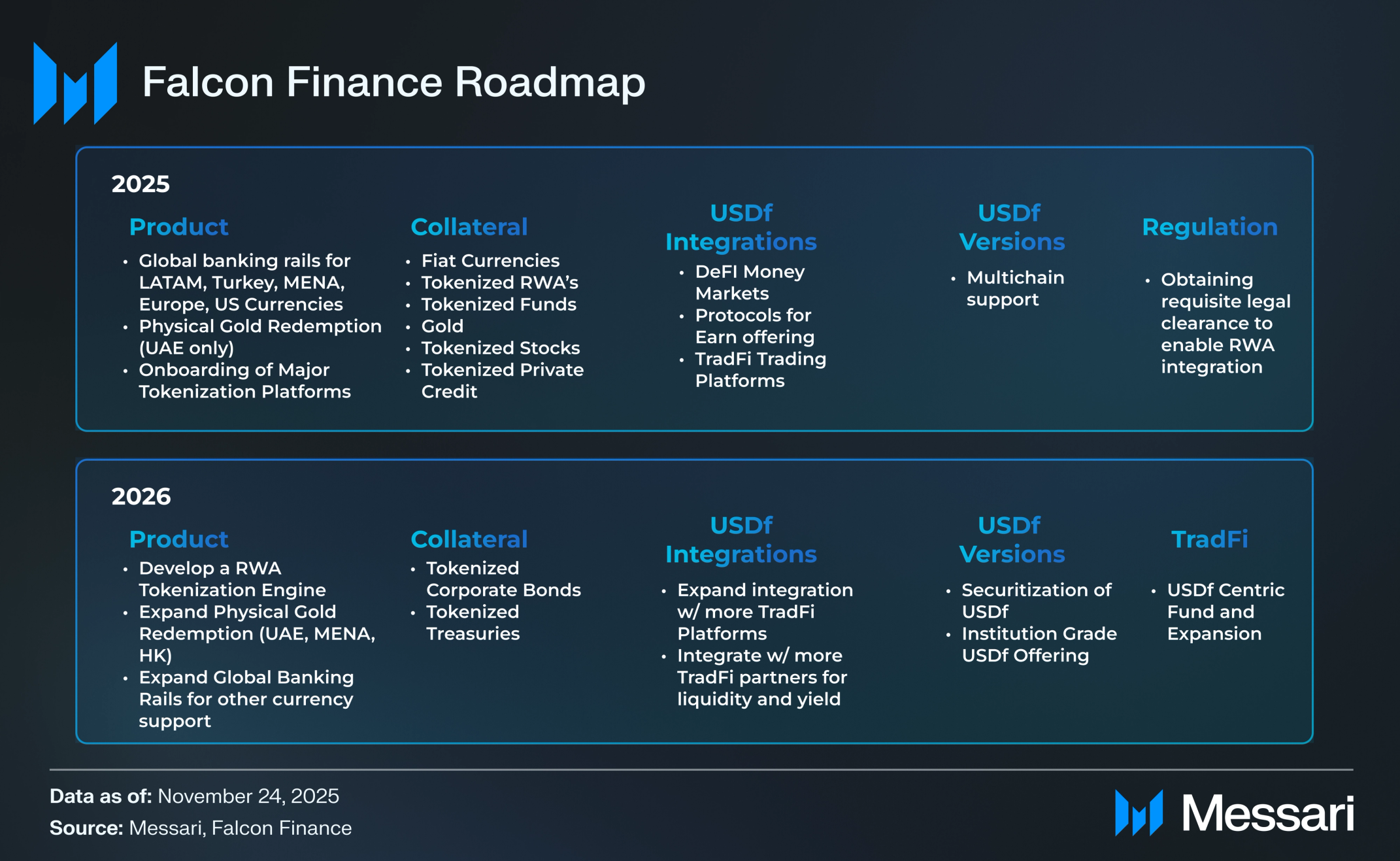
The protocol’s 2025–2026 roadmap emphasizes the expansion of global banking rails across LATAM, MENA, Turkey, Europe, and the USD currencies; the integration of tokenization platforms supporting T-bills, RWAs, and altcoins; and physical gold redemption services in the UAE, as well as future expansion into Hong Kong and the MENA region. By 2026, Falcon plans to introduce a dedicated RWA engine, institutional-grade USDf structures, deeper TradFi partnerships, and USDf-centric investment funds, positioning the protocol as a bridge between digital and real-world economies.
Closing Summary
Falcon Finance reimagines how synthetic dollars should function by combining overcollateralization, institutional-grade trading strategies, and transparent risk management into a single, cohesive protocol. The dual-token architecture, USDf for stability and sUSDf for yield, creates a clear separation of concerns: stability on one side, performance on the other.
By integrating advanced arbitrage engines, rigorous custody and monitoring layers, and a comprehensive insurance fund, Falcon offers a synthetic dollar that remains resilient across market cycles. Its long-term vision extends beyond crypto: into RWAs, fiat rails, institutional adoption, and cross-border financial interoperability.
This report was commissioned by Falcon Finance. All content was produced independently by the author(s) and does not necessarily reflect the opinions of Messari, Inc. or the organization that requested the report. The commissioning organization may have input on the content of the report, but Messari maintains editorial control over the final report to retain data accuracy and objectivity. Author(s) may hold cryptocurrencies named in this report. This report is meant for informational purposes only. It is not meant to serve as investment advice. You should conduct your own research and consult an independent financial, tax, or legal advisor before making any investment decisions. Past performance of any asset is not indicative of future results. Please see our Terms of Service for more information.
No part of this report may be (a) copied, photocopied, duplicated in any form by any means or (b) redistributed without the prior written consent of Messari®.
Jeremy is a research analyst at Messari with interests in Infra, DeFi, and Enterprise adoption. Prior to joining Messari, Jeremy worked as an analyst at Fidelity Digital Assets.
Jeremy is a research analyst at Messari with interests in Infra, DeFi, and Enterprise adoption. Prior to joining Messari, Jeremy worked as an analyst at Fidelity Digital Assets.