Understanding DeFi valuations

Many DeFi tokens produce income through some value extraction mechanism at the protocol level. In this regard they can be characterized as capital assets, and as capital assets, we can frame discussions about these assets’ worth using traditional valuation methods. The three most common methods used to frame discussions about these cryptoassets’ value are Discounted Cash Flow (DCF), Comparable Company Analysis (Comps), and Comparable Transactions (Precedents).
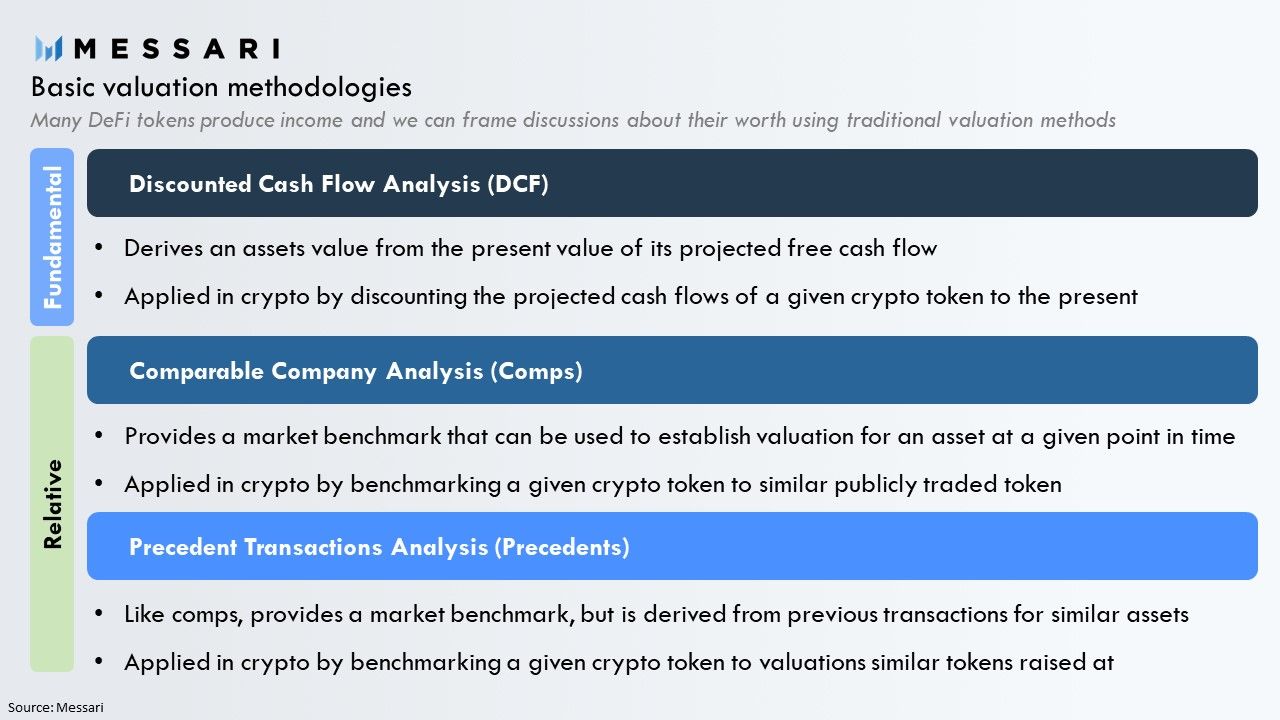
The conceptualization of DeFi tokens as capital assets is well understood among most investors in the space, and there are now public resources dedicated to evaluating these assets as such. What’s less widely discussed, is how much insight applying many of these methods actually provides. Using traditional valuation methodologies is great for modeling out how these assets may potentially accrue value; however, any use of these methodologies beyond such simple value accrual illustrations can quickly become absurd. There are other ways to frame these tokens' value.
Valuation 101
Valuation is both an art and a science. Every asset can be valued using a combination of scientific and artistic elements. This combination of art and science exists on a spectrum, and valuation for a given asset may sit anywhere on this spectrum.
To illustrate this point, let’s just think in terms of companies.
When a company operates predictably and in a stable environment, valuation can be more scientific. A half-century old utility that’s generated $1 billion in cash flow every year for the past decade serves as a prime example of this. Given the company’s long operating history and industry stability, such a utility could be reasonably expected to produce more of the same for the foreseeable future. This makes a model relying on accurate projections of the utility’s future cash flows much more reliable, given that those cash flows are rooted in sound assumptions about the future. The certainty makes valuation for these assets much more precise, and thus scientific.

Ryan Watkins was a Senior Research Analyst at Messari. Previously, he worked at Moelis & Company as an Investment Banking Analyst where he worked on deals in the technology, telecom, and fintech sectors. Ryan graduated Magna Cum Laude from the Gabelli School of Business at Fordham University.