Creditcoin has evolved into an EVM-compatible Layer-1 blockchain that combinesgeneral-purpose smart contract capability with native onchain credit and real-world asset (RWA) functionality.
The network’s dual-chain architecture integrates Substrate-based credit recording with an EVM execution layer, enabling scalable, low-cost credit transactions and interoperability across blockchain ecosystems.
The transition to Nominated Proof-of-Stake (NPoS) and a complete fee-burning mechanism have created a more sustainable and potentially deflationary token economy, reducing annual issuance of CTC by 71.4% post-upgrade.
Strategic partnerships with the Central Bank of Nigeria, Aella, Sui, and Walrus demonstrate Creditcoin’s focus on regulated financial integration and practical RWA deployment in emerging markets.
Creditcoin’s Universal Smart Contract (USC) framework introduces native cross-chain interoperability, positioning Creditcoin as core infrastructure for multichain applications, including credit and RWA use cases.
Introduction
Financial exclusion remains one of the most persistent challenges in emerging markets, where billions of individuals and small businesses lack access to traditional banking services and credit facilities. The World Bankestimates that 1.4 billion adults remain unbanked globally, with the highest concentrations in Sub-Saharan Africa and South Asia. This exclusion primarily stems from the absence of verifiable credit histories, creating a circular problem where individuals cannot access credit to build creditworthiness, and lenders cannot assess risk without historical data.
Creditcoin (CTC) was conceived to break this cycle by leveraging blockchain technology to create a transparent, immutable record of credit performance. By recording loan transactions and repayment histories on a public ledger, Creditcoin enables individuals in emerging markets to build portable, verifiable credit profiles accessible to lenders worldwide. Rather than merely tokenizing existing assets, the protocol establishes infrastructure for credit origination, performance tracking, and risk assessment, enabling the development of more sophisticated credit products and other financial applications.
At the same time, Creditcoin has evolved its architecture to meet broader ecosystem demands. Creditcoin launched its EVM-compatible Layer-1 blockchain in August 2024, enabling developers to build using familiar tools and migrate existing applications smoothly. This transition positions Creditcoin as a full-fledged Layer-1 blockchain that supports general-purpose applications while retaining specialized credit functionality and strong support for RWA, composability, and interoperability.
With this upgrade, Creditcoin’s vision is to provide the technical and economic foundation for bringing offchain real-world value onto the blockchain in a scalable and composable way. By enabling secure data coordination and onchain execution across multiple environments, the protocol aims to expand access to financial services, support the creation of verifiable credit histories, and improve transparency in systems that have traditionally been fragmented or inaccessible. Building on this foundation, Creditcoin continues to innovate with its Universal Smart Contract (USC) layer, extending its interoperability goals and allowing smart contracts on Creditcoin to coordinate, interact, and synchronize with contracts across multiple blockchains.
Creditcoin was founded in 2017 with the objective of creating a decentralized protocol for recording credit transactions and borrower histories onchain. The Creditcoin Foundation leads protocol development and governance, supported by Gluwa, a technology company that builds blockchain-based financial solutions. Together, they have guided the network’s evolution toward full Ethereum Virtual Machine (EVM) compatibility, expanding the ecosystem’s accessibility for global developers and applications.
Creditcoin’s technical development has progressed through three main iterations, each designed to improve scalability, usability, and integration with real-world lending activity:
Creditcoin 1.0 (2019-2023): The original implementation, CC Enterprise, was built on Polkadot’s Substrate SDK and introduced onchain credit history tracking alongside partnerships with fintech lenders in Nigeria and other African markets. Substrate’s modular architecture enabled Creditcoin to customize credit-related logic while leveraging Polkadot’s security and interoperability features.
Creditcoin 2.0 (August 2023): This upgrade replaced Proof-of-Work with Nominated Proof-of-Stake (NPoS) consensus to improve network efficiency and throughput. The change reduced energy usage and increased transaction capacity, enabling partners to record more loans onchain and improving Creditcoin’s operational effectiveness in emerging-market lending.
Creditcoin EVM (August 2024): The latest version launched in August 2024, adding full EVM compatibility while maintaining Substrate-based functionality. This dual-chain architecture allows developers to build general-purpose smart contracts with Ethereum tools while preserving Creditcoin’s credit-recording capabilities. The preceding EVM testnet processed over six million transactions, created three million wallet addresses, and attracted 89 validators. A snapshot of token balances taken on Aug. 21, 2024, ensured continuity for existing users during the mainnet migration.
Technology
Creditcoin’s architecture combines specialized functionality with broad interoperability through a dual-chain structure consisting of Creditcoin Native (Substrate-based) and Creditcoin EVM. These chains are connected through the Credit Wallet, which enables seamless cross-chain interaction and unified user access to applications.
Dual-Chain Architecture
Creditcoin Native serves as the foundational layer, responsible for staking, governance, and the credit-recording functions that differentiate Creditcoin from general-purpose smart contract platforms. The environment is optimized for high-throughput, low-cost transactions to support large-scale credit recording at institutional volume.
Partner institutions such as Aella use Creditcoin Native to record loan originations, disbursements, and repayments. These interactions are facilitated through Credal, Creditcoin’s API and developer interface that enables third parties to write credit events to the chain, query loan data, and operate consumer lending applications at scale. Credal abstracts node management, provides load-balanced RPC access, and offers standardized loan commands and analytics tooling. This allows credit providers to integrate quickly, achieve auditability, and leverage Creditcoin’s transparency, data security, and cross-chain verification capabilities without operating custom infrastructure.
Creditcoin EVM provides full compatibility with the EVM, enabling developers to deploy Solidity contracts and integrate with existing tooling. Beyond simple compatibility, the EVM layer includes optimizations for high-frequency, low-value transactions, such as those found in credit, consumer, and other application categories, while maintaining predictable, cost-efficient gas pricing. Through Credal’s interoperability features, developers can execute and record transactions that originate on external networks, including Ethereum and Bitcoin, while maintaining unified credit histories on Creditcoin.
Credit Wallet bridges both execution environments at the protocol level rather than through external bridges. Users can transfer CTC tokens and interact with applications across the Native and EVM chains within a single interface. The wallet abstracts chain-specific logic, ensuring consistent access to Creditcoin’s credit-recording and smart contract functionality.
Consensus and Network Parameters
Creditcoin operates on a Nominated Proof-of-Stake (NPoS) consensus mechanism that enables broad participation while maintaining economic security. The network’s core parameters are summarized below:
Block Times: 15 seconds
Block Rewards: 2 CTC per block, with 11,520 CTC issued per era (every 24 hours)
Annual Issuance: Approximately 4.2 million CTC, a 71.4% reduction from Creditcoin 1.0
Validator participation is accessible through staking with a minimum stake of 1,000 CTC. Token holders may operate validators directly or nominate trusted validators to act on their behalf. Rewards are distributed at the end of each era based on era points and validator commission structures, and nominators/validators are subject to slashing for malicious or negligent behavior.
The protocol includes a fee-burning mechanism under which CTC used to pay transaction fees is permanently removed from circulation. This reduces net token issuance and introduces deflationary pressure.
Universal Smart Contract (USC) Framework
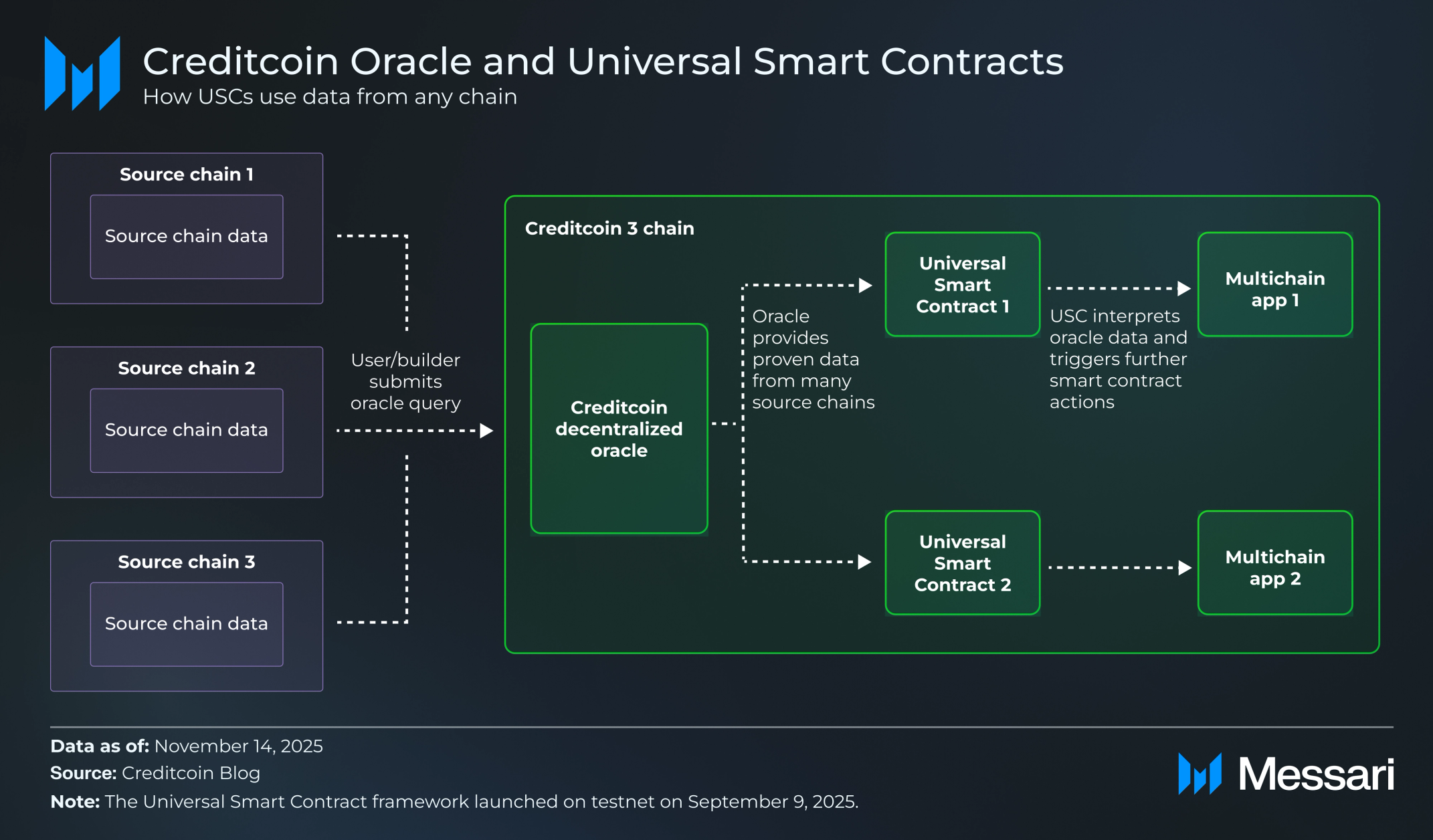
The Universal Smart Contract (USC) framework introduces a system for secure, verifiable cross-chain communication on Creditcoin. Currently live on testnet, USC enables smart contracts to interact with multiple blockchains without relying on centralized bridges or oracle operators. It uses a decentralized oracle network that validates external data through cryptographic proofs, allowing cross-chain verification based on mathematical evidence rather than trust.
The USC architecture is composed of two key components:
Attestors: Observe source blockchains and build consensus on verified transaction histories, create cryptographic summaries called attestation chains.
Provers: Generate STARK proofs that confirm specific data within those attested histories. These proofs are submitted to Creditcoin smart contracts for validation.
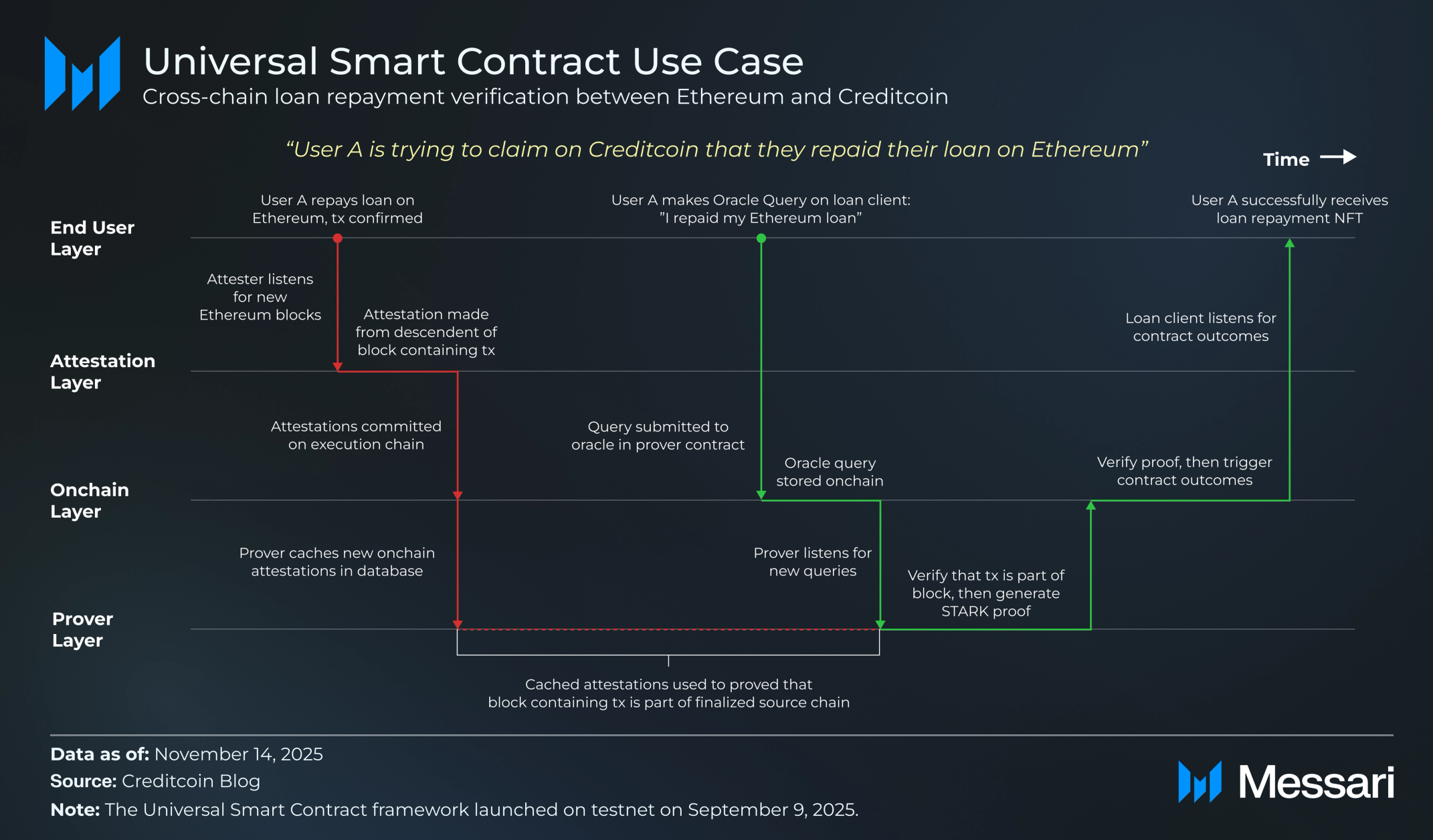
Together, these components allow applications to confirm and act on cross-chain events in a trustless manner. For example, a loan contract on Creditcoin can verify that a repayment occurred on Ethereum and then issue a record of repayment on Creditcoin. The diagram below illustrates this process. In this case, User A repays a loan on Ethereum and submits a repayment claim on Creditcoin. Attestors detect and commit Ethereum block attestations, while provers generate STARK proofs verifying that the repayment transaction exists within Ethereum’s finalized history. Once the proof is verified on Creditcoin, the contract issues a repayment NFT, creating a verifiable onchain credit record. This sequence demonstrates how USC enables automated, secure validation of cross-chain events without relying on centralized intermediaries.
The USC testnet currently supports two primary demonstrations:
Trustless Bridging: Token transfers are verified through cryptographic proofs rather than multisignature or validator-controlled bridges. For instance, a burn event on Ethereum’s Sepolia testnet can be proven and then mirrored on Creditcoin after proof validation.
Cross-Chain Credit Verification: Loan repayments executed on Ethereum are verified and recorded on Creditcoin, enabling portable, verifiable credit histories that can be referenced across protocols.
Beyond these initial demonstrations, USC enables broader functionality such as multichain credit assessment and identity models. Developers can aggregate financial activity across multiple networks, including loan repayments, liquidity provision, and trading behavior, into unified credit profiles that support improved underwriting and new categories of lending products.
USC abstracts the complexity of cross-chain verification behind a standardized interface. Developers interact with the system using standard Solidity functions, while the attestation and STARK proof workflows occur behind the scenes. This removes the need to manage multiple SDKs or maintain separate oracle or bridge infrastructure, simplifying the development of multichain applications.
Ecosystem
Spacecoin
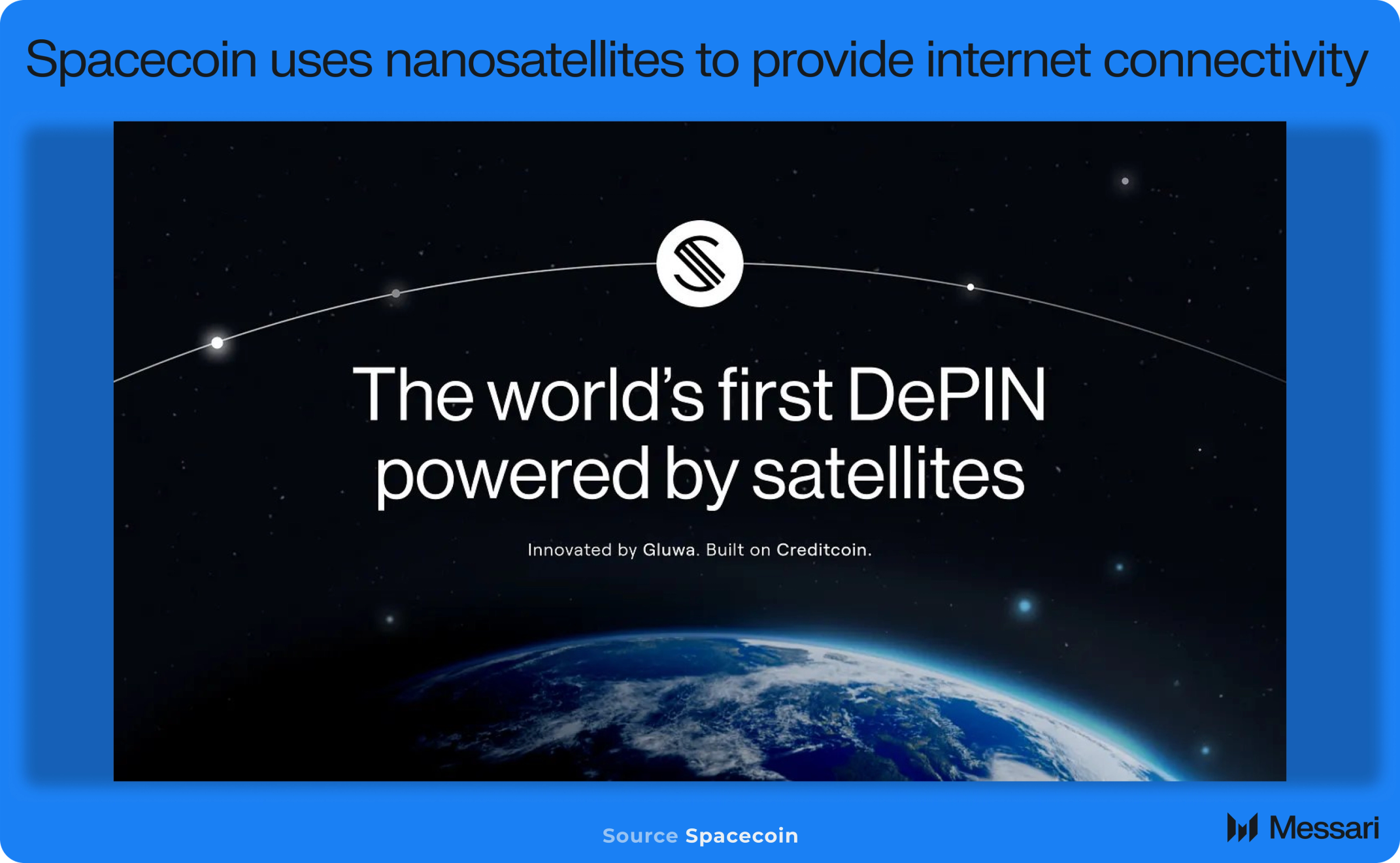
Spacecoin is the first application built on Creditcoin and the first decentralized physical infrastructure network (DePIN) powered by nanosatellites. Its objective is to provide affordable and reliable internet connectivity, particularly in markets that remain underserved by traditional telecom infrastructure. The network deploys nanosatellites that function as orbital cell towers, delivering high-speed, non-terrestrial coverage with minimal reliance on towers, fiber backhaul, or other forms of capital-intensive ground infrastructure. By removing these cost constraints, Spacecoin aims to offer mobile internet access for as little as $1 to $2 per month in target regions.
Role of Creditcoin
Creditcoin functions as the trust and coordination layer for Spacecoin’s decentralized satellite network. All network operations are managed through smart contracts that verify service delivery, validate coverage, and settle payments between users and satellite operators.
Spacecoin also uses Credal, Creditcoin’s onchain credit system, to support flexible payment models. Through Credal, users can access buy now, pay later (BNPL) options for internet fees, improving affordability in low-income regions. As users consume and pay for connectivity, they accumulate onchain credit history, enabling them to build verifiable financial profiles without requiring a bank account. This credit data can support future access to financial services and long-term economic inclusion.
Together, Universal Smart Contracts, BNPL functionality, and Credal’s credit framework enable Spacecoin to operate as a permissionless, trust-minimized telecommunications network while expanding financial access for underserved users.
Mission Status and Roadmap
Spacecoin’s first satellite, CTC-0, launched on Dec. 21, 2024, as part of the Bandwagon-2 mission. The 8U CubeSat completes 90-minute orbits and has demonstrated core capabilities required for a decentralized satellite network. During early tests, Spacecoin conducted the first end-to-end blockchain transaction routed through a satellite. The message was transmitted from a ground station in Chile to the CTC-0 satellite, downlinked to Portugal using store-and-forward relay, and then validated on the Creditcoin network. The encrypted payload maintained its integrity from uplink to downlink, and the resulting transaction can be viewed as both a SatNOGS observation and on the Creditcoin explorer. This test demonstrated that a blockchain transaction can bypass terrestrial internet infrastructure completely and showed that Creditcoin’s settlement layer and Spacecoin’s satellite architecture can operate together under orbital conditions.
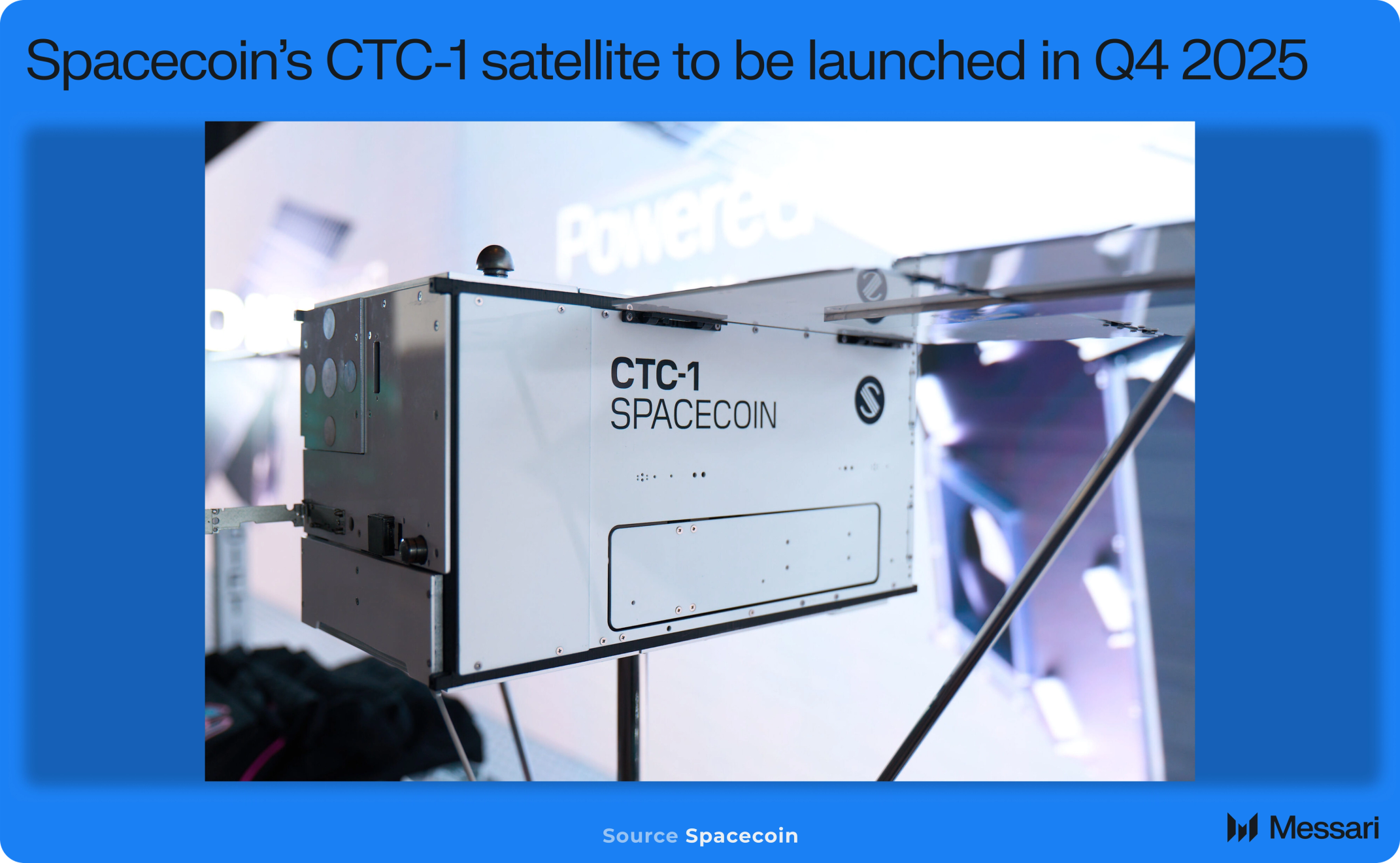
The second mission, CTC-1, is scheduled for Q4 2025 and consists of three 16U CubeSats. This constellation will introduce inter-satellite handoffs and validate Proof of Location, Spacecoin’s geospatial verification system, patented in June 2025. Proof of Location enables trustless location attestations to prevent GPS spoofing and supports permissionless participation by independent satellite operators.
Spacecoin’s aerospace partners include EnduroSat for satellite manufacturing, NearSpace Launch for the CTC-1 satellite bus, CesiumAstro for space-grade communications hardware, Anderson Connectivity for radio payload assembly, and Reliasat for inter-satellite link components. Additional partners, such as DornerWorks and Snaju, support flight software, mission control systems, and ground station management. This supply chain provides the technical foundation necessary for sustained low-Earth orbit operations.
Over time, Spacecoin intends to transition from proprietary deployments to an open protocol model. Satellite and protocol designs will be released as open source, allowing governments, telecoms, and private entities to deploy compatible satellites and join the network permissionlessly. This model is designed to create a distributed ecosystem of operators that can supply affordable connectivity to high-density and remote markets without reliance on centralized carriers.
Penguinbase
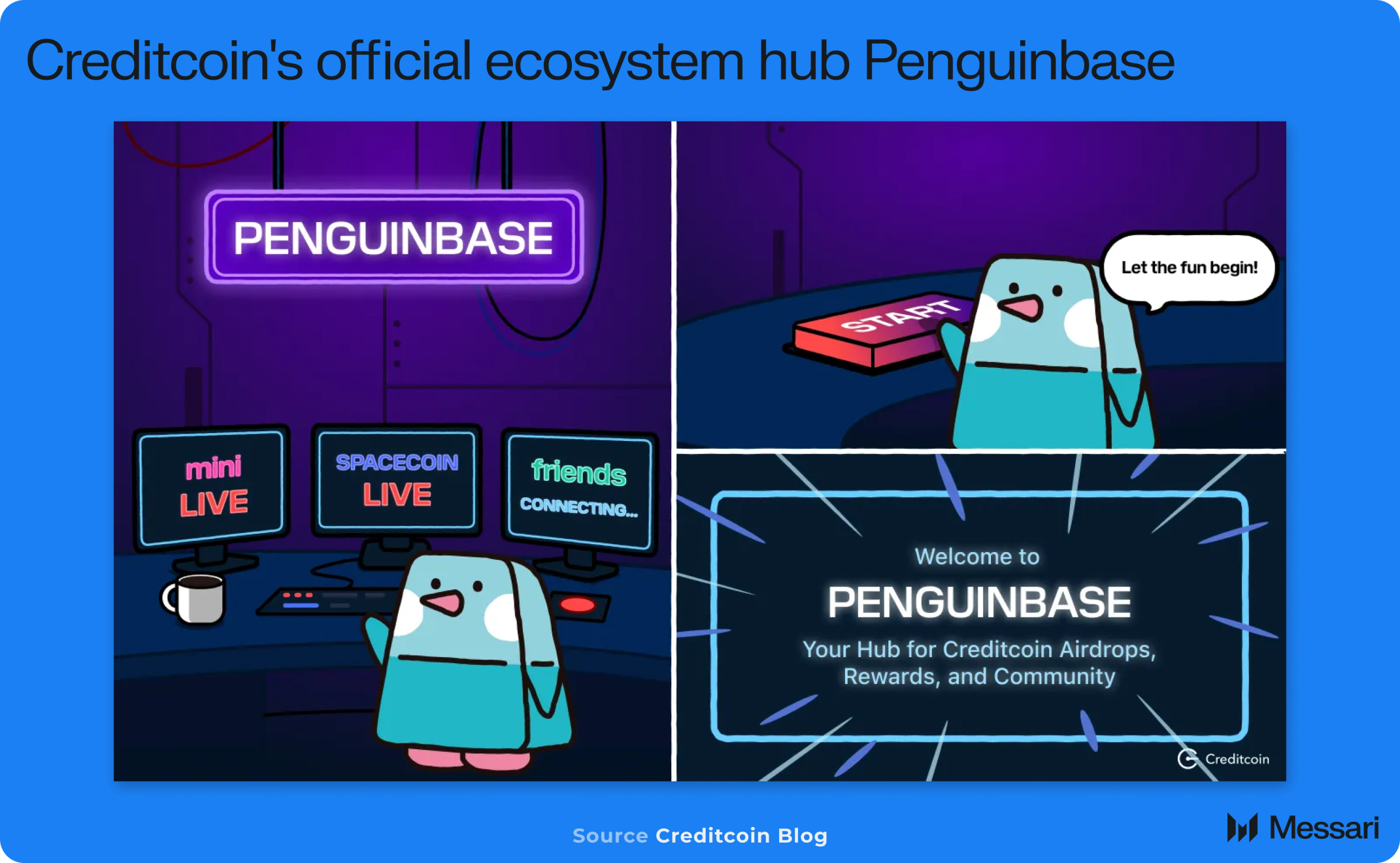
Penguinbase is the central community hub for the Creditcoin ecosystem, bringing together airdrops, games, and onchain experiences in a user-friendly platform. Accessible via the Credit Wallet or any EVM-compatible wallet, Penguinbase allows users to join community programs and earn rewards for active participation. Programs include the Spacecoin (SPACE) Airdrop Season 2, the mini airdrop, and minini universe games.
Access to Penguinbase programs is token-gated. Participants must hold at least one eligible Creditcoin ecosystem asset, such as CTC, G-CRE, WCTC, or a Creditcoin NFT. This gating mechanism ensures that rewards go to genuine community members who are invested in the network’s long-term success.
Through its combination of social interaction, gaming, and onchain rewards, Penguinbase supports Creditcoin’s broader mission of making blockchain participation more engaging and accessible. It strengthens community cohesion, increases token utility, and offers an approachable entry point for new users entering the Creditcoin ecosystem.
Partnerships
Creditcoin’s partnership strategy focuses on collaborations that combine regulatory alignment, market access, and technical integration to advance RWA adoption and credit market infrastructure.
Aella (June 2022): Aella is Creditcoin’s longest-standing fintech lending partner and the first to integrate directly with Creditcoin 2.0 through Credal. Shortly after integration, Aella recorded more than 28,000 loans worth over $1.8 million on the Creditcoin blockchain, including loan terms, payments, and repayments. Aella’s partnership in August 2022 with Tizeti, a major West African broadband provider, brought more than one million users into the Creditcoin ecosystem through onchain recording of Aella Pay internet credit transactions. Additionally, in 2025, Aella surpassed $100 million in total onchain loans recorded.
Central Bank of Nigeria (March 2024): Gluwa partnered with the Central Bank of Nigeria to support the eNaira central bank digital currency (CBDC). The integration of Credal will support credit reputation building for eNaira users and improve loan origination, settlement, and authentication processes for fintech lenders operating in Nigeria’s regulatory environment.
Sui and Walrus (December 2024): Creditcoin joined a strategic partnership with Sui, Walrus, and Spacecoin to support decentralized connectivity through satellite-powered infrastructure. Sui contributes a scalable smart contract environment for computation, while Walrus provides decentralized storage for data and application workloads. Together, these components form a technical stack that supports applications requiring efficient execution, secure storage, and reliable data availability. Within this collaboration, Creditcoin serves as the settlement and credit layer, enabling onchain payments, lending activity, and credit history recording for users connecting through Spacecoin’s satellite network.
Wormhole (October 2025): Creditcoin’s integration with Wormhole provides institutional-grade interoperability via the Native Token Transfer (NTT) standard. Through this bridgeless architecture, native CTC can transfer across Creditcoin, Ethereum, and BNB Chain, enhancing asset mobility and market depth for RWA use cases that span multiple chains. The integration also complements Creditcoin’s USC technology, creating a unified multichain ecosystem where assets, credit records, and other data can move across networks.
Creditcoin Ecosystem Investment Program
The Creditcoin Ecosystem Investment Program (CEIP) is a $10 million initiative led by Credit Labs to accelerate innovation within the Creditcoin network. Since January 2025 and over the next three years, the program will invest between $25,000 and $250,000 in early-stage startups and developers building products that expand Creditcoin’s real-world applications.
CEIP focuses on supporting teams that enhance decentralized credit and payment solutions, improve financial accessibility, and integrate Creditcoin’s blockchain into practical Web3 and RWA use cases. In addition to financial support, participants gain access to Credit Labs’ technical and strategic resources, including engineering guidance from Gluwa, marketing assistance, and exposure to Creditcoin’s network of more than 500,000 users worldwide.
Projects accepted into the program also benefit from direct connections to Creditcoin’s advisors and ecosystem partners, helping founders refine product strategies, align with regulatory requirements, and scale within emerging markets.
CTC Token
Creditcoin uses a multichain token architecture that leverages both Creditcoin Native and Creditcoin EVM. Two primary forms of CTC exist within the Creditcoin network:
CTC (Native): Used on Creditcoin Native for staking, validator participation, governance, and payment of Substrate-based transaction fees.
CTC: Used on Creditcoin EVM for smart contract interactions and EVM-based gas fees.
Users can transfer assets between CTC (Native) and CTC on the EVM chain using Credit Wallet, which supports sending tokens to the corresponding address on each network while managing the required gas fees and confirming the final balances.
Two additional ERC-20 representations exist on Ethereum:
CTC (G-CRE): The ERC-20 token listed on centralized exchanges, which is also known as G-CRE on DEXs.
WCTC: A wrapped ERC-20 representation with limited liquidity on decentralized exchanges such as Uniswap; not available on centralized exchanges.
These ERC-20 tokens offer Ethereum-based users entry points into the Creditcoin ecosystem and can be bridged to the network. G-CRE can be migrated into Creditcoin through the SwapCTC tool, while WCTC can be moved via the Wormhole Portal Bridge for two-way transfers across Ethereum, BNB Chain, and Creditcoin. After bridging, assets can be managed and converted within Credit Wallet for use in staking, smart contract activity, and other ecosystem applications.
Token Functions
The CTC token launched in April 2019 alongside the Creditcoin 1.0 mainnet. CTC is used to record credit transactions on the chain, pay for network operations, secure consensus through staking, and facilitate cross-chain interaction between the Native and EVM Creditcoin environments.
Transaction Fees: CTC is required for all onchain transactions, including credit recording, RWA operations, and other application activity. Fee payments create direct token demand and anchor CTC’s utility to ongoing network activity.
Staking: CTC (Native) holders can participate in the network’s NPoS consensus system either by operating validators or nominating existing validators. Staking yields rewards and removes tokens from liquid circulation for the duration of the bonding period.
Governance: CTC holders may participate in protocol governance, including decisions related to upgrades, parameter adjustments, and long-term strategic direction.
Supply and Distribution
Creditcoin’s token supply model changed with the transition from PoW to NPoS. Under the PoW design, supply was capped, and most issuance was allocated to miners, who collectively held a 70 percent share of the original distribution model. With the shift to NPoS, this miner allocation was eliminated entirely, and the network adopted an unlimited-supply framework where all new issuance flows to stakers. Block rewards were reduced from 28 CTC to 2 CTC, which materially lowered inflation relative to the previous design.
From the original token allocation, the portions that remain applicable are the Creditcoin Foundation (5 percent), investors (10 percent), and Gluwa, Inc. (15 percent). Staking rewards, which replace the former miner allocation, are not capped and expand over time based on block production and participation. All transaction fees paid in CTC are permanently burned, which offsets a portion of new issuance and influences long-term supply dynamics as network activity increases.
Closing Summary
Creditcoin has developed from a purpose-built credit-recording chain into a dual-chain network designed to support real-world financial applications at scale. The network’s architecture now combines a Substrate-based Native chain optimized for credit settlement with an EVM execution environment that enables general-purpose smart contract development. This structure allows Creditcoin to serve both specialized RWA workflows and broader application needs while maintaining compatibility with existing Ethereum tooling.
The transition to NPoS, introduction of an unlimited-supply issuance model with reduced block rewards, and adoption of network-wide fee burning have reshaped Creditcoin’s economic design. These changes are intended to support long-term network security while aligning issuance with usage-driven burn dynamics. Native multichain capabilities, enabled through the Wormhole NTT standard, further position Creditcoin for interoperability across major ecosystems.
Creditcoin’s development strategy has emphasized practical financial integration rather than speculative activity. The network’s real-world adoption through partners in emerging markets demonstrates that its credit infrastructure is already being used in production environments. Continued ecosystem initiatives, including developer programs and geographic expansion efforts, further reinforce this orientation.
Looking ahead, the Creditcoin network and its USC framework represent the next phase of architectural evolution, aiming to support coordinated cross-chain execution anchored on the EVM chain. Additional work on EVM tooling, infrastructure tokenization initiatives, and regulatory-aligned integrations indicate a continued focus on applied credit and RWA use cases. As institutional interest in onchain credit systems expands, Creditcoin’s mix of technical interoperability, credit-focused design, and existing deployment in lending environments provides a foundation for its role in the emerging onchain credit stack.
All content was produced independently by the author(s) and does not necessarily reflect the opinions of Messari, Inc. Author(s) may hold cryptocurrencies named in this report. This report is meant for informational purposes only. It is not meant to serve as investment advice. You should conduct your own research and consult an independent financial, tax, or legal advisor before making any investment decisions. Nothing contained in this report is a recommendation or suggestion, directly or indirectly, to buy, sell, make, or hold any investment, loan, commodity, or security, or to undertake any investment or trading strategy with respect to any investment, loan, commodity, security, or any issuer. This report should not be construed as an offer to sell or the solicitation of an offer to buy any security or commodity. Messari does not guarantee the sequence, accuracy, completeness, or timeliness of any information provided in this report. Please see our Terms of Service for more information.
No part of this report may be (a) copied, photocopied, duplicated in any form by any means or (b) redistributed without the prior written consent of Messari®.
Jake is a Research Analyst on the Protocol Research team. He previously worked as an Investment Analyst at an AI-driven crypto research platform and as a Venture Analyst at a digital assets venture fund. He advised multiple RWA tokenization projects on tokenomics. Jake graduated from the University of Southern California, where he studied Philosophy and Finance.
Jake is a Research Analyst on the Protocol Research team. He previously worked as an Investment Analyst at an AI-driven crypto research platform and as a Venture Analyst at a digital assets venture fund. He advised multiple RWA tokenization projects on tokenomics. Jake graduated from the University of Southern California, where he studied Philosophy and Finance.